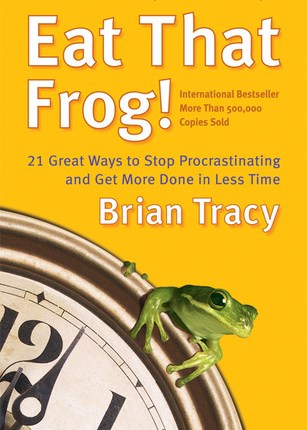
Brian Tracy gives simple and easily acted-upon suggestions for stream lining and maximizing your productivity. The title itself, Eat That Frog!, refers to completing the biggest, ugliest task you may have on your plate on any given day. If you do whatever that is first (the frog), in the morning when you’re at your most energetic and before anything else distracts you, then at least you can say you got something done today. Most everything else will seem almost easy by comparison… at least, that’s the theory.

At first, I thought all of the ideas in this book sounded almost too simple. But as the short audiobook continued, it became more clear just why Tracy is considered one of the leaders in his field of expertise.
Taken altogether, this book gives someone the tools to turn their life around (if they’re in a bad place) or take them to the next level, if they’re already on their way. It’s not just about learning tools to boost your efficiency, it’s also about discovering what you do best and then prioritizing doing THAT to the best of your ability.
The most intriguing idea in here, to me, was “practice creative procrastination”. As we couldn’t possibly get everything done that we ever have to do in one day, by doing the things that MUST get done, you can procrastinate on the things that won’t sink the ship if they’re left undone. You’re doing things, yet not doing things and feeding the inner procrastinator. It’s like having your cake and eating it too.
I’m not a big procrastinator. What I am is a collector of ideas and methods. I’m always open to improving myself or the way that I do things. In fact, I can be too gung-ho when it comes to implementing some of the ideas I read in self-help books. For example, a couple years ago I changed my life through “the magic of tidying up” and was so successful at removing the knick-knacks littering the house that my husband thought I was moving out.

But seriously, I can take things to the extreme. So, I’m encouraged that this book mainly consists of writing lists, scheduling and prioritizing tasks. That shouldn’t freak out the hubby.
And I do find myself doing other, less important things when a big, fat frog of a chore is staring me in the face. At least now, I’m aware of what I’m doing and knowledge is the first step on the road to change.
Recommended for readers looking for a few simple tips to maximize their productivity.
Thanks for reading!
- The Ballad of a Small Player: a Metaphysical Movie Review
- Otherwhere: A Field Guide to Nonphysical Reality for the Out-Of-Body Traveler by Kurt Leland
- Psychic Dreamwalking: Explorations at the Edge of Self by Michelle Belanger
- Archetypes on the Tree of Life: The Tarot as Pathwork by Madonna Compton
- The Goddess and the Shaman: The Art & Science of Magical Healing by J.A. Kent


 The Help Desk Book Blog