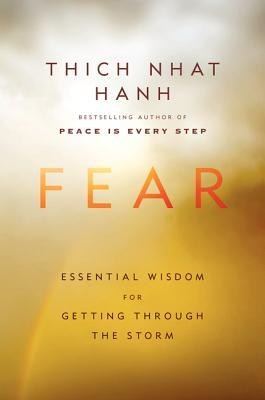
Fear: Essential Wisdom for Getting Through the Storm by Thich Nhat Hanh

Fear: Essential Wisdom for Getting Through the Storm by Thich Nhat Hanh

In Fear: Essential Wisdom for Getting Through the Storm, Thich Nhat Hanh simply and succinctly illuminates the Buddhist path beyond fear into an existence of freedom and joy.

“Nobody can give you fearlessness. Even if the Buddha were sitting right here next to you, he couldn’t give it to you. You have to practice and realize it yourself.” pg 6
Photo by Aleksandar Pasaric on Pexels.com

This book is more than theory, parables and anecdotal stories. Hanh also includes various meditations to assist in the effort.

“When the Buddha was very old, just before he died, he said, ‘My dear friends, my dear disciples, don’t take refuge in anything outside of you. In every one of us there is a very safe island we can go to. … That is a place where you can take refuge whenever you feel fearful, uncertain or confused.'” pg 71

He dissects the various forms fear can take in our lives- from fear of death, grief, anxiety about the future to reconciling with painful emotions from the past.

Photo by David Bartus on Pexels.com

My main takeaway from the book was, to deal with any kind of fear, we need only to approach it with mindfulness and compassion for ourselves and the suffering of others.

“We don’t try to grab on to the pleasant sensation, and we don’t try to push it away. We just acknowledge its existence. When a painful feeling comes, we do the same thing. … A feeling is just a feeling. And you are much more than that feeling.” pg 135

Hanh reminds readers that we are more than the temporary thoughts and feelings that cause so much havoc on their way through our minds and hearts. Our true nature is something else.

My favorite metaphor that Hanh employs to remind readers of this true nature is his comparison of a life to a wave.

“The wave is always water; it doesn’t ‘come from’ water, and it doesn’t go anywhere. It is always water; coming and going are just mental constructions. … Birth and death, coming and going, are just concepts. When we are in touch with our no-birth, no-death nature, we have no fear.” pg 50

Photo by Emiliano Arano on Pexels.com

I appreciated the reminders and found a lot of comfort in these pages. I hope other readers find the same.

Recommended for readers who are interested in learning and utilizing Buddhist philosophy and techniques to overcome any fear or other unpleasant emotion that may be in their lives.

Tales of the City by Armistead Maupin

Tales of the City by Armistead Maupin

Tales of the City is a snappy, humorous and heart-felt look at the intersecting lives of several people living in San Francisco in the 1970’s. As they struggle for love, money and happiness, they establish friendships and create a new kind of family- one of their choosing rather than one they were born into.

“Mary Ann Singleton was twenty-five years old when she saw San Francisco for the first time.” pg 9, ebook

Photo by picjumbo.com on Pexels.com

One of the main characters is Mary Ann from Ohio. She came on a vacation to San Francisco and decided to stay because she loved the people and the general vibe.

But her mid-western upbringing didn’t prepare her for the work and dating scene of San Francisco.

His smile was approaching a leer. Mary Ann chose not to deal with it. “She’s a little strange, but I think she means well.” pg 47

Photo by Lisa Fotios on Pexels.com

On a hunt for the perfect apartment, Mary Ann meets Mrs. Madrigal, the unconventional and slightly mysterious owner of a large place on Barbary Lane.

Once the other residents of the apartment are introduced, the story really takes off. The breakneck pace is probably due to the fact that Tales of the City was originally written as a serial with cliffhanger endings each week to bring readers back to the publication.

It works incredibly well in a novel format. The chapters are short and punchy. Although most of the tension of the story is created through the dialogue rather than action, it is gripping stuff.

In some ways, this book is rather like life. Everybody is mixing together, trying to find their own way and lifestyle that feels right to them.

From day to day, it doesn’t seem like much happens. But taken altogether, it encompasses the growing pains accumulated through weeks, months and years of a lifetime.

Photo by Elly Fairytale on Pexels.com

“No wonder you’re miserable. You sit around on your butt all day expecting life to be one great Hallmark card. … You’ve got to make things work for you, Mary Ann.” pg 111

Recommended for readers who enjoy their fiction with a big helping of soul-searching and humor, delivered at the speed of life.

This book has been made into a show at least twice now. Both versions can be viewed on Netflix.

Thanks for reading!

Embrace Your Weird: Face Your Fears and Unleash Creativity by Felicia Day

Embrace Your Weird: Face Your Fears and Unleash Creativity by Felicia Day

Embrace Your Weird is a non-fiction and self help manifesto encouraging creativity and told in Felicia Day’s unmistakably humorous way.

I say “unmistakable” for any of her myriad fans who have watched her ground-breaking web series, “The Guild,” or read another of her books like You’re Never Weird on the Internet. Her tone and sense of humor remains the same.

Photo by Prateek Katyal on Pexels.com

And if you haven’t had the chance to enjoy any of Day’s other creations, I encourage you to give them a try. They’re light-hearted and fun.

“Aside from (over)sharing a lot of my opinions, I have filled this book with exercises designed to uncover the joy of creativity. To help people beat back the fear that keeps them from trying new things.” pg xi

On almost every other page, Day encourages readers to stop a moment and draw a picture, fill out a list, or write empowering messages over and over so that they’ll sink in. The act of reading this book is nearly a creative act in and of itself. (Sadly, I couldn’t do this because I was reading a library book. Suggestion for future readers: buy yourself a copy.)

“No, I don’t think creativity is a cure-all. But I do believe it could be a cure-most.” pg 29

Photo by Pixabay on Pexels.com

Besides reminding readers that we have unique voices and viewpoints that the world needs to hear, Day loosely structures the rest of the book off of life viewed as a game. She asks us to remember our “hero-self,” identify “enemies” and “allies” of our creativity, and to view the steps we take towards creation as “quests.”

Day also shares moments in her life when she’s completed or failed attempting various pieces of this philosophy in her own life.

“I constantly hand my heart over to strangers to batter however they wish, and I wonder why I’m constantly wounded all the time, and this makes me reluctant to create. Good way to operate? NOT REALLY!” pg 143

As I said, the whole book has a definite Felicia Day vibe. And it’s fun!

“Playfulness is the root of all creation. All invention. All discovery. There is no reason NOT to feel joyous when we make things.” pg 206

Photo by Sharon McCutcheon on Pexels.com

She wasn’t afraid to tackle all sorts of hang-ups people might have in their creative process. Day nailed my biggest issue: finishing projects once they’re started.

“But we will never get anywhere if we don’t focus on one thing at a time. And then see that thing through before moving on!” pg 239

Message received. Now to put it into action…

Recommended for anyone looking to start or jump start their creativity. This book is an excellent place to begin. Thanks for reading!

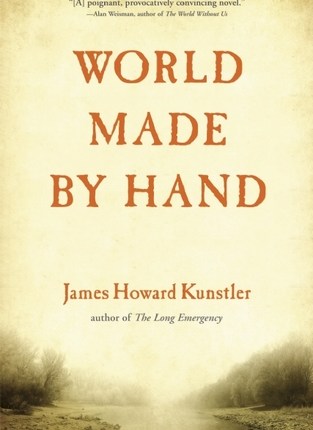
World Made by Hand by James Howard Kunstler

World Made by Hand by James Howard Kunstler

“It was chilling to reflect on how well the world used to work and how much we’d lost.” pg 12, ebook.

Photo by Davide Locatelli on Pexels.com

In World Made by Hand, civilization has fallen to pieces. There is no consistent electricity. The town of Union Grove has running water, but only because of a water system that relied more on elevation than anything else.

Worse, the justice system has fallen apart. There is little to no medical care facilities or supplies available. Television stations have ceased to broadcast. The radio sometimes broadcasts religious programming in the moments the electricity flickers on and then off.

“It’s not all bad now,” I said. “We’ve lost our world.” “Only the part that the machines lived in.” Jane Ann patted my thigh, but said no more and got up to leave.” pg 25, ebook

Photo by Pixabay on Pexels.com

A slow-paced dystopian novel that savors the end of life as we know it might not have been the best book for me to read right now. In the midst of a global pandemic and unfounded fears that life may never go back to the way it was, this wasn’t as much an escape as an additional cork-popper to my ever-present anxiety.

The characters lack depth, but I found myself caring for them because they seemed so real.

They want food, shelter and safety for their loved ones, even though all of those things have become difficult to find.

“By the time he passed away, it was obvious there would be no return to ‘normality.’ The economy wouldn’t be coming back. Globalism was over. The politicians and generals were failing to pull together at the center.” pg 29, ebook.

There are very few moments of action in here. I can see the slow pace being frustrating to some readers.

“The afternoon weather resolved into an uncomfortable drizzle, driven by hot winds out of the south. I had an old ripstop nylon poncho from my collegiate camping days, but it had lost its waterproofing.” pg 126, ebook

Photo by Sam Willis on Pexels.com

But, to play the devil’s advocate, perhaps that would be the way the world would actually end. To quote T.S. Eliot: “Not with a bang, but with a whimper.”

Recommended for readers who enjoy dystopians like Station Eleven and who are brave enough to read this kind of thing with the current state of things.

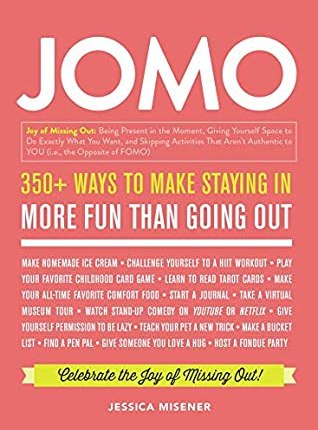
JOMO: Celebrate the Joy of Missing Out! by Jessica Misener

JOMO: Celebrate the Joy of Missing Out! by Jessica Misener

JOMO or “the joy of missing out” lists “350 plus ways to make staying in more fun than going out.” Unfortunately, a large number of these suggestions included books to read or programs to watch. In my mind, all of those fit into one of two categories, reading or watching television.

“Because skipping a night on the town doesn’t mean you’re missing out on life – you’re just missing out on someone else’s idea of what your life should look like.” pg 7

Photo by Alex Qian on Pexels.com

That being said, there were a few solid suggestions in this book for alleviating boredom. I particularly liked “shower with the lights off” pg 24, “listen to autonomous sensory meridian response videos” pg 47, and “do The New York Times’s 36 questions” pg 127.

The rest of these seemed repetitive, as I mentioned, or uninteresting.

Perhaps this book would have been more enjoyable in the pre-COVID world, when I hadn’t been quarantining at home for months, disappointed with the state of the world and feeling stymied. Maybe I could have gotten into “make a homemade pizza” or “rearrange your furniture.” But things have moved beyond expecting the completion of simplistic tasks to hold the answers to life’s problems, at least for me.

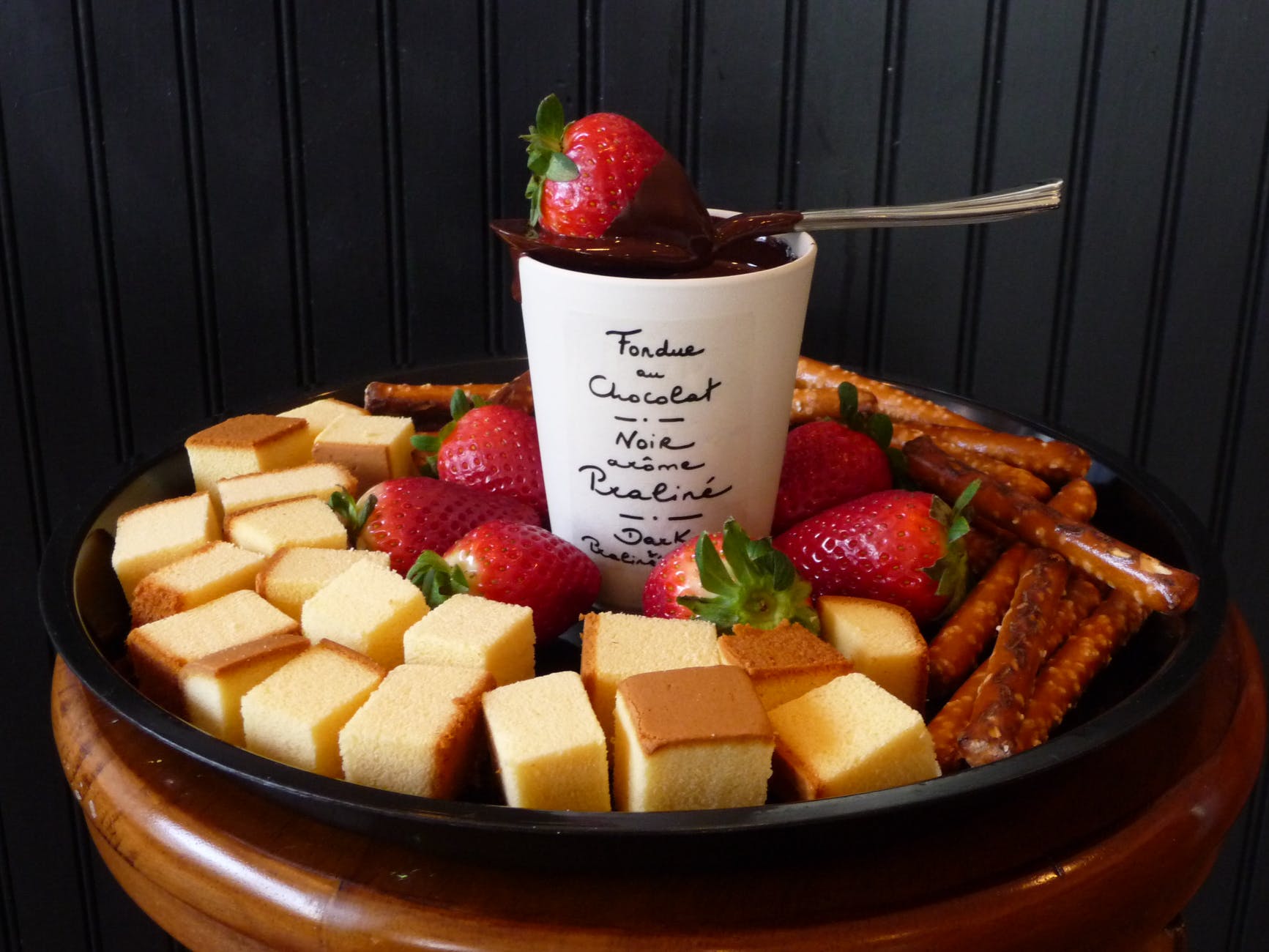
“Host a fondue party,” that appears on the cover of this book, seems like something that happened in another world. Will we ever get back there?

Photo by Laurel Natale on Pexels.com

Thanks for reading!

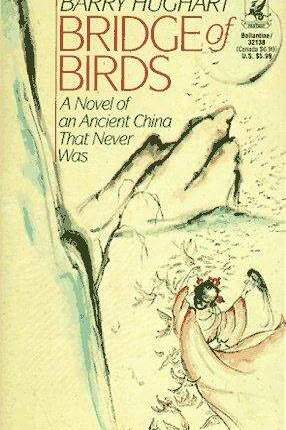
Bridge of Birds (The Chronicles of Master Li and Number Ten Ox, #1) by Barry Hughart

Bridge of Birds (The Chronicles of Master Li and Number Ten Ox, #1) by Barry Hughart

Bridge of Birds is a charming, award-winning fantasy novel that follows the investigative efforts of Master Li as he strives to safe the mysteriously stricken children from the village where Number Ten Ox lives.

“Jade plate, Six, Eight. Fire that burns hot, Night that is not. Fire that burns cold, First Silver, then gold.” pg 22, ebook

Photo by Somya Dinkar on Pexels.com

A beautiful blend of myth and fantasy, the reader is ferried from one exotic locale to the next at the side of the two heroes, one ancient and one young with surprising strength.

We navigate dangerous mazes to hidden treasure hoards, satisfy the grieving souls of haunted ghosts, and marvel at the lightning intellect of Master Li, the scholarly genius with “a slight flaw in his character”.

“My surname is Li and my personal name is Kao, and there is a slight flaw in my character,” he said matter-of-factly. “You got a problem?” pg 32, ebook

There is very little downtime in Bridge of Birds. And just when you think things couldn’t possibly get worse for Master Li and Number Ten Ox, somehow they do.

Despite its breakneck pacing, I found many beautiful moments to marvel over in this story. It is a fairy tale with both substance and heart. Easy to see why it received the 1985 World Fantasy Award for Best Novel and 1986 Mythopoeic Award for Best Fantasy.

Photo by eberhard grossgasteiger on Pexels.com

I think that’s even more impressive when you consider this was Barry Hughart’s debut novel.

“Reverend Sir, in your studies of myth and folklore, have you ever encountered a ghostly handmaiden who pleads that birds must fly?” pg 154, ebook

Highly recommended for readers who like fantasy and historical fiction novels with a dash of mystery and for their heroes to have slight flaws in their character – such a propensity to drink too much wine or the willingness to swindle others but for very good reasons.

Pathways to Bliss: Mythology and Personal Transformation by Joseph Campbell

Pathways to Bliss: Mythology and Personal Transformation by Joseph Campbell

“Each entered the Forest Adventurous at that point which he himself had chosen, where it was darkest and there was no way or path.” You enter the forest at the darkest point, where there is no path. Where there’s a way or path, it is someone else’s path; each human being is a unique phenomenon. The idea is to find your own pathway to bliss.” pg xxvi

Pathways to Bliss is a collection of Joseph Campbell’s writings and lectures, expanding upon the theory he put together in The Hero With a Thousand Faces. Namely, that myths serve a psychological function to help individuals safely traverse the various stages of his or her life.

Photo by Elina Sazonova on Pexels.com

That statement is over simplifying Campbell’s complex and richly-developed discussions of mythology, but it’s the basic building blocks of the thing.

“If it is a living mythology, one that is actually organically relevant to the life of the people of the time, repeating the myths and enacting the rituals center you. Ritual is simply myth enacted; by participating in a rite, you are participating directly in the myth.” pg xix

Campbell talks about not only the importance of the myths throughout generations of humankind, but the idea that it is a living, breathing system. He believes there is trouble on the horizon if society’s myths don’t change and evolve to keep up with the challenges of the current day.

He also stresses the need for the individual to find their own meanings in the stories and symbols of the mythology. The pathway to that which you are here to live is something that only you can find for yourself.

Though, he does point out, you could experience your unique pathway through ritual and communion with a community of like-minded believers. Campbell applies his mythological lens to the world religions, to life stages, to everything in-between to see what universal truths he can pull out of the stories and the common experience of humanity.

“And my little sermon to the churches of the world is this: you have got the symbols right there on the altar, and you have the lessons as well. Unfortunately, when you have a dogma telling you what kind of effect the symbol is supposed to have upon you, you’re in trouble. It doesn’t affect me that way, so am I a sinner?” pg 43

Photo by Pixabay on Pexels.com

I found this book easier to understand than The Hero With a Thousand Faces, which I read a few months ago. Despite this, I suggest you read Hero first, because it’ll give you a better contextual base to understand what the heck Campbell is going on about.

I had some issues with his concluding chapter of this book, Dialogues. In an open discussion with some female attendees of one of his seminars, Campbell and the women try to define how the woman’s heroic journey is different than a man’s.

I didn’t agree with some of their conclusions. Maybe you had to be there to truly grasp the essence of what he was saying.

“The suffering overtakes women – it is part of the nature of womanhood. Whereas the man has to undertake suffering – it’s a big difference.” pg 153

Photo by João Jesus on Pexels.com

Women’s life is suffering? hmmmm…

Recommended for readers interested in more of the musings of Joseph Campbell or for people interested in mythology and its practical applications. Beware that some of the material may be somewhat dated.

The Lies of Locke Lamora (Gentleman Bastard, #1) by Scott Lynch

The Lies of Locke Lamora (Gentleman Bastard, #1) by Scott Lynch

In The Lies of Locke Lamora, readers are introduced to Locke, an orphan in a fantastical city with magical glass relics the size of entire city blocks. The glass is all that was left behind by the people who founded the city. Its inhabitants now do not understand how it was constructed, but that doesn’t keep them from utilizing the spires of magic glass or appreciating its otherworldly beauty.

Within this strange city that is similar to our world’s Venice, yet so different, Locke Lamora is taken in by various characters in the realm’s criminal underworld. The boy shows promise for a life of theft and confidence games… if he can reign in his propensity for accidentally getting people killed.

Photo by Pixabay on Pexels.com

“At the height of a long wet summer of the seventy-seventh year of Sendovani, the Thiefmaker of Camorr paid a sudden and unannounced visit to the Eyeless Priest at the Temple of Perelandro, desperately hoping to sell him the Lamora boy.”

There are layers to this tale. There’s intrigue and backstabbing among the criminal underworld or those who call themselves, “the right people”. There’s a gang of criminal masterminds, the Gentleman Bastards, who prey on the city’s upper class citizens, but who pass themselves off as simple sneak thieves to the rest of the gangs.

And while Locke’s gang, the Gentleman Bastards, are running one of the biggest cons of their life, the chapters of that storyline are interspersed with the personal histories of the gang’s members. Part of that history includes the Gentleman Bastards’ training as priests of the various orders in the city, of which there are many.

So, to recap: there’s complex religion, city hierarchy, criminal hierarchy, levels of con games, and then the real story begins when Locke’s plan, as usual, begins to go sideways.

“I ache in places I didn’t previously realize I owned,” said Locke, gingerly applying adhesive paste to his chin with his fingers. “But it can’t be helped.”

Photo by Francesco Ungaro on Pexels.com

I first read The Lies of Locke Lamora eight years ago in March 2012. I recently re-read it in May 2020. To my surprise, I enjoyed it somewhat less the second time around.

I still like the characters, the story and the setting, all of which were beautifully written. My complaint was the pacing. Just as the author gets rolling on the main story line, he draws us back into the past. I didn’t seem to mind it the first time I read the book, but I definitely noticed it in the second reading.

But don’t let a small thing like pacing dissuade you from reading The Lies of Locke Lamora. It is an awfully entertaining fantasy read. And if I remember correctly, the next two books in the series are fun as well.

Promethea, Vol. 2 by Alan Moore

Promethea, Vol. 2 by Alan Moore

Promethea, Volume 2 was an incredibly disappointing follow-up to a promising comic series.

The reader continues to follow the efforts of Sophie, a student who has learned to channel the spirit of a being of enlightenment named Promethea, while battling demons and other nebulous, bad guys.

Photo by Francesco Ungaro on Pexels.com

We have yet to learn more about the villains of the story, except in brief asides, or Sophie’s allies, some sort of technological heroes.

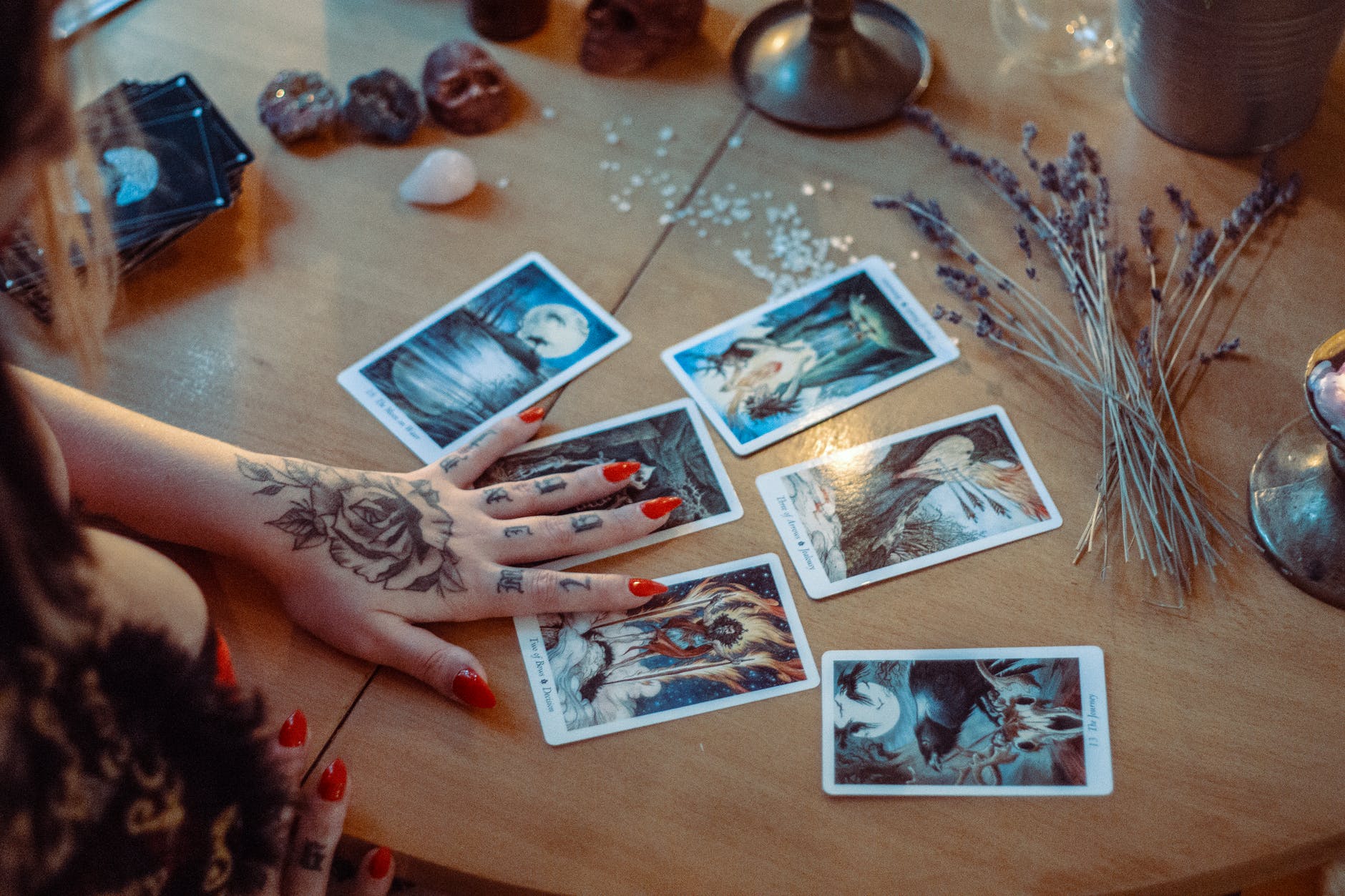
This entry is bogged down with a lengthy metaphysical poem about the progression of tarot cards and an unexpected tantric sex primer.

Photo by Alina Vilchenko on Pexels.com

My quibbles with the tarot card piece is it is far too simplistic but also too long. Each card can be interpreted a number of different ways, and not just applied to principles of civilization. It is also a metaphor for the soul’s journey, which Alan Moore touches on, but, I feel, never truly explains.

Also, by presenting the whole thing through rhyme, I couldn’t help but draw comparisons to Dr. Seuss. I get what Moore was going for, but it didn’t work for me.

Meanwhile, I couldn’t help but wonder if the lead character in this story was a guy if we would have been subjected to the tantric stuff at all.

Photo by Roy Reyna on Pexels.com

I believe the earthly can be spiritual and the spiritual can be earthly. I think “kundalini rising” is just the lightning flash of inspiration in reverse. But a male hero being pressured into trading his body for secret knowledge? I don’t see it happening.

I liked the first entry of Promethea. I thought it was ground-breaking in the way it depicted a strong female character on a spiritual journey.

This second book simply isn’t of the same quality. Perhaps the series will redeem itself in the next entry. One can only hope.