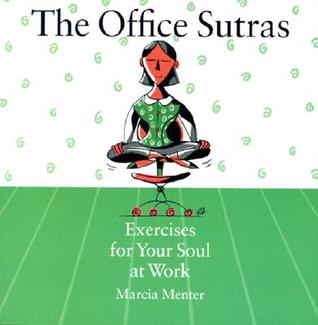
The Office Sutras: Exercises for Your Soul at Work by Marcia Menter

The Office Sutras: Exercises for Your Soul at Work by Marcia Menter
officesutras

The Office Sutras sums itself up in the first couple of pages: “The basic premise of this book is that we’re on a spiritual journey every second of our lives, not just during those times we set aside to contemplate the cosmos. The job you have right now, no matter how frustrating, no matter how screamingly imperfect, is part of your spiritual path.”pg 3

Every page there after pretty much repeats the same theme.

This book just wasn’t for me. Every chapter presents a common problem that one can encounter at work and then gives exercises that you can use to come to an understanding about it.

I realized that I was never going to do any of the exercises and I didn’t regret that in any way. Big fail.

If you’re going to read a self help book that deals with work and has a Buddhist vibe, I’d suggest Peace Is Every Breath: A Practice for Our Busy Lives.

Thich Nhat Hanh is brilliant and I find his writing to be more appealing than this offering. Thanks for reading!

Tin Star by Cecil Castellucci

Tin Star by Cecil Castellucci

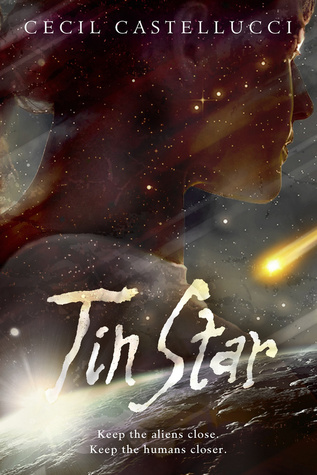
tinstarTin Star is the story of Tula Bane, a teenager who joined a space colonizing cult from Earth. She is abandoned on a way station near the edge of the known universe on the way to her new home.

How will Tula Bane survive among aliens who think human beings are the worst? Will she ever be able to go home to Earth or the colony’s planet? How will she manage to put bread on the table?

I love a good space opera and I thought that I would enjoy Tin Star more than I did.

The promise of books set in space, in my opinion, is the opportunity for unique interstellar exploration and worlds created entirely from the author’s imagination. Because of Tula’s unique plight- being stuck in what is essentially a space gas station- the author left herself very little room to write a creative story.

Mainly, Tin Star deals with character development and social struggles, not adventuring in new places.

The villain of the tale was charismatic and creepy. Take this description: “He had his hand on my shoulder in a way that he had a million times before. Only before it was comforting, encouraging, affectionate. Now it was menacing. He was looking at me and his face was smiling. To anyone looking from afar, he seemed to be pleased with me, but it was just a mask. His attitude shifted from concerned leader to unknowable monster.” pg 4

Tula manages to befriend a shady, insect-like alien named Heckleck. He’s my favorite character.

In this passage, Heckleck explains the problems Tula will face in trying to leave the station: “I know about you,” Heckleck said. “Everyone does. And you will never get off this station. You are nobody. And worse, you’re a Human. Even if you did not get on a ship that would take one of your kind, you’d have nowhere to go but to roam like the others of your kind do.” pg 35.

Keeping it real: with Heckleck.

I thought Cecil Castellucci could have done more with the cultural differences between Tula and the others on the station.

One of the most interesting exchanges in the book was between Tula and Tournour, the head of the outpost. She’s trying to figure out how old he is and, because they’re from different planets/species, it’s a surreal conversation. More of that would have been nice.

But Castellucci wrote cultural and language barriers out of the story by introducing nanites into Tula’s bloodstream to translate alien languages for her.

Something that Castellucci did well was writing profound silences between characters into her story. For much of this story, Tula finds herself standing around with Heckleck and Tournour and having nothing to say. But, somehow, it works.

I liked how Castellucci wrote the thoughts spinning through Tula’s mind at these moments. It reminded me of myself when I can’t think of anything to say: “It was a silent agreement between us that if we spoke too much then we would have to talk about the practical things. … If we ever spoke of the things that truly pressed up against us, our very real worries, our seemingly impossibly plans for escape, our divergent hopes for the future, our bubble would blow apart.” pg 184

This book in three lines: “In the end, good must win over evil. The trouble is trying to figure out which is which. Sometimes they look so much alike.” pg 204

Read this book if you enjoy light, young adult drama in space. If you’re looking for a meaty, space adventure, you’ll need to find another title.

Some read-alikes are: The Knife of Never Letting Go (teen trying to survive on an alien planet) or Gated (teen trying to leave a cult).

Thank you to Roaring Brook Press for sending an advance reader copy of this book. And, thank you for reading!

Shutter by Courtney Alameda

Shutter by Courtney Alameda

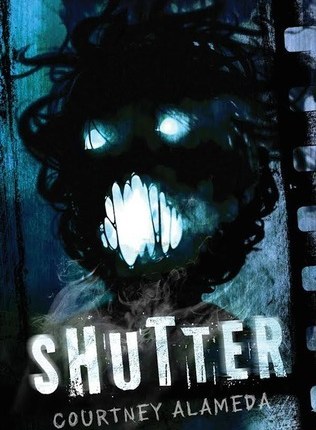
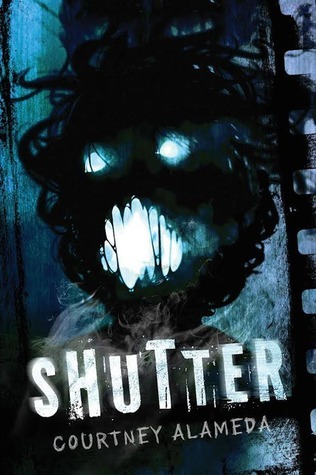
shutterMicheline Helsing is the last of the line of Van Helsings, of monster slaying fame. In this version of the tale, Micheline slays ghosts and otherworldly beings by capturing their visages on film, thereby taking away their power and banishing back to the realms where they belong.

One night, Micheline and her team has a mission go awry and now, because of a curse, they are going to die. Unless, they can find the ghost that caused the sickness, rid the world of it, and save themselves. The clock is ticking…

Shutter was a Brom Stoker award nominee for Best First Novel. That’s what drew me to this creepy tale.

Horror isn’t my usual genre and the scary parts of this tale really scared the heck out of me. If horror is your thing, this one might not be scary enough. Reading is such a personal experience, you know? It’s hard to predict.

Alameda was at her best during the truly terrifying moments, which, in my opinion, were the undead creatures and anything scenario involving a mirror. Everybody has mirrors in their homes. What if, hypothetically, these were portals into other worlds and *things* could come crawling out of them into this one- eeeeeek!

I didn’t enjoy the so-so character building, teen angst or abusive relationship with the father. That could be a potential trigger too.

Micheline is the type of teen heroine that I met in the Divergent trilogy and wasn’t impressed with then: not trusting anyone in authority with her problems even though they could potentially help her, throwing herself into life threatening situations without proper planning and, therefore, putting her friends in danger too, and pining for the lantern-jawed guy with the ridiculously pumped up fighting skills.

If it wasn’t for the insanely entertaining parts with the ghosts, mirrors, strong friendships with her team and tragic back story, this would be a two-star book instead of a four. But, I believe that its positive attributes outweighed the negatives. Again, reading is such a personal trip. You may disagree. And that’s ok.

For a debut book, Shutter is really very good. I read the last couple chapters of this in a rush because I was terrified for the well-being of the main characters.

If you love young adult horror tales, you should give this one a read. Some read-alikes: Jackaby or 13 Days of Midnight. Shutter is scarier than either of those, but they have similar themes.

Thanks for reading!

Magonia by Maria Dahvana Headley

Magonia by Maria Dahvana Headley

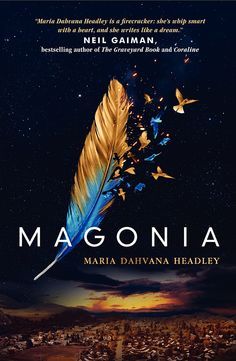
magoniaAza Ray Boyle can’t breathe. It seems like she has always been sick- inexplicably short of breath and weak.

This continuous illness has made her always feel different from the people around her. But, perhaps, there are stranger and more exotic reasons why she is different. Ones that Aza can’t even imagine…

Jason is Aza’s dearest friend. They are so close that they almost speak their own language.

He realizes there is more to Aza than meets the eye. How will Jason handle it when he discovers the shocking truth?

This young adult fantasy is weird, but I enjoyed it.

That’s probably because I read a lot of weird, non-fiction. The story of Magonia, a world in the sky above the every day world which we know, has shown up in some of those books.

One of those books, Passport to Magonia: On UFOs, Folklore, and Parallel Worlds, captured my imagination.

That book recounts an incident where a bunch of villagers were holding church service and they heard a crash outside. They went to investigate the noise and discovered what appeared to be a ship anchor attached to the roof of their church. It was connected to, this just blows my mind, a ship in the sky. This supposedly happened in 1211 AD.

The astonishing thing about Passport to Magonia is it has pages and pages of stories like that, eyewitness accounts of bizarre ships, people, and incidents concerning people from the sky. And they all actually happened, reportedly.

I remember thinking that an author needed to get her hands on these stories and turn it into something fantastic. Maria Dahvana Headley used a different source material than the book that I read, but does a good job bringing a mysterious blip in history to life.

She has the ability to interweave actual events with fantasy fiction story lines so that the two begin to blur in the reader’s mind.

I read Headley’s first book Queen of Kings years ago and I remember being struck by its originality.

Headley took Cleopatra’s life and turned it into a vampire story. It sounds sort of silly described that way, (oh, ANOTHER vampire story) but it is actually rather fun.

I had read Margaret George’s The Memoirs of Cleopatra shortly before Queen of Kings so I had a pretty good idea of the actual story of the Egyptian queen.

Back to this book, Magonia isn’t going to appeal to everyone.

I was, at first, rather turned off by the uber-intellectual back and forth conversations of the main characters- Jason and Aza.

I think, since the mega success of John Green’s The Fault in Our Stars, authors make their teenage protagonists so brainy and well-spoken, it is just unbelievable.

I mean, it’s been awhile, but I remember high school. My peers and I were lucky if we could string two cogent sentences together, let alone present verbal dissertations on the meaning of pi.

Anyway, once I was able to look past their flowery repartee, I got really into the story.

Headley paints a magical and dangerous world.

If you enjoyed Magonia, you may also enjoy The Mermaid’s Sister or Under the Empyrean Sky. Both are young adult novels and take place in fantasy worlds that are so close to the world we know, but different in surprising ways.

Check out my review of Aerie, the sequel to this book.

Thanks for reading!
Malice in Ovenland: Volume 1 by Micheline Hess

Malice in Ovenland: Volume 1 by Micheline Hess

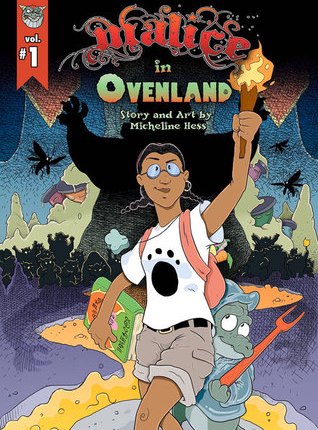
Malice in Ovenland by Micheline Hess is a graphic novel for children. Lily Brown’s mom tells her to clean the kitchen- and her adventure begins.

An excellent pick for reluctant readers, this story is a cute, gross, and, endearing romp through a fantastical world hidden behind an oven.

Lily’s heroic journey reminded me of the comic series, Princeless by Jeremy Whitley. In Princeless, the heroine tires of waiting for a prince to come save her, so, she sets about saving herself.

Lily is no wilting flower either, despite her name. 🙂

With art and a storyline appropriate for the pre-teen crowd and an empowered female protagonist, I could see this being a great addition to any juvenile’s graphic art collection.

What I enjoyed most about Malice in Ovenland were the homages to other great works of children’s literature.

The obvious one, of course, is to Alice in Wonderland but I also caught shades of the Lord of the Rings in the poem included at the end of Chapter 1.

The moment that Crumb comes to visit Lily in the dungeon reminded me of when Taran met Gurgi in the Black Cauldron.

The Queen’s advisor, named Crispodemus, reminded me of Nicodemus the rat from the classic children’s story, Mrs. Frisby and the Rats of NIMH by Robert O’Brien. (One of my all-time favorites, by the way)

And finally, The Royal Rangers reminded me of the Beagle Boys from Duck Tales– bumbling, minimally intelligent thugs, who would be harmless if they weren’t so determined to be bad.

Malice in Ovenland would be a great title for a reluctant reader or a reluctant eater. The story, in addition to the adventure, teaches kids to not be afraid to try new things- either food or life related.

It’s a message that can’t be repeated enough.

The humor is mainly gross-out or potty-related but, as a mother of a soon-to-be-10 year old, that’s exactly where her humor is at right now. It’s perfect for the audience that it is seeking.

Big thanks to NetGalley for providing me with a free digital edition of this title for review purposes and thanks for reading!

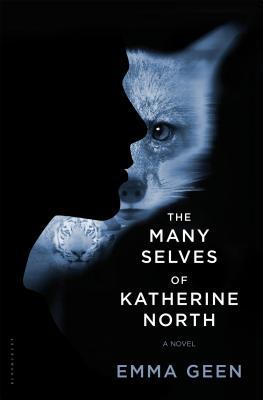
The Many Selves of Katherine North by Emma Geen

The Many Selves of Katherine North by Emma Geen

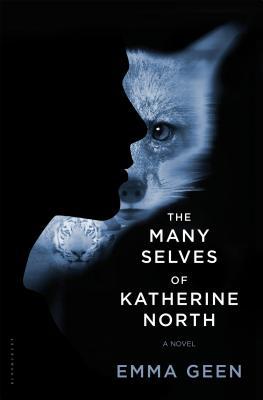
katherinenorthIn The Many Selves of Katherine North by Emma Geen, humanity has harnessed the power of consciousness and mechanized the ability to place that consciousness in different bodies at will.

Katherine is a teenager who works for a large research company. She’s the longest lasting “phenomenaut” (person who’s consciousness is put into the body of an animal) because she seems to be special.

The process of consciousness transfer seems to stop working when the brain ages and loses its plasticity. Despite her age, Katherine’s brain seems to be fine.

But then, one day, Katherine sees something strange when she’s out of her body… and perhaps she’s not as well as she imagined.

The Many Selves of Katherine North asks some pretty powerful questions like: What is consciousness? How does our physical body change how we perceive the world? What is reality?

I think that this story has the potential to open up a dialogue about these questions between readers who may not have considered them before. In that way, this is a very powerful book.

I did not like how the story flips back and forth between the present and the past. I think Geen was using the shifting timeline to build the mystery, but, because of the nature of Katherine’s many consciousness experiences, it made things rather confusing.

This is a complicated book. At times, maybe too complicated.

The richness and variety of Katherine’s experiences drives a wedge between her reality and the rest of humanity’s reality.

The reader really sees difference in this moment, when Katherine is preparing to go into work: “Later, I lie in bed quivering… because it’s only hours until I’m out of here. Here- not just a room but skin. How can other people call this their totality? There is so much more.” pg 19

Katherine captures the impossibility of explaining out-of-body experiences very succinctly here: “Because how do you cram the lived experience on to a page? The words available to me were never enough. Something would always slip the sentences. Human language developed around human bodies, it never quite fits other ways of being. pg 66

I loved all of the chapters when Katherine was in the body of an animal. In this one, she was a snake: “Old scents have imprinted upon the world like spoor into soft mud, the past blundering prey. I wonder if this is one reason many animals have a poor memory compared to humans. What’s the use in remembering when the world does it for you? pg 146 Fascinating.

Emma Geen included a disclaimer at the back of her book and it contained some of my favorite lines: “…what if there are other valid ways of knowing? What is the world is not one, but multitude, with as many ways of being as there are beings? What if literature were the opportunity to glimpse such refractions, thrown by the world as though from a diamond?” pgs 349-350 Loved that.

If you enjoyed The Many Selves of Katherine North, you may want to pick up The Night Circus by Erin Morgenstern or Mythago Wood by Robert Holdstock for more glimpses of worlds hidden within worlds.

Big thanks to Goodreads First Reads program, NetGalley, and Bloomsbury USA for providing me with an advance reading copy of this novel.

Thanks for reading!

The Abominable: a Novel by Dan Simmons

The Abominable: a Novel by Dan Simmons

The Abominable by Dan Simmons is a historical fiction novel about mountain climbing and a mystery that is set, for the most part, during the early years of World War II.

The story reads like less of an adventure novel and more like an homage to the sport of mountaineering.

Photo by Pixabay on Pexels.com

Dan Simmons takes his time building the tension of the tale with back stories and detours until I nearly lost interest in the whole thing. But, to be fair, I have never been a serious mountain climber, having injured myself the first and only time I tried it.

I do enjoy long hikes in beautiful spaces. I don’t like risking my life or the lives of my companions in the process. So, not my thing, but maybe it’s somebody else’s.

Photo by Sagui Andrea on Pexels.com

If hiking is your jam, the long and technical descriptions of climbing techniques, knots, and methods in The Abominable might be just the read you’ve been looking for.

Here’s a pretty passage about viewing the night sky, high up in the mountains: “When you look at the stars near the horizon…especially when it’s really cold.. they tend to jitter around. Jumping left, then right… all while they jiggle up and down at the same time. I think it has something to do with masses of super-cold air lying over the land or frozen sea acting like a lens that’s being moved…” pg 18

One of the many passages that literally made my hands sweat in fear for the characters: “It’s tricky playing out the rope to Jean-Claude as I crab-shuffle to the left. Most of it is in my rucksack, which keeps trying to pull me back and off the face with just the weight of the extra rope and a few other small things in it, but some I’ve had to loop over my right shoulder to keep playing out to J.C. …

I’ve made it a little more than halfway to the pipe ledge when I slip…” pg 111

There are hundreds of pages with writing like that. I found it stressful, but again, I’m not a mountain climber.

Photo by eberhard grossgasteiger on Pexels.com

There’s a lot of wry humor in this read too: “…why are they so eager to get this blessing from the monastery’s holy man, Dzatrul Rinpoche? If everything’s predestined for them anyway, what difference will the abbot’s blessing make?” Pasang smiles his small smile. “Do not ask me, Mr. Perry, to make sense of the internal contradictions that are common in all religions.” pg 341

More love for mountain climbing: “Machig Labdron once wrote, Unless all reality is made worse, one cannot attain liberation… So wander in grisly places and mountain retreats… do not get distracted by doctrines and books… just get real experiences… in the horrid and desolate.” “In other words,” I say, “face your demons.” “Exactly,” says Reggie. “Make a gift of your body to the demons of the mountains and wilderness. It’s the best way to destroy the last vestiges of one’s vanity and pride.” pg 346

This book in two lines: “We were metaphorical inches from hypothermia-which has a wider range of terrible symptoms than merely going to sleep and freezing to death, not the least of which would be intemperate belligerence and a need to rip our clothes off as we froze-and literal inches from a 9,000-foot drop to our south side and a 10,000-foot drop a few more feet away to the north side. But for the moment, we were very happy.” pg 554

Photo by Aleksandr Slobodianyk on Pexels.com

And some people call that fun.

So, beyond being terrified during the climbing portions and bored by the never ending, rambling style of story-telling, I wanted much more of the fantastical in this tale, for example: the abominable snowman!

I’m not going to say anymore about yetis because I don’t want to spoil the surprising twists and turns of this tale for those who do choose to pick it up. Prepare yourself for one hell of a climb though- because it’s a long and meandering one.

Thanks for reading!

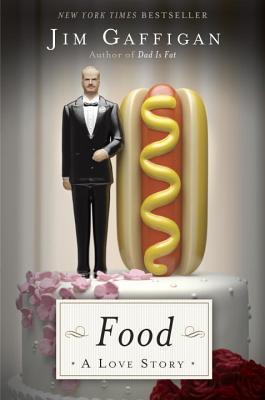
Food: A Love Story by Jim Gaffigan

Food: A Love Story by Jim Gaffigan
food a love story

In Food: A Love Story, Jim Gaffigan waxes poetic about one of his favorite topics – food.

Gaffigan is one of my favorite comics. He has clean, family-oriented humor (so I can watch his specials while my kid is awake rather than waiting for her to go to sleep) and he generally avoids political topics (so I can watch his specials without my husband getting mad and walking away).

I love his humor. However, this book was almost too much for me, even being the huge fan that I am.

At least, in his stand up, he switches topics. Gaffigan is funny in this, don’t get me wrong. But a book’s worth of jokes on just one thing… it’s a tall order. And not just of fries. 🙂

On why he doesn’t like oysters: “Once I had a friend defensively point out to me, “Pearls come from oysters.” I never really understood his reasoning, but I explained I make a rule not to eat things that also make jewelry. Diamonds come from coal, but we aren’t dipping that into cocktail sauce.” pg 60 (ebook)

On BBQ: “I’ve found barbecue to either be some of the best or the worst food I’ve eaten. There is no in between. Either it’s an amazing meal I can’t stop talking about, or I’m angry that I wasted the energy to lift the food to my mouth. Of course, I still finish the whole plate. As I mentioned before, I am not rude.” pg 72 (ebook)

On organic chips: “These potato chips are cooked with avocado oil, so I can eat ten bags. It’s good for me.” Usually the only discernible difference between a regular potato chip and a “healthy chip” is the difficulty in opening the bag. Supposedly there are good fats and bad fats. I like to think of myself as a good fat. It helps my self-esteem when I look in the mirror.” pgs 119-120 (ebook)

Photo by Edu Carvalho on Pexels.com

Kale: “People seem to bring up eating kale as if it’s something that’s going to impress me. Guy: I just ate kale. Me: I don’t care.” pg 154

Comparing different kinds of cakes: “Ice cream cakes: I never really understood the appeal of an ice cream cake. They are so temporary. They just end up stressing me out.” pg 401 (ebook)

And, finally, breakfast: You would feel guilty about eating most traditional breakfast items at any other meal during the day, but since it’s the morning, somehow these foods are considered okay.” pg 416 (ebook)

That’s a good sampling of Gaffigan’s food jokes. It goes on for pages, joke after joke.

The sheer amount of material Gaffigan had to construct about food is kind of impressive actually. Be aware though, it is a one note book.

Thanks for reading!

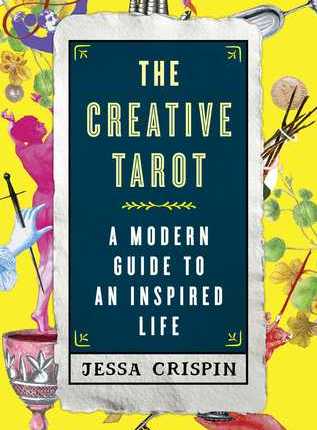
The Creative Tarot: A Modern Guide to an Inspired Life by Jessa Crispin

The Creative Tarot: A Modern Guide to an Inspired Life by Jessa Crispin

The Creative Tarot: A Modern Guide to an Inspired Life is an excellent tarot card reading manual for beginners to the more experienced card reader.

I loved that Crispin gives novel, art, and film suggestions for each card so that the reader can immerse herself in the “feel” or “mood” of them. That was a lovely touch and different from any other book on tarot cards that I’ve read.

Photo by Anna Tarazevich on Pexels.com

Mainly, the books that I’ve picked up have been about tarot card theory and how the cards tie in to the Tree of Life. It’s a complex system and can only be talked about in metaphors.

Imagine my relief to read a book about just the cards themselves and not an arcane “theory of everything.”

A.E. Waite was the co-creator of the Rider-Waite Tarot. He had some interesting thoughts about the tarot card reading qabalists, many of whom wrote books like the ones I’ve mentioned above.

A.E. Waite’s beliefs, which Crispin includes in the chapter entitled, A History of the Tarot, were: “Waite believed that the magical systems (tarot) of the Golden Dawn and other systems were not about imposing your will on a situation… or about telling the future… He believed they were for elevating the soul and for bringing what is unconscious conscious.” pg 7.

Photo by Jonathan Petersson on Pexels.com

I believe that too. But, if you can’t explain the system in a way that makes sense, then what’s the point of writing a beginner’s manual. There can be no “elevation of the soul” if the beginners can’t understand the first thing about reading tarot cards.

Thankfully, Crispin’s interpretations are simple and clear. This is a book that will see some use, not become another expensive paperweight.

I liked Crispin’s description of Temperance: “Temperance is an easily misunderstood card, as it has become associated mostly with abstention. Not drinking, not participating, denying yourself something. But that breaks away from the origins of the card, which traditionally portrays a hermaphrodite blending two cups of water- one hot and one cold- to create something in the middle between these two extremes.” pgs 76-77

Photo by Aleksandar Pasaric on Pexels.com

Temperance is about finding the middle way, not skirting along the edges from one extreme to another. Kind of ruins the idea of a “temperance movement,” doesn’t it.

I also liked this blurb about the Tower: “Remember that scene in Louisa May Alcott’s Little Women, where Amy throws Jo’s stories into the fire? That’s the feeling of the Tower: the realization that all is lost, and you will have to start over from the beginning.” pg 83

Yes, I’m a bookworm. Yes, Little Women is one of my favorite books. I think Crispin nailed the card’s description with that scene.

Photo by Pixabay on Pexels.com

I thought this description of The Moon was brilliant: “The Moon rules our dreams, and that’s a good way to think about this card. They don’t make sense on a logical level, but on a personal level, on an emotional level, they do. The location in a dream will shift without warning; dead people will walk beside the living; your mother will show up, say something nonsensical while wearing a jellyfish on her head, and then stab you in the heart. And you wake up and think, “Oh, of course, this is about that incident that happened when I was five.”

My dreams are just like that. In fact, I had that exact dream last night. 🙂

The tone in The Creative Tarot is very friendly and conversational, as if you asked your best friend to teach you a little bit about her favorite hobby- tarot cards. Highly recommended for artists, dreamers, and aspiring tarot card readers.

Its only weakness, in my opinion, is that I wanted more… more stories, more examples. I understand that we’re dealing with 50 plus cards and they can’t all receive extremely detailed treatment, otherwise we’d get the George R.R. Martin version of Tarot card books, but a girl can dream.

Jessa Crispin has modernized a system that seems to want to stay inaccessible to the beginner. I wish more of the books about the tarot were like this one.

Thanks for reading!