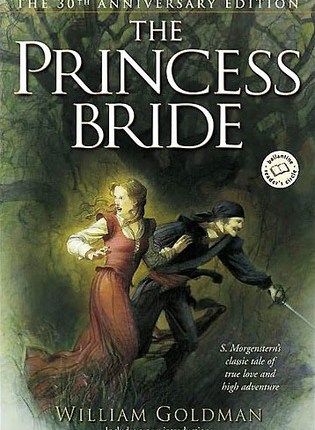
The Princess Bride by William Goldman

The Princess Bride by William Goldman

** spoiler alert ** Please be aware: major spoilers ahead if you have not read the book or watched the film. Consider yourself warned.

A new classic tale about a woman named Buttercup, the man she loves named Westley, a giant who loves to rhyme named Fezzik and Inigo, a Spanish swordsman out for revenge.

Of course, like many, I’ve seen the film The Princess Bride about a bajillion times, but I’d never read the book. It was time to rectify that error. Because the book is always better than the movie, right?

“I love you,” Buttercup said. “I know this must come as something of a surprise, since all I’ve ever done is scorn you and degrade you and taunt you, but I have loved you for several hours now, and every second, more.” pg 59, ebook.
Photo by Charles Pragnell on Pexels.com

But not this time, friends. I know, I was shocked too.

That’s not to say the book isn’t charming, because it is. There’s all of the characters you love and they deliver the classic lines from the film, plus you get the backstory and additional humorous injections from William Goldman. Goldman created a story within a story — he acts as if he’s simply editing a book by S. Morgenstern and has created an entire history around this idea.

He’s so convincing, in fact, that I immediately googled Goldman to make sure I hadn’t missed something.

My favorite part of the book was exploring Prince Humperdinck’s “Zoo of Death”, which we only get to see in passing in the movie.

“The fifth level was empty. The Prince constructed it in the hopes of someday finding something worthy, something as dangerous and fierce and powerful as he was. Unlikely. Still, he was an eternal optimist, so he kept the great cage of the fifth level always in readiness.” pg 68, ebook.

Photo by Daniel Torobekov on Pexels.com

Honestly, some of the scenes in the book go on a bit too long. The part where Westley challenges Prince Humperdinck “to the pain” instead of “to the death” comes off as creepy in the book, whereas, I felt, in the film it was kind of awesome. I’m not entirely certain what the difference is, except his speech is more to the point in the film.

“It means that I leave you to live in anguish, in humiliation, in freakish misery until you can stand it no more; so there you have it, pig, there you know, you miserable vomitous mass, and I say this now, and live or die, it’s up to you: Drop your sword!” pg 225

Those are all just quibbles compared to the ending, which was the most shocking point of all.

Ok, as we all know, in the movie, it ends with a kiss and they all live happily ever after.

In the book, not so! Here are the last lines in the “official story” not counting a few more comments by Goldman:

However, this was before Inigo’s wound reopened, and Westley relapsed again, and Fezzik took the wrong turn, and Buttercup’s horse threw a shoe. And the night behind them was filled with the crescendoing sound of pursuit… pg 228, ebook.
Photo by Min An on Pexels.com

That’s it. I nearly fell out of my chair when I read it. Here’s what our author said about it a few paragraphs later:

“I’m not trying to make this a downer, understand. I mean, I really do think that love is the best thing in the world, except for cough drops. But I also have to say, for the umpty-umpth time, that life isn’t fair. It’s just fairer than death, that’s all.”

It’s such an unsatisfying ending. I can see why they changed the film because I don’t think audiences would have stood for it, which probably says more about film-going audiences than readers, but still. Don’t readers deserve a happy ending too?

Thanks for reading!

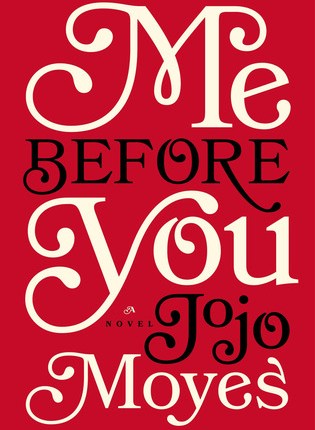
Me Before You by Jojo Moyes

Me Before You by Jojo Moyes

Dear readers, warning!!  I don’t usually put spoilers in my reviews, but I had to in this one to discuss it properly.  Please do not read this if you haven’t read the book yet.

Time to talk about Me Before You. This is a difficult one. Louisa (Lou) Clark recently lost her job. She needs another one, quick, before her family loses the house. Will Traynor used to be an active, world traveling, 1%er, but, after a terrible accident, he’s stuck in wheelchair and suffers each day as a quadriplegic. Both Lou and Will are damaged in their own way, but they make life better for each other.

Me Before You addresses the difficult issue of assisted suicide, so if you have trouble reading about that topic, steer clear. There’s also some flashbacks to a rape, so another warning, for folks who are triggered by such things.

I didn’t struggle with either of those topics, but it bothered me that the author painted such a bleak world for Lou. Her family doesn’t treat her well, her boyfriend, Patrick, doesn’t treat her well, and, in consequence, she doesn’t treat herself very well. I realize that the point of the story is how Will changes Lou’s view about the world and herself but it is awfully depressing.

And then, of course, I hated the ending. After everything they go through, Lou’s love isn’t enough? Yeah, I didn’t like that. You’d think Will would see how he made such a difference in one person’s life and realize that he could help many, many more people, if he could just see his world as larger than his body, but no. This book didn’t make me cry, I just felt awful. Seriously, awful. Stomach hurting, headache inducing, post-book depression, awful. So, you may not want to read Me Before You if you’re feeling down before you begin. It’s not a happy book.

Moyes does a great job with the characterizations. Here is Lou explaining how badly she misses her job: “Unemployment had been a concept, something droningly referred to on the news in relation to shipyards or car factories. I had never considered that you might miss a job like you missed a limb- a constant, reflexive thing. I hadn’t thought that as well as the obvious fears about money, and your future, losing your job would make you feel inadequate, and a bit useless. That it would be harder to get up in the morning than when you were rudely shocked into consciousness by the alarm.” pg 30 ebook Dealing with some unemployed depression at my house right now. That passage rang some bells for me.

Will’s mother, Camilla, is also a major figure in the story. Lou describes her here: “I wanted to say: Well, here I am, being cheery every ruddy day. Being robust, just as you wanted. So what’s your problem? But Camilla Traynor was not the kind of woman you could have said that to. And besides, I got the feeling nobody in that house ever said anything direct to anyone else.” pg 71 ebook

Lou’s perception of time when caring for an ailing Will: “There are normal hours, and then there are invalid hours, when time stalls and slips, when life-real life-seems to exist at one remove. I watched some television, ate, and cleared up the kitchen, drifting around the annex in silence.” pg 90 ebook When my child gets sick, I’ve experienced that strange “between time” too.

Camilla’s frustration as a town magistrate: “It’s quite hard to stay calm and understanding when you see the same faces, the same mistakes made again and again. I could sometimes hear the impatience in my tone. It could be oddly dispiriting, the blank refusal of humankind to even attempt to function responsibly.” pg 112 ebook I feel that sometimes at my job. Why can’t folks learn how to use a copier! Sigh.

I laughed when Lou went to the library for the first time in years and was surprised by what she found. I think it makes a statement for the evolution of library systems: “It wasn’t what I remembered. Half the books seemed to have been replaced by CDs and DVDs, great bookshelves full of audiobooks, and even stands of greeting cards. And it was not silent. The sound of singing and clapping filtered through from the children’s book corner, where some kind of mother and baby group was in full swing. People read magazines and chatted quietly. The section where old men used to fall asleep over the free newspapers had disappeared, replaced by a large oval table with computers dotted around the perimeter. pg 141 ebook. My section! “A librarian stopped by my table, and handed me a card and a laminated sheet with instructions on it. She didn’t stand over my shoulder, just murmured that she would be at the desk if I needed any further help..” pg 141 ebook. If Lou had grown up in my town, that would be me!

The key to Lou’s character, in my opinion: “It felt like I was living a life I hadn’t had the chance to anticipate.” pg 234 ebook  I think a lot of people are like that, sort of stumbling through life without goals or dreams of any kind. For her, love was the key to turning that around.  If only more people could be that fortunate, without the abrupt ending.

If you enjoyed Me Before You, you may want to pick up The Fault in Our Stars by John Green or If I Stay by Gayle Foreman. All of which have film adaptations: so, read the book first, then keep those kleenexes close for the movie.

Thanks for reading!

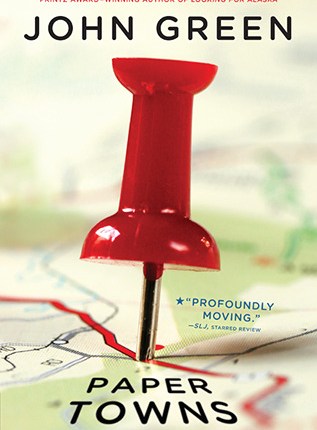
Paper Towns by John Green

Paper Towns by John Green

Warning: this is a book you either love or hate.  Consider yourself warned.

I fell more on the “hate” side of this equation but, surprisingly, enjoyed the film. This young adult, coming-of-age tale has elements of mystery to it.

Quentin has always loved Margo. One night, she wakes him up and they go on a wild tear about town, righting perceived wrongs and causing all sorts of hijinks.

Photo by David Besh on Pexels.com

The next day, Margo has disappeared. Their night out left all sorts of clues to where she went. Q decides to find her.

My negative reaction to Paper Towns surprised me because I loved John Green‘s The Fault in Our Stars so much.

Right off the bat, the reader is thrown into Margo and Quentin’s lives and we’re exposed to some of their worst traits rather than their best. Usually, people behave their best when you first get to know them and then, as they become comfortable with you, they let some of their more questionable sides out.

Photo by Alfonso Escalante on Pexels.com

The whole “rolling around the neighborhood at night and causing mayhem” takes place right at the start of Paper Towns. It isn’t fun because we don’t really know these characters yet.

It’s easier to forgive adolescent hijinks when you know and love the people who are doing them, but we’ve got almost zero time to form a connection before they’re breaking laws.

I think I would have given up on Paper Towns if I hadn’t watched John Green’s TedTalks video on the topic. If you haven’t seen it yet, here it is:https://youtu.be/NgDGlcxYrhQ

Quick summary of Green’s video: The basic idea behind a paper town (a made up town on a map) was copyright protection. The coolest part is that the mapmakers took something that wasn’t real and made it real because they presented it that way for so long.

I know that John Green can write amazing, sympathetic characters. He chose not to in this book and I’ve been rolling it around my brain, wondering why.

I think that Green wrote the characters in this story like a paper town.

At first, he presents the main characters as over-the-top clichés of what teenagers could be. The reader isn’t necessarily meant to bond with them at this point, they’re not real, they’re just “people on paper.”

Photo by Helena Lopes on Pexels.com

Then, through the second part of the book, let’s call it the “clue finding” part, Green slowly reveals more and more of the real parts of their characters just as Quentin finds more and more clues to where Margo has gone.

Through their hopes and dreams, relationships, daily struggles and hopes, they’re becoming more real.

Finally, in the last third of the book, as we join the characters on their mad rush to find Margo, they’ve become real. Real enough to have some close life-threatening moments on the road. Though they started out fake, Green built enough substance for the characters so that they have heft and dimension.

That’s my theory on why Green wrote such awful characters: he meant to. But, I still never liked any of them very much, even after they became “real.”

Photo by Buro Millennial on Pexels.com

I liked Green’s prologue: “The way I figure it, everyone gets a miracle. Like, I will probably never be struck by lightning, or win a Nobel Prize, or become the dictator of a small nation in the Pacific Islands, or contract terminal ear cancer, or spontaneously combust. … My miracle was this: out of all the houses in all the subdivisions in all of Florida, I ended up living next door to Margo Roth Spiegelman.” pg 15 ebook.

“Margo always loved mysteries. And in everything that came afterward, I could never stop thinking that maybe she loved mysteries so much that she became one.” pg 23 (ebook)

And that was the high point in this book for me. It was all downhill afterwards.

Here’s the passage that helped develop my theory about Green writing paper characters in Paper Towns: “… she looks like Margo Roth Spiegelman, this girl I have known since I was two- this girl who was an idea that I loved. And it is only now, when she closes her notebook and places it inside a backpack next to her and then stands up and walks toward us, that I realize that the idea is not only wrong but dangerous. What a treacherous thing it is to believe that a person is more than a person.” pg 406 (ebook)

Photo by Mihis Alex on Pexels.com

In conclusion, if you haven’t read any of John Green’s books, please don’t start with this one.

I highly recommend A Fault in Our Stars. It will break your heart. This one was not so good.

The film adaptation of Paper Towns was surprisingly ok. Borrow it from the library and let me know what you think.

I’m off to be more than a paper character in my own life- thanks for reading!