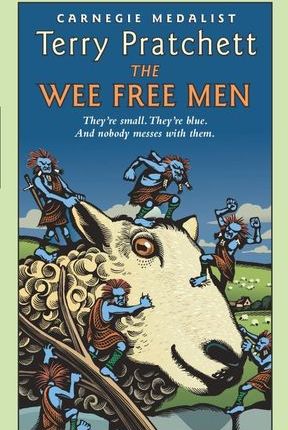
The Wee Free Men (Discworld, #30; Tiffany Aching, #1) by Terry Pratchett

The Wee Free Men (Discworld, #30; Tiffany Aching, #1) by Terry Pratchett

“Tiffany Aching was lying on her stomach by the river, tickling trout. She liked to hear them laugh. It came up in bubbles.” pg 5, ebook.

Photo by Ian Turnell on Pexels.com

With those three sentences, Terry Pratchett introduces readers to one of the most beloved characters from his Discworld series, Tiffany Aching.

Young Tiffany lives in sheep raising country, where chalk from an ancient sea lies beneath the ground. When an otherworldly creature bursts out of a creek and tries to pull her and her little brother Wentworth beneath its waters, Tiffany fights back.

It is the beginning of a life or death struggle with monsters from worlds beyond Discworld, though Tiffany does not know it at the time.

But luckily for her, there are allies who will join her in this fight- the Wee Free Men.

“In the reeds, quite low down, small voices whispered: “Crivens, Wee Bobby, did yer no’ see that?” “Aye, we’d better offski an’ tell the Big Man we’ve found the hag.” pg 10

Photo by Alina Blumberg on Pexels.com

Pratchett weaves this coming of age story with humor and magic. He utilizes the best themes of the Witches Discworld subseries to do so.

Tiffany discovers headology, the importance of belief and appearances, and her own mysterious connection to a witch legacy that was hiding in plain sight in the hills.

The pacing of the tale is quick, racing from one danger to the next, and perfect for young adults or reluctant readers who enjoy fantasy.

In addition, Pratchett uses a real life painting in the story which adds another layer of ‘fairy magic’ to the telling. The artwork is “The Fairy Feller’s Master-Stroke” by Richard Dadd and you can see it here: https://bit.ly/3tW58bb

Detail of “The Fairy Feller’s Master-Stroke”

The surreal painting captures the unsettling feel of the creatures and worlds Pratchett so deftly describes. It is also whimsical, but hints at the danger lurking in the shadows.

For the past few weeks, I have been doing a read-through of the Discworld Witches series and really disliked the last one, Maskerade. I felt like the witches’ character flaws were beginning to dominate the story, which was draining its humor and heart away.

The Wee Free Men brings magic and heart back into the equation. In Tiffany, readers discover a brave young girl who wants to do the right thing but doesn’t have any one to show her the way. We know her mentors will show up eventually, but until then, she and the wee free men need to figure things out on their own.

And how they do that is a very good story. Highly recommended.

Thanks for reading!

Sixteen Ways to Defend a Walled City (The Siege, #1) by K.J. Parker

Sixteen Ways to Defend a Walled City (The Siege, #1) by K.J. Parker

“Orhan.” Nobody called me that. “You’re a clever man and you use your brain, which makes you unique in this man’s town, but you’ve got to do something about your attitude.” “Attitude? Me?” pg 16

Through a series of unfortunate events, Orhan, the leader of a group of military engineers, finds himself in charge of the defense of “the City”, the capital of the Robur empire. The Robur empire seems to have been loosely based on the Roman empire, which, in its conquering of the world, took diverse sets of people and organized them into useful groups under its overarching control.

Orhan is one of these conquered peoples. But he has a unique set of skills, all of which will be put into use during the siege that is to come.

“My meteoric rise, from illiterate barbarian serf to commander of an Imperial regiment, is due to the Hus, the Sherden, the Echmen and, last but not least, the Robur, who are proud of the fact that over the last hundred years they’ve slaughtered in excess of a million of my people.” pg 5

Photo by Maria Orlova on Pexels.com

The story is told entirely from Orhan’s point of view in first-person narrative. This invites the reader to step into Orhan’s shoes and makes the tale quite exciting and immediate.

On the other hand, Orhan is emotionally bereft and runs his life through merciless logic, which doesn’t always serve him, or the people around him, very well.

“That’s one thing about human beings I don’t see the point in: love. It does nobody any good. You love someone, and either they let you down or they die. Either way, you end up crucified.” pg 55

He is an impatient and, occasionally, violent character, who literally punches people when they don’t conform to his view of the world fast enough.

In other words, wearing Orhan’s shoes for the length of the story is an uncomfortable ride for anyone who uses a modicum of emotional intelligence in their lives.

Photo by Miquel Rossellu00f3 Calafell on Pexels.com

That being said, K.J. Parker (pen name for Tom Holt) has done a brilliant job of creating an unforgettable, if unpleasant, narrator. By the end of the book, even though I didn’t like him, I found myself rooting for Orhan anyway because that’s the kind of reader I am.

But if you have trouble connecting with stories where you don’t like the characters, this might not be the book for you.

The one moment where I did connect with the narrator was when he discovers his importance in the siege that is to come.

“If, as I was horribly afraid, I was the senior military officer in the City, I needed confirmation or a warrant or something. If there was someone higher up than me, I desperately wanted to hear about him and ask him for orders.” pg 78

I used to have similar feelings when I first started working as a reference librarian at the library. Prior to that, as a circulation assistant, if I had any question about anything having to do with the library or technology or research, I’d call up whoever was sitting at the reference desk and they’d supply me with the answer.

Photo by Olenka Sergienko on Pexels.com

It was my own version of chain-of-command. There was an unspoken faith that I carried- if I didn’t know the answer, the reference librarian would so there was never any reason to worry.

The day that my training was done, my supervisor went home, and I was left alone at the reference desk, that was my Orhan moment. If I didn’t know or couldn’t find the answer, there was no one else for me to turn to.

It is humbling to realize that it all rests on your shoulders, but it is also a character making moment. How you respond to the pressure says so much about you. And that is the strength of this story, the slow revelation of Orhan’s character under pressure.

Recommended for readers who enjoy historical fiction. Though this is classified as a fantasy too, I feel like it veers more into a parallel universe than a true fantasy world where magic is real and otherworldly creatures are running around. I’d be curious to know what other readers think about its genre.

Thanks for reading!

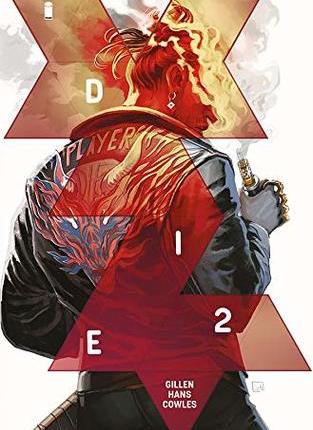
Die #2: Split the Party by Kieron Gillen, Stephanie Hans (Artist)

Die #2: Split the Party by Kieron Gillen, Stephanie Hans (Artist)

Now that the main characters from Die, Vol. 1: Fantasy Heartbreaker are back in the fantasy gaming world of Die, they are struggling to make their way back to the real world.

Part of that struggle involves delving into the past and decisions made by their teenage selves. There are lost loves, old enemies and even a few descendants to contend with- not to mention old hurts that they’ve carried for years between members of their own party.

Which is a particular problem for our intrepid heroes. They all have to agree that they want to leave “Die” in order to do just that. And they don’t all want to leave anymore.

Like most sequels, at least in my experience, the follow up to the first issue wasn’t as strong. Now that readers are in the character development section of the story, action moves a little slower and it reads less like a fantasy adventure and more like a drama.

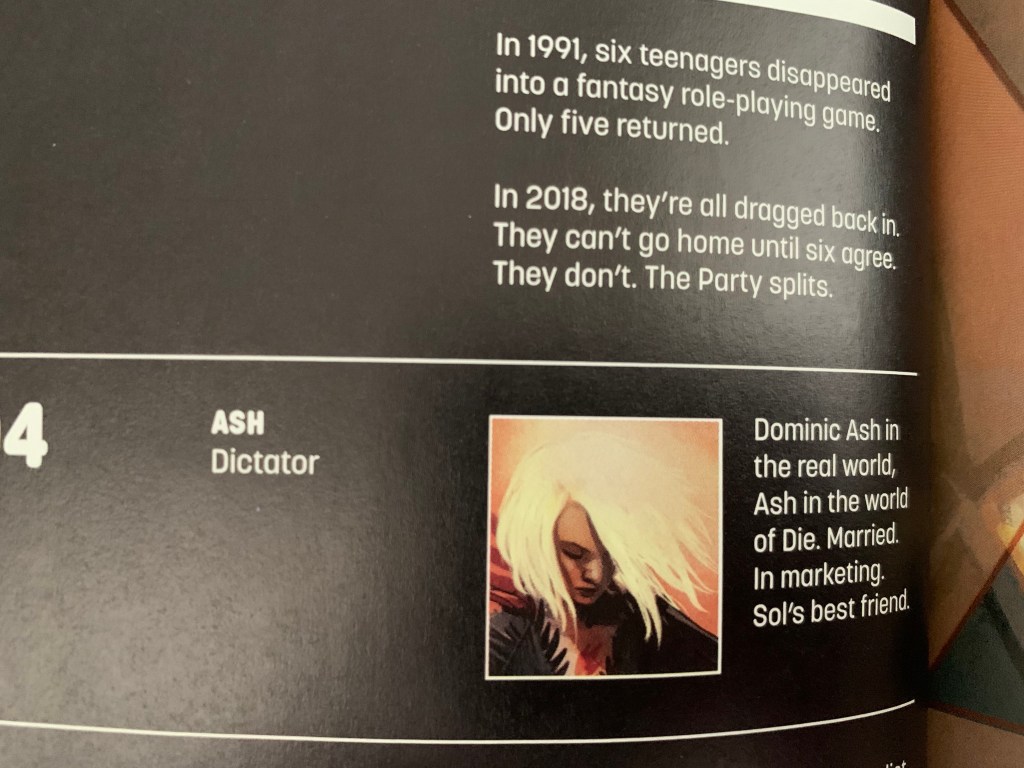
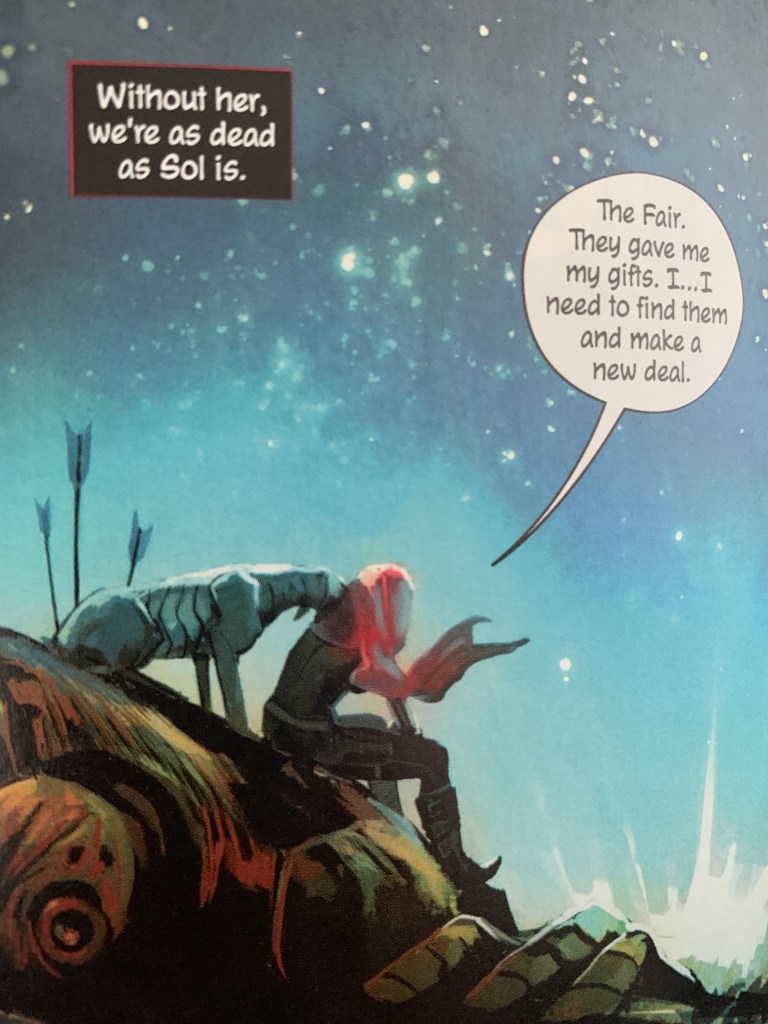
I think the character with the most potential for growth is Ash, the Dictator, who is a man in the real world, but a woman in the world of Die, and controls people’s emotions with her voice. But all of the movers and shakers in this drama have some growing to do.

Ash from “Die #2”

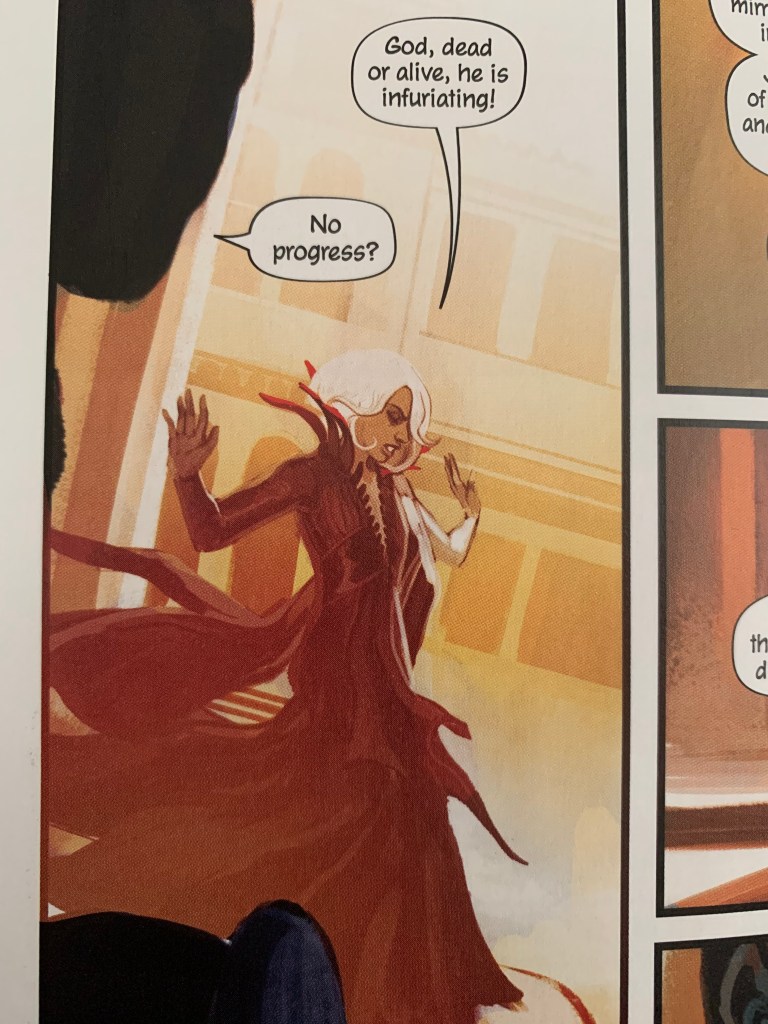
There’s Ash’s sister Angela who plays a cyberpunk named Neo. In order to power her electronics, she uses ‘fair gold’, something which readers get to learn a little more backstory about in this issue.

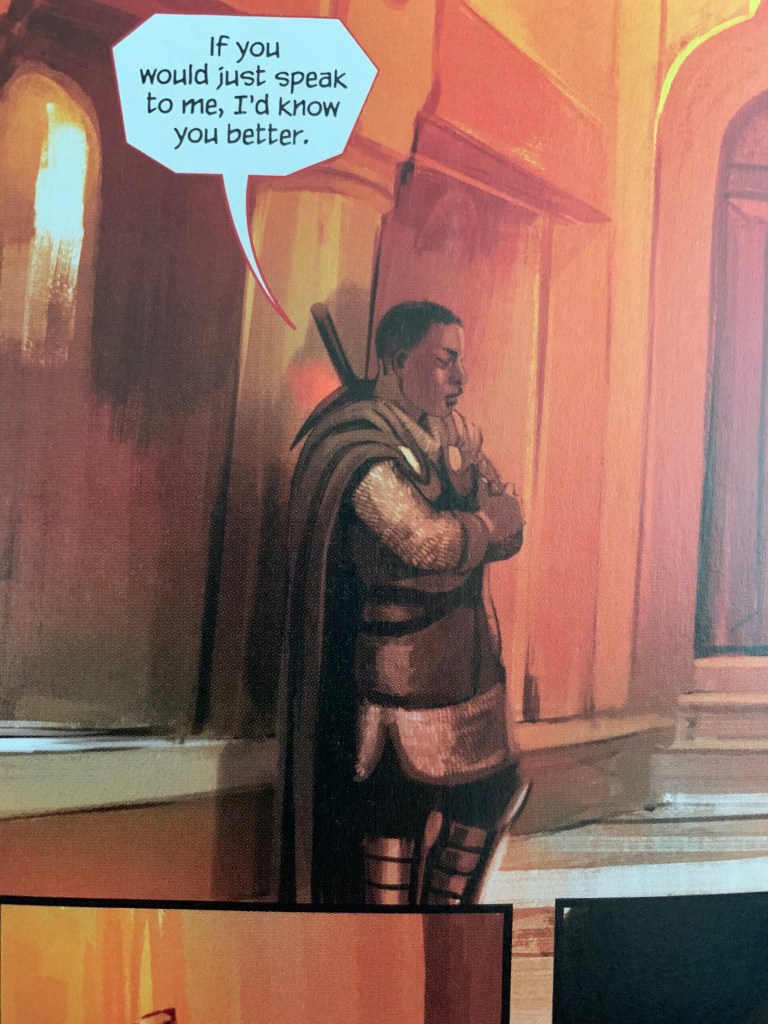
My favorite character is Matt, the Grief Knight, whose power is fueled by his depression and despair. Of everyone in this story, I’m rooting for him to get home the most because of the unshakable love and devotion he has for his family.

He’s also, I think, the most relatable of the group. Who among us hasn’t felt the sting of the pain and sadness that life occasionally dishes up and wishes for a way to harness that power for the greater good?

Matt, The Grief Knight

In this issue, readers get to learn about the origins of Matt’s magical sword, the outer representation of that inner voice that whispers to him about his failings and secret anxieties.

We also brush on the mysteries of Sol’s resurrection, Chuck’s astounding conflict avoidance and the awesome extent, as well as limitations, of Isabelle’s godbinding powers.

Neo the Cyberpunk from “Die #2”

I’m interested to see where the story goes next. Highly recommended for readers who enjoy fantasy and horror-tinged graphic novels.

Thanks for reading!

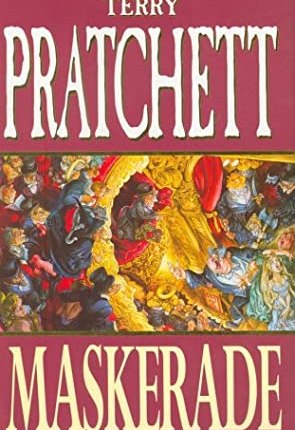
Maskerade (Discworld, #18; Witches #5) by Terry Pratchett

Maskerade (Discworld, #18; Witches #5) by Terry Pratchett

“The huge, be-columned, gargoyle-haunted face of Ankh-Morpork’s Opera House was there, in front of Agnes Nitt. She stopped. At least, most of Agnes stopped. There was a lot of Agnes.” pg 9, ebook.

Photo by Jean Pierre on Pexels.com

The usually charming wit of Terry Pratchett falls flat in this entry of The Witches, a sub-series of Discworld.

Having already lampooned the general idea of ‘theater’ in Wyrd Sisters, Pratchett takes a crack at ‘musical theater’, specifically The Phantom of the Opera. Besides the addition of the witches to the mix, the main gag is that Agnes Nitt is fat.

It’s not a story that has aged well.

“Agnes was, Nanny considered, quite good-looking in an expansive kind of way; she was a fine figure of typical young Lancre womanhood. This meant she was approximately two womanhoods from anywhere else.” pg 21

Agnes is not the only person in the story with weight concerns, the other being one of the lead singers in the opera, a male. But Agnes, despite her obvious talents, is forced to sing in the chorus, providing the voice for a willowy female who looks the part.

Photo by Pixabay on Pexels.com

All of this is just a backdrop for the larger story which is basically that Granny Weatherwax is bored and Nanny Ogg is afraid if they don’t find another member for their coven, then Granny will turn to the dark side.

Which no one wants, obviously. Because Granny Weatherwax is one of the greatest of her age in headology and general witchy works, which vary greatly depending upon the circumstances.

And it brings the readers back around to the concern that I addressed in earlier books about Magrat (the witch they’re looking to replace) being bullied by the other older witches in the coven. In Maskerade, they’re just looking for a new punching bag.

Photo by cottonbro on Pexels.com

The one bright spot in the story was Greebo, slinking around in his predatory human form. I love how he talks to people, elongating his R’s and adopting a general attitude of slightly aggressive insouciance, something which I imagine cats would do, if forced to speak English.

But beyond that, for whatever reason, this entry in the series didn’t hit the spot for me.

Here’s hoping the next is better.

Thanks for reading!

Lord Marksman and Vanadis Vol. 01 by Tsukasa Kawaguchi

Lord Marksman and Vanadis Vol. 01 by Tsukasa Kawaguchi

“I have a homeland to return to and protect. I inherited Alsace from my father. Abandoning it is out of the question.”

Warring factions lead to the capture of Tigrevurmud Vorn, the young count of Alsace by Eleonora Viltaria, a war maiden, one of many, chosen by a powerful dragon king and given a magical weapon to help her succeed in battle.

Eleonora has offered to return Tigre to his home, but first his people must pay a huge ransom, which they can’t afford.

Meanwhile, another powerful leader is preparing to take advantage of Tigre’s absence to ravage Alsace.

What will happen next? Pick up volume 2 to find out.

Photo by Daria Sannikova on Pexels.com

Which I’m not sure I want to do. Having not read a manga series before, I didn’t realize that some cater to particular audiences and preferences. This one, I have since discovered, is classified as “seinen” and recommended for adults (men, says the wiki) between the ages of 18 and 45.

I inadvertently discovered the classification when I turned to a page containing a balloon-chested young woman nearly nude except for a tiny hand towel.

In another, there’s a cantankerous maid in Eleonora’s palace whom is given a teddy bear to sweeten her mood. After admiring the cute cartoon of the teddy bear, I realized that readers could see up the young woman’s skirt.

Photo by Henry & Co. on Pexels.com

I prefer to read manga for the story and not semi-naked cartoon figures. But, if that’s your thing, this fantasy series might be of interest. It is an art form, after all.

As for the story, I was particularly intrigued by the war maiden and dragon part, which volume one didn’t really have time to get into between the introductions to the various characters and the naked scenes. Which, in my opinion, is a shame.

Recommended for adult readers only.

Thanks for reading!

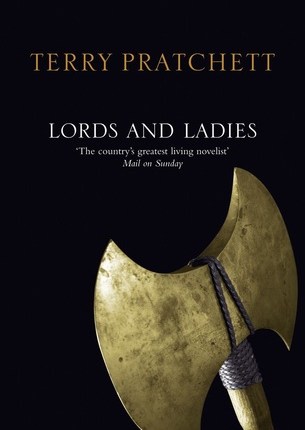
Lords and Ladies (Discworld, #14; Witches #4) by Terry Pratchett

Lords and Ladies (Discworld, #14; Witches #4) by Terry Pratchett

Granny Weatherwax set about finding out what had been happening around the stones in her own distinctive way.” pg 46

Headology, humor and elves are the focus of Lords and Ladies, the fourth entry in The Witches series of Discworld books.

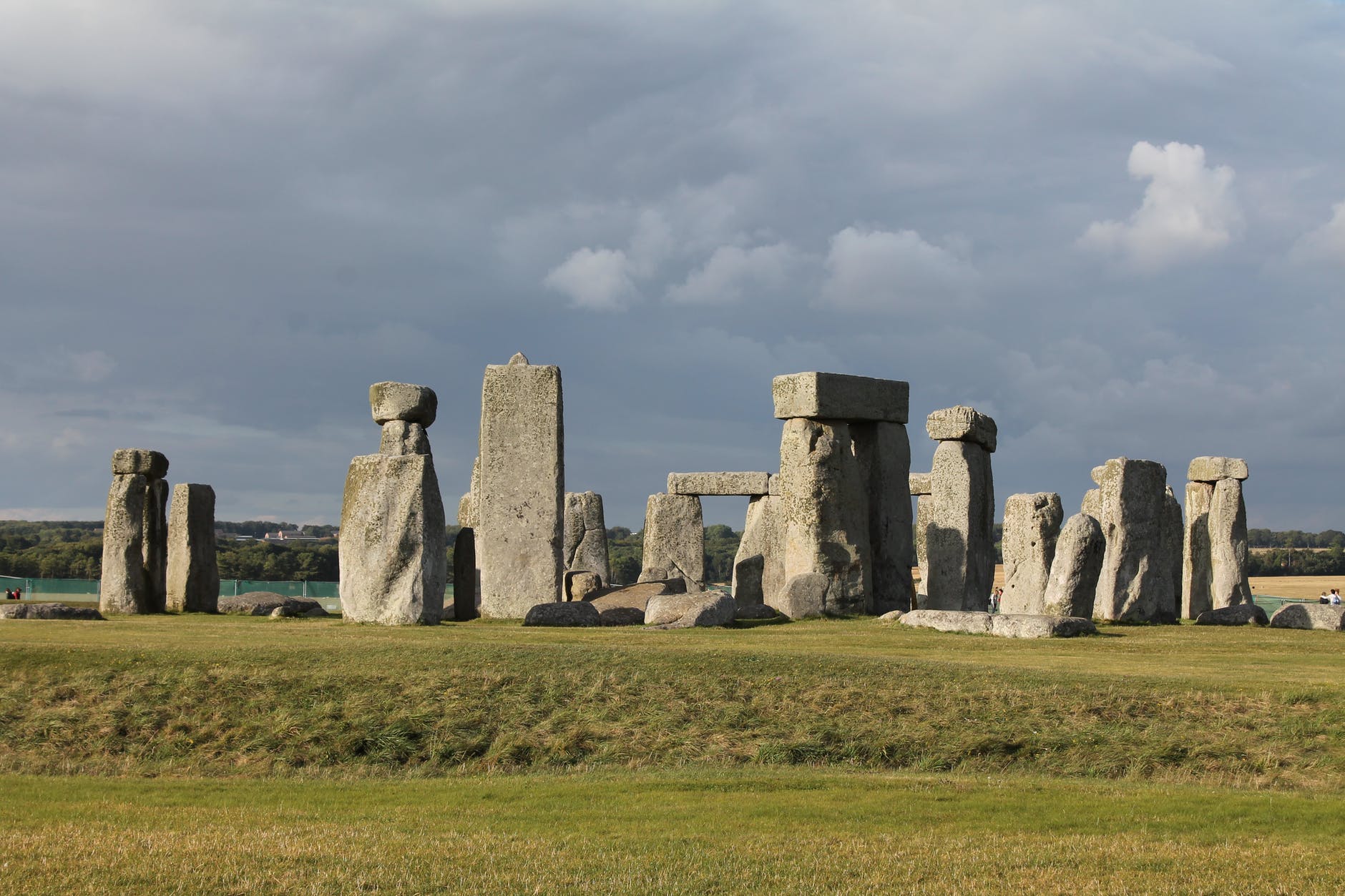
A ring of ancient stones sits in the mountains above Lancre. They were erected so many years ago that no one remembers why they were put up in the first place. No one, that is, except the witches.

Photo by Kris Schulze on Pexels.com

Granny Weatherwax, Nanny Ogg and Magrat have returned from their long journey to install Magrat as a short-term fairy godmother and to free a distant city from the tyranny of stories- a far more dangerous trip than any of them realized it would be.

Upon their return, Verence, the recently crowned king of Lancre, announces his intention to wed Magrat. While the preparations are taking place, something dangerous and cold is pushing its way into Discworld through the stones upon the hill.

“You know,” she said. “The Fair Folk. The Gentry. The Shining Ones. The Star People. You know.” pg 53

Too bad the elves are nothing like what people remember in the fairy tales.

Terry Pratchett takes a completely different view of the elves than any other fantasy author I’ve ever read. Their beauty and glamor hides a viciousness that makes them terrifying rather than enchanting.

Photo by Pixabay on Pexels.com

The three witches face the danger in their own unique way- a charming combination of psychology and common sense.

Unlike the last book where I felt that Magrat was disparaged and bullied, I feel like she comes into her own in Lords and Ladies.

“If you fought an elf and lost… then, if you were lucky, you would die.” pg 169

Photo by Pixabay on Pexels.com

We get to learn more about Granny Weatherwax’s mysterious past as well as Nanny Ogg’s capacity to fascinate a certain amorous dwarf.

Overall, I think it is one of Pratchett’s best. At least, that’s what I believe so far. We’ve reached the end of the Discworld books that I read eight years ago, so perhaps there are some gems waiting in my future.

I’ll let you all know. 🙂

Highly recommended for fans of fantasy and British humor.

Thanks for reading!

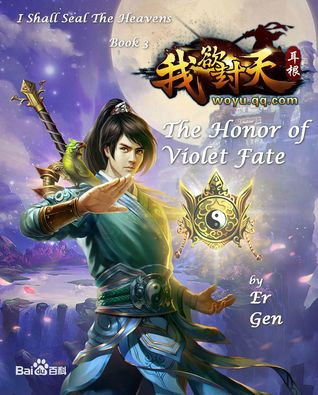
The Honor of Violet Fate (I Shall Seal the Heavens, #3) by Er Gen

The Honor of Violet Fate (I Shall Seal the Heavens, #3) by Er Gen

“His name is Meng Hao,” said Bai Yunlai quietly. “Have you heard of him? Recently, everybody in the Southern Domain has been talking about him.”

Photo by Manuel Joseph on Pexels.com

In The Honor of Violet Fate, former scholar turned cultivator Meng Hao continues his efforts to become one of the most powerful magic users of his era.

He has made the decision to learn alchemy because of the unfortunate ingestion of a highly toxic magical plant which is slowly killing him. If he can learn everything there is to know about how to create medicinal pills, maybe he can concoct a cure before it’s too late.

Every cultivator knows the most talented alchemists can be found in the highly selective and secretive Violet Fate Sect.

“His true goal in joining the Violet Fate Sect was to become a novitiate of Grandmaster Pill Demon and study the most powerful Dao of alchemy in the entire Southern Domain. Then he would create his own branch of alchemic arts.”

Photo by Sharon McCutcheon on Pexels.com

The concerns I had in the last two books were mitigated somewhat in this entry in the series because of the introduction of alchemy to Meng Hao’s cultivation. He finally has some time to stay in one place and have a break from continual attacks from other magic users, which had a lot to do with the repetitious nature of the other books.

That’s not to say that there isn’t some monotony. It may be due to translation issues, but some phrases are used over and over again. It reminds me of passages from Homer or other stories that were originally transmitted through live storytellers. I imagine that if you read this story aloud, it might have a hypnotic quality to it through the repetition.

But I wasn’t reading aloud and it doesn’t really work.

“It felt like being slapped across the face, like having a dagger plunged into his chest. As an alchemist, all of it was a direct attack on him.”

Photo by Pixabay on Pexels.com

It’s still annoying that all of the women in this world are in love with Meng Hoa like in the previous books. However, there seems to be a major love interest developing and the passages where they interact are actually quite touching.

“She wasn’t sure when it had happened, but Meng Hao’s figure had at some point become deeply ingrained into her; he was now a part of her very heart, a part that would never leave her.”

The romantic in me likes that very much.

The more I read I Shall Seal the Heavens, the more I realize that I am not the intended audience. This fantasy is more about spiritual cultivation and competition, than the relationships between the characters or character development. The fighting and acquisition of magical items is more important than the embodiment of spiritual virtues or enlightenment.

But even knowing all of that, I still want to know what Meng Hoa is going to get up to next. So I’m going to press on!

Only recommended for fans of the genre, wuxia.

Thanks for reading!

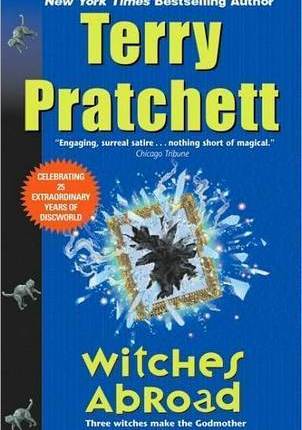
Witches Abroad (Discworld, #12; Witches #3) by Terry Pratchett

Witches Abroad (Discworld, #12; Witches #3) by Terry Pratchett

When Magrat is designated as the next Fairy Godmother (a legacy from her mentor), Granny Weatherwax and Nanny Ogg feel compelled to help her straighten out the troubles of her new fairy goddaughter.

“I don’t trust that wand,” said Granny. “I looks wizardly to me.” “Oh, come on,” said Magrat, “generations of fairy godmothers have used it.” pg 47

Photo by Ksenia Chernaya on Pexels.com

Unfortunately, the city where this young woman resides is quite far away. That means a roadtrip- something that some of the witches tolerate better than others.

Complicating matters is the fact that Fairy Godmothers always come in pairs, a good one and a bad one. We all know that Magrat is good so…

The other Godmother works her magic through the power of stories. She may have some unique ideas about what constitutes a happy ending.

“People think that stories are shaped by people. In fact, it’s the other way around. Stories exist independently of their players. If you know that, the knowledge is power.” pg 8

Photo by Suzy Hazelwood on Pexels.com

Terry Pratchett has crafted three unforgettable characters in the witches. Their traveling, as well as evil-fighting, hijinks are amusing, like in the previous entries in this series.

But let’s talk about Magrat for a minute.

“Magrat would be the first to admit that she had an open mind. It was as open as a field, as open as the sky. No mind could be more open without special surgical implements.” pg 28

Though he’s writing it humorously, the elder witches constantly bully Magrat not only for her youth but also for her progressive ideas about what witchcraft should be. In addition, her open-mindedness makes her a target for derision.

Despite her efforts to look mysterious through the use of various pieces of “occult” jewelry, Magrat is teased by other characters (and the narrator) for her funny hair and ridiculous appearance.

It makes me want to reach through the pages and say, just lay off her already, people. She’s trying to do the best she can with what she has, where she’s at. Can’t say the same for everyone else here.

Photo by Valeriia Miller on Pexels.com

“There’s nothing wrong with happy endings,” said Magrat hotly. “Listen, happy endings is fine if they turn out happy,” said Granny, glaring at the sky. “But you can’t make ’em for other people…” pg 103

The denigration of Magrat makes me view the other characters negatively. Because, even though Granny and Nanny are considered experts in witchcraft as well as wise (in their respective spheres), I don’t think they’re worthy of respect from others when they treat their young colleague like garbage.

I’m not sure why this dynamic between the witches is bothering me more on the second read-through than it did the first, which was eight or so years ago. But it does.

I still consider Witches Abroad an excellent read when I look past the treatment-of-Magrat issues. Highly recommended for readers who enjoy humorous fantasy.

Thanks for reading!

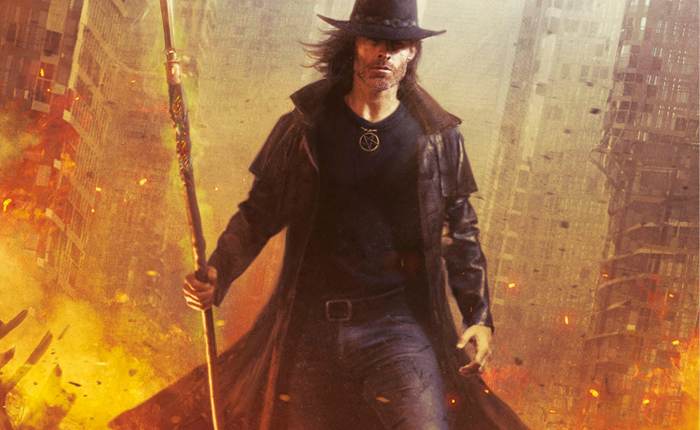
Battle Ground (The Dresden Files, #17) by Jim Butcher

Battle Ground (The Dresden Files, #17) by Jim Butcher

I saw her study my face and then ask, “How bad does it have to be for you not to be making jokes?” pg 3

The last book in the series, Peace Talks, set up the epic battle for Chicago between the wizard Harry Dresden and his various allies against a relic of the old world and her vassals.

Jim Butcher delivers that battle in a very major way in Battle Ground.

“I hadn’t even seen what was coming for Chicago, and I was already bloodied and exhausted. This was going to be a long night.” pg 17

Photo by Alex Powell on Pexels.com

As per usual, Butcher is heavy on the puns and pop culture references, but I thought he did a fantastic job with this installment. Long-time readers of the series get to enjoy scenes from characters who haven’t made an appearance for awhile.

There are also some serious consequences from this book which, I thought, would have made an epic conclusion to the whole thing. However, Butcher teases more to come at the end of the novel, so I suppose it will continue.

“But whatever happened, after tonight there would be walls coming down between the mortal world and the supernatural one that had stood solidly for centuries. Stars and stones, I didn’t think anyone knew what that might mean.” pg 72

Photo by Laker on Pexels.com

Which I’m not opposed to. You’d think I’d be sick of Harry Dresden and his constant, and ever increasingly powerful, problems. But I’m not. I enjoy this urban fantasy series very much.

Part of that is because of the writing and the characters. Despite the fantasy setting, Butcher manages to make everybody feel very real. I like to imagine that if magic were real, that it would function similarly to how Butcher has crafted it in his books.

The other reason I probably enjoy it so much is because I’m a big nerd. Whenever Harry gets into a bind and makes a cheesy joke to relieve his tension, I always get the feeling that I’d do something similarly silly. When the end of the world is staring you in the face, what else is there to do but smile?

Photo by Matheus Bertelli on Pexels.com

Battle Ground is a must-read for fans of the series. If you haven’t read any of the other books yet, please do yourself a favor and start from the beginning.

Thanks for reading!