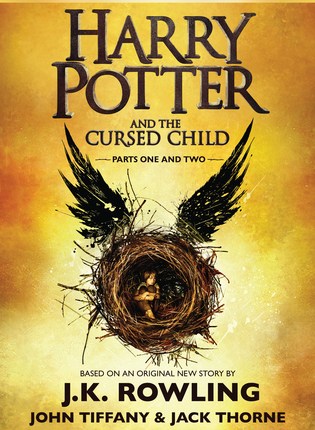
Harry Potter and the Cursed Child by J.K. Rowling, John Tiffany, Jack Thorne

Harry Potter and the Cursed Child by J.K. Rowling, John Tiffany, Jack Thorne

There are spoilers further on in this review.  Please, dear readers, do not read this if you haven’t had a chance to read the book yet.  Thank you 🙂

I had a disagreement with my husband about this book. He’s of the opinion that J.K. Rowling said she wasn’t going to write anymore Harry Potter stuff and that she should just let the seven books remain as they are- like a magnum opus. He was irritated that, with the film coming out in November, and this play being performed, and that new set of Pottermore stories that are being published, it seems like Rowling is just out for more money.

I, on the other hand, just kept saying, “But, it’s Harry Potter!” “But, it’s her creation and she should do whatever the heck she wants with it!” “But, it’s Harry Potter!” Neither of us convinced the other, so I just gave up trying to talk him into reading it and read it myself. I read it through in one sitting and cried and just adored it.

It’s funny- I’d never read a play before and this year I’ve read two, Hamilton: The Revolution and now this. I thought that it’d be annoying with the character listings and stage directions, but, as you read, all of that melts away and you’re just left enjoying the story.

And what a story it is! ***If you have not read it, do not read past this point. I have to talk about things that may ruin your enjoyment of the story and you do not want that. Here’s your warning. You’ve been warned. Seriously. Do yourself a favor and stop now!!!***

Ok. Who else thought that Ron was written like a complete moron in this? I mean, I know he wasn’t the brightest crayon in the box, but come on! He’s bumbling around, constantly eating… at least in the other books, he had moments of brilliance. I was completely let down by the way his character was developed. But, that is really my only complaint in the whole thing.

Hermione continues to be awesome in all the timelines- as it should be. She was always my favorite. I don’t know if it is because she’s a girl, or reads a lot, or both those things, or what. Minister of Magic? Of course! We all knew that she was going straight to the top.

Now Harry… he had Ginny have an interesting relationship. I thought that there’d be more affection and less judgement between the two of them, but maybe that was just me reading between the lines. Also, who else was relieved that Harry finally had a moment to confront Dumbledore and say, totally paraphrasing, “What the heck! I was a kid and you knew all of these terrible things were going to happen, that I’d probably have to die, and you didn’t say a thing! That was not your best moment.” I think we’ve all thought that.

So… FINALLY! It was quite a release. And then, that moment, when he’s there for the death of his parents as an adult- totally understanding what was going down but unable to change it because it would ruin the timeline forever? Oh my gosh, you guys. I don’t cry when I read, but this one had me sobbing. It was so poignant and heartbreaking…

Also, in the alternate timeline when Snape was still alive… aaaaaah! Loved it.

Let me put some of my favorite quotes in here and end this review. I could gush for pages if you let me.

GINNY: “People always look when you three are together. And apart. People always look at you.” pg 14, ebook. Can you imagine having that kind of notoriety? I guess a real world equivalent would be if you were a Kardashian or something… ugh.

DRACO: “I don’t care what you did or who you saved, you are a constant curse on my family, Harry Potter.” pg 58, ebook. Who else missed Draco? Raise your hands, friends…

SCORPIUS: “I, uh, I opened a book. Something which has- in all my years on this planet- never been a particularly dangerous activity. … DELPHI: “She’s weaponized it. She’s weaponized her library.” pg 63, ebook. Good old, Hermione. Fighting back with books.

I’ll leave you with the wisdom of Dumbledore: “Harry, there is never a perfect answer in this messy, emotional world. Perfection is beyond the reach of humankind, beyond the reach of magic. In every shining moment of happiness is that drop of poison: the knowledge that pain will come again. Be honest to those you love, show your pain. To suffer is as human as to breathe. … Those that we love never truly leave us, Harry. There are things that death cannot touch. Paint.. and memory.. and love.” pg 185 & 186 ebook.

Now to see the play performed! If you loved the original series, you will probably get a huge kick out of this. Recommended for ages 10+ or younger, if they can handle some intense magical sequences.

Thank you for reading!

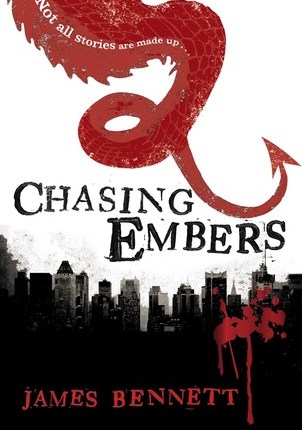
Chasing Embers by James Bennett

Chasing Embers by James Bennett

I seem to be on a dragon themed reading kick lately. And, as far as I’m concerned, that’s awesome!

Red Ben is a dragon, masquerading in human form so that he can walk down the street without everybody freaking out. Hundreds of years before this, he signed a pact called the Lore with a bunch of other magical creatures and knights, in which, he essentially agreed to hide his existence from humanity at large and the knights, in turn, would protect him. Tonight, he was attacked twice. What’s up with that? Ben doesn’t know, but he’s going to find out. He’s also had a falling out with his lady fair. Hiding your true nature from someone doesn’t make for a healthy relationship, but Ben’s enemies seem to know Rose’s (the girlfriend) name. So, now, he has to save his hide, her life, and still preserve the Lore.

Meanwhile, in a desert in Africa, an ancient power is awakening…

I enjoyed Chasing Embers. I really dig the basic premise that there’s a magical world existing alongside ours but we just can’t perceive it. Also, the idea that the Magna Carta wasn’t a political document but a secret, magical pact is fun too.“John, by the grace of God, King of England, Lord of Ireland, Duke of Normandy and Aquitaine and Count of Anjou, doth decree and grant this day, by common counsel of our kingdom, this Pact devised by the Curia Occultus and witnessed by those guardians of our realm. Those Remnants of the Old Lands, which yet linger amongst us, shall forthwith succumb to the Long Sleep…” loc 362, ebook.

The other magical creatures are straight up creepy- like magical creatures should be in my opinion. Also, Bennett seems to ascribe to the Terry Pratchett view that too much magic use thins the veil between worlds and draws attention of the things outside of this world to the magic user, which is also pretty creepy: “The nether wasn’t space, nor the ambient cosmos, but a place that lay beyond, or between, as inner as it was outer. Perhaps it was the raw, empyreal stuff of creation, for all Ben knew. Things lurked in that astral sea, creatures hungry for life, and all magic had its price. When a person drew on the nether- drew on it like a thread in a carpet- they risked unravelling the world entire.” loc 393, ebook.

The romance between Ben and Rose is just the perfect amounts of dysfunction and sparks (nothing graphic in here though for folks who look for such things): “I miss you,” she said, quiet and fierce. “I hate you.” Defeated, Ben rested his head on her shoulder, smoothing down the flowers on her dress. He let her anger hit him like a wave, tasting her muted fury at her love for him. Since he’d first crawled out of his egg, it had always been this way. Some women went for the knight. Others wanted the beast. Neither stood a chance of a happy ending.” loc 711, ebook.

Ben’s angst at his long-lived existence reminded me of Atticus in The Iron Druid Chronicles. He loves deeply but, at the same time, he realizes that those he loves aren’t going to be around that long: “Your love of humans. Do you never grow tired of it? You might as well love a sunbeam that flickers through a cloud. This world was not meant to hold them. Time will take them all so quickly. A blink in the life of a god.” loc 3112, ebook.

What kept Chasing Embers from being a five star read to me is that I thought Bennett explained himself too much. Leave some of the plot mysterious and murky, like magic itself. I don’t need to be spoon-fed why this happened or that happened. Otherwise, this was an excellent read. There’s some language in here and a few disturbing, physical descriptions, but nothing that a mature teen couldn’t handle. Highly recommended for urban fantasy and dragon readers!

Some read alikes: Hounded by Kevin Hearne or Lords and Ladies by Terry Pratchett.

A big thank you to NetGalley and Orbit books for a free, digital advanced reader’s copy of this book for review purposes.  And, thank you for reading!

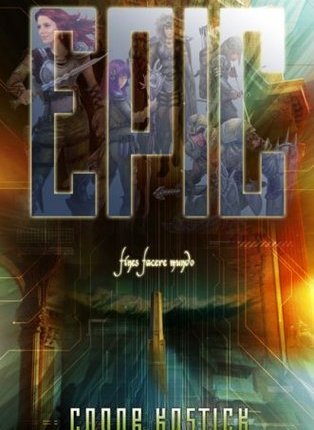
Epic by Conor Kostick

Epic by Conor Kostick

Perfect for fans of Ready Player One or anyone who has ever enjoyed playing an MMORPG. Erik, a young boy in a futuristic society, tires of scrabbling for his day-to-day existence in real life and in a virtual world, where all wealth and legal issues are decided by combat in a game called Epic. Almost everyone in Erik’s society kills kobalds and other low level monsters every day, to gather pennies to improve their online characters and, therefore, their society. After dying, yet again, and crushing his family’s hopes for his advancement in Epic, Erik creates a ridiculously attractive female character and puts all of his points into beauty, a skill that no one else ever considers because it is a useless stat from a fighter’s standpoint. What happens next is an exciting adventure through virtual worlds with magic, monsters, swords, and sorcery… who will triumph? Erik and his friends or the all-powerful Central Allocations team or the game, itself?

Erik’s creation of Cindella (his avatar): “Serious gamers, and the whole world consisted of serious gamers, never wasted a point on beauty that could be spent on more practical attributes, or combat skills, craft skills, weapons, magic items and spells. As a result, Epic’s population of players consisted entirely of dull, gray-looking humanoids. His friends were in for a shock; it would be impossible to explain his choices to them, as there was no rational argument in favor of throwing away every practical advantage in favor of beauty.” pg 15

The power of beauty: “While they made their way through the flapping canvas and rope of the market stalls, Bjorn noticed something unusual. The NPCs were not stationary; their heads were turning towards the two players. “Erik, look at the merchants.” “Hmmm. That’s odd.” Erik’s character made the actions that arose from the wave+smile command. A nearby seller of herbs smiled and waved back. “You try.” Bjorn had his big warrior wave. Nothing. “They like me!” pg 27

Librarians play a huge part in this story, which of course I LOVED: “Son, your story of Cindella and the pirate treasure is exciting. But you need to obtain more information.” “I know.” “Hope has a library. Where all the information ever learned about Epic has been stored. It is our right to be able to consult that information. So we are going to pay the librarian a visit.” pg 36

The villain in this book is just awful: “… the illicit thrill of being a player-killer was something that could not be understood with logic. Nor could logic explain the pattern of his killings. Curiously it was not the stronger looking players that attracted his attention- and if there was any justification for the deaths of players it was to eliminate possible threats to the Central Allocations team. No, it was the slightly heartrending players, with their one weapon and tiny pieces of armor, which drew his attention. There was something bewitchingly naive and tender about them, spending their spare time killing kobolds and orcs for pennies, saving assiduously and slowly. And so he rode them down, bringing their struggle up the ladder of Epic to an abrupt end.” pg 60 Haters gonna hate.

Doing the impossible… dragon slaying! : “I agree with Bjorn,” Sigrid interjected. “Farmers’ children just don’t kill dragons. Nobody kills dragons these days. But if they did, it would be the people in Mikelgard, with all their magic and expensive gear.” “But nobody even thinks about fighting dragons anymore.” Injeborg spoke up. Erik had known that he could count on her. “Only our Erik. That’s why he has seen something that they have missed.” She turned to her brother, “Come on, Bjorn. Let’s try it.” “No, it’s hopeless.” Injeborg stamped her foot in frustration. “You are always waiting for something to happen to you. But that’s not how life is.” pg 85

Big dreams: “Tell me,” said Injeborg. “Everyone, what is it that you would like from life?” She turned to look at Sigrid. “I would like to be allocated a small farm, somewhere near here.” “Bjorn?” “I would like the same.” “B.E.?” Slightly embarrassed, B.E. laughed, and then said, “I would like to be a successful Epic player, like Svein Redbeard.” “Erik?” “I would like nothing better than to be a librarian.” pg 89 🙂

A new way to play the game: “Wouldn’t it be wonderful if the game didn’t matter, other than to play it? We could explore snowy mountains, spectacular caverns, and remote desert civilizations. To journey just for the pleasure of the adventures would be something…” She paused. “Only now do I understand why this game was invented.” pg 192 A good metaphor for life, I think.

Thanks for reading!

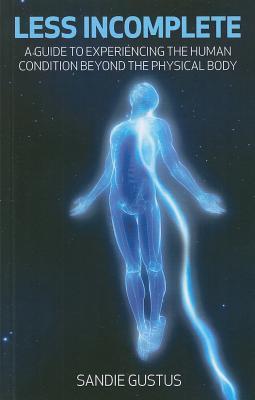
Less Incomplete: A Guide to Experiencing the Human Condition Beyond the Physical Body by Sandie Gustus

Less Incomplete: A Guide to Experiencing the Human Condition Beyond the Physical Body by Sandie Gustus

Like Journeys Out of the Body by Robert Monroe, Less Incomplete is about out-of-body experiences and how to have them.

Unlike Monroe’s book, there’s less personal narrative in this one and more about ethics and practical exercises for the out-of-body state.

So, in that way, it wasn’t as fun to read, but for people who are just starting out, I could see this book being an excellent place to start. I had never heard of Dr. Vieira and his work with the IAC (International Academy of Consciousness), so now, I have another resource to investigate too. Hooray!

Sandie’s reasons for writing the book: “…Vieira’s own books are notoriously sophisticated, technical and intellectual in style… My endeavor, with this book, is to make his work available to a wider nonacademic audience by presenting it in a language and format that everyone can understand follow, without compromising the integrity of his ideas in any way.” pgs 14-15

I feel like she really succeeded at that.

Photo by Cup of Couple on Pexels.com

A simple explanation of other dimensions: “… when thinking about where the extraphysical dimensions are, we can say that many of them coexist and share space with the physical dimension. They are all around us. They are right here, right now. This fact is much easier to understand when we remember that we are also sharing space with innumerable invisible artificial electromagnetic waves, such as those used to broadcast television and radio and to transmit data across mobile phone networks and between aircraft and military installations.” pg 39

Other dimensions sound so normal when she puts it that way.

Sandie stresses the importance of exploring consciousness for evolutionary reasons: “If we take into account the broader, more detailed picture of what it means to be a consciousness… it is clear that physical life, rather than being meaningless or arbitrary, provides us with a sophisticated, challenging environment that is rich in opportunities to better ourselves and to mature- in other words, to evolve.” pg 162

I think it’s fun too.

Consciousness exploration is a chance to evolve, certainly, but it’s also a way to play, explore, and simply exist in a way that is entirely different from regular reality. That’s my only criticism of this book, I feel like it takes itself too seriously at times.

Photo by Felix Mittermeier on Pexels.com

I was having trouble fitting my visions/meditations into the paradigm provided by this book until the chapter on Lucid Projection Techniques, section Projection through the Mental Body Technique: “Targets for a projection in the mental body are notional concepts that are outside the boundaries of ordinary life. The point of them is to break out of the boundaries of what’s known. The experience is epitomized by having an epiphany- suddenly you consider the concept of infinity or spirituality or oneness and you have an expansion of consciousness in which you grasp the whole idea. pg 254 Bingo.

Vieira doesn’t seem to have a high opinion of remote viewing: “Vieira describes it in Projectiology as “a daydream with some flashes of awareness or clairvoyance at a distance.” pg 270

I was surprised by that. It seems like, in this sort of research, one would want to consider all modalities for their possible contributions to the topic.

If you’re looking for more books on how to do out-of-body experiences, you may want to consider Soul Flight: Astral Projection & the Magical Universe by Donald Tyson, Soul Traveler: A Guide to Out-of-Body Experiences and the Wonders Beyond by Albert Taylor, and, one of my favorites, Otherwhere: A Field Guide to Nonphysical Reality for the Out-of-Body Traveler by Kurt Leland.

Thanks for reading!

Railsea by China Miéville

Railsea by China Miéville

“This is the story of a bloodstained boy.” That’s the first line of this strange and fantastical tale of giant creatures that “swim” in the earth’s soil and the brave and flawed “molers” who chase them for profit and life purpose. Miéville has created a dystopian world covered in railway ties with skies poisoned by chemicals and filled with monstrous, alien creatures who feast on those who get too close. But, there may just be something beyond the rails, if the characters in this story are determined and lucky enough to see their way through to the end of the world… Though based off of the tale of Moby Dick, Railsea is an engaging adventure and coming of age story that reads like nothing else I’ve ever experienced. Miéville has blended together steampunk, dytopian, and fantasy elements to create something completely different.

Sham is a boy on the cusp of manhood who can’t quite figure out what he wants to do with his adulthood: “Sham felt sure there was something he fervently wanted to do & to which he was excellently suited. Which made the more frustrating that he could not say what it was. Too vague about his interests for further study; too cautious in company, perhaps a little bruised by less-than-stellar school days, to thrive in sales or service; too young & sluggish to excel at heavy work: Sham’s tryings-out of various candidate activities left him het up.” pg 36, ebook. Anyone who has ever been lost about what path to follow in life will be able to empathize with Sham.

Miéville’s story, like Moby Dick has layers of meaning built into it: “Edging such places is the railseaside, called the littoral zone. Those are the shorelands. Port towns, from where transport, freight & hunting trains set out. Where lighthouses light ways past rubbish reefs breaking earth. “Give me the inland or give me the open rails,” say both the railsailor & the landlubber, “only spare me the littoral-minded.” pg 51 ebook. Clever, no? A warning, if you don’t enjoy reads where the author makes up words to tell the story, you may want to skip Railsea. There’s a bunch of creative adjectives and nouns mixed up in this one.

The religions of this world were a fascinating too. I wish Miéville had explored them more: “He muttered in his head to That Apt Ohm, the great rotund boss-god, one of the few deities worshipped across the railsea, whatever the peculiarities of local pantheons. Bollons was ecumenical, granted church-licences to any deities whose worshippers could pay the fees. But the disrespectful worship of That Apt Ohm was taken more seriously there, pursued with more verve, than at most stops on the railsea. Sham had no idea quite what, if anything, he believed, but there seemed little harm in a quick silent word with one of the few gods whose name he remembered.” pg 100, ebook.

Part of the homage to Moby Dick, finding a captain’s “philosophy”: “How many of these philosophies were out there? Not every captain of the Stereggeye Lands had one, but a fair proportion grew into a close antipathy-cum-connection with one particular animal, which they came to realise or decide-to decidalise-embodied meanings, potentialities, ways of looking at the world. At a certain point, & it was hard to be exact but you knew it when you saw it, the usual cunning thinking about professional prey switched onto a new rail & became something else- a faithfulness to an animal that was now a world-view.” pg 130 ebook. What’s your white mole?

I enjoyed Railsea but I can see how this writer might not be for everyone. He uses fragmented sentences and ampersands (&) to move the story along. The chapters are incredibly short which also kept the pace rolling but it could also be viewed as making the novel choppy. Sometimes, Miéville breaks through the fourth wall and addresses the reader directly. I thought that device was charming, conjuring up images in my mind of storytellers sitting in front of the fire or at a pub. But, again, this may not work for everyone.

Some read-alikes for Railsea: Chaos Walking series by Patrick Ness or Under the Empyrean Sky by Chuck Wendig.  Thanks for reading!

Miss Jane by Brad Watson

Miss Jane by Brad Watson

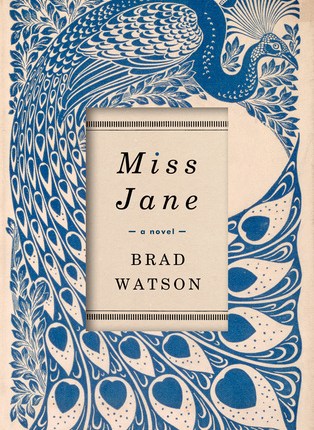
Confession time: I picked this one up because of the cover. I do that sometimes. Who could resist that peacock? It’s an exciting method of book selection because I read novels I would have never considered otherwise and occasionally discover a gem. Miss Jane is, fortunately, one of those gems.

Miss Jane is about Jane Chisolm- an extraordinary girl born in the deep South in the early 19th century with a physical deformity so extreme that she can never have children or even control her bowels. Though Jane struggles with her handicap, it doesn’t define her and she manages to have a beautiful and meaningful life in an otherwise hardscrabble, country existence. Jane’s father is an alcoholic, brewing his own stuff during prohibition, and her mother is deeply unhappy with their relationship, her life, and the world. Jane’s sister, Grace, just wants out of her childhood home and will do anything to achieve that goal. Jane’s doctor, Dr. Thompson, delivers Jane into the world and then spends the rest of his life trying to help her improve the quality of her existence and to also educate the medical community about her condition (there was very little information on it at the time). Miss Jane is based on one of Brad Watson’s actual relatives and I found it to be a fascinating study of not only the South at the turn of the century, but also how poor farming communities handled day-to-day drudgery, poor prospects, and major differences of mind and body.

The farm and nature portions of the story read a lot like a southern, more adult version of Laura Ingalls Wilder’s books, which I’ve always loved, so I guess it’s no huge surprise that I enjoyed this as well. I also loved the way that he wrote about dogs on the farm. Here’s Mr. Chisolm and his hound:“You got the face of bored sadness,” he said to the dog. The dog didn’t take umbrage. Came over beside his left foot and plopped down with a heavy sigh as if he were the one going through all the trouble on this evening.” pg 16 ebook. The peacock from the cover makes an appearance in the story as well, but that has a lot to do with Jane’s condition and I’ll let Watson tell you that detail in his own, lovely way.

Here’s Dr. Thompson, trying to understand the attitudes of the country folk he treats: “Sometimes he was astonished how often he forgot people’s cruel ignorance, people who’d never been anywhere but the little hamlets where they were born, raised, and would die. Not that he hadn’t known plenty of so-called sophisticated people with the same attitude.” pg 39 ebook. Dr. Thompson is a complicated character. He’s highly educated and open minded, but prone to indulging in vices like Mr. Chisolm’s homemade alcohol and prostitutes. Dr. Thompson sees the worst of those he treats- the abuse and neglect- but also their sacrifices and loves. At first, it seems that he only cares for Jane as a medical oddity, but as the story progresses, he comes to love her as a father figure.

In some ways, the isolated world that Jane grew up in was perfect for her. Take the description of her grade school: “It was a small school that took the community children all the way from first grade to high school graduation, and there were not many enrolled, so the environment was relatively intimate, like some great, overgrown family, in a way. The children seemed to know and understand one another like siblings, whether lovingly, or with hostility, or with the purposeful ignoring of this one or that.” pg 58 ebook. That’s the positive and negative of growing up in a small town- that everyone knows everyone else’s business.

Jane’s struggle to fit in is written very beautifully by Watson: “She’d never put a word to the sadness she could sometimes feel, especially in the last couple of years, that would linger at the edge of her thoughts like the invisible ghost of someone she thought she recognized but didn’t know who it was, some kind of familiar she couldn’t quite grasp.” pg 127 ebook

Or this: “She stayed so busy and tired that it seemed like time didn’t matter anymore. Didn’t so much pass as disappear, like memories neglected and forgotten. Years can slip away in such a manner, in such a life.” pg 156 ebook.

A read-alike for Miss Jane: Bull Mountain by Brian Panowich, a story about a family in the deep south but much more violent and with drugs.

Thanks for reading!

You’re Never Weird on the Internet (Almost) by Felicia Day

You’re Never Weird on the Internet (Almost) by Felicia Day

“You’re Never Weird on the Internet (Almost)” is an excruciatingly honest memoir from Felicia Day about her quirky childhood, gaming addiction, cultural attitudes online, and life long struggle with anxiety and other mental health issues.

She reminded me a great deal of Jenny Lawson in her straight forward presentation of difficult topics and also in her exuberant storytelling style. And, in many other ways, she reminded me of myself.

Being a female gamer is hard. There, I’ve said it. Not only do your female friends not want to play video games with you, but your male friends never really accept you as a legitimate gamer. You’re kind of stuck in this twilight space of “this is what I love to do” but society doesn’t agree that it is appropriate for you to do.

Now, unlike the early days of MMORPGs, many more women play video games, and I’m sure that I’d make more female friends if I tried. But, back then in the fall of 2000, when I first got into EverQuest (one of the predecessors of WoW, the game that Felicia played), many more men played female avatars than actual women played. That’s just how it went.

Photo by picjumbo.com on Pexels.com

I loved that Felicia addressed this female gamer white elephant, so to speak. There are few people who really talk about it, but it’s something that I’ve been dealing with for a long time.

I loved her cheerful attitude, even when things got tough: “My story demonstrates that there’s no better time in history to have a dream and be able to reach an audience with your art. Or just be as weird as you want to be and not have to be ashamed.” pg 19 ebook. That’s a pretty powerful lesson and one which artists and dreamers everywhere should know.

Felicia admits that she has very few hands-on skills, something which I also have in common with her. In this passage, she’s joking about ordering coffee: “…I’m determined to enjoy the liquid indulgences of modern life. Might as well take advantage of it all before the zombie apocalypse. I have no practical skills; I’m fully aware that I’ll be one of the first ones “turned.” Instead of learning motorcycle repair or something else disaster-scenario useful, I’ll order the drink I want until I become a shambling corpse.” pg 17 ebook.

I’ve thought about my librarianship skills and book reviewing abilities in that same light. If something catastrophic happens, I’m kind of screwed.

I mean, yes, there have been favorable depictions of librarians after the apocalypse (Station Eleven comes to mind) but really, what good could I do for people struggling to survive or myself? While we’re on the topic of librarians, I also enjoyed that Felicia’s first “job” was working for her aunt, a librarian. She said about it: “No job since has left me feeling so well rewarded.” pg 67 ebook. Aww….

Photo by Pixabay on Pexels.com

Chapter Five: Quirky Addiction = Still an Addiction (How my obsessive personality steered me into a twelve-hour-a-day gaming addiction and an alt-life as a level 60 warlock named Codex) pg 85 ebook, was my favorite.

Gaming addiction is an actual thing. I’ve known multiple people who dropped out of college or lost their jobs because they couldn’t stop playing video games. I’ve also known people whose relationships started or ended because of it too. It seems silly for people who don’t have any interest in video games, but it can be as destructive an addiction and as real as anything else- drugs, sex, whatever.

Felicia nails the siren call of video games in this passage: “When we graduate from childhood into adulthood, we’re thrown into this confusing, Cthulhu-like miasma of life, filled with social and career problems, all with branching choices and no correct answers. Sometimes gaming feels like going back to that simple kid world. pg 93 ebook.

That’s it, really. Do the quest, get the reward, and repeat. Real life is never that simple or straight forward.

Though she felt like she wasted a lot of time, Felicia managed to break free of her addiction and channel her passion into the hugely successfully series: The Guild. I had never watched it, but after reading this book, I binge-watched every episode. She managed to take the culture, friendships, and craziness that is online gaming and turned it into a compulsively view-able series. I loved it.

If you haven’t had a chance to watch it yourself, I highly recommend it. One of the overarching points of this book, and the television show, is that not only can you overcome hurdles that held you back from the life of your dreams, but you can use the very thing that was the stumbling block to move onwards. Well done, Felicia, very well done.

One last little bit that I wanted to include in this review, because it rang so true for me, was Felicia’s thoughts about her struggles with mental illness. She says: “I couldn’t trust my own mind anymore, which was the scariest thing I’ve ever experienced. pg 170 ebook.

When your own internal filter, your brain, is compromised, you feel like you can’t trust yourself ever again. It’s as simple and as terrifying as that and, unless you go through it yourself, there’s not really any good way to explain what’s happened to you or why you’re so afraid.

If you’ve ever had any struggles with anxiety or mental health issues, you may really enjoy this memoir. Also, if you enjoy online gaming or want to understand one of your loved ones who does, you may like this book. Some read-alikes: Nerd Do Well by Simon Pegg, Fantasy Freaks and Gaming Geeks: An Epic Quest for Reality Among Role Players, Online Gamers, and Other Dwellers of Imaginary Realms by Ethan Gilsdorf, or Just a Geek: Unflinchingly honest tales of the search for life, love, and fulfillment beyond the Starship Enterprise by Wil Wheaton.

Thanks for reading!

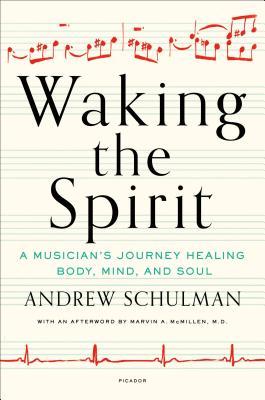
Waking the Spirit: A Musician’s Journey Healing Body, Mind, and Soul by Andrew Schulman

Waking the Spirit: A Musician’s Journey Healing Body, Mind, and Soul by Andrew Schulman
wakingspirit

Waking the Spirit is an educational and uplifting look at music therapy from a world class musician who, not only plays for a critical care unit at a hospital, but was also saved by music himself.

I’ve always known about the healing power of music for the spirit, but I didn’t realize that it had such marked effects on the body itself. When I’m having a bad day or just need to relax, I plop down in front of the piano and play the stress out.

What I did not know, and that Andrew discusses at length in this book, is that music has been used throughout history to treat sick people and the astonishingly positive effects that it has on the critically ill.

The idea behind music therapy in the ancient world is that everything is vibration.

If you play harmonious and balanced music, the human body will, in turn, put itself into harmony and alignment. Sickness was viewed as a simple imbalance: “Early records have been discovered from ancient Egyptian medicine, Babylonian medicine, Arurvedic (Indian subcontinent) medicine, and classical Chinese medicine that incorporated musical healing. The ancient Greeks valued the relationship between music and medicine in the god Apollo, whose gifts included both the musical and healing arts, and the first use of the term “musical medicine” began with Pythagoras, the fifth-century philosopher-mathematician. The Romans are said to have used musicians in their battlefield hospitals as a form of anesthesia.”

Before I read this book, I didn’t realize that music therapy was even a “thing” in hospitals.

It seems like, at least here in the U.S., and this is entirely my opinion, that medicine has moved ever so much farther away from holistic treatments. The preference is for high cost drugs and highly educated doctors to perform surgery… something concrete that people can hold in their hands and say, “Look! This is what I paid for. This thing right here.”

If something, like music therapy, works, but we can’t explain why it works, then people don’t value it as much. That’s where Waking the Spirit comes in.

Andrew provides tons of examples of beneficial music therapy treatments as well as studies to back up his real life experiences. I think this book could be helpful to doctors, nurses, or anyone who is looking to try something inexpensive to make the environment within their institution more appealing.

Take this experience: the patient was in pain and talking to herself (a side effect of the brain surgery she had just undergone). Then, Andrew shows up with his guitar: “At the sound of the first note she turned her head toward me, looking at my face and then at my right hand as it plucked the strings of the guitar. Gone was the scattered expression from her face as her eyes gained focus. She stopped talking, her mouth half-open in surprise, silent. Her face and shoulders relaxed, and she smiled. Not the plastered grin of before but a real smile of pleasure. She was here now, in this room, and not wherever she’d been for the past few hours. Something was connecting. We were just ten seconds into the music.” Powerful.

“Over the years, I’ve witnessed the most remarkable ways in which music can help the healing process, the ways it can calm a patient or lift their spirits, or reach them when they seem locked in a place that no one else can access. It can soothe a staff member’s exhaustion or anxiety and let them refocus on helping a patient, and it can provide a connection for a patient’s family, perhaps bring back old memories and open pleasant topics of conversation.”

Bringing beauty and dignity back to medicine with music.

In this passage, Schulman is talking to Dr. Richard Kogan, a professor of psychiatry, about how just the act of composing music has soothed individuals who are suffering from mental illness and then, their masterworks have gone on to help others: “While it’s important not to overromanticize mental illness- most depressed individuals are too paralyzed to write a symphony and most psychotic individuals are too disorganized to produce a work of art that is coherent- the suffering associated with mental illness can led to bursts of creative inspiration that are less likely to come from an individual that is emotionally content. For many of the greatest composers, music has been profoundly therapeutic.” In other words, artists who used their music to alleviate their own suffering composed some of the greatest music ever written, which in turn as the effect of ameliorating the suffering of others.” It’s a circle of healing.

You don’t have to be a musician to fully enjoy Waking the Spirit. I recommend it for anyone who’s interested in non-traditional treatments for pain and suffering. Thank you to NetGalley and Picador for a free digital ARC of this book.

Thanks for reading!

The Red Queen by Christina Henry

The Red Queen by Christina Henry

redqueenThe second book in The Chronicles of Alice is scheduled to be published on July 12th.

Though it lacked the grittiness and extreme horror of Alice, Red Queen is a fantastic second effort by Henry. We’re reintroduced to Alice and Hatcher as they escape the City and make their way into the wilderness, on a hunt for Hatcher’s long lost daughter, Jenny. Magic, danger, and monsters wait on the path ahead, but those things are nothing compared to what Alice and Hatcher bring with them in their own damaged and twisted minds.

Cheshire, one of my favorite characters, gives a quick summary of the first book in the beginning of this one, in case you didn’t get a chance to read it:“Hatcher and Alice escaped from the hospital, and traveled through the Old City in search of their pasts and in search of a monster called the Jabberwocky who made the streets run with blood and corpses.” The girl shuddered. “I know about him… What about Alice? Did she have a happy ending?” “I don’t know,” Cheshire said.”

Henry weaves enough of the classic tale into her story so that you know that it is a retelling, but still manages to introduce enough original elements in to make it feel entirely new. Like the toll that magic takes on the people who wield it, something that Carroll never addresses: “Maybe power corrupts them,” Alice said. It was a frightening thought, one that made her suddenly reluctant to try any magic at all. She’d spent years under the influence of drugs that made her think she was insane. She was only just learning who Alice was, what it was like to be her own self. She would rather use no magic at all than become some one unrecognizable.”

The world that Hatcher and Alice inhabit feels like the real world in that, there are no guarantees of happily ever after for the main characters. It’s reminiscent of George R.R. Martin in that, Henry makes you feel truly concerned that either Alice or Hatcher are going to be struck down at any moment. But, Henry actually manages to tell a story in 300 or so pages, something that Martin can’t do. Not that I’m bitter or anything… : “The world gobbles us and chews us and swallows us,” Hatcher said, in that uncanny way she had of reading her thoughts. “I think happy endings must be accidents.” “But we hope for them all the same,” Alice said.” I do too.

Alice really comes into her own in this story. She’s brave, but fragile- a damaged hero but resilient. If you’re looking for a strong female protagonist, you’ll find one in this book: “Alice thought, my magic doesn’t seem to be good for much at all. And there is no one who can help me learn, for all the Magicians I have met have been mad or cruel or both. I was mad once too, but it doesn’t seem to have taken properly. I didn’t come out of the hospital with any powerful powers.” Or did she?

This passage summed up the book for me: “This is really all very strange,” Alice murmured. “One of the strangest things I’ve seen, and I have seen lots that is strange. More than my fair share, as a matter of fact.”

Highly recommended for adult readers who enjoy dark fairy tales, magic, and transformation through suffering. I’ve really become a fan of Henry and I can’t wait to see where she takes this story next. If you enjoyed this tale, you may want to try The Library at Mount Char by Scott Hawkins or The Circle by Mats Strandberg.

Thank you to NetGalley and Ace Publishing for a free digital ARC of this book. And, thank you for reading!