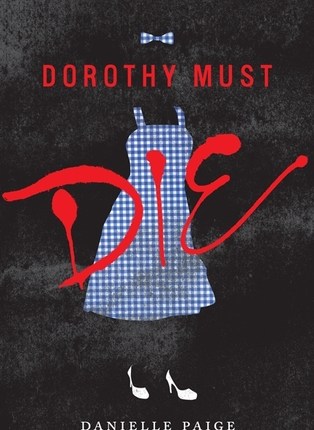
Amy Gunn’s trailer is swept up in a tornado and she finds herself in Oz, but something has gone horribly wrong. The characters from the story that Amy knows are all twisted and changed. She has to get back home, but she also has to save Oz.
The trouble with this book is not the premise, which is excellent, but it’s in the execution of it and in the decision of the author to place this poorly written story in one of the most beloved worlds of fantasy literature. Not a similar world or parallel, the girl in this story is plopped right down in the magical land of Oz. No matter what came next, everything that was written was going to be held up and compared in the light of Baum’s masterpiece. And, this story is found wanting.
The horror twist is interesting but because this is a YA piece, I feel that the author holds back or dumbs down the material. One only needs to read Gaiman to discover that a world can be completely appropriate for a YA audience (Coraline comes to mind) and also be absolutely terrifying. The strange variations that are presented of the beloved characters from the story of Oz are repulsive but not earth shattering. I was so disappointed.
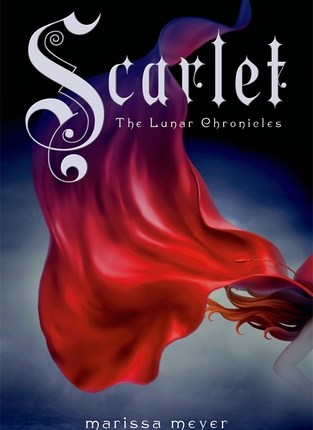
Scarlet the second book in The Lunar Chronicles is better than the first. The introduction of Scarlet and Wolf is a clever and breaks up the the Cinder story line. I don’t like to read reviews of books before I read/listen to them, so I had no idea that Meyer wove more than one fairy tale together. I liked that a lot.
This book, like the previous one, is still plagued by cringe-worthy teen romance scenes and angst. But, it’s easier to ignore those bits because of the crazy stuff that begins to happen with the Lunar Queen and the intense chase scenes.
Iko is by far my favorite character. Team Iko!
Recommended for ages 13+ because of some disturbing, non-graphic torture descriptions. The audiobook is pretty good and may work out well for road trips. You don’t need to have read the first book to appreciate this one because the author does a good job of outlining the backstory. Personally, I prefer to read books in a series in order, but it’s not required here to understand what’s going on.
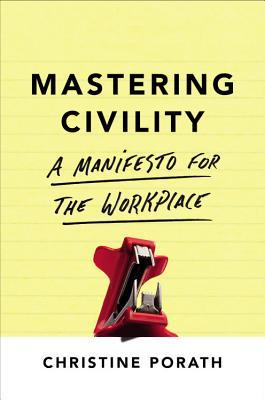
I think we’ve all, at one time or another, worked with one of “those” people- the ones who are rude, who take all the credit, who won’t look up from their phones during meetings, send an email when they should call, or make you do work that they find boring or unimportant.
Before I read Mastering Civility, I assumed that this was behavior I had to endure until the perpetrator got another job or experienced a spontaneous personality overhaul.
Author Christine Porath asserts that tolerating incivility in the workplace is a bad idea because it spreads like a virus. Once rudeness or intolerance enters the scene, it effects everyone it touches and can sink the ship causing everything from profit loss to poor job performance.
Throughout the book, Porath teaches the reader how to recognize incivility in oneself, how to assist coworkers in reforming poor behavior, and how to end working relationships with employees who either can’t or won’t toe the line. Sounding a clarion call for employers and employees alike, Porath rallies readers everywhere to join her in making the workplace civil again.
“Incivility usually arises not from malice but from ignorance. I started my research thinking that jerks out there were intentionally ruining workplaces; I now see that most bad behavior reflects a lack of self-awareness. We don’t want to hurt others, but we do.” pg 12. Until I read this book, I thought that too.
“…incivility has a way of pulling people off track and preventing them from doing their best. I’ve found this to be true in every study I’ve conducted. Even witnesses working around incivility take a hit.” pg 24.
I thought that was especially chilling because Porath ran a bunch of studies. “Many people think of rudeness as a self-contained experience, limited to one person or interaction. In truth, incivility is a virus that spreads, making the lives of everyone exposed to it more difficult. … Left unchecked, incivility can drag down an entire organization, making everyone less kind, less patient, less energetic, less fun- simply less.” pg 39.
Those are the don’ts. Here are a few do’s: “If you want to connect with your employee or team, lead with warmth. Most of us are in a hurry to prove our competence, but warmth contributes significantly more to other’s evaluations. .. It facilitates trust, information, and idea sharing.” pg 71
“… the single biggest complaint I hear from employees about their bosses is that they fail to tune in. Do yourself and others a favor: When you speak or meet with someone, put away your smartphone. Make others the priority.” pg 114. Amen.
I laughed when Porath suggested eating well, exercising, and getting enough sleep to help foster a civil atmosphere in the workplace. Common sense stuff, yes, but how many of us have lashed out because we’re “hangry”? Change starts with you so: eat breakfast, people.
The Optimistic Workplace is a complex but useful manual on how to shift the environment at work. Shawn Murphy talks about all aspects of business from the individual to management to all the levels in-between. There weren’t many surprises in these pages, but the advice was solid.
I knew that leadership was important to the overall vibe in the work space and Murphy does say that it’s important: “…your leadership style impacts climate by up to 70 percent. Think about that 70 percent. It’s mostly how you show up and interact with others that shapes the climate that influences your team’s performance.” pg 9 But, it isn’t the only thing that matters.
There are also ways in which the individual can change the work space. It all starts with greater self knowledge: “Workplace optimism thrives when people understand why they show up to work. Not only is the purpose and meaning of work important, but so, too, are the personal implications. … Personal expression through work is a major contributor to your employees’ well-being. Doing work that matters facilitates the expression of one’s talents.” pg 19 Makes sense. Know thyself does seem to be the foundation of most major life-changing movements.
“..the benefit to positively shaping the climate for your team is getting to know yourself better and discovering how to fulfill your own potential. You position yourself to love your work. In doing so, you set the tone and lead the way to help your employees realize their own potential and find greater meaning in their work and life.” pg 48 Sort of a trickle-down effect of optimistic workplace awesomeness.
Of all of the myriad of studies included in this book, my favorite was the study of “ikigai” : “Your health is linked to a sense of purpose in life, or, as the Japanese all it, ikigai. … A 2008 study in Japan by Toshimasa Sone and his colleagues sought to understand how, if at all, ikigai contributed to longevity in life. … Mortality risks were higher in those who did not have a sense of being and of joy. Those lacking clarity in intentional living had a higher incidence of cardiovascular disease and other life-threatening illnesses.” pg 89 Purpose or death.
The only critical thing I have to say about The Optimistic Workplace is that it’s so broad. Towards the end, I despaired of ever having the time to implement all of the changes suggested, even though they seem like good ones. My boss suggested that I take my favorites and start there. I think I will.
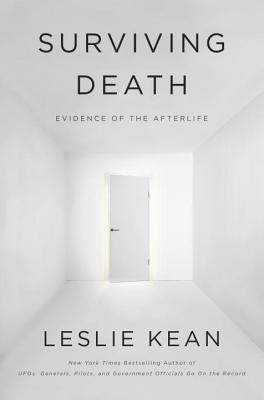
Investigative journalist Leslie Kean takes a close look at a wide variety of unexplained phenomena in order to answer the age old question — does human consciousness survive death intact with the memories, personality, and uniqueness that was exhibited in life?
I found her evidence astonishing.
Much of her research into near-death experiences (NDEs), I had been exposed to in other books. But, the chapters about children remembering past lives, psychic mediums and physical mediums was entirely new to me.
As I read, I kept getting goose bumps up and down my arms. The stories are that powerful.
(Reminder, the following quotes were taken from an advance reader’s copy and may change or be edited in the final printed version.)
Why did Kean write this book? “My intention is to present some of the most interesting evidence from diverse sources and show how it interconnects, making it accessible for the intelligent and curious reader encountering the material for the first time. Strict journalistic protocols can be applied to any topic for which there is data, no matter how unusual or even indeterminate.” loc 51, ebook.
I think she succeeded admirably. Most of Surviving Death is easy to understand, no matter how far-out the material may be.
I’ll admit to losing interest in the passages where she tries to distinguish between intelligence coming from the living human psyche or dead ones, the psi theory vs the survival theory. But, since that was the point of the book, that may be some people’s favorite part so don’t let me put you off.
Take these death bed descriptions of the other side by those about to leave this world: “The great inventor Edison, just hours before his death, emerged from a coma, opened his eyes, looked up, and said: “It’s very beautiful over there.” And more recently, the sister of Steve Jobs reported that just before he died, Jobs looked over the shoulders of his family members, right past them, and said, “Oh wow. Oh Wow. OH WOW!!” loc 2176, ebook.
I was not present when my grandpa passed, but Grandma told me later that at the moment he took his last breath, that a light came into his eyes and his face became so completely peaceful that he looked thirty years younger. I can’t say that I know for sure what waits for us beyond this life, but I can say that I’m not afraid. If you happen to have any fears in that regard, Surviving Death could be of great help to you.
Kean doesn’t answer the question she poses definitively because, of course, she hasn’t died and come back to tell us about it, but the stories and evidence that she presents is compelling. Throughout the chapters, Kean writes about personal, first-hand experiences that she has had. I believe that they are genuine. The hardcore skeptics may disagree.
The most extraordinary part of this book were the physical manifestations that Kean observed in the medium seances. Apparently, these seances have been going on for hundreds of years in certain areas of the world.
Did you know that in the 1920s in Warsaw, Poland, bowls of wax were placed in the seance chapter and apparitions were able to make molds of their hands? “In the Warsaw experiments, gloves were produced with interlocking fingers, with two hands clasping one another, and with the five fingers spread wide apart. Needless to say, the removal of a human hand from such formations would be impossible. Dematerialization was the only method that would leave the molds intact.” loc 4504, ebook. How had I never heard of this!
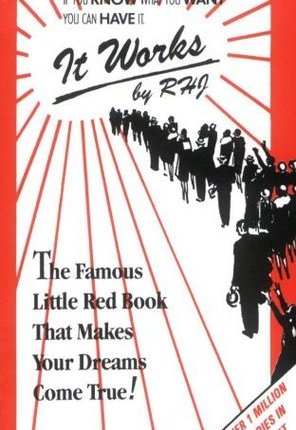
It Works by RHJ is a short book, pamphlet really, on the Law of Attraction. I was fortunate enough to pick up the deluxe version that not only had the text of the original work, but also a PDF of the way it appeared in its first printing.
A short chapter was also included that discussed the nearly-anonymous author.
I’ve read a lot of New Age/New Thought material, but I focused on this one because a certain loved one of mine is struggling. I won’t mention him by name because he says that I talk about him too much in my reviews, but suffice to say, I see him every day. Over a year and a half ago, he was laid off from a job that he enjoyed, had worked at for more than a decade, and he hasn’t found anything else yet to occupy his time. Part of the trouble, I think, is that he doesn’t know what he wants in a new occupation. It Works addresses that directly.
The mechanics of it are simple. Make a list of what you want, think about it every day, don’t tell anybody that you’re doing it. The assumption is that there is a force beyond our comprehension that responds to our thoughts and directs our lives based on what we choose to turn our thoughts towards.
The Abraham Hicks materials cover this in depth, but It Works was published in 1926, long before Abraham and The Secret burst into popular consciousness. This was, in fact, one of the first published books of its kind and even influenced the writings of that titan of new age thought, Napolean Hill.
To get what you want is no more mysterious or uncertain than the radio waves all around you. Tune in correctly and you get a perfect result…” pg 14.
“(Write down exactly what you want and the date you want it.) This may seem very foolish at first, but you can never realize your desires if you do not know positively and in detail what you want and when you want it. If you cannot decide this, you are not in earnest. You must be definite, and when you are, results will be surprising and almost unbelievable.” pg 20.
****Spoilers abound in this review. Please do not read if you haven’t read the book yet.****
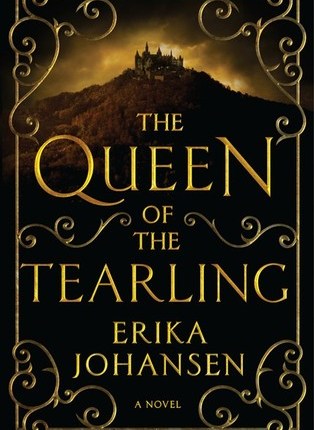
Kelsea was born to be queen. Marked by fire and in possession of two magical sapphire necklaces, she’s taken away from the only home she’s ever known on her 18th birthday to go rule her country. Kelsea’s uncle, the regent, wants her dead. In the neighboring country, the perpetually young Red witch queen, who’s been ruling her people for a century, also wants her dead. There are very few people who don’t want Kelsea dead. She, obviously, wants to live and rule justly. So, our story begins.
I’m not so sure about this fantasy. First of all, the characterizations were so simplistic. Kelsea is good because she reads a lot and doesn’t want people to exist in poverty or slavery. Her mother was bad because she liked to wear dresses, have a lot of pillows on her bed, and sleep with a bunch of dudes. Lazarus is good because he wants the young queen to live long enough to make a difference and is quick with his sword. Arlen Thorne is bad because he supports the black market slave trade and black mails people to have his way. The Red Queen is bad because she keep slaves and rules with an iron fist. I think the most ridiculous characterization was the noble whose crown Kelsea commandeers in her coronation. (I listened to the audiobook so I’m having trouble recalling the name.) She is bad because she literally barred the doors of her keep against her own people when the neighboring army was invading. Not a lot of grey area, is there.
I thought, with the flat characterizations, that this was a young adult offering, but then, the author would slip in some graphic child rape details or language and I’d be reminded that this wasn’t for young adults. I couldn’t quite figure out the audience that Queen of the Tearling was reaching for. Maybe something entirely new like “cozy fantasy”? I suppose she could have been appealing to people who wanted to like a fantasy, but didn’t want to have to think too hard about it. Game of Thrones Lite or Diet Malazan Book of the Fallen.
Two of my best friends love this book. It grew on me a bit. I mean, towards the end, after fourteen hours of narration, I did feel like I wanted things to work out for Kelsea. But, I didn’t feel like the author gave us any of the details that were important. Who is Kelsea’s father for pete’s sake? It was only hinted at a dozen times. Inquiring minds need to know.
Lazarus’ past? More about Tearling history? We’re told that Kelsea spent her formative years with a historian who didn’t want to teach her any history. Why not! Or how about that intriguing scene with the Red Queen and the talking shadow? I could have read another six chapters about that alone.
Also, I had a bit of an issue about the world building. So it takes place in our world, but something cataclysmic happened or society fell apart? Then why is there magic. Did nuclear fall out mutate people so now magic is real? Basing this story in our world felt lazy to me. The author uses our monetary system, our names for drugs… it is the small details that make the world and all of these were so boringly familiar. I would much rather have had Kelsea spending sea stars or her uncle sniffing ground unicorn horn. But, maybe that’s just me.
I’m not sure who to recommend this to. With the material, I’d certainly lean towards the 18+, but I don’t think that the story is complex enough to really entertain adults. I did listen to the whole thing, so that’s saying something and, like I said, I know at least two discerning friends who loved it. I’m going to have to have an in-depth discussion with those ladies. I was neither thoroughly charmed nor disgusted by The Queen of Tearling and feel decidedly middle of the road about the whole thing.
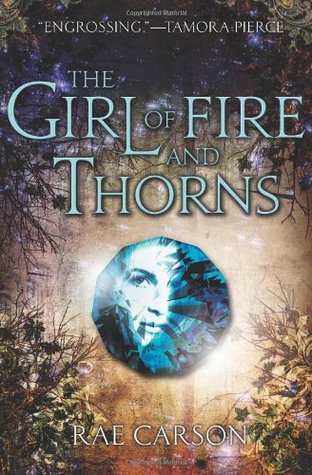
The Girl of Fire and Thorns takes navel gazing to a whole new level… but seriously. In this world, once in a hundred years, one person is chosen by God to do something (the main character is never quite sure what this is) and her position as the chosen one is indicated by a large jewel that mystically implants itself in the person’s belly button. To be fair, I was never really able to get over the silliness of this main premise to truly appreciate the story. The whole Godstone thing was too funny to me. It reminded me of Dark Helmet’s ring in Spaceballs, a religious artifact that inspires fear and reverence but was also patently ridiculous.
The main part of the action takes place in a desert setting (reminiscent of Dune). Elisa, the bejeweled heroine, doesn’t know her own strength, moves through tests that teach her that strength, and then it all leads to a conclusive, final action that was so hilarious that I had to put the book (e-reader) down for a moment to process it.
Now, the cultural struggle between Elisa’s people and the Invernie was interesting. I liked the juxtaposition of an earthy, animalistic, nomadic culture with the more civilized, religiously structured, city culture. I also liked the heroine herself. She seems to have an eating disorder and some seriously raging teen hormones, but otherwise, Elisa is a strong, female role model in the vein of Katniss Everdeen and Tris Prior.
If the reader can overlook the whole belly button situation, he or she may really enjoy The Girl of Fire and Thorns. You may also enjoy the young adult reads: The Sin Eater’s Daughter by Melinda Salisbury or The Girl, the Gypsy and the Gargoyle by Darcy Pattison.
The Nameless City graphic novels are excellent for kids aged 10 to 14. The Stone Heart like The Nameless City is well drawn with diverse characters and a plot that can be followed by young readers. It presents the difficulties of balancing cultural expectations, politics, and belonging with the natural emotions of friendship and understanding.
The kids, Kai and Rat, are from completely different social castes, but it doesn’t matter to them. If only the rest of the world didn’t live with prejudiced blinders over their eyes, then life could be sweet in the Nameless City. But, that’s not how it is.
The General of Blades wants to make a council of all of the nations within the city walls to decide and rule on all matters of importance within the Nameless City. His son, the heir apparent, wants the power that he’s been promised his entire life- to rule the city as the rightful conqueror. They can’t both have their way.
Meanwhile, rumors abound of the ancient power of the builders of the city itself. The monks may know something about it and, if in the wrong hands, this power could bring down the city that it helped to build.
Highly recommended for reluctant readers. There’s very little downtime in these pages.
A huge thank you to NetGalley and First Second Books publishing for an advance reader’s copy of this book. And, thank you for reading!








 ****Spoilers abound in this review. Please do not read if you haven’t read the book yet.****
 The Girl of Fire and Thorns takes navel gazing to a whole new level… but seriously. In this world, once in a hundred years, one person is chosen by God to do something (the main character is never quite sure what this is) and her position as the chosen one is indicated by a large jewel that mystically implants itself in the person’s belly button. To be fair, I was never really able to get over the silliness of this main premise to truly appreciate the story. The whole Godstone thing was too funny to me. It reminded me of Dark Helmet’s ring in Spaceballs, a religious artifact that inspires fear and reverence but was also patently ridiculous.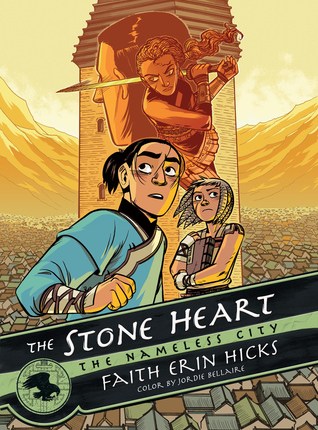
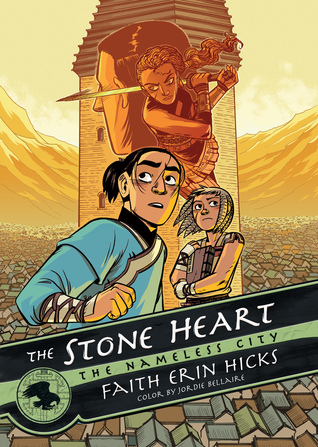 The Nameless City graphic novels are excellent for kids aged 10 to 14. The Stone Heart like
  The Help Desk Book Blog