Otherwhere: A Field Guide to Nonphysical Reality for the Out-Of-Body Traveler by Kurt Leland

Otherwhere: A Field Guide to Nonphysical Reality for the Out-Of-Body Traveler by Kurt Leland

Kurt Leland’s Otherwhere is the first out-of-body memoir/guide (that I’ve read, so far) that discusses the importance of the individual’s consciousness in how the inner worlds are perceived.

It’s not a new idea, being repackaged and sold throughout time, lately in the New Age/New Thought movement, that one’s beliefs shape one’s reality. But, as Kurt Leland points out in other dimensions where thoughts literally are that reality, this individual viewpoint takes creation to a whole different level.

He suggests that what Robert Munroe, Jurgen Ziewe, and so many other consciousness explorers experience when they are in their various out-of-body states is archetypical energy, though he doesn’t use that terminology. Leland calls the perception of this energy: one’s own personal translation tables.

Rather than taking the figures that one encounters at face value or judging them based on ingrained religious beliefs, Leland encourages the Otherwhere visitors to examine what the figure does. It’s very similar to what dream interpreters teach about how to understand your dreams.

Like me, Leland believes that anyone can have out-of-body experiences. He has this to say about why more people don’t: “It’s my firm belief that what prevents people from having out-of-body experiences and exploring nonphysical reality on their own is fear of the unknown. In my experience, the best way to overcome fear of the unknown is to familiarize oneself with the personal accounts of people who have overcome that fear themselves. I believe that personal accounts of out-of-body experiences are far superior to how-to manuals in stimulating people to venture into the unknown.” Preface, xii

He goes on to say: “In my opinion, our fear of the unknown is really just anxiety about becoming unlovable as a result of having had unfamiliar experiences and being changed by them. If we attempt to explore nonphysical reality and succeed, we’re afraid that we’ll be rejected, disbelieved, or thought to be crazy.” pg 27. Time to get over that. Don’t you think? 🙂

Lelend uses lucid dreaming as his method of exploring other worlds (Otherwhere). I’ve explored a few books about lucid dreaming one of which you can read here. If you are interested in my explorations into nonphysical reality, you can read those here.

I found this episode of a woman that he encountered there to be very illuminating. In this passage, he is talking to his Otherwhere instructors about her: (the Instructor saying) “As you can see, my colleague and I intended every image in the dream to contribute in some way to the lesson we wanted you to learn.” (Leland asks) “What about the woman reading the book?” “As you recall, she was facing the door into Otherwhere. There are many people in the world who have an interest in exploring psychic phenomena. They love to read about other people’s adventures in altered states of consciousness. But if a door that would allow them to undertake such explorations on their own were to open, they would make up excuses not to go through. The most common one is that they don’t have time.” pg 99

Let’s not be that woman.

The importance of physical life- in this excerpt, Leland is listening to an instructor in Otherwhere: “While it’s true that I no longer feel regret about anything I’ve experienced during previous lifetimes on Earth, I wouldn’t say that I’m grateful to be among the dead. That would imply that life over here, in Otherwhere, has a greater value than life on Earth. From our perspective, that isn’t true. There are things that can be learned only here and not there. But there are also things that can be learned only on Earth. Learning is all that matters, and no lesson is more or less valuable than any other. pg 152

Keep on learning, check.

In this passage, Leland examines the availability of teachings on other dimensions: “There are many maps of nonphysical reality… scattered throughout the history of your art and literature. These can provide useful translation tables for orientation within nonphysical reality. Why should every individual who explores nonphysical reality start from scratch?” pg 158

Why indeed… with the modern age and the easy availability of formerly difficult-to-discover information through the internet and public libraries, one can stand on the shoulders of giants to begin your own personal studies.

Everyone is an artist: “Every human being is immensely creative. But unless that creativity is channeled into some art or craft, it will be used instead to generate illusion. It could be said, therefore, that every human being is an artist, at least in potential. Developing this creativity is an essential part of every person’s life purpose, even if it isn’t the main focus of one’s career.” pg 238.

I believe that too. I’ve read a bunch of books about creativity, one of which you can explore here.

“How you choose to represent to yourself the ways of gaining access to any zone of Otherwhere is up to you. The validity of such images lies in their usefulness, not in some kind of absolute truth. The only important thing is that you give yourself some way of identifying the zone into which you’ve traveled, so that you can return on future occasions. Whether this manner of identification is the name of a subway line or station, or the number on a gate in an alley, is your choice. The identifying function of such names or numbers is all that matters.” pg 262

Or, like in my own personal explorations, tarot cards.

Leland finishes his account with a modern version of Dante’s Paradiso in which, he traveled to Otherwhere and discovered different areas within that place where the dead came to terms with the life they had just completed. Absolutely fascinating stuff.

Then he talks about ways to remove your consciousness from the ordinary to experience what he and others (and me!) have experienced- whether that be through meditation, lucid dreaming, shamanic drumming, etc, and, the librarian in me loved this part, gives book lists for learning each type of technique. He saves consciousness explorers a lot of time, which is a kind thing to do.

I highly recommend Otherwhere for folks beginning their consciousness exploration or the experienced traveler. It is a how-to guide, a journal, and an encouraging, exploratory ramble through Otherwhere, a place where anyone can go, if they only set their mind and heart on doing so.

Thanks for reading!

Psychic Dreamwalking: Explorations at the Edge of Self by Michelle Belanger

Psychic Dreamwalking: Explorations at the Edge of Self by Michelle Belanger

Psychic Dreamwalking has some instruction on lucid dreaming, but it is interspersed with a lot of personal background information and some psychic vampire stuff. That didn’t bother me, even though it isn’t my particular realm of study. I’ve found that the mind is a very powerful tool for interpreting reality and people seem to believe all sorts of things that I find to not be compatible with my life experience. But, if that kind of thing annoys you, just stop reading Psychic Dreamwalking before Chapter 9 and you’ll avoid most of it.

I rather liked author Michelle Belanger’s opening dedication, “Prayer of the Dreaming”: “I commit myself to you, Lord Morpheus! Open wide the Gates of Dream. Grant me safe passage in your realm So I may return with tales to tell. -from the Introduction. She mentions that this prayer is based on The Dream King from Neil Gaiman’s Sandman series. I haven’t read that comic yet, but it has a great reputation. I’ll have to get to it sometime.

What is dreamwalking anyway?: “Dreamwalking is the art of sending forth a part of the self in order to make contact with others through the medium of dreams. Anyone can learn how to dreamwalk, and, as we explore the concept throughout this book, you will find that most people already do. … The lack of available information on dreamwalking exists in part because there is no consistent nomenclature for the technique. There are accounts of dreamwalking mixed in with experiments in astral projection, dream telepathy, and lucid dreaming, but they are rarely identified as such.” pg 1

It is so difficult in consciousness experimentation to come up with a vocabulary to discuss not only your experiences but to be able to communicate something very personal and individual with someone else who may have had completely different experiences and who are approaching the same topic from a different background. The name of the game in this book is “dreamwalking” which I find to be a rather poetic way to describe a universal phenomenon.

“But this the fundamental premise of dreamwalking: on some level, the dreamspace is real. It is not real in the sense that the physical world it (sic) real, but it is certainly as real as the astral planes described by writers like Madame Blavatsky and Dion Fortune. Like the astral planes, the dreamspace is a subjective reality. As much as it is a place we can go to, it is also a place that we shape with out (sic) hopes, desires, and fears.” pg 25

I think this is a part of the human experience that deserves a far broader investigation than experts and laypersons have given it so far. But there’s always time to get started! Who’s with me?

Belanger talks about Carl Jung a lot in this book. I wonder what he would think about dreamwalking…: “Jung’s concept of the collective unconscious, a layer of myth and symbol deep within each of our minds that connects all of us in mysterious ways, hearkens back to the ancient notions that the dreamspace is a realm unto itself, a hazy place of twilight where men can sometimes meet with gods.” pg 36

It reminds me a great deal of the Dreamtime of the First Nations of Australia. This is not a new concept but one which, as I said before, deserves more experimental research than it has yet received.

The main technique that Belanger uses to access this world within dreams is one that I am very familiar with, namely building a gate: “The Gates of Dream are an archetypal image that I return to again and again in this book. Archetypes and symbols have some objective reality within the realm of dreams, and the Gates of Dream represent the point of passage from your personal dreams to the wider territory of the dreamspace. You can harness this archetypal image in your dream haven, creating a crossing-over point that can later serve as a focus for when you seek to dreamwalk.” pg 51

If you’d like to learn about my experiences with walking through gates, I invite you to explore my blog: https://thelightcongress.com/

Belanger touches a bit on shamanic practices, but not in depth: The shamanic dreamtime, as a realm of myths and images that is peopled by animal totems and celestial teachers, can very easily be equated to Jung’s collective unconscious, the psychological repository of humanity’s collective myths, dreams, and symbols. Many of the totems and other mythic figures encountered in the shamanic realms are Jungian archetypes transported from their existence as simple concepts to vivid, potent entities. … There is a kind of travel that occurs in dreamwalking, but it is, at first, an inward journey. This inward journey, however, can lead the dreamwalker elsewhere. Traveling within can sometimes lead you out. pg 67

I’ve explored a few books about shamanism. You can read those reviews here:

In this passage, Belanger discusses the importance of lucid dreaming in various religious traditions: “From the monks of Buddhist Tibet to the 12th century Spanish Sufi Ibn El-Arabi, mystics the world over have proclaimed the benefits of lucid dreaming. For religious thinkers, lucid dreaming has long been seen as a way to illuminate both the nature of the Self and the nature of reality. Tibetan Buddhists were pursuing lucid dreams as early as the eighth century C.E. According to their philosophy, the mastery of lucid dreams was a necessary step in the pursuit of enlightenment. The ability to recognize the illusory nature of the dreamstate directly correlated to the ability to recognize the illusory nature of all things. pg 139 Fascinating in how the study of dreams can be applied to other areas of your life!

Belanger captured my feelings about psychic vampires very well in this passage: “Ultimately, you and you alone can judge the validity of your experiences. You should never surrender this right, but you should also not use it as an excuse to indulge in wish fulfillment. Make a thorough investigation of every experience and decide for yourself. pg 181. Cura te ipsum.

Though I feel that Psychic Dreamwalking contained a lot of superfluous information, there are some solid dreamwalking techniques in here. I think that the main hurdle to this practice is simply becoming lucid while dreaming in the first place. So, for now, I’ll stick with going into trance. But, for those who already have the ability to lucid dream, this may be something that you’ll want to investigate. Pick up Otherwhere by Kurt Leland for a first person account of dreamwalking or Multidimensional Man by Jurgen Ziewe.

Thanks for reading!

Archetypes on the Tree of Life: The Tarot as Pathwork by Madonna Compton

Archetypes on the Tree of Life: The Tarot as Pathwork by Madonna Compton

Archetypes on the Tree of Life is a dense spiritual text exploring the Tree of Life through the use of Tarot cards.

It’s kind of funny- I think my favorite part of this book wasn’t actually the book at all but instead the brief introduction which was written by Hans Nintzel. Nintzel was a student of the western mysteries who describes himself as “living down the street from Israel Regardie.” As I used the writings of Israel Regardie to do my own explorations into the Tree of Life, I found my mind blown right there. How cool would that have been, to have lived on the occult teacher’s own street? Too cool.

Here’s what Nintzel had to say that was so compelling:
As Qabalah evolved, it was discovered that, using this glyph or map called the Tree of Life, one could move around the geography of the consciousness, so to speak, contacting or balancing various personal energies by contemplating various aspects of the God energy using myths, legends, visions, and dreams, represented by the archetypes of the Tarot.”pg 4

I have yet to see a more concise description of what pathworking is than that. Now why Nintzel didn’t write his own book, I simply don’t know. Being the librarian that I am, I did a bit of digging into his background and it seems that he was a prolific lecturer and a translator of alchemical texts, but didn’t write his own. Disappointing. Here’s a link that I found of works that he helped to bring to the US which were listed in his obituary: https://www.alchemywebsite.com/rams.html

As for Compton’s 300 or so page contribution, I found myself to be disappointed. Archetypes on the Tree of Life is in the main, rather obscure Qabalistic/Kaballistic theory. It reads almost exactly like Regardie’s Garden of Pomegranates or Fortune’s The Mystical Qabalah. That’s not to say that it doesn’t have some gems of interest, but mostly it’s slow going and not as accessible as the publisher (Llewellyn) promised it to be in the page where it described the goals of its Spiritual Perspectives Series.

Compton’s most interesting point has nothing to do with traditional pathworking but is instead a hypothesis that she and her meditation partner have constructed about potential alternate paths across Daath. They’ve chosen a five pointed star to create the paths, but I would perhaps lean more towards a six pointed star, which still sort of works. The six pointed star is a combination of an upwards and downwards facing triangle, an ancient alchemical symbol for self actualization. Though, admittedly, the five pointed star has definite Tiphareth associations… and so the debate continues I suppose. 🙂 Anyway, if you’re interested in Compton’s theory, turn to page 304 to save yourself some time digging through the other stuff.

If you enjoyed this book, may I recommend reading either of the two books I mentioned earlier: The Garden of Pomegranates by Israel Regardie or The Mystical Qabalah by Dion Fortune. If you want more examples of modern pathworking, see my book: https://thelightcongress.com

Thanks for reading!

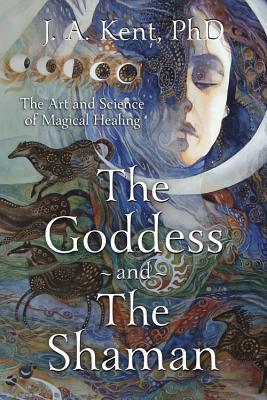
The Goddess and the Shaman: The Art & Science of Magical Healing by J.A. Kent

The Goddess and the Shaman: The Art & Science of Magical Healing by J.A. Kent

“I discovered the presence of a mystical and magical tradition that was largely concealed within our culture that had its roots in ancient pre-Christian Paganism, alchemy, Hermetic philosophy, the holy Qabalah, and elements of Greek, Egyptian, and Gnostic mysticism. It is generally referred to as the Western magical tradition. I tend to see it as the lost shaman tradition of the West.” -From the Preface

J.A. Kent, PhD, examines various occult and healing practices from a variety of traditions by interviewing practitioners as well as providing case studies of her own patients in order to present, what I can only call, her doctoral thesis of her personal magical paradigm. Her paradigm is the title of her book, The Goddess and the Shaman.

“There are strong social and medical pressures in Western-style thinking that regard those who have psychic experiences to be either fraudulent or psychotic.” pg 16

Let me briefly explain this paradigm, though I highly recommend reading the book to get it in Kent’s own words.

“The Goddess” is another name for what Kent calls the “Elphame,” essentially the other non-physical worlds that exist either alongside or on top of (depending upon who you speak to) our normal every day world. “The shaman” are the lightworkers and healers who explore these realms for various reasons including healing others of sicknesses both of the body and spirit.

I think it took a great deal of bravery to write a book like this, especially with the prevailing worldviews at work today. Well done, J.A. Kent!

The world is an enchanted, mysterious, and magical place that will reveal its many secret powers and energies to those who have the persistence and determination to unlock them.” pg 64

The trouble with spiritual healing or any type of work in the Elphame, Goddess, or whatever you want to call it, is that the practitioner exits the consensual reality of the every day world and enters non-consensual reality- the abode of the dreamers, lovers, poets, musicians, mad, etc. I have come to believe that the Western world, Western medicine especially, is not kind to those who venture outside the bounds of the normal.

Kent discusses this in depth in multiple places of this book. Suffers who could find no mundane explanation for their troubles turn to her in order to find some relief. And, encouragingly, many found healing.

“Ultimately they rejected the reductionist psychiatric explanation and embarked on their own magical journey of healing.” pg 159

Recommended for therapists and spiritual healers who are looking for more ideas about how to assist those who come to them seeking help. I enjoyed this book very much.

Thanks for reading!

I’ll Have What She’s Having by Chelsea Handler

I’ll Have What She’s Having by Chelsea Handler

In I’ll Have What She’s Having, Chelsea Handler shares amusing (often hilarious) stories and anecdotes about her family, relationships, pets and other memories from her life. The focus of the essays is all about uplifting and encouraging others through sharing the gifts and love that Chelsea has experienced throughout her life.

“This woman I’ll become, she will never be silent.” pg 4

Through the use of meditation, exercise, professional therapy, and various psychedelics, Ms. Handler has reached a relatively stable and positive stage of her life. As someone who has enjoyed her books and stand-up comedy for years, it is such a pleasure to read that she is both happy and thriving.

“None of the things other people have called me has ever really mattered. What other people say about you only matters if you believe what they are saying is true.” pg 18

She not only stands up for herself in these pages- defending her choices and lifestyle from both naysayers and judgey people of all types, but she also stands up for others. Ms. Handler has a talent for seeing how someone else is hurting and bringing them the comfort that they need most at that time.

It is a rare gift.

“Sitting around and thinking of all the people who don’t love you or don’t want to hang out with you diminishes your own light. … There are many moments in life when your own light is all you need.” pg 104

As someone who is childless by choice, Ms. Handler does not use this as an excuse to be standoffish when the young people in her life need assistance. In this book, she discusses at length how she is a matriarch/patriarch to both her family and her friends’ children. She sets an example for how to be and interact in the world- as a strong woman and parental figure.

I believe it is this type of behavior that builds strong communities, which uplifts everyone. Well done, Chelsea!

Highly recommended for readers who enjoy Ms. Handler’s comedy but also anyone who is looking for a pick-me-up in book form. I took great courage from I’ll Have What She’s Having and I hope others do too.

Thanks for reading!

Your Highness by Sean Phillips

Your Highness by Sean Phillips

Your Highness, a two comic collection, is the prequel to a film called, you guessed it, “Your Highness”.

In these pages, Fabious, the elder prince, goes on a quest to slay a monster who was unleashed by an evil sorcerer. The younger brother, Thadeous, is sent by his father, the king, to secure a treaty with a nearby dwarven kingdom.

Both princes encounter adventures that they were not prepared for.

I wish, in preparation for reading this slim tome, that I had had the chance to rewatch the movie. But I didn’t. So, until then, I’ll just have to rely on my memory of the film from twelve plus years ago.

In the comic, as in the movie, both princes are caricatures of the angel/devil archetype of consciousness.

Fabious, the elder brother, stands in for our “angelic nature”. He is driven to bring justice and safety to those around him while carefully protecting his honor throughout the quest. The flipside to this personality is he suppresses his baser urges, leading to some amusing innuendo with his fellow knights.

(Sexual innuendo and clever word play isn’t something I necessarily find funny, but for those who do, Fabious provides this in spades.)

The other brother, Thadeous, represents humanity’s shadow mode of consciousness. He delights in excess whether that is food, marijuana, or sex. And though he is tasked by his father with as important a mission as his brother, readers know immediately that he will probably fail- not because he’s is incapable of doing what is required, but because he will most likely chose to indulge in his baser instincts to the detriment of his goal.

Overall, I liked the artwork in Your Highness. I thought the panels flowed nicely and the dialogue was well done too.

As for the story itself, I felt it was a tad predictable, but still enjoyable.

I wish, in the Thadeous storyline, the dwarves’ weed had had some magical properties that elevated it beyond bringing an excellent high. Maybe using it could cause one to see where minerals were hidden beneath the earth?

Anyway, recommended for fans of the movie and readers who enjoy fantasy comics in general.

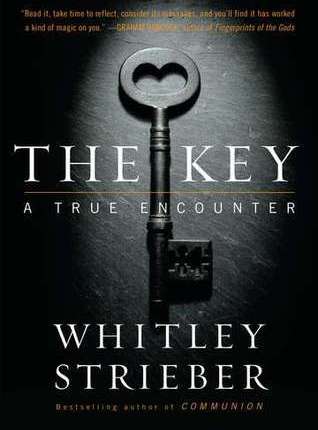
The Key: A True Encounter by Whitley Strieber

The Key: A True Encounter by Whitley Strieber

Originally Reviewed on April 12, 2015

I enjoyed this book not necessarily for its message but because it’s a stunning example of a clear communication from a mysterious source of non-human/non-physical intelligence. It’s not a huge surprise to me that Strieber was able to make such a connection as he details his daily transcendental meditation practice and has previous experiences with the worlds and beings beyond the everyday waking world. (For an example, see his story in this book about meeting the small, withered old man or one of his numerous other non-fiction works.)

If you pick up this book, you’re either going to believe what Strieber has to say or dismiss the information- there’s not a lot of wiggle room. Let’s continue this review with the assumption that you, like me, believe Strieber saw and heard something or someone, received a message, and wrote it down. If you don’t believe that basic assumption, then this review is going to be a waste of your time. I’d suggest moving on to the next one. Peace.

Now, I believe that there are all manner of spirits that inhabit the unseen world. Like the “Master of the Key” described in Strieber’s midnight conversation, I believe there are forces that allow things to thrive and forces that deny this. I think the way to decide which force is what is to examine how the communication makes us feel and the actions that we feel compelled to take after the encounter.

What was the ultimate impact of the “Master’s” words for you, the reader? I felt fear- deep, bone-chilling fear.

First of all, I felt fear for the being’s assertion that the Earth is going to be destroyed in a climate related disaster that no one can stop now because we ruined the atmosphere. That not only affects me, but my children’s children’s children. There are always steps we can take to make the world, and the future, a better and brighter place. I will not give up this agency to anyone, despite what hidden knowledge they may profess to have.

Second, I felt fear for his idea that none of the major world religions (Christianity, Buddhism, Islam) reveal the full truth of conscious evolution, which, in one fell swoop, denied the inner truths for a majority of the people on this planet today. And, the quietly implied addendum to this revelation, that none of the major religions know the truth, BUT I DO- this mysterious guy who shows up in the middle of the night, dumps all of this in Strieber’s lap, then makes him drink a concoction to have him forget everything that he didn’t write down. This doesn’t feel like a benevolent act to me. It feels like a play to make Strieber feel afraid, directionless, and unwilling to seek out help from anyone from a major religion, which is a lot of people and shuts a lot of potential open doors.

Third, I felt fear for this mysterious being’s assertion that the world will be lost because of a child who was never born because of the Holocaust. What sort of creature/being/visitor would know the full extent of the evil caused by one of the worst atrocities in human history, save that knowledge until fifty years after the fact, and tell it to someone who, by his own admission, doesn’t have the power to do anything about it? Fiendishly clever, no?

And, again, this third bit of information seeks to remove Strieber’s, and any reader’s, feelings of hope for the future. I reject the idea that nothing can be done about future events. Everyone exists in the Now moment, which is quite a powerful place to be. It is here that we can change the world, not by ruminating on past horrors and the terrible fallout from them. I will not abandon hope. A dream of mine is that others will not give up also.

I find it interesting that the “Master of the Key” in the book planted enough prophetic tidbits in his fear-filled message to impress Strieber with a feeling of truth from the communication like with the gas-holding memory idea for machines. But, for me, the nature of the messenger himself is clear, given the underlying effect that almost everything the visitor had to say was to sow fear, create a feeling of impotence or divisiveness, and to manufacture a driving need to consciously evolve now, now, NOW in this brand new way or everybody’s going to die and be chained to a dying planet forever until the end of time.

Let’s go back to our existential questions again for a moment: what sort of being wants people to feel afraid, separate from the source of your being, feeling like you have forgotten important knowledge that is required to save your soul that only the mysterious being knows? What sort of being would counsel a soul to not go into the light because that isn’t God, it’s oblivion?

When Strieber asks this being his name, the reply was something like “You could call me, Michael. Or, you could call me, Legion. I would be honored to be called human.” This was a red flag for me. “Who’s in there with you, Legion?” would have been my next question to the being.

I think what Strieber experienced was real. I think that it was a cleverly packaged hodgepodge of truths, possible futures, and small twists of religious dogma designed to make Strieber doubt everything, even his own inner guidance. Strieber himself said that, after everything that had happened, what he most wanted was to talk to this being again. If I was in his shoes, I’d feel the exact same way. There are quite a few things that could use clarification. The first of which, in my mind, is why does this being instill such a feeling of fear in those he communicates with? Is that really necessary to get his message across or is it some kind of unfortunate side effect of the type of energy the being is emitting?

Despite my thoughts on the true nature of the “Master of the Key,” if you liked The Key and were able to distill some truths that rang true for you from all of the fear-mongering, you might like troubling predictions of Heaven is Real But So is Hell by Vassula Ryden. I got the same kind of vibe from her book. I feel like there may be truths there to be found but the large part of the message felt devoted to making the recipients of that message just quake in fear. Proceed cautiously.

Thanks for reading!

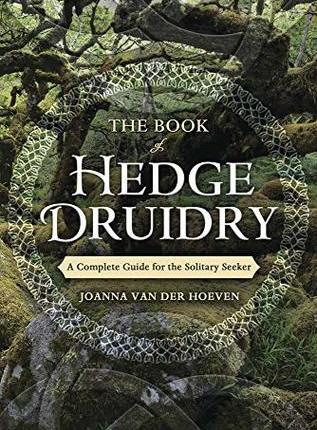
The Book of Hedge Druidry: A Complete Guide for the Solitary Seeker by Joanna van der Hoeven

The Book of Hedge Druidry: A Complete Guide for the Solitary Seeker by Joanna van der Hoeven

Joanna van der Hoeven, a practicing Druid, has written an excellent introduction for anyone interested in creating their own similar spiritual path.

The book has four parts: Theory, Practice, Study, and Skills and Technique

The first part, Theory, discusses various aspects of Druidry including the mysterious Awen, the role of gods and ancestors, the three realms, the world tree, the wheel of the year, the cycles of the moon and more.

“Druidry is the quest to find our place in the world and to work in the world in balance and harmony.” pg 2

Photo by Felix Mittermeier on Pexels.com

I loved how the author presented this section, which could have been mammoth, very succinctly. She gives so many aspects of the practice because she’s encouraging readers to find the parts that work for them. You don’t have to embrace everything, only what speaks to you.

The second part, Practice, outlines various rites and rituals to incorporate one’s practice into daily life.

She talks about how the ancient practice of Druidry has been lost and how practitioners today are creating their own versions of what that might have looked like. I liked that she emphasizes that unbroken lineage doesn’t lend credence to the practice as much as personal exploration and empowerment. Again, she encourages readers to make these rituals their own.

“We don’t know what ancient Druids really did, nor do we wish to emulate them in every aspect. We seek to find out as much as we can and learn from it, thereby creating wisdom in our being.” pg 66

Photo by cottonbro studio on Pexels.com

The third part, Study, looks into herblore, ogham (a type of alphabet that can be used like runes), and spellcraft. Practitioners are encouraged to study and learn these various topics in order to deepen their knowledge.

The final part, Skills and Technique, was the most interesting to me. In it, Joanna van der Hoeven discusses ethics, peace, voice, body and movement, as well as leadership roles.

I found the topics of ethics and peace to be timely.

“We cannot control how others behave. We only have control over how we behave in the world, how we act and react to others. We can lessen our reaction to others to a more intentional way of being through mindfulness of our thoughts, our bodies, and the world around us.” pg 296

Change ultimately starts at the individual level and goes from there. Thank you, Joanna, for the reminder.

Highly recommended for spiritual seekers who may be looking for an earth-based spiritual practice.

Maestros by Steve Skroce (Writer/Illustrator), Dave Stewart (Colorist), Fonografiks (Letterer)

Maestros by Steve Skroce (Writer/Illustrator), Dave Stewart (Colorist), Fonografiks (Letterer)

When the Maestros and his entire extended family are killed in an inter-dimensional fight, the only part of the Wizard King’s bloodline remains with a young man named Will who was banished to Earth with his mother, Margaret.

Now as Will takes the throne, his enemies, and his father’s enemies, are on the move. Will he be able to retain power or, in these uncertain times, his life? We shall see.

The artwork of this series is amazing. From the colors to the style, each page has eye-catching illustrations. Well done, Steve Skroce!

This graphic novel is rated Mature and it is easy to see why. There’s nudity, graphic violence, and some depictions of torture. So, librarians, please categorize it correctly.

Despite its mature, and occasionally disturbing, elements, I enjoyed the story in this comic quite a lot. It is a fantasy-laden coming-of-age tale that asks the question: does absolute power corrupt absolutely?

Highly recommended for mature comic book readers. Thanks for reading!