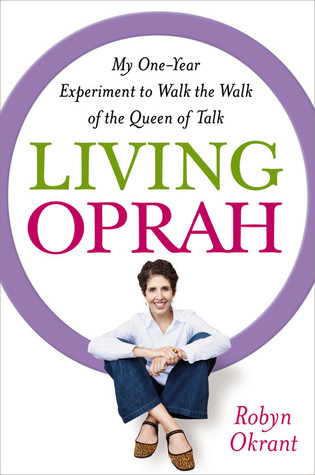
Living Oprah: My One-Year Experiment to Live as TV’s Most Influential Guru Advises by Robyn Okrant

Living Oprah: My One-Year Experiment to Live as TV’s Most Influential Guru Advises by Robyn Okrant
livingoprah

Living Oprah is Robyn Okrant’s account of how she spent one year conscientiously following the advice Oprah dishes out to millions of women across America.

If Oprah said to read a book or watch a film, Robyn did it. If she advised de-cluttering, new make-up tips or relationship work, Robyn was on-board.

For the most part, I enjoyed this quirky book, but I also found it to be slightly repetitive- similar to what Robyn found following Oprah to be after a few months.

She starts out with high hopes: “Could Oprah’s guidance truly lead a woman to her ‘best life,’ or would it fail miserable? Is it even possible to follow someone else’s advice to discover one’s authentic self?” pg 4.

We all discover the answer to be no. But, Robyn gives it a good run because: “It’s vitally important for women to question the sources of influence and persuasion in our lives. We are inundated with get rich/get thin/get married suggestions every time we turn on the TV or walk by the magazine rack. And sadly, we tend to judge ourselves against seemingly impossible standards.” pg 11.

I liked her thought process throughout the year. I also thought her reasoning for doing the experiment was excellent:Β “One of the reasons I was drawn to Oprah as a subject for this project was my continual search for new ways to manage my pain, keep my self-esteem from faltering, and ease the stress and fear associated with scoliosis.”Β pg 36. In some ways, Robyn was sort of Oprah’s target audience.

Photo by Jean van der Meulen on Pexels.com

My favorite part of this book was when Robyn was trying to follow Oprah’s advice to read Eckert Tolle’s A New Earth and live by its precepts, while still engaging in the consumerism and self improvement programs Oprah touts on her program each week.

“It’s also uncomfortable to enjoy a celebrity lovefest on Oprah after I’ve spent an hour competing my reading assignment for A New Earth. Oprah’s Book Club selection focuses on separating ourselves from our ego and learning to connect with people on an authentic level rather than a superficial one. I don’t see how a segment on the show glamorizing Mariah Carey’s lingerie closet supports the work Oprah’s asked us to do.” pg 72.

Robyn comes to the conclusion that if Oprah’s viewers followed all of Oprah’s advice, they quickly wouldn’t need her anymore to live their best lives. Part of Oprah’s draw is that she has viewers convinced there’s always something more to be improved upon, tweaked, de-cluttered or examined.

It is a never-ending process of evolution. That is why Oprah’s built her empire and also why women don’t stop watching.

And sometimes it’s the promise of ‘infotainment’ that keeps viewers coming back: “Oprah frequently reminds her guests and audience that her tell-all shows are not pulp entertainment, they are for our education. I do take her warning to heart but think that if this is something we must constantly be reminded about, maybe a different format is in order.” pg 57-58

I’ve never been a huge watcher of Oprah (or any tv for that matter), but I still enjoyed this book for it’s honest examination of hero worship, popular culture and the self improvement industry. I think Oprah viewers may enjoy this book even more.

Thanks for reading!

The Accidental Highwayman: Being the Tale of Kit Bristol, His Horse Midnight, a Mysterious Princess, and Sundry Magical Persons Besides (Adventures of Kit Bristol #1) by Ben Tripp

The Accidental Highwayman: Being the Tale of Kit Bristol, His Horse Midnight, a Mysterious Princess, and Sundry Magical Persons Besides (Adventures of Kit Bristol #1) by Ben Tripp
accidentalhighwayman

This is the story of Kit, a half-fairy princess, a highwayman, a tightrope walker, a man who’s lost his memory and more.

The Accidental Highwayman is not a “swashbuckler.” I listened to the digital audiobook and didn’t see that description of this story until I came to its Goodread page. That’s a positive thing because I may have felt cheated otherwise.

Though it has a large cast of characters, the pace is quite slow. This is a book that can be savored but I see how it could just as easily be put aside.

I confess, I nearly gave it up when I went nearly four chapters in a row with nothing happening other than the wagon moving onwards. But, I stuck with it to the end.

The style of storytelling feels more like a Victorian era book rather than a modern fairytale. I believe this was a purposeful choice on the part of Ben Tripp- to give it a faux-classic feel.

I feel like The Princess Bride could be an apt comparison if you slowedBride‘s pacing way down and remove almost half of the adventure. The Accidental Highwayman has charm in my opinion, but not a lot of substance.

That being said, it contains one of the most over-the-top romantic lines I’ve ever heard in an audiobook: “If I don’t kiss you, I shall perish.”pg 269. If you like that kind of thing, you might enjoy this book very much. Think “slow burning wick” of a romance. Very slow. And not graphic but sweet.

Actually, The Accidental Highwayman was sort of like The Night Circus but with more goblins and less immersive descriptions. In that book, as in this, I felt like the story was reaching for more but never quite made it.

In conclusion, I recommend this book for readers with buckets of patience and a penchant for the fantastical and overly dramatic.

Thanks for reading!

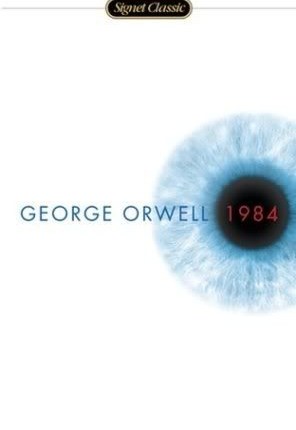
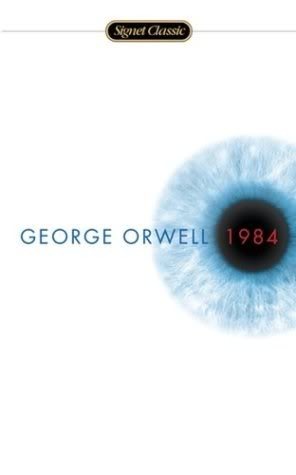
1984 by George Orwell

1984 by George Orwell
1984

Spoiler warning at the end of this review. Please do not read the last paragraphs if you haven’t had the chance to read this classic dystopian.

In 1984 or thereabouts, Winston Smith is a hard-working member of the Party. There is only one Party and it rules with an iron fist. It is divided into divisions that specialize in different areas on the surface, but actually occupy themselves with maintaining power.

The country, an amalgamation of the countries we know now, is always at war with one or another of the two other world powers.

Winston works in a literary branch of the government. He is responsible for making changes to printed literature to make the past in-line with current party sentiment. “As soon as all the corrections which happened to be necessary in any particular number of the Times had been assembled and collated, that number would be reprinted, the original copy destroyed, and the corrected copy placed on the files in its stead.” pg 39.

In the course of his job, he notices things changing. For instance, he knows that at one time, they were at war with someone different than the enemy they fight now. “Nothing exists except an endless present in which the Party is always right. I know, of course, that the past is falsified, but it would never be possible for me to prove it, even when I did the falsification myself. After the thing is done, no evidence ever remains.” pg 155.

But this is not knowledge that he can share. The Party exerts control over everyone at all times through screens built into the wall of every home. You can see the state-sponsored programs like a regular television but they can look out through the screen and see you too.“The two aims of the Party are to conquer the whole surface of the earth and to extinguish once and for all the possibility of independent thought. There are therefore two great problems which the Party is concerned to solve. One is how to discover, against his will, what another human being is thinking, and the other is how to kill several hundred million people in a few seconds without giving warning beforehand.” pg 193.

The Thought Police drag away any trouble makers or those whose thoughts aren’t acceptable to the Party. That could be anyone. Winston knows that one day it will be him. But not just yet.

“There was of course no way of knowing whether you were being watched at any given moment. How often, or on what system, the Thought Police plugged in on any individual wire was guesswork. It was even conceivable that they watched everybody all the time. … You had to live- did live, from habit that became instinct- in the assumption that every sound you made was overheard, and, except in darkness, every movement scrutinized.” pg 3.

The absolute powerlessness of Winston’s situation is terrifying. And then, he falls in love with a girl named Julia who works in his building. “He wondered vaguely how many others like her there might be in the younger generation- people who had grown up in the world of the Revolution, knowing nothing else, accepting the Party as something unalterable, like the sky, not rebelling against its authority but simply evading it, as a rabbit dodges a dog.” pg 131.

This was the first time I ever read 1984. I was still convinced, until a few pages before the end, that it was going to have a happy ending. The rat-mask part had me doubting but then, I still considered the possibility that Winston was faking his conversation. But, after he spoke to Julia one last time, I finally abandoned that theory too.

He lived through his ordeal, but at what cost? He lost everything- even his ability to think. I found it to be incredibly bleak, but worth the time, if only for the warnings that it contains.

Thanks for reading!

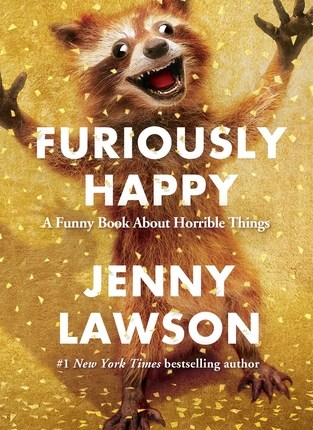
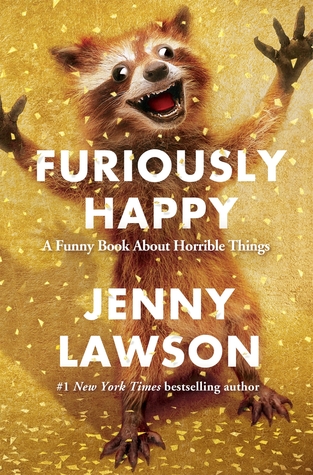
Furiously Happy: A Funny Book About Horrible Things by Jenny Lawson

Furiously Happy: A Funny Book About Horrible Things by Jenny Lawson
furiously happy

Jenny Lawson may not appeal to all readers, but I love her stuff. Her books are like open diaries and sometimes you just have to look away, but I always find myself looking back. I loved her first book and this one was even better.

In addition to being, in my opinion, uproariously funny, Jenny is a poster child for the millions who suffer silently from mental illness and the social stigma that goes along with that. She has more than embraced her condition, she’s transcended it into a weird alternate reality with grinning, taxidermied raccoons and brown (not white) Pegasuses with back herpes.

Though she obviously has her dark moments, Jenny’s world seems a lot more fun than the ordinary world. That in itself is miraculous when you consider the sheer amount of mental anguish that she’s lived through. I think Jenny gives people with debilitating mental illnesses hope- that they too can live a life filled with laughter, quirkiness and fun despite any obstacles.

It’s weird but my favorite part was the bit about Japanese toilets. I googled it and found out that Japanese toilets are a for-real “thing”- those buttons, squirting water and all. So, in addition to being entertaining and inspiring, this book could also be considered educational. πŸ™‚

If you enjoyed Furiously Happy, you may want to try I’m Just a Person by Tig Notaro, Mother. Wife. Sister. Human. Warrior. Falcon. Yardstick. Turban. Cabbage. by Rob Delaney or Sleepwalk With Me and Other Painfully True Stories by Mike Birbiglia.

Thanks for reading!

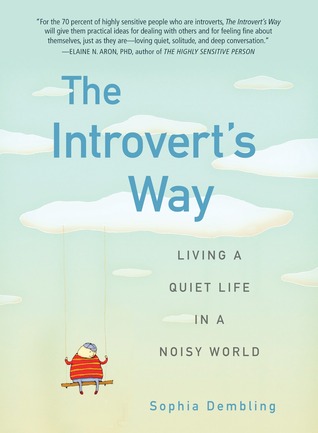
The Introvert’s Way by Sophia Dembling

introvertThe Introvert’s Way: Living a Quiet Life in a Noisy World is a collection of Dembling’s blog posts about introversion. She talks about how introverts are different from extroverts, how we rub each other the wrong way, and how, with some understanding on both sides, we can all get along and thrive. Β It’s engaging, but she writes as the royal “we” which I found distracting. No one has the authority to speak for introverts as a group. Right, introverts? *crickets*

I loved how she cleared up some rather major misunderstandings that I’ve been running into my entire adult life, like this one: “When we want to, not-shy introverts can nut up to the task of being charming and witty. We can meet new people. We can start conversations and keep them rolling, and even draw shy people out, since we’re good at not getting up in anyone’s face and we’re patient listeners… Introverts who are not shy are used to being told that they could not possibly be introverts. This can be irritating, but think of it as a teachable moment.” pg 16-17

Dembling gives some concrete ways in which introverts can improve their social skills: “If you’re misinterpreted more often than not, you might need to give some thought to what your quiet is telling people. When you are sitting quietly, try to parse what kind of quiet you’re feeling. “Leave me alone” quiet is different from “thinking hard” quiet, which is different from “enjoying watching the scene” quiet, which is different from “I’m totally overwhelmed, get me out of here” quiet. Once you have a sense of what you want to project, consider your body language. pg 37 My husband has expressed to me, many times, that he can’t read my “quiet”. This can be problematic because when I’m upset, I withdraw completely and, if he’s not paying attention, he misses the whole thing. Maybe I should make some signs…

“…with our deep listening habits and our hyperawareness and sensitivity, introverts are particularly susceptible to being sucked into the vortex of other people’s demands and expectations, which can cause us to keep going long after we are completely drained of energy.” pg 55 This is a legit problem. I’m from a large family of extroverts and I’ve learned that I have to draw very clear boundaries to preserve my space. There’s an assumption that if I’m home that I’m not doing anything “important” and I should be willing to go out and do whatever it is that they’re doing. Annoying. I know that they do it out of love and the desire to make me feel included, but sometimes, most times really, I just want to be left alone.

This, just this: “Nine out of ten introverts agree: the telephone is the tool of the devil.” pg 64 End of story. I can never think of anything to say while I’m on the phone, but after I hang up, I think of ten million things I could have said. It’s a vicious cycle of terror and then regret. I’m over it.

Dembling’s “Affirmations for Introverts” are excellent. Here’s my favorite: “I know what I need better than anyone else.” pg 179

It was encouraging to read about how some of my major personality quirks, which I have always viewed as flaws, are not really stumbling blocks at all. It’s just how I interact with the world. I’m very fortunate in that my friends and family have accepted me for who I am, for the most part, and not pushed me to be someone that I’m not. I just wish that I had been more aware of what makes me happy and not been so hard on myself for so many years because I wasn’t an extrovert. I wish I was good at parties, made small talk with ease, or lit up a room with my mere presence, but I don’t. And, at long last I realize: that’s ok.

If you’re looking for more books on this topic, try The Power of Personality: How Introverts and Extroverts Can Combine to Amazing Effect by Sylvia Loehken or The Life-Changing Magic of Not Giving a F*ck: How to Stop Spending Time You Don’t Have with People You Don’t Like Doing Things You Don’t Want to Do by Sarah Knight (not necessarily a book on personalities, but I found it useful as a technique to manage my energy).

Thanks for reading!