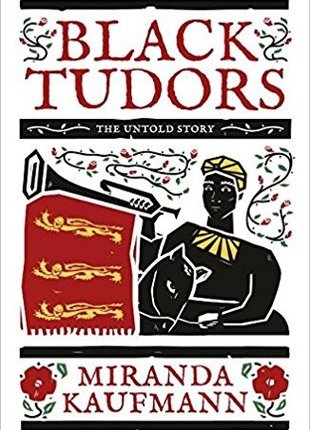
Black Tudors: The Untold Story by Miranda Kaufmann

Black Tudors: The Untold Story by Miranda Kaufmann

Scholar and historian Miranda Kaufmann has written vignettes of half a dozen or so Africans who lived and worked in England during the Tudor Era.

The trouble with this collection is that so little information exists, Kaufmann has to parcel it out among other more well-known history. I still found it interesting, but for readers looking for Black History only, it feels rather disappointing.

The answers are complex, but the questions that most commonly spring to mind about the Black Tudors are simple: why and how did they come to England? How were they treated? What were their lives like?” pg 3

Photo by Chris Carter on Pexels.com

The answers, in addition to complex, are brief. But this book did clear up some misconceptions I held about the time period.

For example: “Tudors were far more likely to judge a new acquaintance by his or her religion and social class than by where they were born or the colour of their skin, though these categories did on occasion intersect.” pg 4

Many of the records Kaufmann produces were held by the church — baptisms, marriages and so forth.

As an American, it is a different perspective to learn about a country’s history that was affected so little by slavery. People could move in and out of England with their slaves, but these unfortunate persons could also be freed or claim their freedom.

Henry VII set a precedent when he freed an African man named Pero Alvarez who was from Portugal, a country with slavery at that time. And it was backed up by the courts.
Photo by Mike on Pexels.com

In author William Harrison’s “Description of England”, he wrote: “As for slaves and bondmen, we have none; nay such is the privilege of our country by the especial grace of God and bounty of our princes, that if any come hither from other realms, so soon as they set food on land they become as free in condition as their masters, whereby all note of servile bondage is utterly removed from them.” pg 16

I wish America had been more like that.

Readers get to learn about musicians, African princes, ship wreck divers, explorers and more in this book. Recommended for fans of history and non-fiction.

Thanks for reading!

Here’s the History Guy episode that I wrote after reading some of the historical happenings in this book:
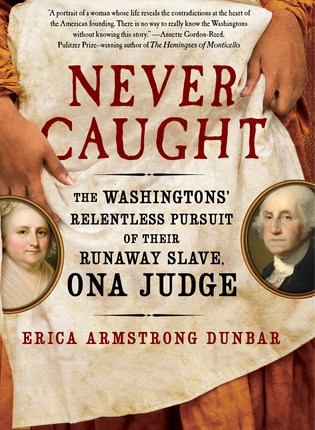
Never Caught: The Washingtons’ Relentless Pursuit of Their Runaway Slave, Ona Judge by Erica Armstrong Dunbar

Never Caught: The Washingtons’ Relentless Pursuit of Their Runaway Slave, Ona Judge by Erica Armstrong Dunbar

An interesting, non-fiction book about Ona Judge, a woman who was one of Martha Washington‘s personal slaves until she ran away. Ona remained a fugitive for the rest of her life. This book dissects early emancipation laws in the United States and Ona’s life, as well as revealing struggles in the private lives of George and Martha Washington.

Ona was born to a black slave and a white, indentured servant. Ona and her mother were abandoned by Ona’s father after only a few years.

“Ona Judge learned valuable lessons from both of her parents. From her mother she would learn the power of perseverance. From her father, Judge would learn that the decision to free oneself trumped everything, no matter who was left behind.” pg 14

Photo by Todd Trapani on Pexels.com

Author Erica Dunbar does a fairly good job bringing Ona Judge to life on the few details that were available. It must have been tricky to fill in the blanks on a life that wasn’t as well-documented as her famous, former owners.

“Those of us who research and write about early black women’s history understand how very difficult it is to find our subjects in the archives. Enslavement, racism, and sexism often discarded these women from the historical record, and as historians we are frequently left unsatisfied with scant evidence.” from the Author’s Note.

Because she gave two interviews to journalists towards the end of her life, Ona may well be one of the only female, fugitive slaves from Virginia to have a personal narrative that survived to exist in the historical record.

“The interviewer wrote, ‘When asked if she is not sorry she left Washington, as she has labored so much harder since, than before, her reply is ‘No, I am free, and I have, I trust, been made a child of God by the means.'” pg 187

Photo by Maksim Romashkin on Pexels.com

What I liked most about this book, beyond Ona’s own life story, was the way Dunbar made George and Martha Washington into people, not just icons, in my mind. They made mistakes and would act in their own best interest. It was interesting to discover that one of the founding fathers and his spouse were just as human as the next person.

But also sad in the way they held and treated “human property.” I suppose everyone is a product of his or her own time.

(Martha Washington) had no interest in releasing the slaves at Mount Vernon, who numbered in the hundreds. Instead, she would move quickly to join her husband in New York, shielding her slaves from the contagion of liberty.” pg 31

Photo by cottonbro on Pexels.com

They simply couldn’t understand why someone would want their freedom — at any cost. It seems like a no-brainer now. But, once the Washingtons discovered where Ona was hiding, they sent agents to talk to her and try to convince her to return to slavery.

“She told Whipple that under no circumstances would she return to slavery, where she could be “sold or given to any person.” She would rather die than return.” pg 144

Recommended for readers who love history, especially American history, and want to learn about another facet of the American experience.

Thanks for reading!

Here’s the History Guy script I wrote about Ona Judge:

Barracoon: The Story of the Last “Black Cargo” by Zora Neale Hurston

Barracoon: The Story of the Last “Black Cargo” by Zora Neale Hurston

Zora Neale Hurston interviewed Oluale Kossola before he died in the 1930’s to create this first-person narrative by one of the last people to be transported to the United States through the middle passage. It is interesting in that, among the existing records of that period in time, it is written from the perspective of someone who lived slavery rather than perpetuated it. It wasn’t written with an agenda. It is a record of a history.

It is a story of a culture and a life lived far from home and family because of human greed.

“I hailed him by his African name as I walked up the steps to his porch, and he looked up into my face as I stood in the door in surprise.” pg 17

Photo by Johannes Plenio on Pexels.com

Hurston records Kossola’s responses to her questions phonetically, which makes you feel like you’re sitting there with her, listening to the remembrances of Kossola as he says them.

In the introduction by Deborah G. Plant, she captures this feeling: “The narrative space she creates for Kossula’s unburdening is sacred. Rather than insert herself into the narrative as the learned and probing cultural anthropologist, the investigating ethnographer, or the authorial writer, Zora Neale Hurston, in her still listening, assumes the office of a priest.” pg xxv

I think, as someone looking back, it’s important to understand the transportation of slaves into the U.S. was made illegal in 1808, fifty years before Kossula was taken from his home. It’s a piece of American history that has been almost entirely forgotten.

“Of the thousands of Africans smuggled into American after 1808, only one man was held accountable and hanged, and even he died proclaiming his innocence.” pg 132

Photo by GEORGE DESIPRIS on Pexels.com

In Barracoon, not only are we given the story of Kossula’s transportation in life in the U.S., but also, he shares fascinating details of his life in Africa. There’s information about the justice system, social structure, rites of initiation and more.

In addition to his life story, Kossula shares fables he created to share his feeling of loss about his family as he outlived all of his children and wife. I enjoyed this folk lore part of the book the most.

There’s some controversy surrounding this book. Apparently, Hurston published a magazine article about Kossula early in the last century and was accused by later scholars of plagiarism.

“Of the sixty-seven paragraphs in Hurston’s essay,” Hemenway relates, “only eighteen are exclusively her own prose.” pg 120

Photo by Pixabay on Pexels.com

The text in question is Emma Langdon Roche’s Historic Sketches of the South, that was published in 1917. The full text is available from the U.S. Library of Congress and can be accessed online. That’s how I read it and was able to see some of the similarities in the writing.

However, the interview portions of this book, written in Kossola’s distinctive style of speaking, are entirely unique. As the editor of this book points out, Hurston was never accused of plagiarism in her works after writing about Kossola and it was very early in her career. We all make mistakes.

Recommended for any readers interested in history. Barracoon is a treasure.

Thanks for reading!

Here’s the History Guy episode I wrote about Oluale Kossola: