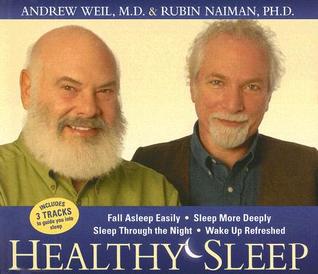
Healthy Sleep by Andrew Weil, Rubin R. Naiman

Healthy Sleep by Andrew Weil, Rubin R. Naiman

Doctors Andrew Weil and Rubin Naiman have created an audiobook to help cure the various troubles one may have while falling to sleep.

I liked their multimodality approach to a problem that everybody seems to have. They start with an exercise to help you figure out what type of sleep problem you may be facing. They discuss the differences between “rest” and “sleep”, which I had never considered. They also talk about how to structure your bedroom to give yourself the best opportunity for sleep.

Photo by Ketut Subiyanto on Pexels.com

Dr. Weil gives some natural suggestions for sleep like maintaining a consistent diet and exercise routine, going to sleep the same time every night, realigning your body with the natural rhythms of the outdoors, and more. He also discusses holistic remedies and the doses he recommends to his patients with potential side effects.

There are also multiple meditations to assist with relaxation and then sleep. As Dr. Naiman points out in the program, one does not truly “go to” sleep as it’s not a location or something you can “catch”. Sleep is more about stepping back and allowing your body to naturally do its thing.

The doctors also go into the importance of dreaming for the health of the psyche. If you’re not sleeping, there’s some underlying issues that your consciousness may not have time to deal with during the waking day. Managing your sleep is more than a benefit for your health, it is also vitally important for your mental health too.

Photo by Vecislavas Popa on Pexels.com

In addition to sleep for individuals, they talk about sleeping with a partner and the special challenges that can bring. I could see this being particularly helpful for sleep-challenged couples and is another aspect of the sleep environment that I hadn’t necessarily considered before.

Highly recommended for people who are looking to increase or improve the quality or quantity of their zzz’s.

Thanks for reading!

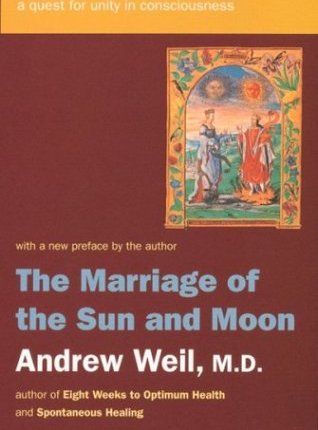
The Marriage of the Sun and Moon: A Quest for Unity in Consciousness by Andrew Weil

The Marriage of the Sun and Moon: A Quest for Unity in Consciousness by Andrew Weil

Andrew Weil travels around the world taking conscious-altering drugs or participating in mind-altering experiences (like a solar eclipse) to see what happens.

And to think, I assumed this book would be about meditation. 🙂

I recently read Weil’s Breathing: The Master Key to Self Healing and I really liked the way he presented Eastern teachings and techniques for a Western audience. I also like his mind-set, that practical knowledge is better than mere theory.

“I must emphasize at the outset my prejudice that the experience of an altered state of consciousness is intrinsically more valuable than any amount of theorizing about it, unless the theory helps individuals to make more and better use of the states available to them.” pg 241

Andrew Weil
Photo by Pixabay on Pexels.com

Similar to Tim Ferriss (the self help/improvement guru who brought us such works as The 4-Hour Body: An Uncommon Guide to Rapid Fat-Loss, Incredible Sex, and Becoming Superhuman), Weil is focused on collecting actual experiences and he uses his own body and mind as a test subject.

This book is a collection of newsletters that Weil wrote for the Institute of Current World Affairs. They offered him a fellowship after the publication of his book The Natural Mind: A Revolutionary Approach to the Drug Problem, to further test his theories about consciousness in the real world. I think his results are fascinating.

All of the chapters converge toward the idea of unifying consciousness. pg 5

Photo by Jonas Ferlin on Pexels.com

The dual consciousness Weil is talking about is the active mind, represented in ancient alchemy by the sun, and the subconscious mind, represented by the moon. Within each of us, both minds operate more or less in balance. Though many of his studies involve the conscious use of drugs to achieve that balance, Weil promotes natural methods above all else. He believes that though drugs may be used ritualistically and responsibly, that any state they reveal was already a latent potential in the mind.

Basically, you can get there without the drug.

The highs of altered states of consciousness such as those of trance and meditation are similarly related to the focusing of awareness. When we learn to bring about this kind of concentration at will, we can be independent of external triggers for highs, whether drugs, sex or mangoes. pg 26

Yes, according to Weil, mangoes, the fruit, have been used by mystics for millennia to unify the conscious and subconscious minds through a type of ecstasy of the mouth. Who knew?

Weil exposes himself some far out stuff. He has three different chapters about his experiences with mushrooms.

“In other words, there is no line between poisonous and psychedelic mushrooms. Mushrooms are a pharmacological continuum, from the white cultivated variety that has no action as a drug to species like the Death Cup that can easily kill. If one likes to get high by eating mushrooms, he can choose species over a wide range of toxicity.” pg 47

Photo by Pixabay on Pexels.com

In addition to all kinds of drugs, there’s consciousness altering through purposeful vomiting in Mexico, chili eating, personally observing Uri Geller doing his metal-bending thing and more.

This book is perfect for readers who are interested in varying states of consciousness but, for whatever reason, aren’t able to make the trips or take the risks themselves. And there are risks because not everything that Weil tries is safe. At one point, he’s riding waves of nausea in the rain in the middle of the jungle while his friend vomits again and again an arm’s length away and there’s nothing he can do about it. Certainly doesn’t sound like something I’d want to attempt.

Though these newsletters were written in the ’70s and this book was published in 1980, I feel that it still has applicable uses for today. Just look at all of the states that are legalizing marijuana (and our Canadian friends!). Questions about altered states of consciousness and addiction are going to crop up that society, after decades of avoidance, is going to have to answer.

“Sooner or later we will learn that plants with effects on the body and mind, such as marijuana, are what we make of them. Used intelligently and carefully they can help us. Used irresponsibly they can harm us.” pg 98

Good thing we have trailblazers like Weil showing us a middle way.

Thanks for reading!

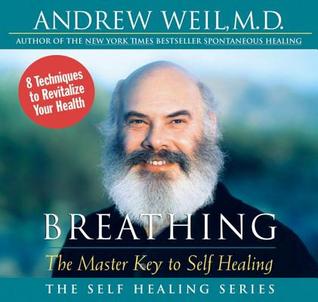
Breathing: The Master Key to Self Healing by Andrew Weil

Breathing: The Master Key to Self Healing by Andrew Weil

Andrew Weil presents pranayama, Eastern breathing techniques for health and well being, for a Western audience. If you have never tried meditation or deep breathing before, this would be a good place to start.

Weil talks about how breathing is one of the only bodily functions that can be performed both consciously and automatically. That unique control allows for a bridge to be made between the conscious and subconscious minds. Ever notice how people who are upset breathe faster? There’s reasons for that.

Photo by Karolina Grabowska on Pexels.com

The first disc of this audiobook is almost unbelievable in Weil’s claims of healing mental and physical disorders through simple breathing, but I don’t think he’d lie about it. I guess our culture has always put so much belief in Western healing through the use of medicines and concrete therapies, that we haven’t always entertained other types of healing.

Of particular interest to me was Weil’s testimony about a patient of his with anxiety disorders that were so severe that they were causing heart palpitations. His patient was given medications to suppress the anxiety, but after awhile they stopped working and Weil’s patient was forced to find something else. He approached all manner of doctors and psychologists, but didn’t see any movement forward on his problems until he began to practice Weil’s breathing techniques.

I know a few people in my own life who might find that story interesting too. Couldn’t we all use tools to increase our inner peace and decrease those pesky anxieties?

Photo by Harry Cooke on Pexels.com

The second disc is half a dozen or so different breathing exercises. They’re all fairly simple and you can do them in minutes.

I listened to this audiobook years ago and, honestly, forgot everything I learned. But I explored it again last week and realized that it was never too late to get back on track. Recommended self help book for anybody who breathes. 🙂

Thanks for reading!