Old Man’s War (Old Man’s War, #1) by John Scalzi

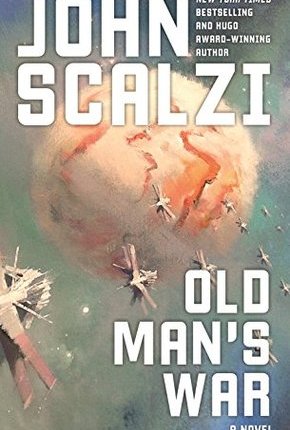
Old Man’s War (Old Man’s War, #1) by John Scalzi

In Old Man’s War, humanity has gone to the stars, and it’s a jungle out there. For the people on Earth, life and death continues as it always has. Out in space, it’s a whole different story…

I really enjoyed this book. After recently reading and being disappointed by John Scalzi’s The Kaiju Preservation Society, a friend recommended I give this series a try.

It is a fast-moving, action-packed book full of fascinating aliens and small (sometimes large) windows into the human condition.

I read it in two days – that’s how good it is.

A couple times, I felt like the narration was bogged down by scientific jargon. But for the most part, I loved it.

Highly recommended for science fiction readers.

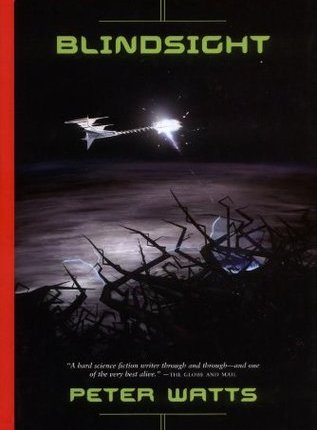
Blindsight (Firefall, #1) by Peter Watts

Blindsight (Firefall, #1) by Peter Watts

Blindsight is an incredibly imaginative science fiction novel that takes on the foibles of human consciousness and examines, in a serious way, what an alien-form of consciousness might look like.

Siri is a unique protagonist. Because of severe seizures when he was young, doctors performed dramatic brain surgery in order to save his life, essentially cutting his brain in half.

Photo by meo on Pexels.com

“The brain’s a very flexible piece of meat; it took some doing, but it adapted. I adapted.” pg 9, ebook.

This early surgery changed the way Siri’s brain worked and how it processed reality, making him the perfect translator for other humans whose brains and bodies have been so changed that baseline humans can no longer communicate with them.

And Siri’s special talents are desperately needed after aliens unleash surveillance technology in the atmosphere. Humanity called the strange lights in the sky, “fireflies.”

“How else would you explain 65,536 probes evenly dispersed along a lat-long grid that barely left any square meter of planetary surface unexposed? Obviously the Flies had taken our picture.” pg 24, ebook.

Photo by Felipe Helfstein on Pexels.com

Siri becomes part of an elite mission sent by Earth to discover where the “fireflies” originated from and who or what created them.

Blindsight isn’t a simple read. It proposes complex ideas that demand some attention to unravel and it makes the reader consider how real is her own perception of this thing we call “reality.”

It asks how technology may change not only how humankind takes in information, but how that information is interpreted and how that would separate people from each other. The characters Peter Watts has created for the alien-seeking mission are some of the most unique I’ve read because he takes those ideas to extreme conclusions.

“When the fate of the world hangs in the balance, you want to keep an eye on anyone whose career-defining moment involves consorting with the enemy.” pg 135, ebook.

But it feels very real. That is Watts’ strength – making the fantastical seem perfectly logical like vampires, real vampires.

Highly recommended for readers who enjoy “hard” science fiction.

The Three-Body Problem by Liu Cixin

The Three-Body Problem by Liu Cixin

The Three-Body Problem is an inventive science fiction read that suffers, in my opinion, from some translation issues. None of the characters feel quite right. Their dialogue seemed wooden and stilted. And, perhaps this was just my Western mind, I never really understood some of their motivations.

“She could no longer feel grief. She was now like a Geiger counter that had been subjected to too much radiation, no longer capable of giving any reaction, noiselessly displaying a reading of zero.” pg 22

Photo by Pixabay on Pexels.com

My quibbles with the characters aside, some of the concepts in this book were utterly fascinating.

There’s a mysterious government installation, video game with a deeper, hidden meaning, unexplained deaths, numbers appearing out of thin air, and, my favorite part, an in-depth imagining of what unfolding a proton in different dimensions might look like. For fans of the genre, I can see why the The Three-Body Problem would be appealing.

“All the evidence points to a single conclusion: Physics has never existed, and will never exist. I know what I’m doing is irresponsible. But I have no choice.” pg 61

Photo by Sourav Mishra on Pexels.com

In the library copy I read, some of the major cultural issues needed to understand the text are included in footnotes. It helped, but it made me wish I could read this in its original form.

“Everything that’s happening is coordinated by someone behind the scenes with one goal: to completely ruin scientific research.” pg 135

I particularly liked Liu Cixin’s descriptions of the landscapes contained in the video game of the story. The desolate vistas and civilization-ending weather were fascinating to explore.

The idea that there was a world where the law of physics didn’t apply was also mind-bending. Cixin has created a place where suns swirl through the sky in no discernible pattern and pendulums don’t swing in the expected pattern. In a world like that, anything could happen. And it does.

Photo by Pixabay on Pexels.com

“Even if God were here, it wouldn’t do any good. The entire human race has reached the point where no one is listening to their prayers.” pg 205

Recommended with reservations for fans of science fiction. There’s much to enjoy in this read, especially if you favor the “science” part of the genre.

For readers who enjoy book to screen adaptations, this novel has already been made into a film. It is also slated to become a television series.

Thanks for reading!

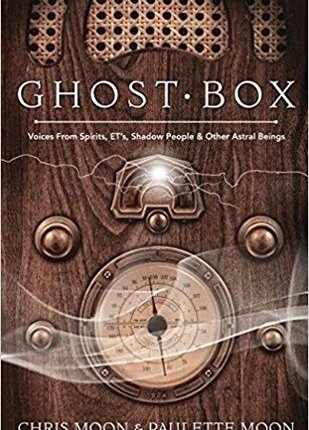
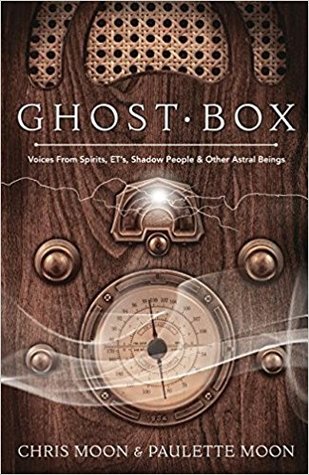
Ghost Box: Voices from Spirits, Ets, Shadow People & Other Astral Beings by Chris Moon, Paulette Moon

Ghost Box: Voices from Spirits, Ets, Shadow People & Other Astral Beings by Chris Moon, Paulette Moon
ghost box

Ghost Box is Chris Moon’s collection of paranormal investigations that he has conducted using electronic voice phenomena (EVP) and his own intuitive skills.

There is little to no science presented in this book so if you’re interested in the tech-side of paranormal investigation, you’ll have to keep looking.

Readers who want concrete information about the afterlife may grow a tad frustrated with this book. The majority of Moon’s investigations are conducted through feelings and feedback from the people he’s interacting with.

That’s not to say that he doesn’t have some solid hits. Occasionally, the information that he receives through his “ghost box” is absolutely spot on. It gave me the chills.

I watched a documentary once about Mario Bacci, an Italian man who has been receiving other worldly voices through an old radio for years. He has a group of devoted followers that gathers around him to hear his sessions with his own “ghost box”. They claim to hear their deceased family members through Bacci’s radio.

That documentary convinced me that this phenomena is real because of how the people reacted when they heard the noises coming through the radio.

Moon had his doubts at first too. When he first receives the box, he doesn’t think it will work. But, through using it and the evidence it provides, he becomes convinced that it is the real deal too.

Photo by Igor Mashkov on Pexels.com

“The machine facilitates real-time two-way communication with the spirit world and, as soon as my dad and I experienced it in action, we knew it would revolutionize the paranormal investigation field.” loc 95, ebook.

He receives this machine from Frank Sumption- an electrical tech who claims to have completed Thomas Edison’s ‘Telephone to the Dead.’

I didn’t even know that was a thing. “Apparently, Edison’s mother was a Spiritualist and he was very close to her. After her death, Edison started to re-examine his views on the afterlife. He realized that since energy could neither be created nor destroyed and that it could only change form, we humans (being energy) had to go somewhere.” loc 224. Fascinating.

The rest of the book, including aliens speaking through the ghost box and sightings of shadow people, I didn’t connect with as much. But, if you’re interested in that type of information, Moon’s book might be something that you’d really enjoy.

Thank you to NetGalley and Llewellyn Publications for a free digital copy of this book. Reminder: the brief quotations that I pulled for this review may change in the final printed version.

Thanks for reading!

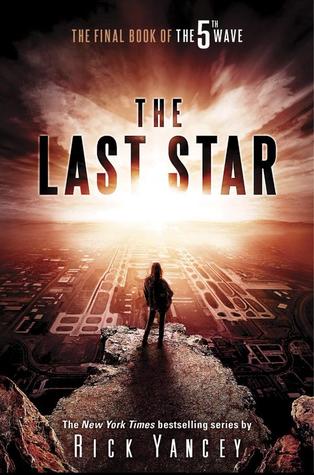
The Last Star (The 5th Wave #3) by Rick Yancey

The Last Star (The 5th Wave #3) by Rick Yancey
thelaststar

The Last Star is the final entry in The 5th Wave, a trilogy about aliens, teenagers and the end of the world.

It is also a morality play about what matters. Why do cars, jobs and stuff matter so much when, in the end, it is all about our relationships and love.

I’m sorry to say that I found the ending to be unsatisfying. Yancey wove such a puzzling yarn that I felt like he didn’t completely untangle all the knots. To be fair, there was a lot going on. But, I read the last pages and I felt a big, internal: “huh?”

This book also reminded me of The Road. “From piles of blackened bones to corpses wrapped head to toe in tattered sheets and old blankets, just lying there in the open like they’d dropped from the sky, alone or in groups of ten or more. So many bodies that they faded into the background, just another part of the mess, another piece of the urban vomit.”pg 70.

The Last Star also raised big questions about civilization and its durability. How thin is the veneer on civilization? What would it take for humanity to turn on itself? Most dystopian writers say, not much.

I don’t know. I’m of two minds on the issue. One part of me says, civilization is a flimsy set of agreements that could easily crumble with enough fear, famine and plague.

The other part of me, the eternal optimist side, says that there is something within each of us that even the worst calamity couldn’t touch.

Kill the body, yes. Kill hope, yes. But kill the soul and its purpose? No. I feel like that part would find a way. And part of that soul’s purpose, I think, is connection to others. That means, civilization. So, there’s something more permanent to it, something fated.

Anyway, The 5th Wave as a three-part story is intense, gritty and could lead to some excellent discussions because it leaves a lot of open-ended questions and ambiguous answers. Rather like life.

Thanks for reading!

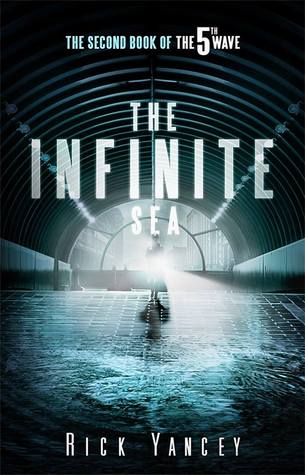
The Infinite Sea (The 5th Wave, #2) by Rick Yancey

The Infinite Sea (The 5th Wave, #2) by Rick Yancey
theinfinitesea

Gritter and more disturbing than The 5th Wave, Cassie, Ben, Ringer, et al are still trying to survive the end of the world. The mystery of the aliens increases. The manner in which the war against humanity is waged sinks to new lows. Yancey takes the story on some unexpected turns and I liked them.

The pace of this story is relentless and the lines are blurred between the “good guys” and the “bad guys.” It gives you a tension headache if you don’t take a break from it every couple of chapters. At least, it did for me. “Anyway, no debt is ever fully repaid, not really, not the ones that really matter. You saved me, he said, and back then I didn’t understand what I had saved him from. … Now I was thinking he didn’t mean I saved him from anything, but for something.” pg 128.

But for what! Yancey answers most of the questions he introduced the reader to in The 5th Wave. He also weaves in some complications. I won’t say anything about those… but they’re very serious and deadly. “No one can be trusted,” I said. “Not even a child.” The cold bored down to my bones and curled inside the marrow.” pg 148.

“I understand the game within the game now: There is nothing private, nothing sacred. There is no part of me hidden from him. My stomach churns with revulsion. He’s violated more than my memories. He’s molesting my soul.” pg 188. The aliens still seem to have the upper hand with the technology that can peer into people’s minds. With all of the creepy things in these books, that bit bothered me the most.

Will our intrepid teenage-survivalists solve the mystery of what the invaders want or what they are before everyone is dead? I don’t know… but I’m going to read the last book and find out. Recommended for young adults or the young-at-heart who enjoy dystopian/mystery thrill-rides.

Thanks for reading!

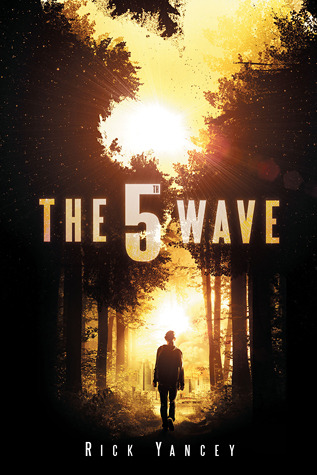
The 5th Wave (The 5th Wave, #1) by Rick Yancey

The 5th Wave (The 5th Wave, #1) by Rick Yancey
the5thwave

Major spoilers ahead. Please do not read if you haven’t read this book.

The 5th Wave is about the end of the world and aliens, yes, but it also explores why life is worth living.

Cassie didn’t know how good she had it until the alien spaceship appeared in the sky and life was never the same. First, there was chaos, but now it is clear that the aliens want to exterminate everyone. And, if they just want the planet for themselves, why are they waging war in such a sadistic manner? It is a mystery and Cassie is going to figure it out.

I was really into the narrative when Rick Yancey chose to change characters and continue the story from a different point of view. I felt that it was unnecessary and broke the flow.

Also, and this is another pet peeve of mine, must every young adult dystopian contain romance as a major part of the plot? The Hunger Games, Divergent, I could go on… and this. You’d think the teens would be far too busy staying alive to fall in love, but that’s clearly not the case from the literature.

I really liked the manner in which Yancey introduces his aliens. First, you get to see their results on humanity. Then, he drops breadcrumbs about how they got here. It’s creepy. “There will be no awakening. The sleeping woman will feel nothing the next morning, only a vague sense of unease and the unshakable feeling that someone is watching her. … And what the shadow has come for- the baby within the sleeping woman- will feel nothing. The intrusion breaks no skin, violates not a single cell of her or the baby’s body.” pg 17, ebook. So scary.

I read a few reviews in which this book was accused of being a copycat of The Host and I feel that it deserves a comment. They are similar in that they both contain aliens, both are dystopians and both have the alien consciousness inside human consciousness. But, those are very broad strokes. The details of the books are different enough and I feel that Yancey has his own plans for his story.

In The Host, the aliens feel more misunderstood and benevolent than the scary creatures in The 5th Wave. This book has a lot more action, The Host is more nuanced. To be fair, superficially, they seem too similar for that to be a coincidence. But in reality, they are as different as Star Wars and Dune. Wait a minute, bad comparison? 🙂

Here’s one of my favorite passages: “Forget about flying saucers and little green men and giant mechanical spiders spitting out death rays. Forget about epic battles with tanks and fighter jets and the final victory of us scrappy, unbroken, intrepid humans over the bug-eyed swarm. That’s about as far from the truth as their dying planet was from our living one. The truth is, once they found us, we were toast.” pg 19, ebook.

Also this one, for obvious reasons: “.. I have a thing about books. So did my father. … While the rest of us scrounged for potable water and food and stocked up on the weaponry for the last stand we were sure was coming, Daddy was out with my little brother’s Radio Flyer carting home books.” pg 33, ebook. Seriously. If the apocalypse ever comes, I’m going to camp out in the library, Station Eleven style. Who’s with me?

Recommended for people who like dystopians and intense survival scenes and aren’t annoyed by angst-y teen romance. The 5th Wave is one scary alien story. They’re here and they’re out to get you and everyone you know! And, so far, they’re doing a VERY good job.

Thanks for reading!

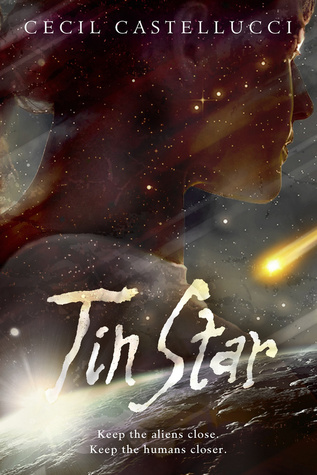
Tin Star by Cecil Castellucci

Tin Star by Cecil Castellucci

tinstarTin Star is the story of Tula Bane, a teenager who joined a space colonizing cult from Earth. She is abandoned on a way station near the edge of the known universe on the way to her new home.

How will Tula Bane survive among aliens who think human beings are the worst? Will she ever be able to go home to Earth or the colony’s planet? How will she manage to put bread on the table?

I love a good space opera and I thought that I would enjoy Tin Star more than I did.

The promise of books set in space, in my opinion, is the opportunity for unique interstellar exploration and worlds created entirely from the author’s imagination. Because of Tula’s unique plight- being stuck in what is essentially a space gas station- the author left herself very little room to write a creative story.

Mainly, Tin Star deals with character development and social struggles, not adventuring in new places.

The villain of the tale was charismatic and creepy. Take this description: “He had his hand on my shoulder in a way that he had a million times before. Only before it was comforting, encouraging, affectionate. Now it was menacing. He was looking at me and his face was smiling. To anyone looking from afar, he seemed to be pleased with me, but it was just a mask. His attitude shifted from concerned leader to unknowable monster.” pg 4

Tula manages to befriend a shady, insect-like alien named Heckleck. He’s my favorite character.

In this passage, Heckleck explains the problems Tula will face in trying to leave the station: “I know about you,” Heckleck said. “Everyone does. And you will never get off this station. You are nobody. And worse, you’re a Human. Even if you did not get on a ship that would take one of your kind, you’d have nowhere to go but to roam like the others of your kind do.” pg 35.

Keeping it real: with Heckleck.

I thought Cecil Castellucci could have done more with the cultural differences between Tula and the others on the station.

One of the most interesting exchanges in the book was between Tula and Tournour, the head of the outpost. She’s trying to figure out how old he is and, because they’re from different planets/species, it’s a surreal conversation. More of that would have been nice.

But Castellucci wrote cultural and language barriers out of the story by introducing nanites into Tula’s bloodstream to translate alien languages for her.

Something that Castellucci did well was writing profound silences between characters into her story. For much of this story, Tula finds herself standing around with Heckleck and Tournour and having nothing to say. But, somehow, it works.

I liked how Castellucci wrote the thoughts spinning through Tula’s mind at these moments. It reminded me of myself when I can’t think of anything to say: “It was a silent agreement between us that if we spoke too much then we would have to talk about the practical things. … If we ever spoke of the things that truly pressed up against us, our very real worries, our seemingly impossibly plans for escape, our divergent hopes for the future, our bubble would blow apart.” pg 184

This book in three lines: “In the end, good must win over evil. The trouble is trying to figure out which is which. Sometimes they look so much alike.” pg 204

Read this book if you enjoy light, young adult drama in space. If you’re looking for a meaty, space adventure, you’ll need to find another title.

Some read-alikes are: The Knife of Never Letting Go (teen trying to survive on an alien planet) or Gated (teen trying to leave a cult).

Thank you to Roaring Brook Press for sending an advance reader copy of this book. And, thank you for reading!