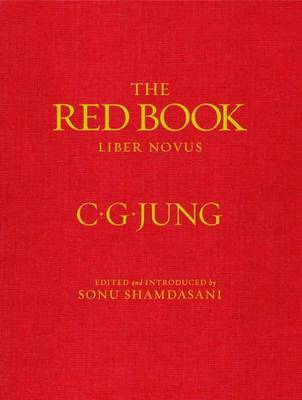
The Red Book: Liber Novus by C.G. Jung

The Red Book: Liber Novus by C.G. Jung

“The years, of which I have spoken to you, when I pursued the inner images, were the most important time of my life. Everything else is to be derived from this.” preface

The Red Book is a stunning publication. It is a physically large book which mimics Jung’s own handwritten copy which measured 11.57 inches by 15.35 inches.

Carl Jung’s calligraphy

The contents are just as impressive. The first part is a brief history of Jung and his publications. The second contains pages of calligraphy in both German and Latin of his “active imagination” visualizations as well as sketches and paintings created by Jung to accompany the text.

The last section of the book is the English translation of the second part.

“Jung described his technique for inducing such spontaneous fantasies: ‘The training consists first of all in systematic exercises to eliminating critical attention, thus producing a vacuum in consciousness.'” pg 209

Painting from Carl Jung’s The Red Book

The visions themselves are interactions between Jung and voices or figures that he named his soul, gods and other archetypical figures.

“To this my soul spoke a word that roused my anger: ‘My light is not of this world.’ I cried, “I know of no other world.” The soul answered, “Should it not exist because you know nothing of it?” pg 240

As he stated in the preface, Jung felt as if his ‘confrontations with his subconscious’ affected his work for the rest of his life. It is a fascinating, little-examined side of a man who has had a huge effect on psychology and is credited, by some, as being one of the leading figures of the New Age movement.

The road to publication for this book is a story in itself. At first, Jung’s family carefully kept The Red Book in a safe deposit box to protect it as they recognized its value as a one-of-a-kind creation. They also believed that Jung wouldn’t have wanted its contents made public as he hadn’t left any specific instructions in his will about it.
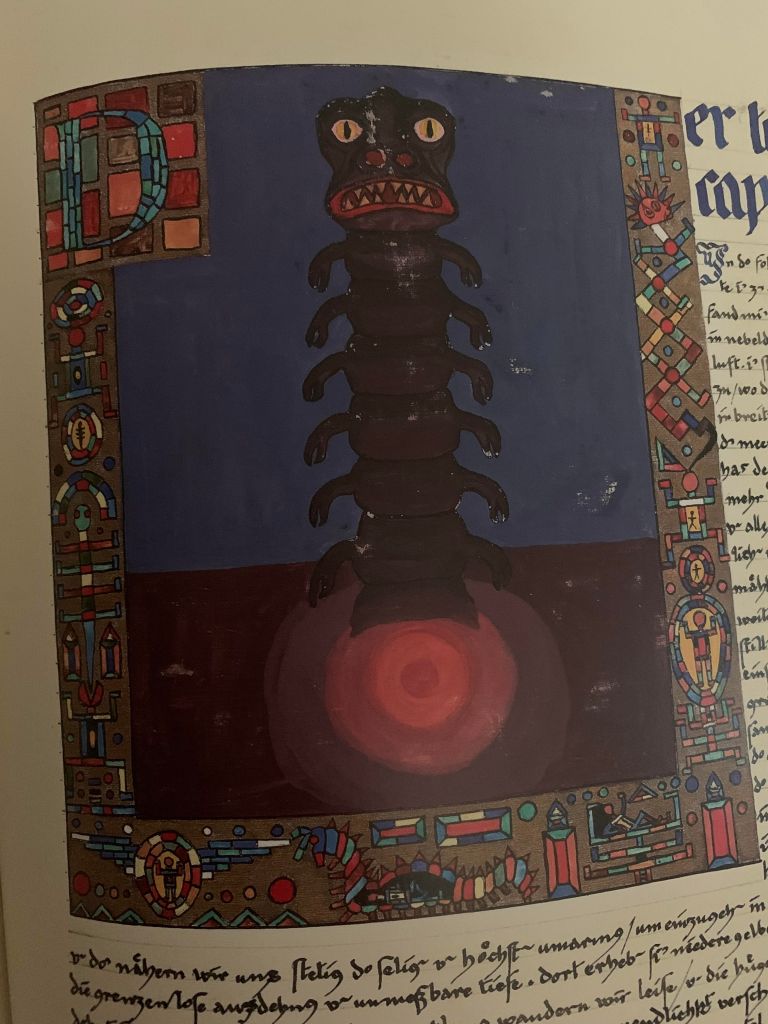
Painting from Carl Jung’s The Red Book

However, researchers and scholars have since examined the text and found parts where Jung addresses, “my dear friends,” leading to the opinion that he did intend to share it with a wider audience. They also point to its importance to Jung’s following works as another reason why it should be published.

Whatever their reasoning, I’m so very glad his family and foundation made the decision to publish. This book is a treasure.

Curiously, The Red Book ends in an incomplete sentence.

Here it is:“I knew of nothing better than to write them down in a ‘precious,’ that is to say, costly book and to paint the images that emerged through reliving it all- as well as I could. I knew how frightfully inadequate this undertaking was, but despite much work and many distractions I remained true to it, even if another/possibility never…” epilogue

Painting from Carl Jung’s The Red Book

I wonder what he was going to write next.

Though I didn’t use Jung’s method of active imagination, I too have undertaken lengthy ‘confrontations’ of my subconscious and have come back with pages of material that read, in some ways, quite similar to this book.

Perhaps, one day, I will also find the courage to publish it.

Highly recommended for any readers interested in Carl Jung’s methods, archetypes or dream interpretation.

Thanks for reading!

The One Thing: The Surprisingly Simple Truth Behind Extraordinary Results by Gary Keller

The One Thing: The Surprisingly Simple Truth Behind Extraordinary Results by Gary Keller

“Anyone who dreams of an uncommon life eventually discovers there is no choice but to seek an uncommon approach to living it.” pg 73, ebook

The One Thing contains simple, ridiculously obvious advice- find your passion, make time for it and live it. But, if it’s really that easy, then why aren’t more of us doing it?

Photo by Ylanite Koppens on Pexels.com

“Where I’d had huge success, I had narrowed my concentration to one thing, and where my success varied, my focus had too.” pg 8, ebook

This book has helped me to adjust my focus so that I spend more of my time on what I love, writing. That being said, there are still chores that must be done, a family business to tend to, a child to raise and numerous other responsibilities that chip away at time that I can give to my one thing.

And, as author Gary Keller points out, this isn’t a big deal. Everybody has their big ONE THING but smaller one things in other areas of their lives. You can use the same focusing principles on each to improve your life in each sphere.

What’s the one thing you can do to improve your family life? Health? Diet? etc., etc.

Photo by Maria Orlova on Pexels.com

This book also taught me that a majority of my output comes from a very small percentage of my actions, something that I had never considered before. Like I said, obvious in hindsight now that I know it, but it wasn’t something I instinctively knew.

“Happiness happens on the way to fulfillment.” pg 98, ebook

I read tons of non-fiction and self help titles. Have they all improved my life? No. Do I always learn something from them? Generally.

Photo by Wallace Chuck on Pexels.com

For me, the fun is in the search.

Read The One Thing if you want to learn some methods to narrow your focus and advance what is most important to you in your life. If you already know how to do that, this isn’t the title for you.

Thanks for reading!

Lords and Ladies (Discworld, #14; Witches #4) by Terry Pratchett

Lords and Ladies (Discworld, #14; Witches #4) by Terry Pratchett

Granny Weatherwax set about finding out what had been happening around the stones in her own distinctive way.” pg 46

Headology, humor and elves are the focus of Lords and Ladies, the fourth entry in The Witches series of Discworld books.

A ring of ancient stones sits in the mountains above Lancre. They were erected so many years ago that no one remembers why they were put up in the first place. No one, that is, except the witches.

Photo by Kris Schulze on Pexels.com

Granny Weatherwax, Nanny Ogg and Magrat have returned from their long journey to install Magrat as a short-term fairy godmother and to free a distant city from the tyranny of stories- a far more dangerous trip than any of them realized it would be.

Upon their return, Verence, the recently crowned king of Lancre, announces his intention to wed Magrat. While the preparations are taking place, something dangerous and cold is pushing its way into Discworld through the stones upon the hill.

“You know,” she said. “The Fair Folk. The Gentry. The Shining Ones. The Star People. You know.” pg 53

Too bad the elves are nothing like what people remember in the fairy tales.

Terry Pratchett takes a completely different view of the elves than any other fantasy author I’ve ever read. Their beauty and glamor hides a viciousness that makes them terrifying rather than enchanting.

Photo by Pixabay on Pexels.com

The three witches face the danger in their own unique way- a charming combination of psychology and common sense.

Unlike the last book where I felt that Magrat was disparaged and bullied, I feel like she comes into her own in Lords and Ladies.

“If you fought an elf and lost… then, if you were lucky, you would die.” pg 169

Photo by Pixabay on Pexels.com

We get to learn more about Granny Weatherwax’s mysterious past as well as Nanny Ogg’s capacity to fascinate a certain amorous dwarf.

Overall, I think it is one of Pratchett’s best. At least, that’s what I believe so far. We’ve reached the end of the Discworld books that I read eight years ago, so perhaps there are some gems waiting in my future.

I’ll let you all know. 🙂

Highly recommended for fans of fantasy and British humor.

Thanks for reading!

The Honor of Violet Fate (I Shall Seal the Heavens, #3) by Er Gen

The Honor of Violet Fate (I Shall Seal the Heavens, #3) by Er Gen

“His name is Meng Hao,” said Bai Yunlai quietly. “Have you heard of him? Recently, everybody in the Southern Domain has been talking about him.”

Photo by Manuel Joseph on Pexels.com

In The Honor of Violet Fate, former scholar turned cultivator Meng Hao continues his efforts to become one of the most powerful magic users of his era.

He has made the decision to learn alchemy because of the unfortunate ingestion of a highly toxic magical plant which is slowly killing him. If he can learn everything there is to know about how to create medicinal pills, maybe he can concoct a cure before it’s too late.

Every cultivator knows the most talented alchemists can be found in the highly selective and secretive Violet Fate Sect.

“His true goal in joining the Violet Fate Sect was to become a novitiate of Grandmaster Pill Demon and study the most powerful Dao of alchemy in the entire Southern Domain. Then he would create his own branch of alchemic arts.”

Photo by Sharon McCutcheon on Pexels.com

The concerns I had in the last two books were mitigated somewhat in this entry in the series because of the introduction of alchemy to Meng Hao’s cultivation. He finally has some time to stay in one place and have a break from continual attacks from other magic users, which had a lot to do with the repetitious nature of the other books.

That’s not to say that there isn’t some monotony. It may be due to translation issues, but some phrases are used over and over again. It reminds me of passages from Homer or other stories that were originally transmitted through live storytellers. I imagine that if you read this story aloud, it might have a hypnotic quality to it through the repetition.

But I wasn’t reading aloud and it doesn’t really work.

“It felt like being slapped across the face, like having a dagger plunged into his chest. As an alchemist, all of it was a direct attack on him.”

Photo by Pixabay on Pexels.com

It’s still annoying that all of the women in this world are in love with Meng Hoa like in the previous books. However, there seems to be a major love interest developing and the passages where they interact are actually quite touching.

“She wasn’t sure when it had happened, but Meng Hao’s figure had at some point become deeply ingrained into her; he was now a part of her very heart, a part that would never leave her.”

The romantic in me likes that very much.

The more I read I Shall Seal the Heavens, the more I realize that I am not the intended audience. This fantasy is more about spiritual cultivation and competition, than the relationships between the characters or character development. The fighting and acquisition of magical items is more important than the embodiment of spiritual virtues or enlightenment.

But even knowing all of that, I still want to know what Meng Hoa is going to get up to next. So I’m going to press on!

Only recommended for fans of the genre, wuxia.

Thanks for reading!

Witches Abroad (Discworld, #12; Witches #3) by Terry Pratchett

Witches Abroad (Discworld, #12; Witches #3) by Terry Pratchett

When Magrat is designated as the next Fairy Godmother (a legacy from her mentor), Granny Weatherwax and Nanny Ogg feel compelled to help her straighten out the troubles of her new fairy goddaughter.

“I don’t trust that wand,” said Granny. “I looks wizardly to me.” “Oh, come on,” said Magrat, “generations of fairy godmothers have used it.” pg 47

Photo by Ksenia Chernaya on Pexels.com

Unfortunately, the city where this young woman resides is quite far away. That means a roadtrip- something that some of the witches tolerate better than others.

Complicating matters is the fact that Fairy Godmothers always come in pairs, a good one and a bad one. We all know that Magrat is good so…

The other Godmother works her magic through the power of stories. She may have some unique ideas about what constitutes a happy ending.

“People think that stories are shaped by people. In fact, it’s the other way around. Stories exist independently of their players. If you know that, the knowledge is power.” pg 8

Photo by Suzy Hazelwood on Pexels.com

Terry Pratchett has crafted three unforgettable characters in the witches. Their traveling, as well as evil-fighting, hijinks are amusing, like in the previous entries in this series.

But let’s talk about Magrat for a minute.

“Magrat would be the first to admit that she had an open mind. It was as open as a field, as open as the sky. No mind could be more open without special surgical implements.” pg 28

Though he’s writing it humorously, the elder witches constantly bully Magrat not only for her youth but also for her progressive ideas about what witchcraft should be. In addition, her open-mindedness makes her a target for derision.

Despite her efforts to look mysterious through the use of various pieces of “occult” jewelry, Magrat is teased by other characters (and the narrator) for her funny hair and ridiculous appearance.

It makes me want to reach through the pages and say, just lay off her already, people. She’s trying to do the best she can with what she has, where she’s at. Can’t say the same for everyone else here.

Photo by Valeriia Miller on Pexels.com

“There’s nothing wrong with happy endings,” said Magrat hotly. “Listen, happy endings is fine if they turn out happy,” said Granny, glaring at the sky. “But you can’t make ’em for other people…” pg 103

The denigration of Magrat makes me view the other characters negatively. Because, even though Granny and Nanny are considered experts in witchcraft as well as wise (in their respective spheres), I don’t think they’re worthy of respect from others when they treat their young colleague like garbage.

I’m not sure why this dynamic between the witches is bothering me more on the second read-through than it did the first, which was eight or so years ago. But it does.

I still consider Witches Abroad an excellent read when I look past the treatment-of-Magrat issues. Highly recommended for readers who enjoy humorous fantasy.

Thanks for reading!

Why Good People Do Bad Things: Understanding Our Darker Selves by James Hollis

Why Good People Do Bad Things: Understanding Our Darker Selves by James Hollis

“Expressed in its most functional way, the Shadow is composed of all those aspects of ourselves that have a tendency to make us uncomfortable with ourselves.” pg 9

Jungian analyst James Hollis examines “shadow work” from the perspective of an individual to couples then communities and all the way up to the collective unconscious.

He’s at his best when he’s illuminating how the Shadow works at an individual level. When he goes beyond that into couples or groups, I thought he began to generalize to the point where the book was no longer helpful on a practical level and moved more into the realm of philosophy.

Photo by Sunsetoned on Pexels.com

Hollis brought the book back into the self help genre by providing a final chapter full of questions for “reflection” by the reader. The purpose of this inner gazing is not just self knowledge, says Hollis, but also wholeness at a soul level.

“This book operates from a central thesis that is relatively unknown to the general public but is a truism for depth psychology, namely, that the human psyche is not a single, unitary, or unified thing, as the ego wants to believe. It is diverse, multiplicitous, and divided… always divided.” pg xi, preface.

I read Why Good People Do Bad Things in conjunction with a philosophy class off of The Great Courses Plus (Wondrium) called “Understanding the Dark Side of Human Nature” by Daniel Breyer. The two complemented each other quite well.

“Can the reader imagine that something inside you wishes to ‘talk’ to us? As a result of this conversation, consciousness is strengthened, new energies are available, and each person lives a richer life, one that is more authentically one’s own.” pg 192

Photo by Bianca Salgado on Pexels.com

This isn’t what I would call a ‘fun’ read. In fact, I had to take Why Good People Do Bad Things in sections, put it down for awhile, and come back to it, again and again.

I don’t mind self knowledge. I’ve done dozens of meditations where I look at aspects of myself and come back with a different understanding of who I am than before I started.

The difficulty is looking into the bits that I don’t want to see. Like I said, I can manage it in small doses. It isn’t somewhere I’d want to live.

It is understandable why so few attempt Shadow work. It is much easier to scapegoat others, blame, and feel superior to them.” pg 203

Photo by Umberto Shaw on Pexels.com

Recommended for any seekers who are looking for a psychologist’s take on Shadow work. This book might be the push that you need to brave that darkness. But beware, there’s someone in there who may have been waiting to talk to you for a long time and you might not like what they have to say.

Thanks for reading!

Battle Ground (The Dresden Files, #17) by Jim Butcher

Battle Ground (The Dresden Files, #17) by Jim Butcher

I saw her study my face and then ask, “How bad does it have to be for you not to be making jokes?” pg 3

The last book in the series, Peace Talks, set up the epic battle for Chicago between the wizard Harry Dresden and his various allies against a relic of the old world and her vassals.

Jim Butcher delivers that battle in a very major way in Battle Ground.

“I hadn’t even seen what was coming for Chicago, and I was already bloodied and exhausted. This was going to be a long night.” pg 17

Photo by Alex Powell on Pexels.com

As per usual, Butcher is heavy on the puns and pop culture references, but I thought he did a fantastic job with this installment. Long-time readers of the series get to enjoy scenes from characters who haven’t made an appearance for awhile.

There are also some serious consequences from this book which, I thought, would have made an epic conclusion to the whole thing. However, Butcher teases more to come at the end of the novel, so I suppose it will continue.

“But whatever happened, after tonight there would be walls coming down between the mortal world and the supernatural one that had stood solidly for centuries. Stars and stones, I didn’t think anyone knew what that might mean.” pg 72

Photo by Laker on Pexels.com

Which I’m not opposed to. You’d think I’d be sick of Harry Dresden and his constant, and ever increasingly powerful, problems. But I’m not. I enjoy this urban fantasy series very much.

Part of that is because of the writing and the characters. Despite the fantasy setting, Butcher manages to make everybody feel very real. I like to imagine that if magic were real, that it would function similarly to how Butcher has crafted it in his books.

The other reason I probably enjoy it so much is because I’m a big nerd. Whenever Harry gets into a bind and makes a cheesy joke to relieve his tension, I always get the feeling that I’d do something similarly silly. When the end of the world is staring you in the face, what else is there to do but smile?

Photo by Matheus Bertelli on Pexels.com

Battle Ground is a must-read for fans of the series. If you haven’t read any of the other books yet, please do yourself a favor and start from the beginning.

Thanks for reading!

1Q84 by Haruki Murakami

1Q84 by Haruki Murakami

Things are not what they seem, Aomame repeated mentally. “What do you mean by that?” she asked with knitted brows. pg 28, ebook

Yes, what do you mean by that, I found myself asking over and over throughout 1Q84, my first foray into Haruki Murakami’s fictional works.

A few years ago, I read and enjoyed Murakami’s What I Talk About When I Talk About Running, a non-fiction book about the author’s creative process and long distance running habit. The way his mind works is fascinating.

He talks about how writing a novel is like participating in a marathon. It takes effort and discipline to go from page one to the end. In addition, the break throughs that he makes in his writing he attributes, in part, to the flow state he experiences during his physical exertions.

Photo by Samuel Silitonga on Pexels.com

This creates a detail-filled and highly introspective world in his novels that some readers can’t get enough of.

But that approach didn’t appeal to me in this book.

The story develops slowly, so so slowly. We are in the characters’ minds for nearly every thought. We learn their eating and drinking habits, sleeping problems, past history, sexual preferences ad infinitum.

The magical realism portions of the story, my favorite parts by the way, were fleeting and infuriatingly uninformative. This is another draw, or so I have gathered, for some readers who like having major unanswered plot points by the end of the story.

This could lead to some interesting book club meetings, but I’m not one of those readers. If you’re going to tell a story, for heaven’s sake, tell the story.

Photo by JV Buenconcejo on Pexels.com

On one hand, the introspective nature of the storytelling gives deep insight into the characters. By the time you’re through, you feel like you could write what Tengo and Aomame are going to do next. It is introversion to the extreme. On the other hand, it crushed my interest in caring what was going to happen next.

Why? Personal preference, I suppose.

Legions of readers love this book. I’m curious as to why, but it might be as simple as how readers like to experience and absorb stories.

Final note: Trigger warnings for domestic violence and sexual abuse.

On Having No Head: Zen and the Rediscovery of the Obvious by Douglas E. Harding

On Having No Head: Zen and the Rediscovery of the Obvious by Douglas E. Harding

Douglas Harding had a strange experience when he was a young man. As he was hiking in the Himalayas, Harding had a moment he would later describe as of “no thought”, and where he perceived his body as having no head. In addition, he had a vision of his body as a house with a single window, but inside the house, there was nothing looking out at the world.

That nothingness is where Harding envisioned his consciousness resides.

Trippy, I thought. If that had happened to me, I might have been pretty freaked out.

Photo by Asep Syaeful Bahri on Pexels.com

Not necessarily so for Harding, who described the experience as incredibly peaceful and enlightening. When he came back from this experience, he applied his insight to various Eastern schools of philosophy, notably Zen.

The result is this book- a discussion of not only what happened to him, but an examination of consciousness itself. Where does consciousness reside? Where is the ‘me’ of our constant thoughts and emotions?

It’s somewhat of a winding path to get there, but Harding eventually points to the idea that consciousness is space in which reality is perceived.

When I first hopped into this book, I thought, how ridiculous. We all have heads attached to our necks. We can see them and feel them. Not only that, we can see and feel the heads of other people if we really wanted to.

Photo by Gabby K on Pexels.com

Harding takes this idea of ‘seeing’ and ‘touch,’ and questions what it is that people actually perceive. Yes, he says, you can see your head in a mirror. But that is a reflection of your head and not the head itself.

Everybody says these constructs are the thing itself. However, as Harding points out, they’re not really, are they? If you look down your own face, you can usually ‘see’ your nose as a series of splotches and shapes. Is that your nose though, or just splotches?

And he goes on from there.

By the end of the book, I was nodding my head a little and felt like I could understand something of what he was saying. But now that I’m trying to write a portion of it down, it just sounds like nonsense.

Photo by Olya Kobruseva on Pexels.com

Perhaps this is a book to be experienced rather than described. Rather, I might humbly suggest, like consciousness itself?

Recommended for spiritual seekers or anybody who enjoys pondering koans.

Thanks for reading!