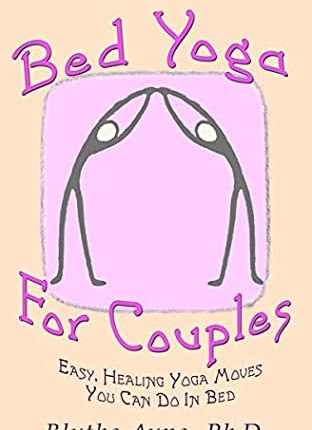
Bed Yoga for Couples: Easy, Healing, Yoga Moves You Can Do in Bed by Blythe Ayne

Bed Yoga for Couples: Easy, Healing, Yoga Moves You Can Do in Bed by Blythe Ayne

“If it’s a lazy Saturday morning and you don’t feel like getting up just yet, you can ease into your day with a few shared yoga poses. It’s a great way to feel connected, to hook up your energies and get on the same wavelength.” pg 3, ebook

Bed Yoga for Couples is a simple yoga manual for two practitioners that includes stick figure diagrams, brief explanations of each pose, and a few basic breathing techniques.

I’ve practiced hatha yoga for nearly two decades so I was familiar with the poses in this book. However, even if you have zero experience, most are so simple that beginners shouldn’t have any problems either.
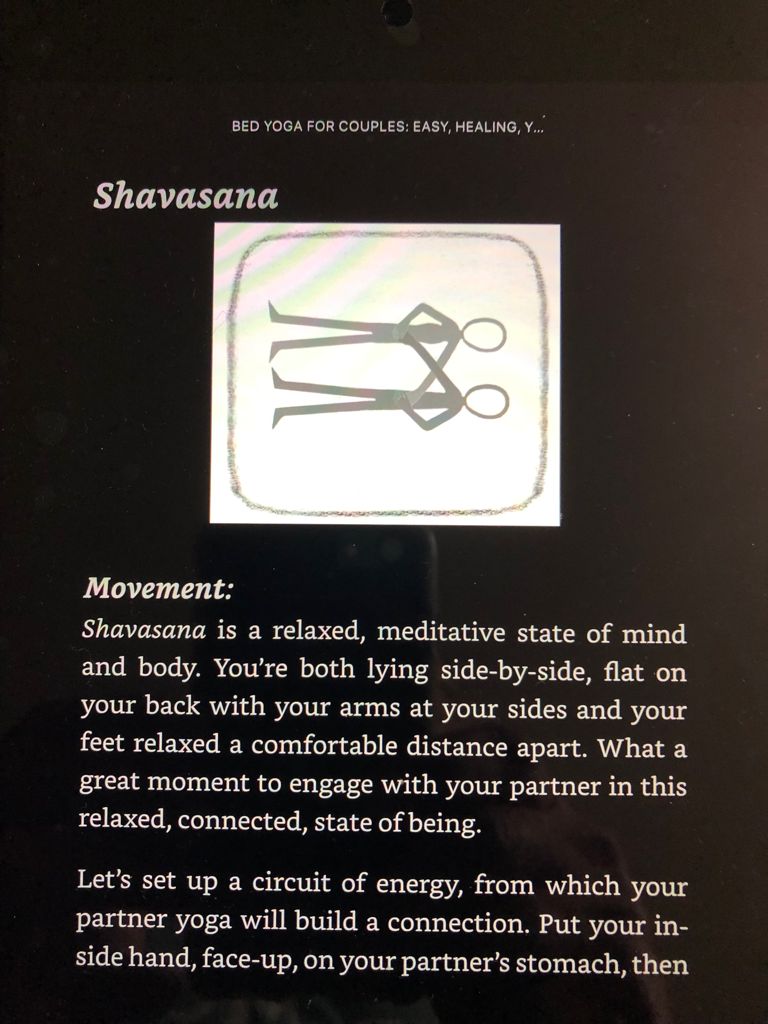
That being said, I’m not convinced of the efficacy of the moves while laying down. Part of yoga, at least for me, is experiencing gravity working on different areas of my body while holding the poses. Clearly, this will be very different while on one’s side rather than standing.

But, as the author Blythe Ayne points out, this method of practice is much easier for anyone who has trouble standing for long periods of time or other health issues that make regular yoga practice difficult.

“The most important point for the two of you to remember is that yoga is about you and for you. … Always communicate clearly with one another about any of the poses- if you’d like to go further into the movement, or if you’ve reached your ‘comfort zone.'” pg 4, ebook

Photo by u0410u043bu0435u043au043au0435 u0411u043bu0430u0436u0438u043d on Pexels.com

I could see this book being most useful for couples who are looking for creative and meditative ways to connect. However, it is not an in-depth examination of the subject. If you’re looking for a detailed history of yoga or the poses, you would be best served looking elsewhere.

Yoga has always had that centering and calming effect on me. The only thing that could possibly improve that experience would be to have it simultaneously with a loved one.

Highly recommended. Thanks for reading!

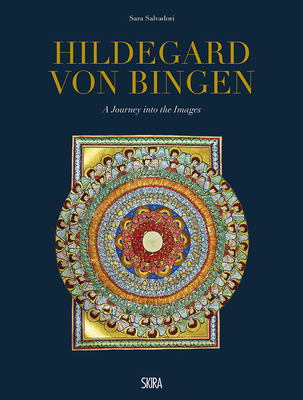
Hildegard von Bingen: A Journey into the Images by Sara Salvadori

Hildegard von Bingen: A Journey into the Images by Sara Salvadori

“What I do not see I do not know,” an elderly Hildegard wrote to the Cistercian monk Guibert of Gembloux, describing the visions from which she gained her knowledge of the cosmic, human and divine dimension, from childhood until the end of her life.” From the preface.

Hildegard von Bingen, born 1098-died 1179, was a female mystic of the Christian tradition. She had extraordinary visions, which she recorded, and in her later years, she shared with others.

“The ‘Sybil of the Rhine‘ appears to us in the 21st century as a real woman who developed the many aspects of her femininity: worldly and joyous, learned and visionary, profoundly human yet open to the divine, inclined to dance, friendship and leadership.” pg 6

But this is not all Hildegard accomplished. She also composed the music she heard in these visions. She traveled extensively at a time when travel was not a simple task in order to bring together communities of believers.

All in all, Hildegard was a pretty cool lady who experienced fairly trippy visions.

“Our historical human condition enables us to appreciate her fascinating, layered personality, which made her equally at home with plants and flowers, angelic powers and the virtues that courted them; and capable of dialoging with the powerful of the Earth both inside and outside the Church, without feeling in any way intimidated or inferior.” pg 7

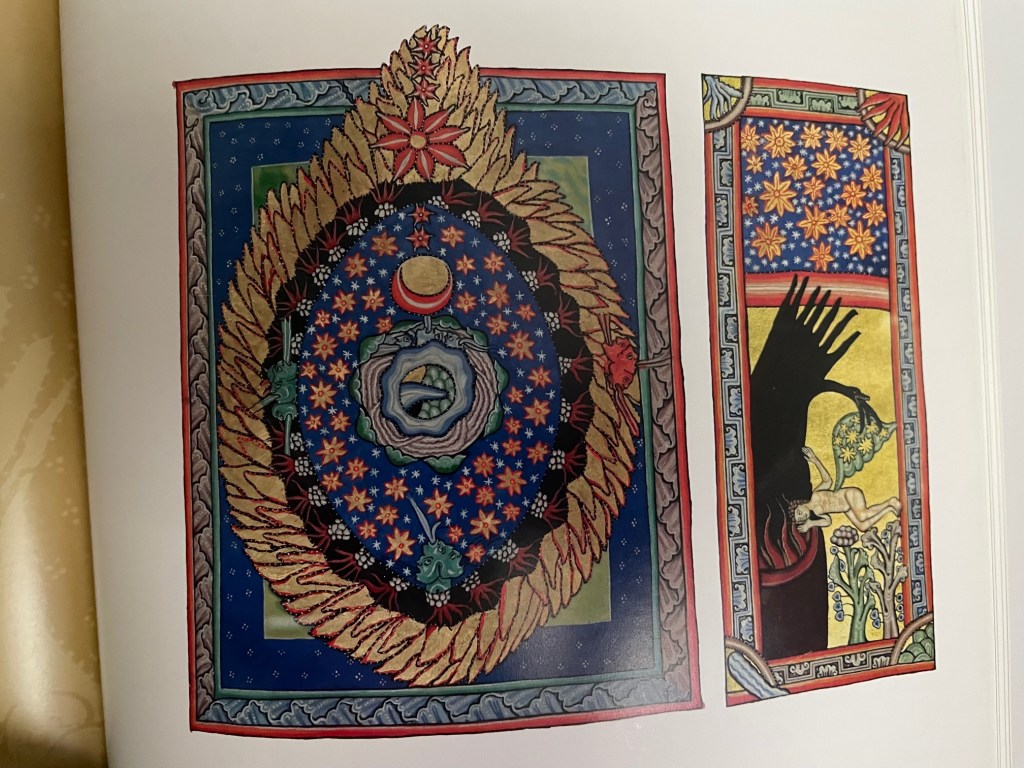
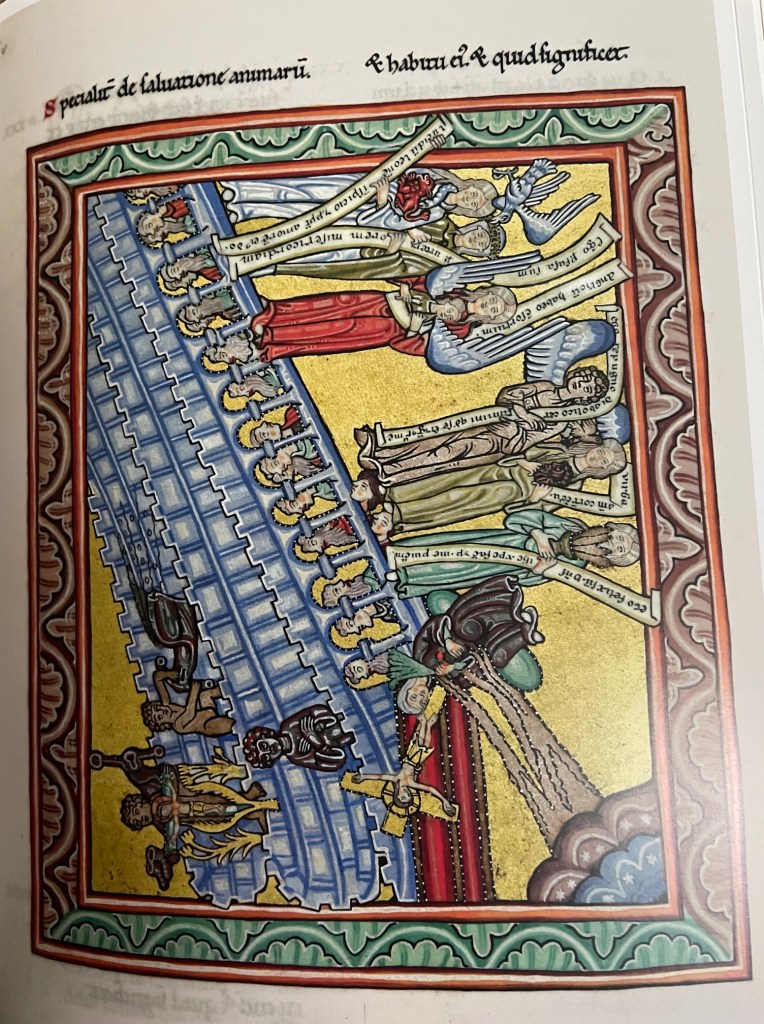
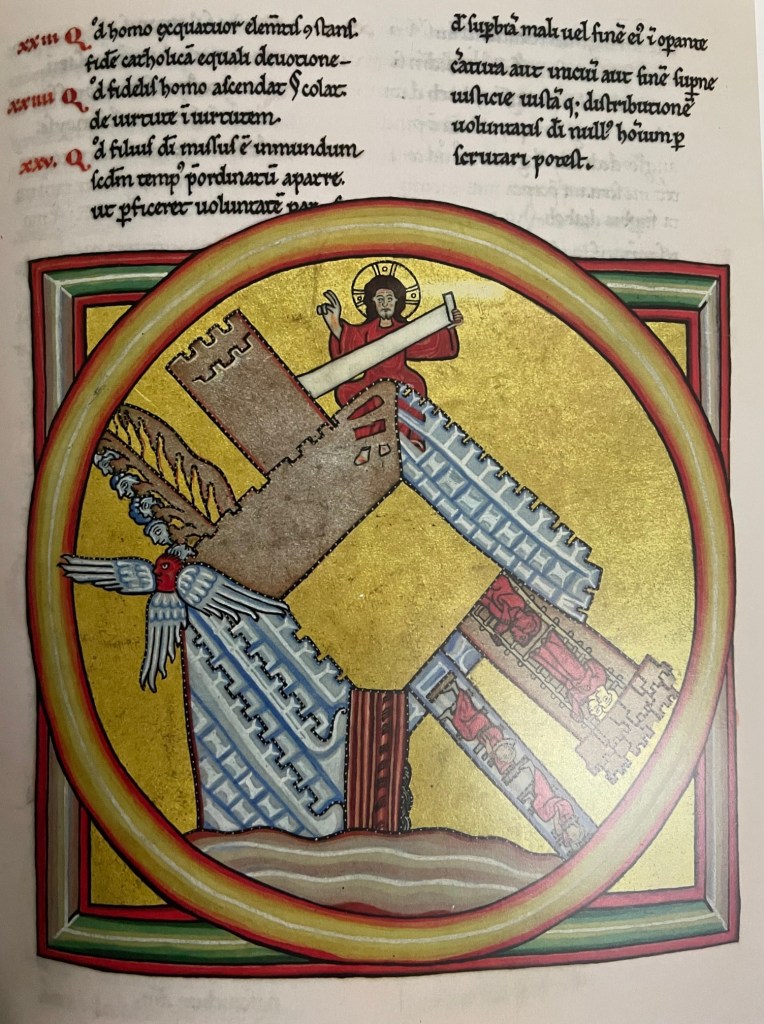
The visions themselves are organized into sections. Hildegard gave each a title, summarized list of chapters, description, explanation and Biblical passages to go along with each. In a time when very few were literate, Hildegard’s illustrated visions were used as teaching tools, similar to medieval bestiaries. (Which I learned about here: Book of Beasts: The Bestiary in the Medieval World)

The colorful visions of Hildegard are meant to be experienced rather than enjoyed second-hand, so I won’t bore you with extensive descriptions about them. But I will share my impression of her work.

I found Hildegard to be transportive. I didn’t understand all of them, but the images speak to my subconscious mind through their beauty and repetitive patterns. “Look at the mystery of existence,” they seem to say.

I think its fascinating that Hildegard was a female mystic in a tradition where the divine feminine was relegated to a backseat role. (No offense meant to the tradition by the way, just an observation.) It makes me wonder where such mystics are today, if they exist.

And if they do, would we listen and learn from them like Hildegard? Or dismiss their experience as a brain malfunction and put them on medication.

Something to consider. Highly recommended for spiritual seekers.

Thanks for reading!

Blood of Elves (The Witcher, #1) by Andrzej Sapkowski

Blood of Elves (The Witcher, #1) by Andrzej Sapkowski

In a fantasy realm where the races of humankind, elves, dwarves, and gnomes have ceased to co-exist peacefully, there lives a princess whose inner power, if left uncontrolled, could destroy the world. Geralt of Rivia, also known as the Witcher, and his friends, are tasked with not only protecting this girl but also instructing her so that her abilities don’t destroy her mind from the inside-out.

“Ciri had heard such reassurances in the past. … Now she believed it. Because it was Geralt of Rivia, the White Wolf, the Witcher, who said it. The man who was her destiny.” pg 11, ebook

Photo by Lukas Hartmann on Pexels.com

But there are forces in this world who are seeking Ciri for other reasons. She has the potential to be a force for the greater good or a weapon of chaos.

“Difficult times are approaching,” she said quietly. “Difficult and dangerous. A time of change is coming. It would be a shame to grow old with the uncomfortable conviction that one had done nothing to ensure that these changes are for the better.” pg 23, ebook

I picked up Blood of Elves because I recently watched most of the Netflix show based on the video games and also these books. I thought Blood of Elves was the first in the series, but apparently I missed a short story collection prior to this book.

That didn’t lessen my enjoyment of this tale, but I do enjoy having context. Andrzej Sapkowski does a good job of dropping bread crumbs about who Witchers are, who Ciri is, and the complex interactions of the different powers in the world, so newcomers to the book-version of the story, like me, can keep up and it doesn’t feel like an information dump.

“You are not learning in order to kill and be killed. You are not learning to kill out of fear and hatred, but in order to save lives. Your own and those of others.” pg 59, ebook

Photo by Engin Akyurt on Pexels.com

A small complaint though, and I had this same comment about the Netflix show, is that the storyline bounces around quite a lot. If you’re not paying attention, or reading carefully, you’re in danger of losing the thread because this isn’t a simple world nor is it populated by one dimensional characters.

Sapkowski shines in the dialogue between these characters, especially during the action sequences. It is easy to see why a video game was created using this material.

“Remember,” she repeated. “magic is Chaos, Art and Science. It is a curse, a blessing and progress. It all depends on who uses magic, how they use it, and to what purpose.” pg 147, ebook

Highly recommended for fans of the genre, the games or show. Blood of Elves delivers.

Thanks for reading!

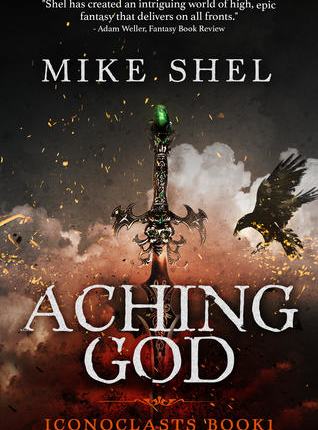
Aching God (Iconoclasts, #1) by Mike Shel

Aching God (Iconoclasts, #1) by Mike Shel

In the fantasy world of Aching God, a mysterious plague has emerged at the headquarters of the Syraeic League, an adventuring guild that explores the ruins of an ancient civilization. Their century-old quest is to retrieve relics from the ruins and to discover more information about its culture and gods.

Auric Manteo used to go on these quests for the League until a disastrous final foray led to an abrupt retirement and years of nightmares. But things have been looking up for the aging adventurer, until he receives a letter from the League requesting his help in banishing the plague.

Photo by John-Mark Smith on Pexels.com

“Three years of untroubled sleep, disturbed by this nightmare the very morning a summons to Boudun and the Citadel arrived? Was it a hateful premonition?” pg 28, ebook

Can Auric face the demons from his past in order to save the afflicted from the ravages of the Aching God?

“His mind flashed to images from his tenacious nightmare: the corpses, the pit, Lenda’s raggedly severed head gaping at him in accusation. He rested a shaking hand on the pommel of his sword to steady it.” pg 73, ebook

Photo by Susanne Jutzeler on Pexels.com

Despite its promise, I think Aching God would be a better dungeon module than it is a story. Mike Shel begins to flesh out his characters, but they never get far beyond the basics of birthplace and motivation. I didn’t feel drawn to any of the characters because of this superficial depiction.

His magic system with its secretive sorcerers who embed gems in their foreheads in order to bind themselves to their magical powers and comrades was also interesting. But, again, Shel leaves a majority of the storytelling to the reader’s imagination rather than actually writing it.

The adventure itself is linear with few unexpected twists and turns. Even the reveal of the great mystery of the Aching God leaves something to be desired.

Only recommended for readers who adore the fantasy adventure genre. Otherwise I would give this a pass.

Thanks for reading!

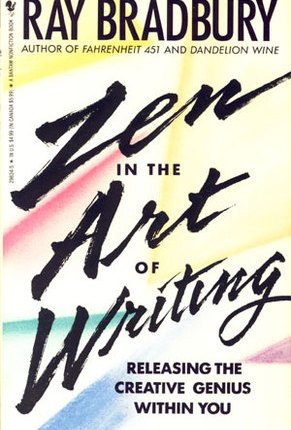
Zen in the Art of Writing by Ray Bradbury

Zen in the Art of Writing by Ray Bradbury

Ray Bradbury, a titanic author of American science fiction, shares remembrances and anecdotes from his lifetime. Within the essays, Bradbury shares both his passion for writing and the methods with which he accomplished it.

“And what, you ask, does writing teach us? First and foremost, it reminds us that we are alive and that it is a gift and a privilege, not a right. … Secondly, writing is survival.” pg 12, ebook

From his childhood days in Waukegan, Illinois, to penning screen plays in Ireland, Bradbury mined his life experiences with his subconscious mind and unearthed, so to speak, the stories that he wrote.

Ray Bradbury

“And when a man talks from his heart, in his moment of truth, he speaks poetry.” pg 32, ebook

Bradbury also highlights the importance of writing at least a little bit every day. Through his habit of writing an essay a week, Bradbury cranked out hundreds during his lifetime. Though he admits not all of them were brilliant, each one brought something to his experience, whether that was honing his craft or creating avenues towards other brighter stories.

Recommended for aspiring authors or any reader who is a fan of Bradbury. This book shines a spotlight on both the man and his creations.

Thanks for reading!

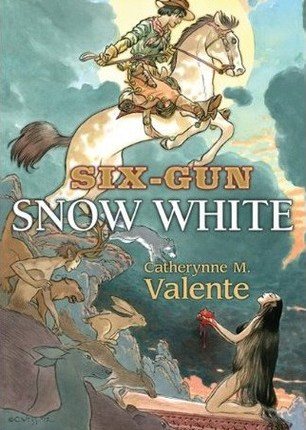
Six-Gun Snow White by Catherynne M. Valente

Six-Gun Snow White by Catherynne M. Valente

“I gradually understood the truth of my situation: I was a secret.” pg 14, ebook.

Catherynne Valente has penned a bewildering and ultimately disappointing western-tinged fairy tale retelling in Six-Gun Snow White. Her reimagining of the classic story has Snow White as an unloved daughter of a mine speculator and an abused, indigenous mother. When her mother ends her own life, Snow White’s father marries a mysterious woman from back East, the evil stepmother of fairytale infamy, whom the narrator calls Mrs. H.

“She named me a thing I could aspire to but never become, the one thing I was not and could never be: Snow White.” pg 27, ebook

Photo by John Finkelstein on Pexels.com

The disappointing part of the story is not the set up or general idea of Snow White as a western, both of which I thought were excellent. The trouble arrives in the magical portions of the story which are, in my opinion, not well written. They felt disjointed and tacked on.

It’s curious to me that I didn’t like this story because Valente is one of my favorite authors. There is no one like her when it comes to an interwoven story or mysterious magic. Maybe my issue with this tale is that it’s so short Valente didn’t have a chance to work her usual story telling magic? Perhaps.

The ending was an enormous let down as well.

Not recommended.

Thanks for reading!

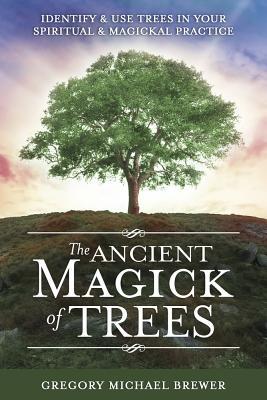
The Ancient Magick of Trees: Identify & Use Trees in Your Spiritual & Magickal Practice by Gregory Brewer

The Ancient Magick of Trees: Identify & Use Trees in Your Spiritual & Magickal Practice by Gregory Brewer

“Since the dawn of humanity, in all cultures and religions across the globe, trees have been revered not only as a life-sustaining source of food and medicine but also as a place where spirits dwelt, awaiting to reveal great mysteries to those who sought their wisdom, knowledge, and magick.” pg 2

Author Gregory Brewer examines the wonder and mystery that are trees from the pagan perspective in this book which is part informational, tree-related ritual/meditation suggestions, and reference.

Photo by Pixabay on Pexels.com

Understanding the symbolism of trees throughout countless cultures of human history is an enlightening study, but equally important is learning to form a personal connection with them in order to better comprehend the interaction of how the divine reveals itself to us through nature.” pg 243

The majority of the book is dedicated to descriptions and occult associations for different types of trees.

I read The Ancient Magick of Trees in order to learn more ways to invite nature into my life. The book has that but I found Forest Bathing: How Trees Can Help You Find Health and Happiness to be more immediately practical. I also connected more with the information in the forest bathing book.

Thanks for reading!

The Witch’s Heart by Genevieve Gornichec

The Witch’s Heart by Genevieve Gornichec

“The third time she was reborn, Gullveig fled, though she left something behind: her speared heart, still smoking on the pyre.” pg 4

Angrboda, the Norse witch formerly known as ‘Gullveig’, is hiding from the Aesir when the trickster god Loki finds her. And changes her life (or in her case: lives) forever.

“Although her memories as Gullveig were vague enough, she recalled feeling like she didn’t belong – and the moment they’d turned on her, burned her, she’d felt a lot of things. But the emotion she could recall most distinctly was not fear or anger, but the feeling of being used.” pg 43

Photo by Jeremy Bishop on Pexels.com

The gods kill Angrboda because of her refusal to share the secret of her scrying power, called ‘seid’. She will not look into the future and give Odin the mysteries that reside at the end of all things.

Odin does not take no for an answer.

Genevieve Gornichec reimagines the shadowy character of Angrboda in this Norse myth-filled retelling. Maybe it’s because I’m a classics major and gravitate towards mythology, but it seems to me that it has become somewhat popular to do so – think The Song of Achilles or Circe.

Photo by Bakr Magrabi on Pexels.com

In this case, I feel like Gornichec didn’t go far enough in her imagining. She gave Angrboda a voice, a rare talent, and a fierce love for her children, but, beyond that, the witch remains a fairly passive character.

Part of this could be due to the fact that the Aesir are such powerhouses in the old myths. They hog the spotlight and the action. But still, I believe there’s enough room around the stories to give a figure whose mythology has been largely forgotten a new legacy.

I think the biggest missed opportunity for this is in Angrboda’s relationship with Loki.

“She would do anything for him, she realized then… And for some reason, this scared her, as if the thought itself were a promise she knew that she couldn’t hope to keep.” pg 74

Photo by Liza Summer on Pexels.com

Like the other major players in the mythology, readers will be familiar with many of Loki’s hijinks. He is constantly in action, tricking people or becoming the victim of his own cleverness. What readers have never really gotten to see is his interior world. What is he thinking when he pulls his legendary stunts? What are his secret motivations?

One would think this is something he might share with a lover. But the storytelling never quite got there and I found The Witch’s Heart to be rather a disappointment in that way.

That being said, if you’re a reader who enjoys mythological retellings, there is still much to enjoy in this story. It is well-written if fairly limited in scope.

Thanks for reading!

The Heretic’s Guide to Homecoming: Book One: Theory by Sienna Tristen

The Heretic’s Guide to Homecoming: Book One: Theory by Sienna Tristen

The Heretic’s Guide to Homecoming is a fantasy journey in which Ronoah, an introverted and anxious main character, discovers a strength inside himself that he didn’t know he had and, along the way, learns about the world outside of the regimented and ill-fitting expectations of his hometown.

It is not a simple adventure because Ronoah, with all of his hang ups, is a very unlikely hero.

“… Ronoah was not one tenth the rebel she needed him to be. Inertia had him by the throat, and its consequence was a keen pain squatting ugly at the bottom of his soul, rotting it from the roots up.” pg 9

Photo by Mariana Montrazi on Pexels.com

Like other readers, I found author Sienne Tristen‘s depiction of Ronoah’s crippling anxiety and panic attacks to be one of the most insightful and sensitive pieces of writing I’ve ever had the privilege to read. Unlike most works of fantasy in which the action takes place in an external world, Ronoah’s greatest battles are in his own mind.

The anxiety speaks with its own voice and becomes a main character throughout the story.

“What were you thinking, it sneered, acting like you’re so important, so worldly, making it out like you’re some big intellectual champion when all you really are is a petulant runaway with a few bits of trivia stuck in your useless head? Talking and talking like you’re an authority on anything- who do you think you are?” pg 53

Photo by Brigitte Tohm on Pexels.com

Ronoah’s interactions with the other characters from the book take on a secondary importance to the all-encompassing relationship that he has with his inner world. But they are still beautiful connections.

“… He had this way of grabbing life by the horns and refusing to let go, no matter how it tried to shake him off. You know those people you sometimes find, the ones who…” “Who shine.” pg 154

Sienna Tristen’s writing brings to light foibles of anxious people that might otherwise remain shrouded in the sufferer’s inability to vocalize their feelings. Anybody who has ever spent a sleepless night stuck in the agony of fear and indecision will understand exactly what Tristen is spelling out in this story.

On the other hand, I found the first two-thirds of the book to be extremely triggering because of this gigantic magnifying glass that is held up to anxiety. The pacing didn’t do me any favors either. As Ronoah slowly twisted in the unending spirals of panic in his own head, I hung on the hook right along with him.

Photo by Meruyert Gonullu on Pexels.com

It was helpful to see Ronoah’s thinking process which Tristen writes so beautifully. Almost every time, readers can feel the moment he tips from functional person with some worries to frozen anxious mess. In my own life, I’ve started to watch for those tipping points- the moments I go from concerned about the future to paralyzed by anxiety. It has actually been quite illuminating.

But all of that new found self knowledge doesn’t make for a fun read. Fiction is one of my escapes from reality. In this book, I found quite a lot of reality and it wasn’t an escape after all.

“How far do you have to push your boundaries before you can feel them stretch? How high do you have to climb before your horizon expands? Is it possible to notice your own growing, or is improvement like an eyeball- visible to everything but itself?” pg 193

Recommended for readers who don’t mind very slow pacing in exchange for gorgeous writing about anxiety. Mind the triggers.

Thanks for reading!