The Red Book: Liber Novus by C.G. Jung

The Red Book: Liber Novus by C.G. Jung

“The years, of which I have spoken to you, when I pursued the inner images, were the most important time of my life. Everything else is to be derived from this.” preface

The Red Book is a stunning publication. It is a physically large book which mimics Jung’s own handwritten copy which measured 11.57 inches by 15.35 inches.

Carl Jung’s calligraphy

The contents are just as impressive. The first part is a brief history of Jung and his publications. The second contains pages of calligraphy in both German and Latin of his “active imagination” visualizations as well as sketches and paintings created by Jung to accompany the text.

The last section of the book is the English translation of the second part.

“Jung described his technique for inducing such spontaneous fantasies: ‘The training consists first of all in systematic exercises to eliminating critical attention, thus producing a vacuum in consciousness.'” pg 209

Painting from Carl Jung’s The Red Book

The visions themselves are interactions between Jung and voices or figures that he named his soul, gods and other archetypical figures.

“To this my soul spoke a word that roused my anger: ‘My light is not of this world.’ I cried, “I know of no other world.” The soul answered, “Should it not exist because you know nothing of it?” pg 240

As he stated in the preface, Jung felt as if his ‘confrontations with his subconscious’ affected his work for the rest of his life. It is a fascinating, little-examined side of a man who has had a huge effect on psychology and is credited, by some, as being one of the leading figures of the New Age movement.

The road to publication for this book is a story in itself. At first, Jung’s family carefully kept The Red Book in a safe deposit box to protect it as they recognized its value as a one-of-a-kind creation. They also believed that Jung wouldn’t have wanted its contents made public as he hadn’t left any specific instructions in his will about it.
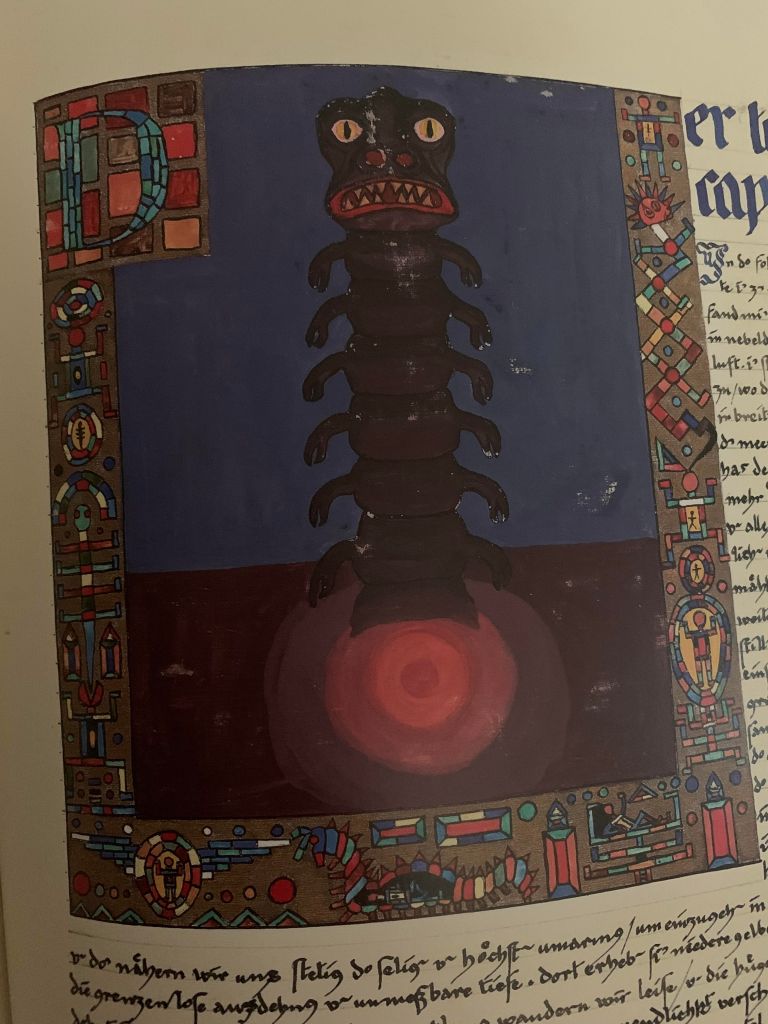
Painting from Carl Jung’s The Red Book

However, researchers and scholars have since examined the text and found parts where Jung addresses, “my dear friends,” leading to the opinion that he did intend to share it with a wider audience. They also point to its importance to Jung’s following works as another reason why it should be published.

Whatever their reasoning, I’m so very glad his family and foundation made the decision to publish. This book is a treasure.

Curiously, The Red Book ends in an incomplete sentence.

Here it is:“I knew of nothing better than to write them down in a ‘precious,’ that is to say, costly book and to paint the images that emerged through reliving it all- as well as I could. I knew how frightfully inadequate this undertaking was, but despite much work and many distractions I remained true to it, even if another/possibility never…” epilogue

Painting from Carl Jung’s The Red Book

I wonder what he was going to write next.

Though I didn’t use Jung’s method of active imagination, I too have undertaken lengthy ‘confrontations’ of my subconscious and have come back with pages of material that read, in some ways, quite similar to this book.

Perhaps, one day, I will also find the courage to publish it.

Highly recommended for any readers interested in Carl Jung’s methods, archetypes or dream interpretation.

Thanks for reading!

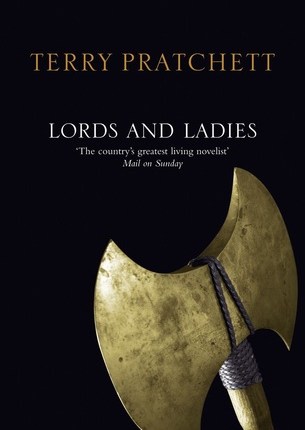
Lords and Ladies (Discworld, #14; Witches #4) by Terry Pratchett

Lords and Ladies (Discworld, #14; Witches #4) by Terry Pratchett

Granny Weatherwax set about finding out what had been happening around the stones in her own distinctive way.” pg 46

Headology, humor and elves are the focus of Lords and Ladies, the fourth entry in The Witches series of Discworld books.

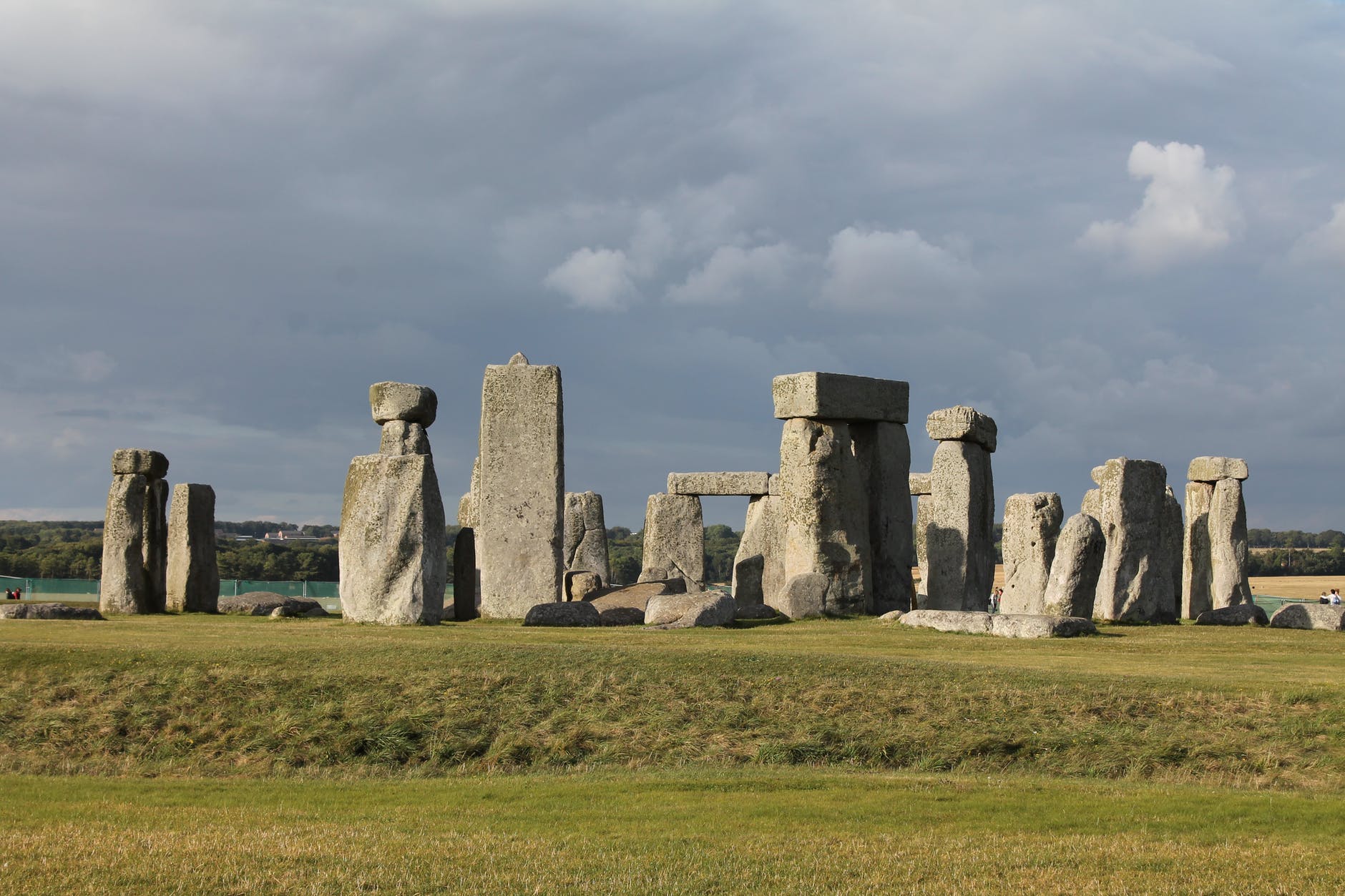
A ring of ancient stones sits in the mountains above Lancre. They were erected so many years ago that no one remembers why they were put up in the first place. No one, that is, except the witches.

Photo by Kris Schulze on Pexels.com

Granny Weatherwax, Nanny Ogg and Magrat have returned from their long journey to install Magrat as a short-term fairy godmother and to free a distant city from the tyranny of stories- a far more dangerous trip than any of them realized it would be.

Upon their return, Verence, the recently crowned king of Lancre, announces his intention to wed Magrat. While the preparations are taking place, something dangerous and cold is pushing its way into Discworld through the stones upon the hill.

“You know,” she said. “The Fair Folk. The Gentry. The Shining Ones. The Star People. You know.” pg 53

Too bad the elves are nothing like what people remember in the fairy tales.

Terry Pratchett takes a completely different view of the elves than any other fantasy author I’ve ever read. Their beauty and glamor hides a viciousness that makes them terrifying rather than enchanting.

Photo by Pixabay on Pexels.com

The three witches face the danger in their own unique way- a charming combination of psychology and common sense.

Unlike the last book where I felt that Magrat was disparaged and bullied, I feel like she comes into her own in Lords and Ladies.

“If you fought an elf and lost… then, if you were lucky, you would die.” pg 169

Photo by Pixabay on Pexels.com

We get to learn more about Granny Weatherwax’s mysterious past as well as Nanny Ogg’s capacity to fascinate a certain amorous dwarf.

Overall, I think it is one of Pratchett’s best. At least, that’s what I believe so far. We’ve reached the end of the Discworld books that I read eight years ago, so perhaps there are some gems waiting in my future.

I’ll let you all know. 🙂

Highly recommended for fans of fantasy and British humor.

Thanks for reading!

The Song of Achilles by Madeline Miller

The Song of Achilles by Madeline Miller

Madeline Miller brings her incomparable talent for rewriting ancient myths for the modern audience to the tale of the Greek hero, Achilles, and his lover, Patroclus.

“For many years now, Achilles, I have urged companions on you and you have turned them away. Why this boy?” … “He is surprising.” pg 26, ebook

Photo by Bakr Magrabi on Pexels.com

Readers don’t have to be familiar with the mythology behind the story to enjoy it. In addition, Miller includes a helpful guide of figures from classical myth at the back of the book in case you are in need of a refresher course.

Here’s a brief summary: Helen, the most beautiful woman in the world, is kidnapped (or leaves of her own accord, it’s unclear) and taken to Troy. Warriors around the globe gather to fight on one side or another because of this inciting incident, and the gods do as well.

As told in The Illiad, it is a struggle between mortals, immortals, and those who stand inbetween those two- the demi-gods, children of both worlds.

Among this special group, there is the son of Thetis, a sea nymph, and Peleus, the king of a small Grecian country. His name is Achilles. There is a prophecy, a couple in fact, about Achilles and that plays a large part in the story that follows.

Photo by GEORGE DESIPRIS on Pexels.com

The part of the story that has not been told before, and that Miller illustrates with such brilliance, is the life of Patroclus, the man whose death is so central in the myth but who is rather ancillary to the other heroes in the original telling.

“This was more of the gods than I had ever seen in my life. He made it look beautiful, this sweating, hacking art of ours.” pg 32, ebook

Miller also brings attention to the shadowy figure of Thetis, Achilles’ mother. Her role in the story was marginalized as well, but in The Song of Achilles she comes to the forefront.

Like parents throughout history, she wants her son to succeed to the best of his ability. In this particular case, she thinks he should shed his mortality take his place among the gods.

To do so, he has to achieve godlike status on earth. Falling in love with a mortal does not fit into Thetis’ plan for Achilles’ future.

Photo by Hernan Pauccara on Pexels.com

“There is no law that gods must be fair, Achilles,” Chiron said. pg 55

I read Miller’s Circe prior to this story and so wasn’t surprised that I enjoyed this tale as much as I did. As I mentioned before, she excels at taking old themes and making them feel new again.

This cultural development is important for humanity, as I recently read in Antigone Rising: The Subversive Power of the Ancient Myths. There is power in the stories we tell and the manner in which we tell them. It helps to shape the future.

Highly recommended for readers who enjoy mythology or a simply well-told tale.

Thanks for reading!

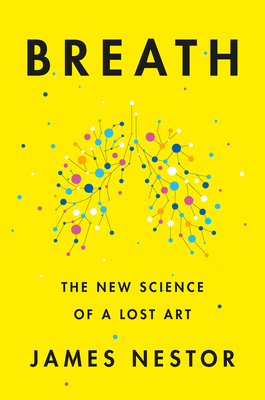
Breath: The New Science of a Lost Art by James Nestor

Breath: The New Science of a Lost Art by James Nestor

James Nestor takes a deep dive into the fascinating and surprisingly mysterious world of breathing. “How mysterious could it be, Heidi?” I hear you ask. It’s something everyone does without thinking literally a few times every minute every day of their lives.

Photo by Daisa TJ on Pexels.com

Well, there’s a lot of mysteriousness, as Nestor discovered through his journey from terrible breathing to consciousness-shifting, bone-building, better breathing.

“I do as instructed, and listen as the rushing wind that was pouring through my lungs suddenly stops and is replaced by pure silence, the kind of jarring quietude a skydiver feels the moment a parachute opens. But this stillness is coming from inside.” pg 143, ebook

He talks to researchers and mystics from around the globe to access both cutting edge research as well as ancient teachings from such exalted texts as The Upanishads.

What he’s discussing here isn’t new, but it feels new, perhaps because of the chronic disconnect between the mind and body that seems to haunt modern humanity.

Photo by Craig Adderley on Pexels.com

From breathing slower to exhaling more, the dangerous of mouth breathing and the astonishing connection carbon dioxide inhalation has to panic attacks, there’s a lot to explore.

And, despite all of the observed benefits and ten years of extensive research, Nestor doesn’t forget to mention that breathing isn’t a panacea. I appreciated that part as well.

“… what I’d like to make clear now, is that breathing, like any therapy or medication, can’t do everything. Breathing fast, slow, or not at all can’t make an embolism go away. … No breathing can heal stage IV cancer. These severe problems require urgent medical attention.” pg 184-185, ebook

Photo by Daria Shevtsova on Pexels.com

I bookmarked all of the exercises Nestor gathers together from the text and lists at the end of the book. Each has similar yet slightly different affects according to practitioners of the methods. I may have to try every one to see for myself.

Highly recommended.

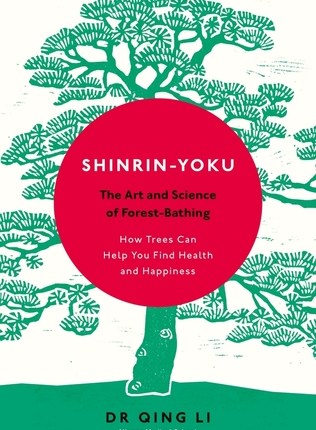
Shinrin-Yoku: The Art and Science of Forest Bathing by Qing Li

Shinrin-Yoku: The Art and Science of Forest Bathing by Qing Li

“Shinrin-yoku means bathing in the forest atmosphere, or taking in the forest through our senses. This is not exercise, or hiking, or jogging. It is simply being in nature, connecting with it through our sense of sight, hearing, taste, smell and touch.” pg 12

Nature lovers or those aspiring to be nature lovers will find much to enjoy in Shinrin-Yoku: The Art and Science of Forest Bathing.

Photo by Jose Vega on Pexels.com

Qing Li reminds readers that the human race is a part of this world even if we have walled ourselves up in cities and covered the ground in concrete. Through various scientific studies, he proves again and again that by taking a time out and forest bathing people can sleep more deeply, experience less stress and think more clearly.

“We may not travel very far on our forest walk but, in connecting us with nature, shinrin-yoku takes us all the way home to our true selves.” pg 15

Not convinced? He provides evidence that patients at hospitals heal faster if the view outside their window includes a tree rather than a wall. People who exercise outside report the exertion they need to complete the workout is less and they enjoy the time more than those who churn out the miles on a treadmill.

“The average sleep time of participants after a two-hour forest walk increased by 15 percent, or fifty-four minutes. Participants were significantly less anxious after a two-hour walk in the forest.”

Photo by WARREN BLAKE on Pexels.com

Forest bathers have reported higher levels of creativity, writers find relief from the dreaded block, and the sense of connection caused by the practice has been known to increase feelings of gratitude.

“The researchers concluded that there ‘is a real, measurable cognitive advantage to be realized if we spend time truly immersed in a natural setting’, and found that spending time in nature can boost problem-solving ability and creativity by 50 per cent. Is it any wonder that Buddha found enlightenment sitting under a tree?” pg 106

Is there anything that forest bathing doesn’t help? How about your health or physical age?

“A group of Canadian, American and Australian researchers studying tree density and health in Toronto found that… having eleven more trees on a block lowered cardio-metabolic illnesses, like high blood pressure, diabetes and obesity, comparable to the effects on well-being conferred by being given a $20,000 a year pay rise or being 1.4 years younger.” pg 116

Photo by Johannes Plenio on Pexels.com

In addition to the information about forest bathing, this book contains beautiful photos of forests every couple of pages. Qing Li gives readers the instructions so, if they desired, they could hold their own traditional tea ceremony in the woods. He includes anecdotal information about aromatherapy, tips on how to bring the forest into your home, advice on how to incorporate beneficial natural sounds into your daily life and more.

I enjoyed this book very much. Highly recommended.

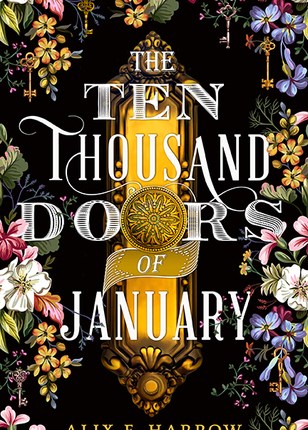
The Ten Thousand Doors of January by Alix E. Harrow

The Ten Thousand Doors of January by Alix E. Harrow

The Ten Thousand Doors of January is a beautiful portal fantasy novel wherein our heroine learns the world contains far more magic than she imagined and so does she.

Photo by Pixabay on Pexels.com

“If we address stories as archaeological sites, and dust through their layers with meticulous care, we find at some level there is always a doorway. A dividing point between here and there, us and them, mundane and magical. It is at the moments when the doors open, when things flow between the worlds, that stories happen.” pg 2

January has never quite fit into the glittering and privileged world of her fabulously wealthy guardian, Mr. Locke. She perpetually waits for her father to return from his many voyages where he’s constantly seeking lost treasures for his demanding employer.

She has very few friends, except Samuel, the local grocer’s son, and, eventually, a feisty hound named Sinbad, “Bad” to those who know him. In her enforced solitude, January has a lot of time to herself. One day, she discovers something strange in a field.

Photo by Irina Iriser on Pexels.com

“I almost didn’t notice the Door at all. All Doors are like that, half-shadowed and sideways until someone looks at them in just the right way.” pg 8

Once she has found the way to another world, January’s life is never quite the same.

I really enjoyed this debut novel by Alix Harrow. The writing is beautiful and most of the book acts as an homage to reading as an escape.

“It smelled of salt and age and adventure. It smelled like another world, and I want to return right this minute and walk those strange streets. Instead, I added articulately, “I liked it.” pg 13

Photo by Harrison Haines on Pexels.com

It also asks the reader to consider the magic of thresholds. The two-headed Roman god, Janus, from which we get the name of the month, January, had an interesting place in the pantheon. Though he didn’t necessarily have a priest dedicated to only him, Janus would be invoked at the start of each religious ceremony, no matter who the ceremony was dedicated to. It was appropriate because Janus holds the authority over beginnings and endings.

He also has a mystical association with the conscious and subconscious mind. The two faces of the god coincide to the two portions of a person’s psyche. Janus can symbolize the unification of these two minds in order to become something greater.

Photo by Octoptimist on Pexels.com

It relates to this story as January comes of age and claims her own, very unique, abilities as well as discovering her mysterious past.

It is also somewhat of a love story: “It’s a profoundly strange feeling, to stumble across someone whose desires are shaped so closely to your own, like reaching toward your reflection in a mirror and finding warm flesh under your fingertips. If you should ever be lucky enough to find that magical, fearful symmetry, I hope you’re brave enough to grab it with both hands and not let go.” pg 91

Photo by Ashley Williams on Pexels.com

Highly recommended for readers who enjoy fantasy. There’s plenty of magic and escape to enjoy in these pages.

Thanks for reading!

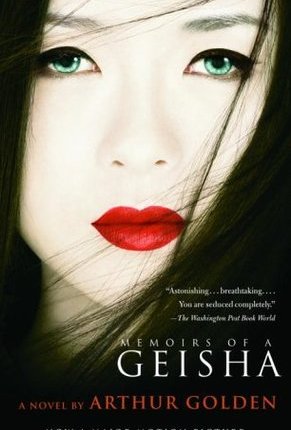
Memoirs of a Geisha by Arthur Golden

Memoirs of a Geisha by Arthur Golden

An engrossing historical fiction novel about a girl with extraordinary eyes named Chiyo and how she became a celebrated geisha named Sayuri. The path of her life was not always easy, but like water flowing over bumpy rocks, she braves the rapids and, eventually, reaches the ocean of her dreams.

“But the truth is the afternoon when I met Mr. Tanaka Ichiro really was the best and the worst of my life. He seemed so fascinating to me, even the fish smell on his hands was a kind of perfume. If I had never known him, I’m sure I would not have become a geisha.” pg 13, ebook

Photo by Anna Tarazevich on Pexels.com

It is a coming-of-age story but also a romance. Some have compared this book to the fairy tale of Cinderella. I see the comparison, but feel as if this historical fiction is better than Cinderella. Unlike the made-up fairy tale, the land and closed world of the geisha actually existed.

“After a block or two I worked up my courage and said to Mr. Bekku, “Won’t you please tell us where we’re going?” He didn’t look as if he would reply, but after a moment he said, “To your new home.” pg 41, ebook.

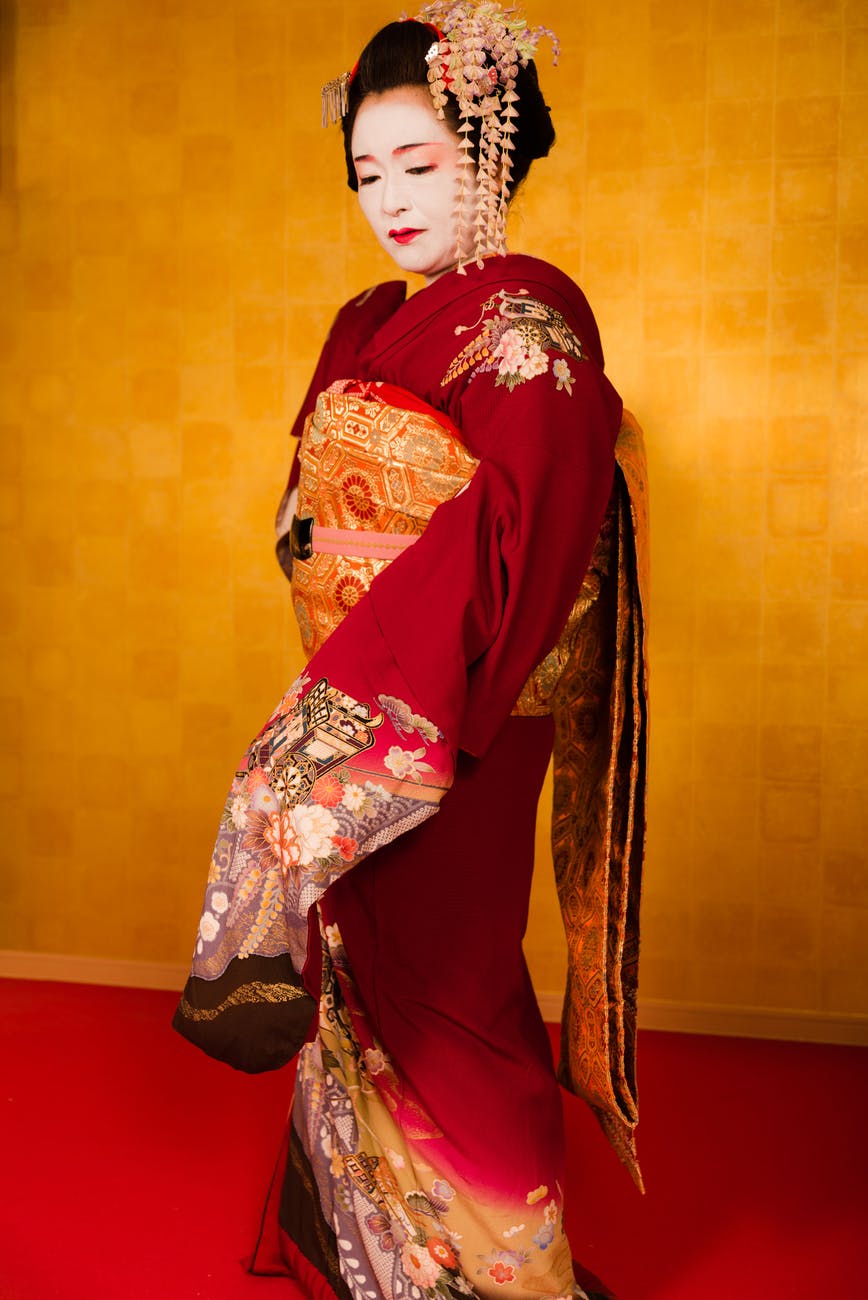
To be a geisha was to excel at the arts. It was to demonstrate excellence in dance, music and the art of conversation. It was a way of being, and dressing. As a geisha, Sayuri transports the men she is with to another world, the world of “Flowers and Willows”.

I did some research into the history of the geisha and what I found was fascinating. From what I read, the history portrayed in Memoirs of a Geisha was rather close to the truth, minus the made-up characters.

Photo by Ivan Siarbolin on Pexels.com

“Because, you see, when a geisha wakes up in the morning she is just like any other woman. … Only when she sits before her mirror to apply her makeup with care does she become a geisha. And I don’t mean that this is when she begins to look like one. This is when she begins to think like one too.” pg 67, ebook

The whole culture seems so exotic to me. This book is truly an escape into a different world. I, of course, adored the main character, Sayuri.

Years ago, I saw the film version of this book and remember enjoying it very much. Fortunately, I forgot most of it except for one critical moment towards the end. That, however, didn’t ruin my enjoyment of the book. It is better, much better.

There’s more character development, more battles with Hatsumomo, more to the conclusion. Sayuri’s life completes a circle in the written version of the story — I seem to remember that the story felt a bit stunted in the film. I think I’ll watch it again to see if I’m remembering it right.

“We lead our lives like water flowing down a hill, going more or less in one direction until we splash into something that forces us to find a new course. If I’d never met Mr. Tanaka, my life would have been a simple stream flowing from our tipsy house to the ocean.” pg 112, ebook

Photo by Dianne on Pexels.com

There’s also the development of the theme of water. The characters in the story attribute Sayuri’s startling blue eyes to an abundance of water in her soul. Throughout the book, she’s alluding to water — how it flows, bends and can wear down rocks. You really begin to view her life through this lens of watery inevitability.

“Here you are… a beautiful girl with nothing on earth to be ashamed of,” he said. “And yet you’re afraid to look at me. Someone has been cruel to you.. or perhaps life has been cruel.” “I don’t know, sir,” I said, though of course I knew perfectly well. pg 119, ebook.

Highly recommended for fans of historical fiction. Memoirs of a Geisha is a surprising treat, like a sudden rainbow glinting off the water into your eyes. Blink once, and it’s gone.

Thanks for reading!

Bloody Rose (The Band, #2) by Nicholas Eames

Bloody Rose (The Band, #2) by Nicholas Eames

Readers get the opportunity to return to the adventure-filled world of bands and monsters, Grandual, in Bloody Rose. Nicholas Eames second book in The Band series, the sequel to The Kings of the Wyld takes place years after the first book. It follows the exploits of a band called Fable, a bard named Tam and Bloody Rose, the daughter of Golden Gabe, one of the members of a band called Saga, who readers got to know and love in Kings of the Wyld.

The world is on the brink of annihilation, again.

“Hey, did you hear the news? There’s another Horde, apparently. North of Cragmoor, in the Brumal Wastes. Fifty thousand monsters hell-bent on invading Grandual.” pg 5

Photo by Lisa Fotios on Pexels.com

Tam wants to see the world, but her father is a retired mercenary. He doesn’t want Tam to have the life he led, risking life and limb to battle monsters. He also doesn’t want to lose her, like he lost her mother.

“To Tam, there was nothing worse than the prospect of never leaving home, of being cooped up in Ardburg until her dreams froze and her Wyld Heart withered in its cage.” pg 20

Bloody Rose, Gabriel’s daughter, has never quite left her father’s shadow, even though she’s a formidable fighter and bandleader in her own right.

“She’s got something to prove — whether it’s to herself, or her father, or the world in general, I don’t know. I can’t have been easy growing up the daughter of Golden Gabe. The man’s got boots even a giant could wriggle its toes in, but that doesn’t stop Rose from trying to fill them.” pg 63

The other members of Rose’s band include Brune (a shaman), Cura (an inkmage) and Freecloud (a mighty druin fighter). They have their own burdens to bear and shadows to face down. A large part of this story is getting to know them through the band’s adventures.

“And yet here they all were: at the cold edge of the world — each of them vying to be worthy of one another, to protect one another, to prove themselves a part of something to which they already, irrevocably belonged.” pg 265

Photo by eberhard grossgasteiger on Pexels.com

Like the first book, the world has become more civilized and bands fight in contrived battles against captive-bred monsters in arenas to the cheers from bloody-thirsty crowds. It is more show than substance.

“She began to question every song she’d ever heard about heroic mercenaries and vile monsters doing battle on the arena floor. If those so-called battles were anything like the one-sided slaughter she watched from the comfort of the Lair’s armory, then the work of a bard was even more difficult than she’d been led to believe.” pg 103

I enjoyed Bloody Rose, but I missed the characters from the first book. Eames writes an ripping tale, but my favorite parts of this book included cameos (and one rather large story arc) of people from the last one.

That being said, there is still the snappy dialogue, epic fights and breath-stealing finale that characterized Eames’ debut novel. Highly recommended for fantasy readers and I look forward to his next one.

Thanks for reading!

Senlin Ascends (The Books of Babel, #1) by Josiah Bancroft

Senlin Ascends (The Books of Babel, #1)  by Josiah Bancroft

Senlin Ascends is a steampunk adventure novel wherein our hero, Thomas Senlin, ventures into the mythical and massive Tower of Babel to reunite with his new wife and love of his life, Marya.

Sounds simple? It’s not.

Each ring of the tower is a different country with tyrannical and ruthless rulers who run their circle of influence with an iron fist. And as Senlin ascends, the technology becomes more and more advanced to the point where, even to an educated man like Senlin, it looks like magic.

Photo by Pixabay on Pexels.com

“There is a lot of debate over how many levels there are. Some scholars say there are fifty-two, others say as many as sixty. It’s impossible to judge from the ground.” pg 4

And their married life had started out so well…

“Their honeymoon was ruined, that much seemed certain. They would have to fabricate some fable of luxury to tell their friends, and he would, of course, make it all up to her with a quiet weekend in a pastoral cottage, but for the rest of their marriage she would remember what a terrible trial their honeymoon had been.” pg 16

Senlin is no fool in love though. He’s introverted, introspective and thoughtful. His wife, Marya, is younger and impulsive. Together, they make a great team. If only he could figure out which direction she went.

The character of Senlin is one of the delights of this fantasy novel. He’s prickly and doesn’t seem lovable right off the bat. But as you get to know him, you realize, he’s one-of-a-kind.

Photo by Enric Cruz Lu00f3pez on Pexels.com

“The subtext was obvious: Love, pure and eternal, reigned supreme. Senlin did not believe in that sort of love: sudden and selfish and insatiable. … He believed true love was more like an education: It was deep and subtle and never complete.” pg 59

Senlin is still hopeful he’ll find his wife until he discovers what the tower really is and what it does to the unknowing who venture within its walls.

“I am upset because we have pooled out human genius into the building of an elaborate Tower and have filled it up with the same tyrants that have plagued our race since we crawled from the sea. Why does our innovation never extend to our conscience?” pg 142.

Why indeed.

Photo by Navneet Shanu on Pexels.com

Highly recommended for fans of fantasy and adventure fiction. Senlin Ascends is a masterful debut novel and start of a unique series.

Thanks for reading!