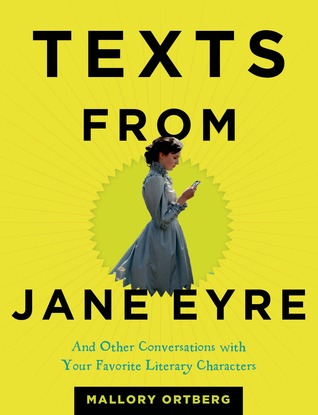
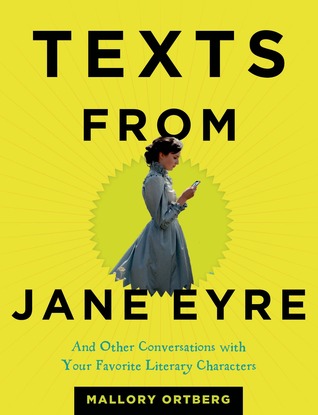
Though the premise was clever, Texts from Jane Eyre reads a lot like text message conversations in real life- shallow and repetitive after the first few lines.
Also, there wasn’t a synopsis included in these pages, so if you hadn’t read a classic or, if you’d read it so long ago that you’d forgotten most of it, you were out of luck.
The best of the lot was the Samuel Taylor Coleridge chapter that starts on pg 43 in which he’s on a ramble about the golden palace of Kubla Khan and then a delivery guy comes to the door and ruins his flow.
The worst was the Harry Potter chapter in which Ron and Hermione have a ‘conversation’ but Ron is written as a complete moron and she is confounded by his idiocy. Very mediocre and unworthy of either of those characters.
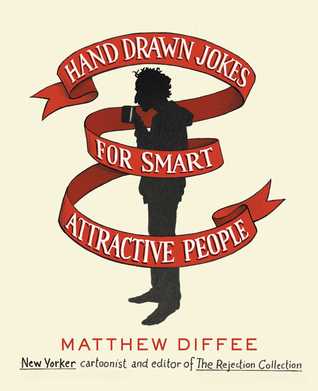
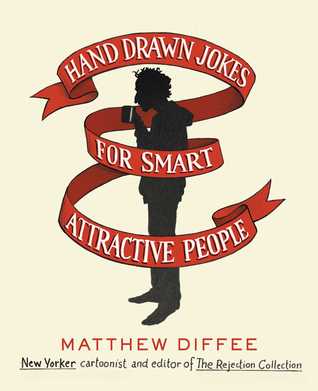
Sadly, the best part of this book is its inspired title: Hand Drawn Jokes for Smart Attractive People.
The rest is either clever, but not funny, or offensive depending on the page.
It’s a shame really- the artwork itself is great and it’s clear that Diffee is a talented cartoonist. I just didn’t connect with much of the work.
Out of all of it, my favorite cartoon was on page 188- Moses: The Teen Years where a young adult version of Moses is depicted staring into a mirror, carefully parting his long hair with a comb. The worst was the entirety of Chapter Eight: For Smart Attractive Indians and Eskimos and really soured this whole book for me.
Warning: this is a book you either love or hate. Consider yourself warned.
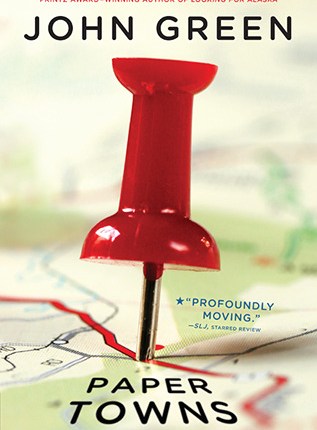
I fell more on the “hate” side of this equation but, surprisingly, enjoyed the film. This young adult, coming-of-age tale has elements of mystery to it.
Quentin has always loved Margo. One night, she wakes him up and they go on a wild tear about town, righting perceived wrongs and causing all sorts of hijinks.
Right off the bat, the reader is thrown into Margo and Quentin’s lives and we’re exposed to some of their worst traits rather than their best. Usually, people behave their best when you first get to know them and then, as they become comfortable with you, they let some of their more questionable sides out.
The whole “rolling around the neighborhood at night and causing mayhem” takes place right at the start of Paper Towns. It isn’t fun because we don’t really know these characters yet.
It’s easier to forgive adolescent hijinks when you know and love the people who are doing them, but we’ve got almost zero time to form a connection before they’re breaking laws.
I think I would have given up on Paper Towns if I hadn’t watched John Green’s TedTalks video on the topic. If you haven’t seen it yet, here it is:https://youtu.be/NgDGlcxYrhQ
Quick summary of Green’s video: The basic idea behind a paper town (a made up town on a map) was copyright protection. The coolest part is that the mapmakers took something that wasn’t real and made it real because they presented it that way for so long.
I know that John Green can write amazing, sympathetic characters. He chose not to in this book and I’ve been rolling it around my brain, wondering why.
I think that Green wrote the characters in this story like a paper town.
At first, he presents the main characters as over-the-top clichés of what teenagers could be. The reader isn’t necessarily meant to bond with them at this point, they’re not real, they’re just “people on paper.”
Then, through the second part of the book, let’s call it the “clue finding” part, Green slowly reveals more and more of the real parts of their characters just as Quentin finds more and more clues to where Margo has gone.
Through their hopes and dreams, relationships, daily struggles and hopes, they’re becoming more real.
Finally, in the last third of the book, as we join the characters on their mad rush to find Margo, they’ve become real. Real enough to have some close life-threatening moments on the road. Though they started out fake, Green built enough substance for the characters so that they have heft and dimension.
That’s my theory on why Green wrote such awful characters: he meant to. But, I still never liked any of them very much, even after they became “real.”
I liked Green’s prologue: “The way I figure it, everyone gets a miracle. Like, I will probably never be struck by lightning, or win a Nobel Prize, or become the dictator of a small nation in the Pacific Islands, or contract terminal ear cancer, or spontaneously combust. … My miracle was this: out of all the houses in all the subdivisions in all of Florida, I ended up living next door to Margo Roth Spiegelman.” pg 15 ebook.
“Margo always loved mysteries. And in everything that came afterward, I could never stop thinking that maybe she loved mysteries so much that she became one.” pg 23 (ebook)
And that was the high point in this book for me. It was all downhill afterwards.
Here’s the passage that helped develop my theory about Green writing paper characters in Paper Towns: “… she looks like Margo Roth Spiegelman, this girl I have known since I was two- this girl who was an idea that I loved. And it is only now, when she closes her notebook and places it inside a backpack next to her and then stands up and walks toward us, that I realize that the idea is not only wrong but dangerous. What a treacherous thing it is to believe that a person is more than a person.” pg 406 (ebook)



 The Help Desk Book Blog