It’s like the foreign legion for nerds,” I said, and laughed. “With polar bears.” “Or seals,” Aparna added.” pg 32, ebook
Master author John Scalzi penned a lovely book about large creatures in an alternate dimension. That ending though… no spoilers in this review so I won’t say much more about it other than it was a huge disappointment.
“We think we’re smart,” Niamh repeated. “And because we think we’re smart, we only looked at what we wanted to look at and didn’t think to look past it.” pg 165
I was looking for a light-hearted fiction read, which this book is. The characters are diverse and it was quite fun to discover the world Scalzi created for them.
The kaiju themselves are fascinating. Again, I don’t want to say too much and ruin the best part of this book- the creatures.
I liked the humor in the story even though the same gag is used multiple times. It lends a sense of familiarity in the middle of an alien world.
Though it does get a bit repetitive after a little while.
All that being said, I only recommend this book to Scalzi fans. I could not get over that ending.
“Star-crossed lovers! What will Demeter and Aphrodite think of their children’s secret relationship?” pg 20
The blurb for Electric Idol is what drew me in to this romance novel. I have not read the first book of “Dark Olympus” so I may have missed a ton of world building, which was missing from this entry in the series.
“Psyche Dimitriou might actually be what passes for a unicorn in Olympus – a good person.” pg 32
Welcome to Olympus, where the gods and goddesses walk among us, wielding their power not through magical powers, but through armed soldiers, assassins and social media.
All of which could have been very fun, but I felt this novel fell flat.
Most of the tension was in back-and-forth conversations between the two main characters that went something like – I love him/her so much. He/she could never love me. Oh no, people want to kill us.
It went on and on like that for more than 350 pages.
“I want Psyche for my own. A desire that was kindled that first night has grown beyond control in the last twenty-four hours. I don’t care if she deserves someone just as sweet as she is.” pg 123
There’s some erotic interludes in here so librarians please classify it correctly. Not young adult.
Only recommended for serious romance/erotica fans. Others may want to give it a pass.
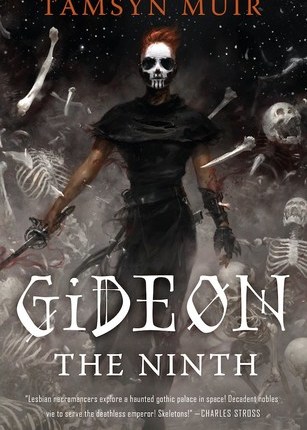
Gideon wants to escape from her dreary life on a dead end planet but when her plans are hijacked by the head of her household, she ends up having to become a cavalier for her nemesis. Snarky humor, profanity, and gothic themes follow.
“Gideon marveled that someone could live in the universe only seventeen years and yet wear black and sneer with such ancient self-assurance.” pg 24
I was unprepared for the violence and blood-soaked pages of this book. (Maybe I should have read some of the reviews first!)
I also had trouble keeping track of character’s titles. Each character could be referred to in three or four different ways, and the author used the titles interchangeably.
It made it hard for me to enjoy the story. The pacing was slow in the middle, which didn’t help matters.
One positive thing I have to say about Gideon the Ninth is the story is quite unique. I’ve never read a story about necromancers in space – until now.
Also, the humor was note-worthy. Tamsyn Muir, the author, uses modern language to build sparkling dialogue and funny interactions. If readers are fond of Deadpool, they may enjoy this story too.
I wish I had enjoyed it more. Only recommended for readers who like their humor dark, their bloody wounds flowing and their character lists massive.
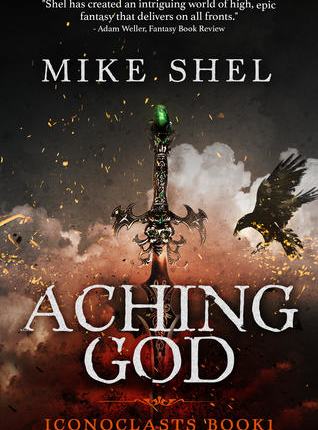
In the fantasy world of Aching God, a mysterious plague has emerged at the headquarters of the Syraeic League, an adventuring guild that explores the ruins of an ancient civilization. Their century-old quest is to retrieve relics from the ruins and to discover more information about its culture and gods.
Auric Manteo used to go on these quests for the League until a disastrous final foray led to an abrupt retirement and years of nightmares. But things have been looking up for the aging adventurer, until he receives a letter from the League requesting his help in banishing the plague.
“Three years of untroubled sleep, disturbed by this nightmare the very morning a summons to Boudun and the Citadel arrived? Was it a hateful premonition?” pg 28, ebook
Can Auric face the demons from his past in order to save the afflicted from the ravages of the Aching God?
“His mind flashed to images from his tenacious nightmare: the corpses, the pit, Lenda’s raggedly severed head gaping at him in accusation. He rested a shaking hand on the pommel of his sword to steady it.” pg 73, ebook
Despite its promise, I think Aching God would be a better dungeon module than it is a story. Mike Shel begins to flesh out his characters, but they never get far beyond the basics of birthplace and motivation. I didn’t feel drawn to any of the characters because of this superficial depiction.
His magic system with its secretive sorcerers who embed gems in their foreheads in order to bind themselves to their magical powers and comrades was also interesting. But, again, Shel leaves a majority of the storytelling to the reader’s imagination rather than actually writing it.
The adventure itself is linear with few unexpected twists and turns. Even the reveal of the great mystery of the Aching God leaves something to be desired.
Only recommended for readers who adore the fantasy adventure genre. Otherwise I would give this a pass.
“I gradually understood the truth of my situation: I was a secret.” pg 14, ebook.
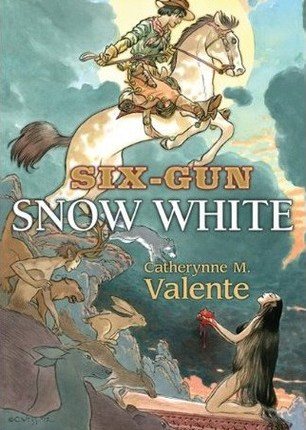
Catherynne Valente has penned a bewildering and ultimately disappointing western-tinged fairy tale retelling in Six-Gun Snow White. Her reimagining of the classic story has Snow White as an unloved daughter of a mine speculator and an abused, indigenous mother. When her mother ends her own life, Snow White’s father marries a mysterious woman from back East, the evil stepmother of fairytale infamy, whom the narrator calls Mrs. H.
“She named me a thing I could aspire to but never become, the one thing I was not and could never be: Snow White.” pg 27, ebook
The disappointing part of the story is not the set up or general idea of Snow White as a western, both of which I thought were excellent. The trouble arrives in the magical portions of the story which are, in my opinion, not well written. They felt disjointed and tacked on.
It’s curious to me that I didn’t like this story because Valente is one of my favorite authors. There is no one like her when it comes to an interwoven story or mysterious magic. Maybe my issue with this tale is that it’s so short Valente didn’t have a chance to work her usual story telling magic? Perhaps.
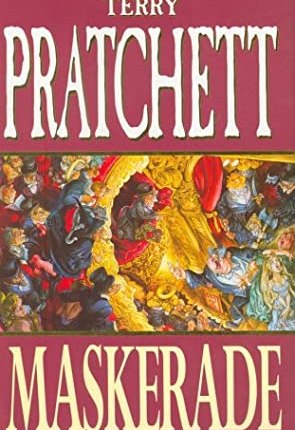
“The huge, be-columned, gargoyle-haunted face of Ankh-Morpork’s Opera House was there, in front of Agnes Nitt. She stopped. At least, most of Agnes stopped. There was a lot of Agnes.” pg 9, ebook.
The usually charming wit of Terry Pratchett falls flat in this entry of The Witches, a sub-series of Discworld.
Having already lampooned the general idea of ‘theater’ in Wyrd Sisters, Pratchett takes a crack at ‘musical theater’, specifically The Phantom of the Opera. Besides the addition of the witches to the mix, the main gag is that Agnes Nitt is fat.
It’s not a story that has aged well.
“Agnes was, Nanny considered, quite good-looking in an expansive kind of way; she was a fine figure of typical young Lancre womanhood. This meant she was approximately two womanhoods from anywhere else.” pg 21
Agnes is not the only person in the story with weight concerns, the other being one of the lead singers in the opera, a male. But Agnes, despite her obvious talents, is forced to sing in the chorus, providing the voice for a willowy female who looks the part.
All of this is just a backdrop for the larger story which is basically that Granny Weatherwax is bored and Nanny Ogg is afraid if they don’t find another member for their coven, then Granny will turn to the dark side.
Which no one wants, obviously. Because Granny Weatherwax is one of the greatest of her age in headology and general witchy works, which vary greatly depending upon the circumstances.
And it brings the readers back around to the concern that I addressed in earlier books about Magrat (the witch they’re looking to replace) being bullied by the other older witches in the coven. In Maskerade, they’re just looking for a new punching bag.
The one bright spot in the story was Greebo, slinking around in his predatory human form. I love how he talks to people, elongating his R’s and adopting a general attitude of slightly aggressive insouciance, something which I imagine cats would do, if forced to speak English.
But beyond that, for whatever reason, this entry in the series didn’t hit the spot for me.
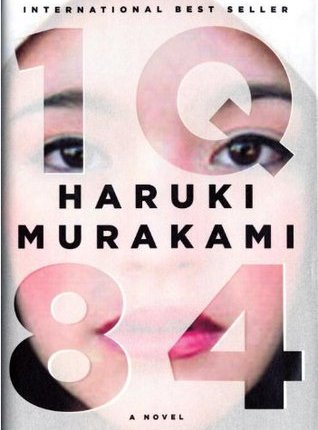
Things are not what they seem, Aomame repeated mentally. “What do you mean by that?” she asked with knitted brows. pg 28, ebook
Yes, what do you mean by that, I found myself asking over and over throughout 1Q84, my first foray into Haruki Murakami’s fictional works.
A few years ago, I read and enjoyed Murakami’s What I Talk About When I Talk About Running, a non-fiction book about the author’s creative process and long distance running habit. The way his mind works is fascinating.
He talks about how writing a novel is like participating in a marathon. It takes effort and discipline to go from page one to the end. In addition, the break throughs that he makes in his writing he attributes, in part, to the flow state he experiences during his physical exertions.
This creates a detail-filled and highly introspective world in his novels that some readers can’t get enough of.
But that approach didn’t appeal to me in this book.
The story develops slowly, so so slowly. We are in the characters’ minds for nearly every thought. We learn their eating and drinking habits, sleeping problems, past history, sexual preferences ad infinitum.
The magical realism portions of the story, my favorite parts by the way, were fleeting and infuriatingly uninformative. This is another draw, or so I have gathered, for some readers who like having major unanswered plot points by the end of the story.
This could lead to some interesting book club meetings, but I’m not one of those readers. If you’re going to tell a story, for heaven’s sake, tell the story.
On one hand, the introspective nature of the storytelling gives deep insight into the characters. By the time you’re through, you feel like you could write what Tengo and Aomame are going to do next. It is introversion to the extreme. On the other hand, it crushed my interest in caring what was going to happen next.
Why? Personal preference, I suppose.
Legions of readers love this book. I’m curious as to why, but it might be as simple as how readers like to experience and absorb stories.
Final note: Trigger warnings for domestic violence and sexual abuse.
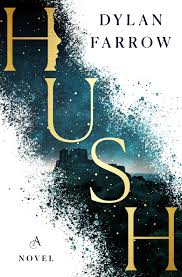
In the world of Hush, ink, the suspected origin of a deadly plague, has been declared the enemy of humankind and outlawed. The keepers of the law, High House and its magical soldiers called bards, roam the world, rooting out those who break the law and rewarding those who bend to their will.
“Our history shows that vigilance and caution are tantamount to survival. Burn the ink from the page. Turn away from forbidden words, toxic tales, and deadly symbols. Cleanse the country of this malignant blight. Join us.”
Shae lost her brother to the mysterious plague early in her life and her family has been outcast from her small village since. When tragedy once again darkens her family’s doorstep, what will Shae do not only to seek justice for her brother but, potentially, the whole world?
The premise of Hush had some interesting ideas, but this debut, young adult novel suffers from wooden characters and predictable plot twists.
“The Bards arrive today.” The Bards. Suddenly I feel as though the house has been encased in ice. The town elders say there’s power in words- that certain phrases can change the world around you.”
Weakness in the character development aside, Shae is a strong protagonist who struggles to create her own reality which differs quite markedly from the reality that her small town has imagined for her. Teens might connect with her more strongly than I did, which is to say, not at all.
I’m not sure what it was. Maybe I’m suffering from YA dystopian reading burnout?
Instead of appreciating Shae for her flaws which include falling in love too quickly, trusting everybody and pushing all her friends away the moment she could really use their help, I found myself annoyed with her.
“I spent countless nights lying awake, staring at the austere wooden beams of the ceiling, trying to figure out if I was mad or cursed- or both.”
Be smarter, I thought. The odds are stacked against you, and you need to pay attention, not fall for the first stranger you meet who has a dreamy pair of eyes.
But as I said, I’m definitely not the intended audience for the book.
Here’s the author, Dylan Farrow, talking about Hush:
Thank you to NetGalley and the publisher for an advance reader copy. And thank you for reading!
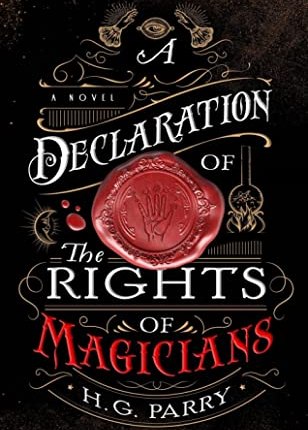
In a world where magic is real and controlled by government authorities, H.G. Parry re-imagines true historical events and people, inviting readers to add an additional layer of conspiracy to movements that changed the course of history like the French Revolution or the slave rebellion in the Caribbean.
The premise didn’t work for me for a couple reasons.
I felt like this book minimized the atrocities that were committed during the era. The slave trade and the French Revolution’s cost in both human lives and suffering is immeasurable, and it felt somewhat flippant to take those events and say, “Well, magic,” as the main driving force behind the conflicts.
I felt the same could be said for the subtle twisting of the lives of historic figures.
“His quiet voice spoke of a country built on Enlightenment principles, whose people were virtuous, where magic was a free resource to be used for the betterment of all, where food was well distributed and plentiful, where courts were in the hands of the people and not the talons of the Aristocracy, where the poorest Commoner was free to vote and grow and be educated.” pg 155
That is not to say that history or historic personages couldn’t or shouldn’t be in fantasy novels. It is a hallmark of the genre to take a reality, change the rules of that reality, and then tell the story with the new rules. Though if that was what the author was going for, perhaps she should have staged her story in another world or made the focus of the story characters she invented with the real people living their lives in the backgrounds.
Taking real events, real people and real world locations to drive the story didn’t coalesce into the fantasy novel I believe she was reaching for.
I think fantasy, alternative-historical fiction is something that can be done successfully, but I have yet to see its promise fulfilled. This may be an unpopular opinion, but I had the same issues with this story that I had with Abraham Lincoln: Vampire Hunter.
Students of history may find themselves frustrated by A Declaration of the Rights of Magicians because of the way the true events are spun. I didn’t have any specialized knowledge of the era, but a friend who is somewhat of an expert told me the complexity of the time period is so dumbed down that he was distracted by it.
“It had seemed so simple after the fall of the Bastille. The National Assembly of Magicians had risen up, exactly as Robespierre had hoped. They had issued a proclamation declaring it the right of all citizens to be free to practice their own magic: a Declaration of the Rights of Magicians.” pg 179
Setting my concerns with fantasy clumsily applied to horrific real life events aside, my biggest issue with this book was the glacial pacing. Readers sit through meeting after meeting, and it’s incredibly dull. But with the time period we were in, it should have been gripping. I told myself that a big payoff for all of this story building was coming, as the book clocks in at over 500 pages, but I felt like it never materialized.
I don’t mind a long book. But please, tell the story.















 The Help Desk Book Blog