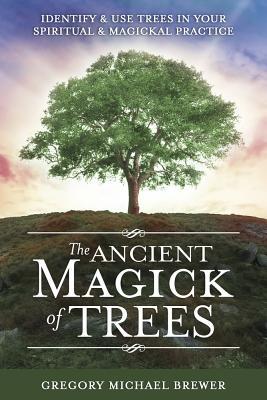
“Since the dawn of humanity, in all cultures and religions across the globe, trees have been revered not only as a life-sustaining source of food and medicine but also as a place where spirits dwelt, awaiting to reveal great mysteries to those who sought their wisdom, knowledge, and magick.” pg 2
Author Gregory Brewer examines the wonder and mystery that are trees from the pagan perspective in this book which is part informational, tree-related ritual/meditation suggestions, and reference.
Understanding the symbolism of trees throughout countless cultures of human history is an enlightening study, but equally important is learning to form a personal connection with them in order to better comprehend the interaction of how the divine reveals itself to us through nature.” pg 243
The majority of the book is dedicated to descriptions and occult associations for different types of trees.
I read The Ancient Magick of Trees in order to learn more ways to invite nature into my life. The book has that but I found Forest Bathing: How Trees Can Help You Find Health and Happiness to be more immediately practical. I also connected more with the information in the forest bathing book.
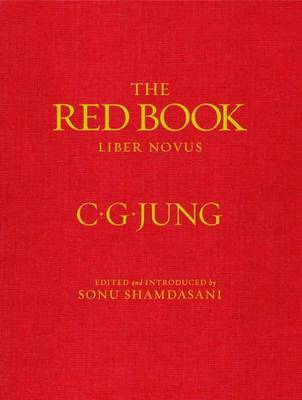
“The years, of which I have spoken to you, when I pursued the inner images, were the most important time of my life. Everything else is to be derived from this.” preface
The Red Book is a stunning publication. It is a physically large book which mimics Jung’s own handwritten copy which measured 11.57 inches by 15.35 inches.
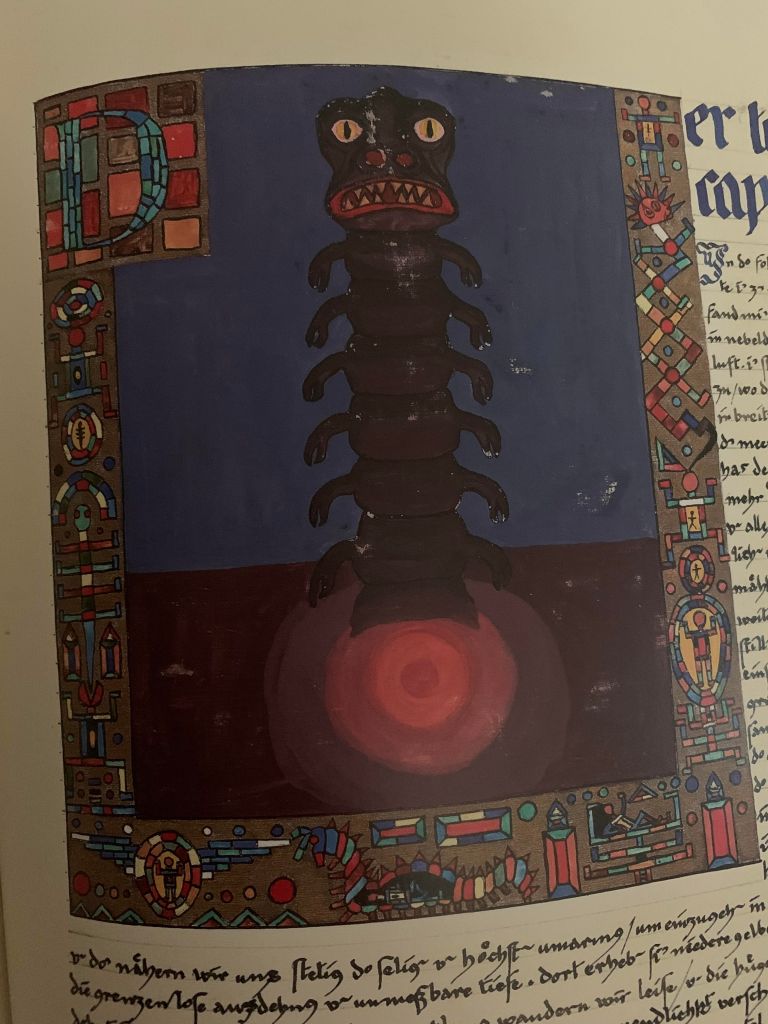
Carl Jung’s calligraphy
The contents are just as impressive. The first part is a brief history of Jung and his publications. The second contains pages of calligraphy in both German and Latin of his “active imagination” visualizations as well as sketches and paintings created by Jung to accompany the text.
The last section of the book is the English translation of the second part.
“Jung described his technique for inducing such spontaneous fantasies: ‘The training consists first of all in systematic exercises to eliminating critical attention, thus producing a vacuum in consciousness.'” pg 209
Painting from Carl Jung’s The Red Book
The visions themselves are interactions between Jung and voices or figures that he named his soul, gods and other archetypical figures.
“To this my soul spoke a word that roused my anger: ‘My light is not of this world.’ I cried, “I know of no other world.” The soul answered, “Should it not exist because you know nothing of it?” pg 240
As he stated in the preface, Jung felt as if his ‘confrontations with his subconscious’ affected his work for the rest of his life. It is a fascinating, little-examined side of a man who has had a huge effect on psychology and is credited, by some, as being one of the leading figures of the New Age movement.
The road to publication for this book is a story in itself. At first, Jung’s family carefully kept The Red Book in a safe deposit box to protect it as they recognized its value as a one-of-a-kind creation. They also believed that Jung wouldn’t have wanted its contents made public as he hadn’t left any specific instructions in his will about it.
Painting from Carl Jung’s The Red Book
However, researchers and scholars have since examined the text and found parts where Jung addresses, “my dear friends,” leading to the opinion that he did intend to share it with a wider audience. They also point to its importance to Jung’s following works as another reason why it should be published.
Whatever their reasoning, I’m so very glad his family and foundation made the decision to publish. This book is a treasure.
Curiously, The Red Book ends in an incomplete sentence.
Here it is:“I knew of nothing better than to write them down in a ‘precious,’ that is to say, costly book and to paint the images that emerged through reliving it all- as well as I could. I knew how frightfully inadequate this undertaking was, but despite much work and many distractions I remained true to it, even if another/possibility never…” epilogue
Painting from Carl Jung’s The Red Book
I wonder what he was going to write next.
Though I didn’t use Jung’s method of active imagination, I too have undertaken lengthy ‘confrontations’ of my subconscious and have come back with pages of material that read, in some ways, quite similar to this book.
Perhaps, one day, I will also find the courage to publish it.
Highly recommended for any readers interested in Carl Jung’s methods, archetypes or dream interpretation.
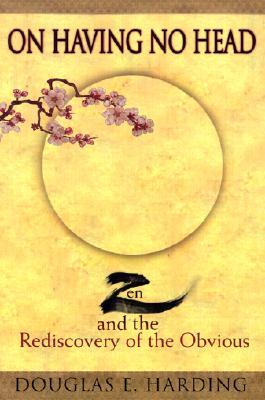
Douglas Harding had a strange experience when he was a young man. As he was hiking in the Himalayas, Harding had a moment he would later describe as of “no thought”, and where he perceived his body as having no head. In addition, he had a vision of his body as a house with a single window, but inside the house, there was nothing looking out at the world.
That nothingness is where Harding envisioned his consciousness resides.
Trippy, I thought. If that had happened to me, I might have been pretty freaked out.
Not necessarily so for Harding, who described the experience as incredibly peaceful and enlightening. When he came back from this experience, he applied his insight to various Eastern schools of philosophy, notably Zen.
The result is this book- a discussion of not only what happened to him, but an examination of consciousness itself. Where does consciousness reside? Where is the ‘me’ of our constant thoughts and emotions?
It’s somewhat of a winding path to get there, but Harding eventually points to the idea that consciousness is space in which reality is perceived.
When I first hopped into this book, I thought, how ridiculous. We all have heads attached to our necks. We can see them and feel them. Not only that, we can see and feel the heads of other people if we really wanted to.
Harding takes this idea of ‘seeing’ and ‘touch,’ and questions what it is that people actually perceive. Yes, he says, you can see your head in a mirror. But that is a reflection of your head and not the head itself.
Everybody says these constructs are the thing itself. However, as Harding points out, they’re not really, are they? If you look down your own face, you can usually ‘see’ your nose as a series of splotches and shapes. Is that your nose though, or just splotches?
And he goes on from there.
By the end of the book, I was nodding my head a little and felt like I could understand something of what he was saying. But now that I’m trying to write a portion of it down, it just sounds like nonsense.
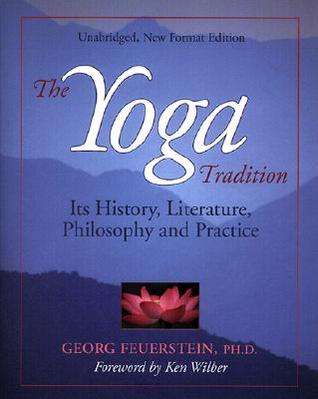
The Yoga Tradition is a reference book for the history and practical methods of yoga in its myriad forms throughout time and different religious traditions.
“In its oldest known form, Yoga appears to have been the practice of disciplined introspection, or meditative focusing, in conjunction with sacrificial rituals.” pg 27
From these ancient beginnings, author Georg Feuerstein takes readers on a fantastical and spiritual journey through the various branches of yoga including Raja, Hatha, Bhakti, Jnana and more. He’s printed original texts, along with analysis of them, throughout the book to provide context and origin materials for each tradition.
What emerges in The Yoga Tradition is stunning in its complexity as well as sheer variety of methods, beliefs and practices.
“Long before the word yoga acquired its customary meaning of ‘spirituality’ or ‘spiritual discipline,’ the sages of India had developed a body of knowledge and techniques that aimed at the transformation and transcendence of ordinary consciousness. This stock of ideas and practices formed the matrix out of which grew the complex historical phenomenon that later came to be called Yoga.” pg 65
Beyond sharing the history, philosophy, and practice of yoga, Feuerstein encourages modern scientists to look closely at the traditions in these pages to see what benefits could be gained from the ancient knowledge.
“Gradually, modern medicine and psychology, aided by advanced scientific concepts, methods, and instrumentation, are rediscovering some of the amazing facts that yogins have talked about and demonstrated for centuries.” pg 400
In my mind, that is one of the most exciting aspects of this book- what humanity could possibly learn about the enduring mystery of consciousness itself through the application of modern methods of study to ancient techniques.
Highly recommended for anyone interested in yoga and looking for a scholar’s thorough dissection of its history and forms. Your search can begin and end with this title.
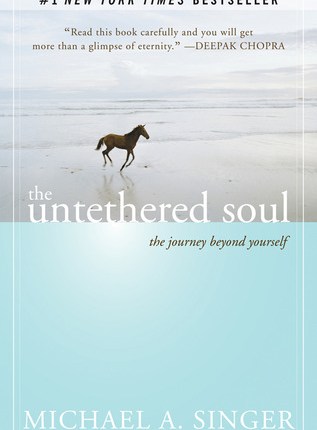
Michael Singer reminds readers that we are not the thoughts that we habitually think or the bodies that we walk around in. He gives multiple tips on how to access the spiritual strength inside ourselves and how to view life through the wide lens of this non-attached perspective.
Singer writes that it is through this new way of looking at life that one can find enlightenment.
The ideas that are shared in Untethered Soul can be found in countless other books on spiritual studies. This isn’t new information. But, I think, there is always room on my bookshelf for a book that reminds me of spiritual truths.
It is all too easy to get caught up in the day-to-day trivialities of life with its stresses and constant demands on our attention. If you take a breath and a step back, it’s surprising what you can see.
Perhaps the mammoth success of The Untethered Soul over other books in its genre is the exposure it received on The Oprah Winfrey show. Whatever the case, it is quite accessible to readers who haven’t considered these concepts before.
Recommended for spiritual seekers both seasoned and not.
Shaman Durek offers practices to spiritual seekers who are looking for ways to improve their lives through the use of shamanistic techniques. Like most new age or spiritual books, not everything in here resonated with me. But I will take a few key concepts and jettison the rest.
For starters, I took issue with the title of this book, “Spirit Hacking”. It implies that there are some sort of tested and proven short cuts to bringing spiritual dimensions into one’s life. I think most readers are wise enough to know that such a thing doesn’t exist. To put that sort of label on a work is false advertising to delusional, depending, I suppose, on how much one believes one’s own hype.
On the other hand, if “Spirit Hacking” was simply an effort to connect with readers who sincerely want to believe in such spiritual short cuts then this book will probably fill some sort of gap in his or her journey to a desired “goal”.
Personally, I took the title as a type of warning flag before I read it. Tread softly here, Heidi, I said to myself. And question everything.
Shamanism, like other semi-organized movements, varies greatly depending upon who is imparting the wisdom and from what tradition. Shaman Durek touches upon topics I’ve studied from other sources such as there are different types of spirits, various rituals or practices to interact with these spirits and time isn’t as fixed as some imagine it may be. But he puts his own unique spin on the information.
I like the empowering side to shamanism. If you have lingering physical or emotional pain, these practices suggest that you can do something about it, today if you’d like. If you’d like to change the world, go within and change yourself, then the rest will follow.
I also like the idea that everything on the planet from plants to animals to places has a guiding spirit or intelligence. If only one knew the way to interact with these intelligences, life itself could become a guide into the mysteries of the spirit. That part of shamanism is pretty cool.
On the other hand, I don’t like how some shamanistic movements act like established religions, insisting that their ways or traditions are the only way to go. In addition to the snobbery, I take issue with the manner in which some shaman teach their methods. They fail to distinguish between the real world and visionary space, leading adherents to confuse one with the other or worse, not draw any dividing lines at all.
Shaman Durek’s tone can be somewhat abrasive, but if readers are looking for basic shamanistic ideas, they can be found here. Recommended with reservations for new age spiritual seekers.
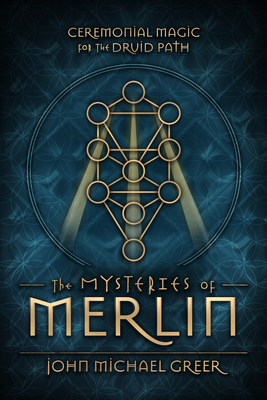
John Michael Greer, one of the most influential authors on Druidism in the modern age, takes a crack at reviving ancient traditions through ceremonies involving the mysterious figure of Merlin. As for his success at this integration, I think that’s up to individual readers to decide for themselves.
I didn’t connect with the rituals myself, but the first part of this book which details the author’s research into mystery cults and mythology in general, was fascinating to me.
“… myths are things that never happened but always are. They express spiritual truths too profound to be communicated in any more direct way.” pg 12
Though this topic has been covered by a variety of different authors, perhaps most notably Joseph Campbell, Greer’s take on the subject is welcome and refreshing. His focus in this book is piecing together what the Pagan Celtic religion of Britain may have looked like through the fragmentary records and mythology that remain behind.
“Was Merlin, then, purely a god, and his appearances as a Dark Age prophet and wizard only garbled mythology? That is a surprisingly difficult question to answer.” pg 27
Greer’s writing is accessible even for those who may not have a background of western occultism or paganism to draw upon. But, this book might be most useful for those who feel drawn to those spiritual paths because, as I mentioned before, the majority of this book is dedicated to detailing rituals that Greer has created for those traditions.
Seekers interested in the forgotten history of paganism in Europe, as I am, might be better served with another book. If I find one, I’ll let you know.
“Vortigern ordered the workmen to dig into the hill and they found the lake; once the water was drained away, the rocks appeared, and the dragons leapt out of them and began to fight each other. As they struggled, Vortigern asked Merlin what the combat meant, and the boy burst into tears and began to prophesy.” pg 22
As for the actual historical personage of ‘Merlin,’ I think Greer’s interpretation of the sparse evidence is as good as any I’ve read which, admittedly, isn’t very much because there’s not much to go on.
And as for the retrieval of ancient traditions and mystery cults, perhaps new mythologies, like this book, need to be written. The old lineages may simply be lost forever.
Here’s my contribution to the mysteries of Merlin which I recovered through my explorations into the Qabalistic Tree of Life. It is from a series of pathworkings I recorded called “The Light Congress”:
In Chapter 13, Merlin is the wizard in the wood who called himself ‘Nobody’:
Though he appears again further on in the book, these two initial encounters were quite revealing. I hope you find some meaning in the symbolism and message therein.
Through The Light Congress, I hope to discover a new path, one of endless spiritual mythologies and stories for the modern age. It remains to be seen how successful the attempt will be.
Small disclaimer, Mr. Greer and my’s only association is through the reading of his books (which are quite worthwhile for spiritual seekers and I highly recommend them). I wish him well in his exploration of the worlds of spirit and the mysteries they contain. Any missteps I make in my personal journey are my own fault and may be laid entirely at my doorstep.
David Sheff examines the life and spiritual transformation of Jarvis Jay Masters, a man who has spent years on death row and in solitary confinement for a crime he says he didn’t commit.
“Even if Masters was innocent, I didn’t know what to think about the claims that he was, as his supporters described him, an enlightened Buddhist practitioner who had changed and saved lives.”
It is a powerful non-fiction account not only because Masters is honest and open about how he came to be where he is today, but because the spiritual lessons he has discovered throughout his experience are applicable for all of us. You don’t have to be sitting in a literal prison to feel like you’re locked in a cell and can’t get out.
The mind and heart can create suffering wherever in the world you are.
“Set in a place of unremitting violence, insanity, confusion, and rage, Masters’s story traverses the haunted caverns and tributaries of loneliness, despair, trauma, and other suffering- terrain we all know too well- and arrives at healing, meaning, and wisdom.”
I don’t think you need to be a practitioner of Buddhism to appreciate the wisdom in this book. Spiritual lessons like the knowledge that can be found in self awareness and how to obtain freedom from suffering can be helpful for all of us.
I enjoyed the book so much that I read it in only a few sittings.
The lama wrote that all people have been sentenced to death- in that way, Jarvis wasn’t unique. … “We all live in a prison, and we all hold the key,” Chagdud Tulku wrote.
My mind has been going in circles as I’ve pondered, for days, how to review this book. It is a poorly organized and bewildering publication that could be tremendously important for pagans or religious scholars who are looking for information about The Horned God.
“The Knell of Inbetweenness hath been struck, The Bell of MISRULE soundeth; Reverberating the Thirteen Angles, Echoing through the Nine Spheres”
It begins with a foreword by Michael Howard speaking of the scarcity of information about a male god within the existing neo-pagan revival movement. Then, the author, Nigel Jackson, goes into what could almost be called a tirade against established religions and the current neo-pagan movement in a chapter entitled, “In the Sign of the Horns.”
“The old time is passed away and the ‘age between the ages’ is begun: the Aionic Twilight falleth over the world and the day of the cross and the mitre is wholly done with.” pg 11
Honestly, that type of tribalism and fear-mongering is a poor look for any type of spiritual movement. Why immediately alienate readers from other spiritual paths who are coming to your materials with an open mind and a willingness to learn?
Despite his initial hostility, Nigel Jackson quickly turns his attention to what he believes are different aspects of a male pagan god, throughout history, and includes various rituals to invoke this ancient being.
As I mentioned earlier, it is a bewildering hodge-podge of material with only the thinnest of connecting threads between. Newcomers to occult matters or pagan practices may lose their way within the quickly shifting time periods, places, names and associated mythologies.
However, I found information in “Chapter Three: Cycles of the Midnight Hunt” and “Chapter Seven: Wudewasa, the Knowledge of the Green Man” that was completely new to me and interesting.
“It was held that when nocturnal thunder broke over the wildwood and the forked lightning-flash clove the darkness and the night-tempest roared and tossed the boughs, that the wild host of Woodwoses came forth in primal panoply, raging through the hoary oaks and pines, their eldritch voices mingling with the storm’s tumult.” pg 107
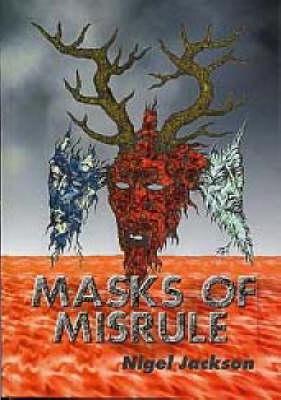
The printing of Masks of Misrule is a travesty for any lover of books. The font is irregular and fades, seemingly at random, within the text. The cover is ridiculous and does nothing to convey the seriousness with which the author treats his subject.
But if you set all of these concerns aside, some of the mythology contained within this book is entirely original, at least to me, and could be incredibly useful for seekers who are looking for a new movement within paganism that celebrates the male side of nature.























 The Help Desk Book Blog