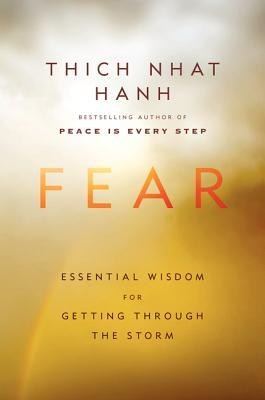
Fear: Essential Wisdom for Getting Through the Storm by Thich Nhat Hanh

Fear: Essential Wisdom for Getting Through the Storm by Thich Nhat Hanh

In Fear: Essential Wisdom for Getting Through the Storm, Thich Nhat Hanh simply and succinctly illuminates the Buddhist path beyond fear into an existence of freedom and joy.

“Nobody can give you fearlessness. Even if the Buddha were sitting right here next to you, he couldn’t give it to you. You have to practice and realize it yourself.” pg 6
Photo by Aleksandar Pasaric on Pexels.com

This book is more than theory, parables and anecdotal stories. Hanh also includes various meditations to assist in the effort.

“When the Buddha was very old, just before he died, he said, ‘My dear friends, my dear disciples, don’t take refuge in anything outside of you. In every one of us there is a very safe island we can go to. … That is a place where you can take refuge whenever you feel fearful, uncertain or confused.'” pg 71

He dissects the various forms fear can take in our lives- from fear of death, grief, anxiety about the future to reconciling with painful emotions from the past.
Photo by David Bartus on Pexels.com

My main takeaway from the book was, to deal with any kind of fear, we need only to approach it with mindfulness and compassion for ourselves and the suffering of others.

“We don’t try to grab on to the pleasant sensation, and we don’t try to push it away. We just acknowledge its existence. When a painful feeling comes, we do the same thing. … A feeling is just a feeling. And you are much more than that feeling.” pg 135

Hanh reminds readers that we are more than the temporary thoughts and feelings that cause so much havoc on their way through our minds and hearts. Our true nature is something else.

My favorite metaphor that Hanh employs to remind readers of this true nature is his comparison of a life to a wave.

“The wave is always water; it doesn’t ‘come from’ water, and it doesn’t go anywhere. It is always water; coming and going are just mental constructions. … Birth and death, coming and going, are just concepts. When we are in touch with our no-birth, no-death nature, we have no fear.” pg 50

Photo by Emiliano Arano on Pexels.com

I appreciated the reminders and found a lot of comfort in these pages. I hope other readers find the same.

Recommended for readers who are interested in learning and utilizing Buddhist philosophy and techniques to overcome any fear or other unpleasant emotion that may be in their lives.

Embrace Your Weird: Face Your Fears and Unleash Creativity by Felicia Day

Embrace Your Weird: Face Your Fears and Unleash Creativity by Felicia Day

Embrace Your Weird is a non-fiction and self help manifesto encouraging creativity and told in Felicia Day’s unmistakably humorous way.

I say “unmistakable” for any of her myriad fans who have watched her ground-breaking web series, “The Guild,” or read another of her books like You’re Never Weird on the Internet. Her tone and sense of humor remains the same.

Photo by Prateek Katyal on Pexels.com

And if you haven’t had the chance to enjoy any of Day’s other creations, I encourage you to give them a try. They’re light-hearted and fun.

“Aside from (over)sharing a lot of my opinions, I have filled this book with exercises designed to uncover the joy of creativity. To help people beat back the fear that keeps them from trying new things.” pg xi

On almost every other page, Day encourages readers to stop a moment and draw a picture, fill out a list, or write empowering messages over and over so that they’ll sink in. The act of reading this book is nearly a creative act in and of itself. (Sadly, I couldn’t do this because I was reading a library book. Suggestion for future readers: buy yourself a copy.)

“No, I don’t think creativity is a cure-all. But I do believe it could be a cure-most.” pg 29

Photo by Pixabay on Pexels.com

Besides reminding readers that we have unique voices and viewpoints that the world needs to hear, Day loosely structures the rest of the book off of life viewed as a game. She asks us to remember our “hero-self,” identify “enemies” and “allies” of our creativity, and to view the steps we take towards creation as “quests.”

Day also shares moments in her life when she’s completed or failed attempting various pieces of this philosophy in her own life.

“I constantly hand my heart over to strangers to batter however they wish, and I wonder why I’m constantly wounded all the time, and this makes me reluctant to create. Good way to operate? NOT REALLY!” pg 143

As I said, the whole book has a definite Felicia Day vibe. And it’s fun!

“Playfulness is the root of all creation. All invention. All discovery. There is no reason NOT to feel joyous when we make things.” pg 206

Photo by Sharon McCutcheon on Pexels.com

She wasn’t afraid to tackle all sorts of hang-ups people might have in their creative process. Day nailed my biggest issue: finishing projects once they’re started.

“But we will never get anywhere if we don’t focus on one thing at a time. And then see that thing through before moving on!” pg 239

Message received. Now to put it into action…

Recommended for anyone looking to start or jump start their creativity. This book is an excellent place to begin. Thanks for reading!

JOMO: Celebrate the Joy of Missing Out! by Jessica Misener

JOMO: Celebrate the Joy of Missing Out! by Jessica Misener

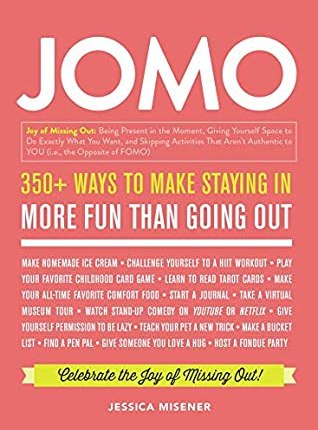
JOMO or “the joy of missing out” lists “350 plus ways to make staying in more fun than going out.” Unfortunately, a large number of these suggestions included books to read or programs to watch. In my mind, all of those fit into one of two categories, reading or watching television.

“Because skipping a night on the town doesn’t mean you’re missing out on life – you’re just missing out on someone else’s idea of what your life should look like.” pg 7

Photo by Alex Qian on Pexels.com

That being said, there were a few solid suggestions in this book for alleviating boredom. I particularly liked “shower with the lights off” pg 24, “listen to autonomous sensory meridian response videos” pg 47, and “do The New York Times’s 36 questions” pg 127.

The rest of these seemed repetitive, as I mentioned, or uninteresting.

Perhaps this book would have been more enjoyable in the pre-COVID world, when I hadn’t been quarantining at home for months, disappointed with the state of the world and feeling stymied. Maybe I could have gotten into “make a homemade pizza” or “rearrange your furniture.” But things have moved beyond expecting the completion of simplistic tasks to hold the answers to life’s problems, at least for me.

“Host a fondue party,” that appears on the cover of this book, seems like something that happened in another world. Will we ever get back there?

Photo by Laurel Natale on Pexels.com

Thanks for reading!

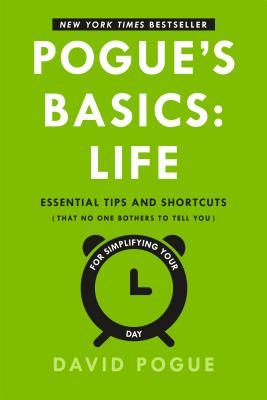
Pogue’s Basics: Life: Essential Tips and Shortcuts (That No One Bothers to Tell You) for Simplifying Your Day by David Pogue

Pogue’s Basics: Life: Essential Tips and Shortcuts (That No One Bothers to Tell You) for Simplifying Your Day by David Pogue

David Pogue and his team tested every suggestion in this book to verify that each works the way it is supposed to.

The result is a gem.

“… the morsels in this book describe features hidden right under our noses, features that lots of people don’t know about. As well as ‘Everyone’s been using it wrong’ insights. Plus tips that are clever, unexpected, and useful.” pgs 5-6

Photo by Kaboompics .com on Pexels.com

I knew some of the tips in these pages, but certainly not all of them.

When I’m done with this book, I’m going to gift it to my pre-teen, who thinks she knows everything but obviously doesn’t. I think she’ll find this incredibly handy in a few years.

A pot of water doesn’t boil over if you lay a wooden spoon across the top of the pot.” pg 81

Who knew? I didn’t. That’s one of the tips I’ve already used to make my life easier.

I’ve also utilized the tip for how to get ketchup out of the bottom of the bottle. And no, it’s not leaving it upside down and leaning against something for two hours though that does work. It is a much more immediate solution.

Photo by Vova Krasilnikov on Pexels.com

Some of the technology tips may be outdated, only because this book was printed in 2015. But I haven’t tested them all yet, so don’t hold me to it. It’s one small section in a stellar lineup of life “basics” that cover topics including the car, travel, food, clothes, your body, animals, house and home, and more.

Highly recommended for anybody who’s looking to make their lives a little bit simpler. Let’s be honest then, that’s everybody.

Thanks for reading!

The Spiritual Gift of Madness: The Failure of Psychiatry and the Rise of the Mad Pride Movement by Seth Farber

The Spiritual Gift of Madness: The Failure of Psychiatry and the Rise of the Mad Pride Movement by Seth Farber

In The Spiritual Gift of Madness, Seth Farber interviews half a dozen people who have had negative experiences with western psychology as well as experts in mental health. His thesis is the mental health system as it is values medication over other types of therapy and, because of this misguided focus, harms the very people it is attempting to help.

He is a champion of the Mad Pride movement, a group that seeks to celebrate and assist those suffering from mental health issues to embrace who they are rather than medicating it away.

Photo by Engin Akyurt on Pexels.com

“… helping the mad does not mean drugging or coaxing them into a state of “adjustment,” but rather appreciating the state of madness for what it is: an existential clearing in the jungle of our insane modern society that potentially leads into the realm of true sanity, which, in the world today, means a state of creative maladjustment.” pg 124

I should mention that Farber doesn’t use “mad” in a negative way, rather he uses it to highlight how individuals with different viewpoints from the rest of society are marginalized and sedated into silence. He puts forward the idea that insanity is believing everyone must view the world in the same manner or be ostracized for it. He holds up society’s repeated failures to handle issues like global warming to racial and gender equality as evidence of the insanity of the world.

“Now one of the things that’s so detrimental about the hospitalization is the power impact of being treated like a patient – people end up believing they’re chronically mentally ill.” pg 44

Farber believes mental illness is a transition to a new, potentially powerful state of being that, as a modern society, we quash before it’s completed. He points out that many of the great prophets and visionaries from history had, what we would now call, complete breakdowns before their epic breakthroughs.

Photo by Ryan Millier on Pexels.com

“… a few weeks of mania could give one access to a sense of understanding that it could take ‘years of meditation’ to achieve, access to visions of ‘the wholeness’ of the universe and ‘the interconnected nature of love, access to a sense of time and space that allows one to discern what is and what is not important.'” pg 21

Instead of medication and psychiatric facilities, Farber would like to see the creation of safe havens for people going through this process so they could assimilate whatever is going on in their minds before going back to the rest of society. That would be for the experiencer’s protection as well as the public.

I think Farber brings up important issues in this book. As someone who has struggled with mental illness, I’ve viewed the system from the inside and recognize some of the problems he points out. There’s the stigma of the diagnosis and the embarrassment of feeling separated from “normal”. There’s the expectation you will take your meds from the day you’re labeled until you die, no matter the side effects.

But, worst of all, is feeling like you can’t trust what’s going on in your head because it went so spectacularly wrong before and what’s to prevent it from going sideways again.

I agree some changes need to be made to the system and, as a society, perhaps we can do a better job minimizing stigma, maximizing communication, and helping people live in a happy and healthy manner that they choose.

However, I feel like Farber goes too far in his insistence that the “mad” are the future. That somehow they hold the keys to a paradise on earth if only we’d let them share their messages unfettered.

Photo by Oliver Sjöström on Pexels.com

In the midst of my psychosis in 2009, I wouldn’t have wanted any of the nightmares in my head to permanently affect my future or my family. If there are lessons to be learned from it, maybe it’s an individual message for the people undergoing the change rather than expecting it to be universal lessons, applicable for everyone.

But, that’s my two cents. I certainly don’t have all the answers, but The Spiritual Gift of Madness asks some interesting questions.

Recommended for seekers who are interested in a different way to both approach and treat those with mental illnesses or for those who have gone “through the looking glass” and are now viewing the world from the other side, like me and the people in this book and many, many others.

Thanks for reading!

The Universe Is Your Search Engine: A User’s Guide to the Science of Attraction by Anita M Scott

The Universe Is Your Search Engine: A User’s Guide to the Science of Attraction by Anita M Scott

The Universe is Your Search Engine is a new age, metaphysical book with anecdotes, suggestions and exercises to assist readers in utilizing the law of attraction in his or her own life.

Anita Scott compares the law of attraction to a universal “search engine.” What you put in, comes back to you kind of like Google for the mind.

Photo by Pixabay on Pexels.com

“While the Universe’s Search Engine delivers real-life experiences, it is not responsible for your quality of life. You are, because no one else can use your mind to think thoughts. You alone are the thinker of your mind, and it is your thoughts alone that trigger the search and the ensuing return of life experiences.” loc 310, ebook

The book is divided into three sections: the first handles different aspects of the law of attraction from science to energy and quantum physics. The next part goes into metaphysics, the body, purpose and more. The third part is a workbook that ties the first two sections together and is also scattered throughout the text.

“Fighting against what is elongates suffering, makes an issue bigger, and squanders your valuable energy.” loc 428, ebook

Photo by Jill Wellington on Pexels.com

I’ve read quite a few books like this- new age materials that teach your thoughts create your reality. I was honestly surprised how much I enjoyed this version of the teaching.

The publisher sent me an email offering a free digital copy of this book through NetGalley, I didn’t request it. And, I’m going to be blunt here, I was feeling rather unsure about it. I simply wasn’t in the right head space to read and review a new age book. But then, I thought, why not give it a chance and I’m glad I did.

This year, 2020, has been the worst. Prior to this mega-disaster of a year, I would have described myself as someone who created her own reality sometimes successfully, other times not so much, but I felt like I always had at least a glimpse of where my life was going.

This year has changed all of that. Now, I’m not certain I create my reality at all.

Current angst aside, I liked The Universe is Your Search Engine. I liked the empowering messages it shares. I like the exercises that encourage readers to find their purpose, focus their thoughts and joyfully move into a future of their own design.

Photo by Dina Nasyrova on Pexels.com

I’m just not sure I believe in it myself anymore. Maybe I’ll get back there some day.

Recommended for readers and seekers who are looking for information on the law of attraction. Anita Scott has written a beautiful, modern book about it. Give it a shot and see if it’s for you.

Thank you to NetGalley and the publisher for a free digital copy of this book. And thanks for reading!

The Power of Discord: Why the Ups and Downs of Relationships Are the Secret to Building Intimacy, Resilience, and Trust by Ed Tronick, Claudia M. Gold

The Power of Discord: Why the Ups and Downs of Relationships Are the Secret to Building Intimacy, Resilience, and Trust by Ed Tronick, Claudia M. Gold

The Power of Discord is a study of human connection and disconnection. The authors, Ed Tronick and Claudia Gold, demonstrate through scientific and therapeutic studies that by working through conflict and the messiness of every day life, our relationships can be stronger than ever before.

Our earliest relationships have a profound affect on the way we interact with others as adults. It is almost scary how fast infants develop the responses that they carry with them into adulthood. In Tronick’s groundbreaking study called the “still-face” experiment, his findings helped researchers discover how infants communicate with their mothers.

Photo by Anna Shvets on Pexels.com

In the experiment, a mother and child are interacting, playing as usual. Then, the mother turns away a moment and when she turns back, her face is still and empty of emotion.

The curious thing about the infants’ reaction to their caregiver presenting them with a face devoid of emotion is that researchers could already see how the relationship between the two was developing. Infants in a healthy relationship kept trying to get a reaction out of the other person until their caregiver “went back to normal.” Infants in a “dysfunctional” relationship, or who were for whatever reason were less connected with their parent, shut down and practiced coping or self soothing mechanisms rather than trying to draw the caregiver out.

Prior to this experiment, it was assumed that infants had little to no communication ability whatsoever.

“When confronted with a stressful situation, (infants) could apply a style of interaction drawn from the everyday exchanges with their caregivers. While they did not yet have the capacity for language or conscious thought, they were able to draw on their countless moment-to-moment interactions to cope with the stress of caregivers’ unfamiliar behavior.”

Photo by Pixabay on Pexels.com

I worried, as I read the study, that the children would somehow be scarred by it. Some of the reactions the researchers described were very intense and painful for everyone involved. But the authors assured readers the level of stress in the experiment wasn’t something beyond what the children would encounter in their daily lives. Still, it seemed rather unfair to them. It wasn’t like researchers could explain what was going on.

Beyond the initial interactions that form the manner in which people craft their relationship styles, Tronick and Gold delve into further issues that may affect how you connect with others like: the pernicious effects of perfectionism and addiction to technology, feeling safe around others, taking responsibility for your connection style, and, the part I liked the most, the surprising way discord makes relationships stronger.

“… it is not simply what happened when we were young that screws us up now. Along the way to growing up and into our adult lives, we continue to create new ways of being screwed up. Only when we have accumulated a whole new set of interactions, when we work through the inevitable moments of disconnection to again find connection, will we grow and change.”

Photo by Josh Willink on Pexels.com

Though we learn how to form connections before we even have language, researchers have found that connection styles can be relearned, relationships can be repaired and are repaired, every day, little by little. In countless “mismatch and repair” moments, we teach ourselves that there is nothing broken that can’t be restored. It builds confidence in the relationship and trust in ourselves and each other – the building blocks of intimacy.

Highly recommended for readers looking to engage in some introspection about their own attachment style or for those who are curious about how relationships are formed and maintained.

Thank you to NetGalley and the publisher for a free advance reader copy of this book.

Shinrin-Yoku: The Art and Science of Forest Bathing by Qing Li

Shinrin-Yoku: The Art and Science of Forest Bathing by Qing Li

“Shinrin-yoku means bathing in the forest atmosphere, or taking in the forest through our senses. This is not exercise, or hiking, or jogging. It is simply being in nature, connecting with it through our sense of sight, hearing, taste, smell and touch.” pg 12

Nature lovers or those aspiring to be nature lovers will find much to enjoy in Shinrin-Yoku: The Art and Science of Forest Bathing.

Photo by Jose Vega on Pexels.com

Qing Li reminds readers that the human race is a part of this world even if we have walled ourselves up in cities and covered the ground in concrete. Through various scientific studies, he proves again and again that by taking a time out and forest bathing people can sleep more deeply, experience less stress and think more clearly.

“We may not travel very far on our forest walk but, in connecting us with nature, shinrin-yoku takes us all the way home to our true selves.” pg 15

Not convinced? He provides evidence that patients at hospitals heal faster if the view outside their window includes a tree rather than a wall. People who exercise outside report the exertion they need to complete the workout is less and they enjoy the time more than those who churn out the miles on a treadmill.

“The average sleep time of participants after a two-hour forest walk increased by 15 percent, or fifty-four minutes. Participants were significantly less anxious after a two-hour walk in the forest.”

Photo by WARREN BLAKE on Pexels.com

Forest bathers have reported higher levels of creativity, writers find relief from the dreaded block, and the sense of connection caused by the practice has been known to increase feelings of gratitude.

“The researchers concluded that there ‘is a real, measurable cognitive advantage to be realized if we spend time truly immersed in a natural setting’, and found that spending time in nature can boost problem-solving ability and creativity by 50 per cent. Is it any wonder that Buddha found enlightenment sitting under a tree?” pg 106

Is there anything that forest bathing doesn’t help? How about your health or physical age?

“A group of Canadian, American and Australian researchers studying tree density and health in Toronto found that… having eleven more trees on a block lowered cardio-metabolic illnesses, like high blood pressure, diabetes and obesity, comparable to the effects on well-being conferred by being given a $20,000 a year pay rise or being 1.4 years younger.” pg 116

Photo by Johannes Plenio on Pexels.com

In addition to the information about forest bathing, this book contains beautiful photos of forests every couple of pages. Qing Li gives readers the instructions so, if they desired, they could hold their own traditional tea ceremony in the woods. He includes anecdotal information about aromatherapy, tips on how to bring the forest into your home, advice on how to incorporate beneficial natural sounds into your daily life and more.

I enjoyed this book very much. Highly recommended.

Chasing the Sun: The New Science of Sunlight and How it Shapes Our Bodies and Minds by Linda Geddes

Chasing the Sun: The New Science of Sunlight and How it Shapes Our Bodies and Minds by Linda Geddes

Chasing the Sun reminds readers of the importance of the sunlight in shaping some of the body’s processes, regulating mood, and the surprisingly deleterious effects that not enough sun, or not adhering to the body’s natural rhythms, can have.

I picked up this book because I’ve been having trouble sleeping and thought maybe this would have some helpful tips. It did, but I felt like most of this information I had heard before in some form or another. I suppose it is nice to have a reminder to get ample sunlight during my daily routine. I have experienced bouts of seasonal affective disorder in the past and know first hand how it can affect your mood.

Photo by Jill Wellington on Pexels.com

It is rather depressing how far removed modern society has made itself from nature. Linda Geddes points out this gap and how the ancients, and some members of our era, made better use of this natural resource.

I enjoyed the history lessons about the Romans and their solariums. They used “heliotherapy” to treat a variety of illnesses. I also enjoyed the studies about the potential effectiveness of “chronotherapy” for patients suffering from certain mental disorders as well as learning about efforts to increase their sunlight by towns that receive little light during the day. For example, there’s a town in Norway that put mirrors on top of the nearby mountains in order to direct more sunlight their way.

Photo by ArtHouse Studio on Pexels.com

As we know more about the importance of sunlight, I’m certain we’ll see more efforts to incorporate this information into our daily routines. And it affects things we may not even consider from school start times to a good night’s sleep.

Recommended for readers who want to learn more about how the sun affects our lives and some of the newer scientific research about the same.