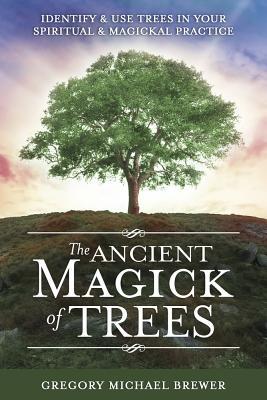
“Since the dawn of humanity, in all cultures and religions across the globe, trees have been revered not only as a life-sustaining source of food and medicine but also as a place where spirits dwelt, awaiting to reveal great mysteries to those who sought their wisdom, knowledge, and magick.” pg 2
Author Gregory Brewer examines the wonder and mystery that are trees from the pagan perspective in this book which is part informational, tree-related ritual/meditation suggestions, and reference.
Understanding the symbolism of trees throughout countless cultures of human history is an enlightening study, but equally important is learning to form a personal connection with them in order to better comprehend the interaction of how the divine reveals itself to us through nature.” pg 243
The majority of the book is dedicated to descriptions and occult associations for different types of trees.
I read The Ancient Magick of Trees in order to learn more ways to invite nature into my life. The book has that but I found Forest Bathing: How Trees Can Help You Find Health and Happiness to be more immediately practical. I also connected more with the information in the forest bathing book.
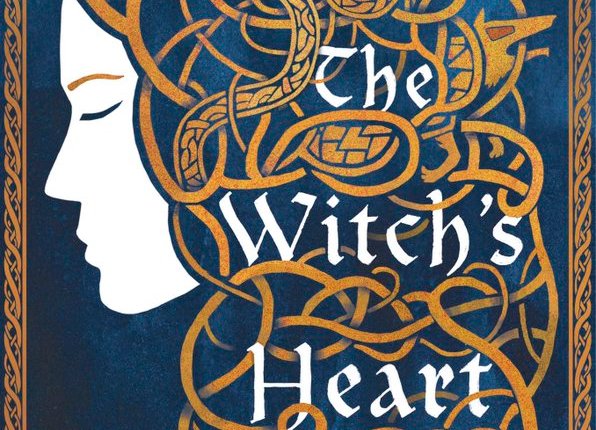
“The third time she was reborn, Gullveig fled, though she left something behind: her speared heart, still smoking on the pyre.” pg 4
Angrboda, the Norse witch formerly known as ‘Gullveig’, is hiding from the Aesir when the trickster god Loki finds her. And changes her life (or in her case: lives) forever.
“Although her memories as Gullveig were vague enough, she recalled feeling like she didn’t belong – and the moment they’d turned on her, burned her, she’d felt a lot of things. But the emotion she could recall most distinctly was not fear or anger, but the feeling of being used.” pg 43
The gods kill Angrboda because of her refusal to share the secret of her scrying power, called ‘seid’. She will not look into the future and give Odin the mysteries that reside at the end of all things.
Odin does not take no for an answer.
Genevieve Gornichec reimagines the shadowy character of Angrboda in this Norse myth-filled retelling. Maybe it’s because I’m a classics major and gravitate towards mythology, but it seems to me that it has become somewhat popular to do so – think The Song of Achilles or Circe.
In this case, I feel like Gornichec didn’t go far enough in her imagining. She gave Angrboda a voice, a rare talent, and a fierce love for her children, but, beyond that, the witch remains a fairly passive character.
Part of this could be due to the fact that the Aesir are such powerhouses in the old myths. They hog the spotlight and the action. But still, I believe there’s enough room around the stories to give a figure whose mythology has been largely forgotten a new legacy.
I think the biggest missed opportunity for this is in Angrboda’s relationship with Loki.
“She would do anything for him, she realized then… And for some reason, this scared her, as if the thought itself were a promise she knew that she couldn’t hope to keep.” pg 74
Like the other major players in the mythology, readers will be familiar with many of Loki’s hijinks. He is constantly in action, tricking people or becoming the victim of his own cleverness. What readers have never really gotten to see is his interior world. What is he thinking when he pulls his legendary stunts? What are his secret motivations?
One would think this is something he might share with a lover. But the storytelling never quite got there and I found The Witch’s Heart to be rather a disappointment in that way.
That being said, if you’re a reader who enjoys mythological retellings, there is still much to enjoy in this story. It is well-written if fairly limited in scope.
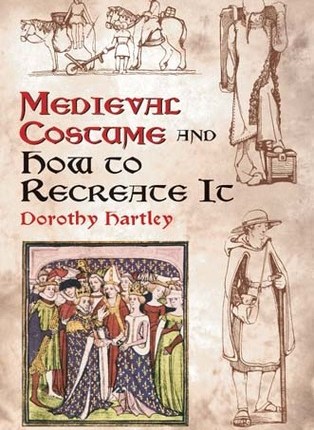
“All too late it is beginning to be realized, slowly indeed but no less surely, that the historic evolution of dress and personal ornament offers a wide field for methodical study; that it is in fact a science and can be made to subserve worthier ends than those of mere amusement.” pg 11, ebook
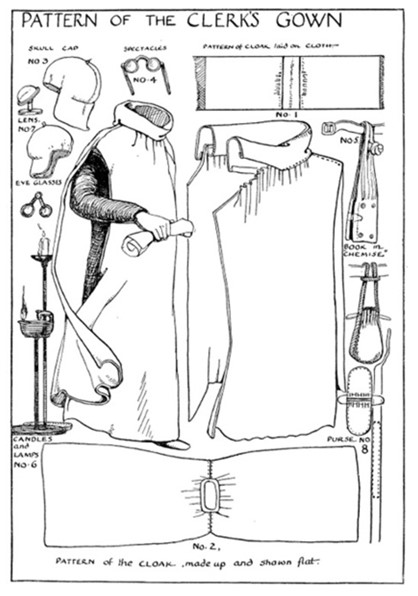
Medieval Costume and How to Recreate It by Dorothy Hartley is more of a history book than practical manual for dressing as a historical figure, unless the reader happens to have a very highly developed tailoring ability.
From the book.
At least, more than I currently have.
That being said, the divisions of different types of historical costumes into profession is inspired. As author Dorothy Hartley explains, at the beginning of the book, professions had a huge affect on how medieval persons looked. Think doctor compared to butcher compared to musician or priest.
“After the careful restrictions of religion and royalty, musicians are refreshingly loose, and may wear anything. Since there is no definite costume for musicians we have concentrated on robes and sleeves that give free play to the arms.” pg 74, ebook
In addition to the visible clothing, this book delves into the garments worn under historical clothing, which was a topic I hadn’t considered before. But, as Hartley writes, dressing as a historical figure gives the roleplayer the opportunity to both entertain and educate through the details of the costume.
For example, the thickness and type of the fabrics that go into hose have an obvious function as well as a proper place on timeline of historical costumes.
“To the casual enquirer it will no doubt seem a curious anomaly: it is none the less a fact that in the majority of costume-books no portions of man’s apparel are slurred over in so haphazard a fashion as those under the above heading.” (hose and breeches) pg 80
This book is a learning experience but, as I mentioned, also a practical one if you already know how to construct a shirt or are curious about how to make a cloak hang correctly.
“The idea of Less Doing is to reclaim your time and- more important- your mind, so you can do the things you want to do.” pg xv
Ari Meisel, a self-professed “achievement architect”, outlines ways to streamline your chores, finances, and more in order to free up time for the activities, and people, that are most important to you.
“I don’t want you to run errands, ever ever ever again. They’re not efficient, and there’s no way to make them efficient.” pg 69
Many of his suggestions are common now, like setting up an automatic delivery from Amazon for your regularly needed household items like toilet paper and paper towels. But when I considered that this book was published in 2014, then it seemed like a stroke of genius.
However, that won’t necessarily be useful to readers who are looking for more updated suggestions to make their lives that much more efficient- except for a few of his timeless strategies. For example, measure and monitor how much time it takes you to do things so then you can figure out where your time is going to.
Not rocket science, but helpful.
The one suggestion of his that I found most intriguing was his idea of creating an ‘external brain’. Basically, you write notes, diary entries, clip electronic articles and organize it in a program (he likes Evernote) so that you can access it again quickly if you would like.
“… you can create an ‘external brain’ that stores everything reliably, offers instant access, and frees your mind for more interesting work.” pg 18
I thought this approach could be very helpful for someone like me who reads and researches different topics all the time, for the fun of it, but also for professional content creators who are looking for their next blog post or YouTube video, etc.
How much easier would it be to be able to access all of your previous research rather than having to start over from scratch each time?
On the other hand, there is a massive amount of time required to both create this external brain and keep it updated. I suppose the investment only makes sense depending on what you’re eventually going to use the database for.
Recommended with reservations for readers who are looking for ways to streamline their lives.
The First 100 Chinese Characters, Simplified Character Edition: The Quick and Easy Way to Learn Basic Chinese Characters delivers on everything it promises in the title except the part that mentions “easy”.
I didn’t find it easy at all.
“You’ll be learning a writing system which is one of the oldest in the world and which is now used by more than a billion people around the globe every day.” pg 4
After a brief introduction in which the author Alison Matthews outlines the book (there is a pronunciation guide, explanation about the construction of the language, techniques and more), it hops right in to the basic characters, beginning with numbers.
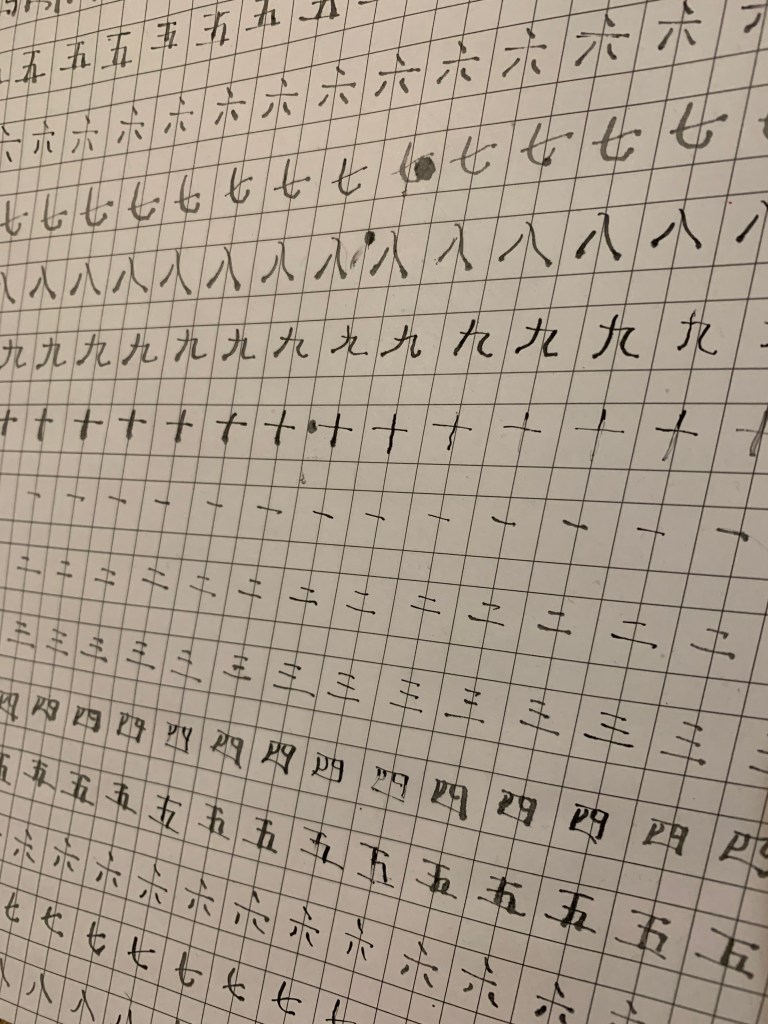
The book provides plenty of space for practice, but I utilized calligraphy paper because I’m not allowed to write in a library book. 🙂
That being said, I am going to acquire a copy of this just for me, because not only is it fun, but also it’s going to take me longer than a few weeks to master the basics.
I had some warning going in to this project that it wasn’t going to be a cakewalk. One of my nephews took Chinese as his foreign language option in the lower grades and, though he’s a smart little dude, he said it was very difficult.
It is. But it is also beautiful. I love how the characters sometimes resemble the words they stand for, a dimension English lacks with our boring Roman alphabet.
My efforts at writing Chinese numbers!
And like calligraphy, there is an art to creating the characters. I suppose the same could be said of cursive, but it doesn’t have the same feel at all. When I finish a practice page of Chinese characters, I feel like I’m looking at a painting rather than an essay.
In addition, being a left-hander is a benefit in writing Chinese rather than the hindrance that I feel it has been for me in English. The characters are traditionally written top to bottom, right to left. I don’t smear the ink across my hand and wrist! It’s been quite novel.
Highly recommended for anybody interested in learning how to write Chinese characters.
“China, so far, tends to creep into our narrative only from the time it appears on the imperial horizons of the West, or when it enters the international politics of the twentieth century, or when its economy seems unresistingly relevant (or threatening) to us.” Preface, x
Ways of Heaven, by professor Roel Sterckx from the University of Cambridge, seeks to build a bridge for the western mind to a thorough understanding of Chinese thought through its philosophy, history, historical figures, rituals, food and more.
The result is a delightful window into a different world, complete with context and signposts to guide your way.
I was looking for a book with a general overview of Chinese philosophy and this one definitely fits the bill.
Duke Ling of Wei asked Confucius about military formation. Confucius replied: ‘I have, indeed, heard something about the use of sacrificial vessels, but I have never studied military matters.’ The following day, he left the state. (An. 15.1) pg 221
Sterckx explains how Chinese history changed with each dynasty as well as the interpretations of key philosophical texts. Each succeeding ruling figure had to prove that their rule was legitimate and connected to all of the ones that went before it. Also, if Confucius’s teachings didn’t fit with how the current emperor wanted to rule, all that had to be done was to craft a different interpretation for the new ruler.
In that way, Chinese history and philosophy are both living systems, shaped by those who came before us and also, perhaps, changed in ways we will never know. It is fascinating to consider.
(And also ripe fodder for any authors who are looking for material to create historical fiction or alternative universes.)
I appreciated how Sterckx teases out the importance of symbols and materials that permeate Chinese culture. Lately, I’ve been on a Chinese and Korean television binge through Netflix and I could tell I was missing all sorts of meanings because I didn’t grasp the cultural cues.
Ways of Heaven helps with that too.
“In the Olympics of Chinese metaphor, champions are those who float along the river of life with ease, accompanied by a teacher or loved one and with the looks of a dragon and a character like jade.” pg 367
My favorite part of the book is when Sterckx talks about the use of music in Chinese ritual. How many times in films and television have you seen an ancient sage playing a flute while seated serenely on the side of a mountain? I can think of dozens of examples of just that. Now I know why:
“Music creates an unspoken bond that no other medium can achieve. … It is ritual lived through sound: ‘Music is what sages delight in, and it can be used to make the hearts of the people good. Its effect on people is deep; it can change habits and alter customs.'” pg 241
Highly recommended for readers who are interested in Chinese history or philosophy.
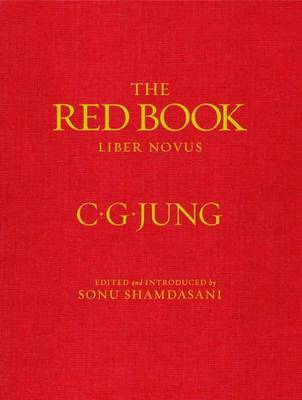
“The years, of which I have spoken to you, when I pursued the inner images, were the most important time of my life. Everything else is to be derived from this.” preface
The Red Book is a stunning publication. It is a physically large book which mimics Jung’s own handwritten copy which measured 11.57 inches by 15.35 inches.
Carl Jung’s calligraphy
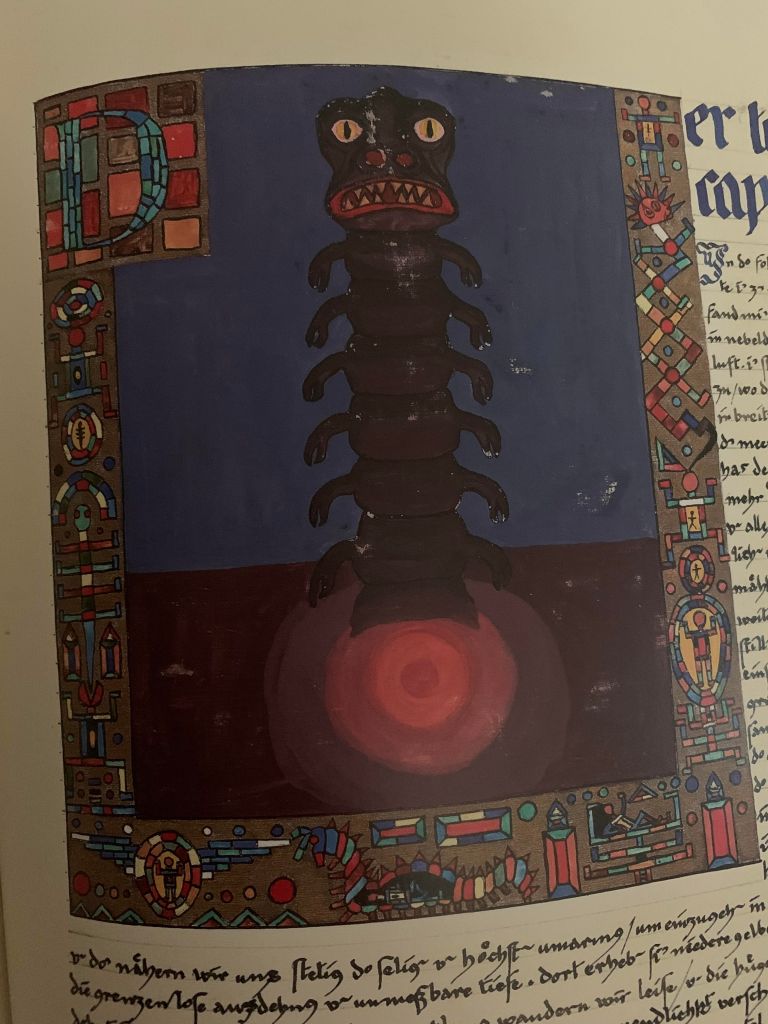
The contents are just as impressive. The first part is a brief history of Jung and his publications. The second contains pages of calligraphy in both German and Latin of his “active imagination” visualizations as well as sketches and paintings created by Jung to accompany the text.
The last section of the book is the English translation of the second part.
“Jung described his technique for inducing such spontaneous fantasies: ‘The training consists first of all in systematic exercises to eliminating critical attention, thus producing a vacuum in consciousness.'” pg 209
Painting from Carl Jung’s The Red Book
The visions themselves are interactions between Jung and voices or figures that he named his soul, gods and other archetypical figures.
“To this my soul spoke a word that roused my anger: ‘My light is not of this world.’ I cried, “I know of no other world.” The soul answered, “Should it not exist because you know nothing of it?” pg 240
As he stated in the preface, Jung felt as if his ‘confrontations with his subconscious’ affected his work for the rest of his life. It is a fascinating, little-examined side of a man who has had a huge effect on psychology and is credited, by some, as being one of the leading figures of the New Age movement.
The road to publication for this book is a story in itself. At first, Jung’s family carefully kept The Red Book in a safe deposit box to protect it as they recognized its value as a one-of-a-kind creation. They also believed that Jung wouldn’t have wanted its contents made public as he hadn’t left any specific instructions in his will about it.
Painting from Carl Jung’s The Red Book
However, researchers and scholars have since examined the text and found parts where Jung addresses, “my dear friends,” leading to the opinion that he did intend to share it with a wider audience. They also point to its importance to Jung’s following works as another reason why it should be published.
Whatever their reasoning, I’m so very glad his family and foundation made the decision to publish. This book is a treasure.
Curiously, The Red Book ends in an incomplete sentence.
Here it is:“I knew of nothing better than to write them down in a ‘precious,’ that is to say, costly book and to paint the images that emerged through reliving it all- as well as I could. I knew how frightfully inadequate this undertaking was, but despite much work and many distractions I remained true to it, even if another/possibility never…” epilogue
Painting from Carl Jung’s The Red Book
I wonder what he was going to write next.
Though I didn’t use Jung’s method of active imagination, I too have undertaken lengthy ‘confrontations’ of my subconscious and have come back with pages of material that read, in some ways, quite similar to this book.
Perhaps, one day, I will also find the courage to publish it.
Highly recommended for any readers interested in Carl Jung’s methods, archetypes or dream interpretation.
“Anyone who dreams of an uncommon life eventually discovers there is no choice but to seek an uncommon approach to living it.” pg 73, ebook
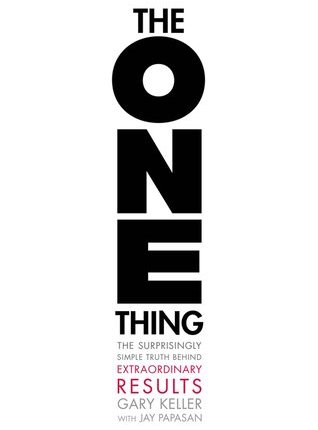
The One Thing contains simple, ridiculously obvious advice- find your passion, make time for it and live it. But, if it’s really that easy, then why aren’t more of us doing it?
“Where I’d had huge success, I had narrowed my concentration to one thing, and where my success varied, my focus had too.” pg 8, ebook
This book has helped me to adjust my focus so that I spend more of my time on what I love, writing. That being said, there are still chores that must be done, a family business to tend to, a child to raise and numerous other responsibilities that chip away at time that I can give to my one thing.
And, as author Gary Keller points out, this isn’t a big deal. Everybody has their big ONE THING but smaller one things in other areas of their lives. You can use the same focusing principles on each to improve your life in each sphere.
What’s the one thing you can do to improve your family life? Health? Diet? etc., etc.
This book also taught me that a majority of my output comes from a very small percentage of my actions, something that I had never considered before. Like I said, obvious in hindsight now that I know it, but it wasn’t something I instinctively knew.
“Happiness happens on the way to fulfillment.” pg 98, ebook
I read tons of non-fiction and self help titles. Have they all improved my life? No. Do I always learn something from them? Generally.
Read The One Thing if you want to learn some methods to narrow your focus and advance what is most important to you in your life. If you already know how to do that, this isn’t the title for you.
“Expressed in its most functional way, the Shadow is composed of all those aspects of ourselves that have a tendency to make us uncomfortable with ourselves.” pg 9
Jungian analyst James Hollis examines “shadow work” from the perspective of an individual to couples then communities and all the way up to the collective unconscious.
He’s at his best when he’s illuminating how the Shadow works at an individual level. When he goes beyond that into couples or groups, I thought he began to generalize to the point where the book was no longer helpful on a practical level and moved more into the realm of philosophy.
Hollis brought the book back into the self help genre by providing a final chapter full of questions for “reflection” by the reader. The purpose of this inner gazing is not just self knowledge, says Hollis, but also wholeness at a soul level.
“This book operates from a central thesis that is relatively unknown to the general public but is a truism for depth psychology, namely, that the human psyche is not a single, unitary, or unified thing, as the ego wants to believe. It is diverse, multiplicitous, and divided… always divided.” pg xi, preface.
I read Why Good People Do Bad Things in conjunction with a philosophy class off of The Great Courses Plus (Wondrium) called “Understanding the Dark Side of Human Nature” by Daniel Breyer. The two complemented each other quite well.
“Can the reader imagine that something inside you wishes to ‘talk’ to us? As a result of this conversation, consciousness is strengthened, new energies are available, and each person lives a richer life, one that is more authentically one’s own.” pg 192
This isn’t what I would call a ‘fun’ read. In fact, I had to take Why Good People Do Bad Things in sections, put it down for awhile, and come back to it, again and again.
I don’t mind self knowledge. I’ve done dozens of meditations where I look at aspects of myself and come back with a different understanding of who I am than before I started.
The difficulty is looking into the bits that I don’t want to see. Like I said, I can manage it in small doses. It isn’t somewhere I’d want to live.
It is understandable why so few attempt Shadow work. It is much easier to scapegoat others, blame, and feel superior to them.” pg 203
Recommended for any seekers who are looking for a psychologist’s take on Shadow work. This book might be the push that you need to brave that darkness. But beware, there’s someone in there who may have been waiting to talk to you for a long time and you might not like what they have to say.























 The Help Desk Book Blog