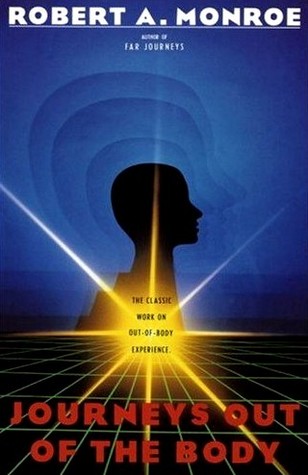
Journeys Out of the Body: The Classic Work on Out-of-Body Experience by Robert A. Monroe

Journeys Out of the Body: The Classic Work on Out-of-Body Experience by Robert A. Monroe
journeys out of the body

A ground breaking work into the mystery that is the out-of-body experience by a leading researcher in the field.

Ultimately, Journeys Out of the Body left me with more questions than answers, but, for the most part, I enjoyed the ride.

Charles Tart’s introduction is excellent: “… OOBE’s are a universal human experience, not in the sense that they happen to large numbers of people, but in that they have happened all through recorded history, and there are marked similarities in the experience among people who are otherwise extremely different in terms of cultural background. One can find reports of OOBEs by housewives in Kansas which closely resemble accounts of OOBEs from ancient Egyptian or oriental sources.” pg 8.

That statement reminded me of the near death experiences described in Wisdom of Near-Death Experiences: How Understanding NDEs Can Help Us Live More Fully by Penny Sartori. OOBEs like NDEs are a human experience rather than a cultural one.

Munroe points out a curious habit of society that I’ve noticed:“Many (in spiritual and occult circles) have deep professional jealousy for each other, and often are inclined to be suspicious of techniques and theories propounded outside their particular activity. They may even subtly deride or look with tolerant, superior amusement at results unrelated to their specialty. pg 37.

Why can’t we all just get along? I bet we’d learn more that way.

Photo by Min An on Pexels.com

Munroe’s thoughts on the “natural” home for what he calls the “second body”, astral body, or body of light: “The Second Body is basically not of this physical world. To apply it to visits to George’s house or other physical destinations is like asking a diver to swim down to the ocean bed without scuba gear or pressure suit. He can do it, but not for long, and not too many times.” pg 75-76.

That was why Munroe believes that out of body experiences are so hard to substantiate. When explorers are looking for evidence from the physical world, it isn’t the natural place for that consciousness to be.

Munroe talks about going to an alternate dimension in his explorations. He quotes a college professor about the possibility of this: “Dr. Leon M. Lederman, professor of physics at Columbia University, has stated: “Basic physics is completely consistent with the cosmological conception of a literal antiworld of stars and planets composed of atoms of antimatter, which is to say negative nuclei surrounded by positive electrons. We can now entertain the intriguing idea that these antiworlds are populated by antipeople, who antiscientists are perhaps even now excited by the discovery of matter.” pg 100

I think that would make a great science fiction novel. Has anybody written anything like that?

Photo by Yan Krukov on Pexels.com

I had imagined that learning about out of body experiences would be empowering and uplifting but parts of Munroe’s account didn’t really leave me feeling that way.

Take this journal entry in which he describes aliens and the loss of his belief system: “Then they seemed to soar up into the sky, while I called after them, pleading… By this time, it was getting light, and I sat down and cried, great deep sobs as I have never cried before, because then I knew without any qualification or future hope of change that the God of my childhood, of the churches, of religion throughout the world was not as we worshiped him to be- that for the rest of my life, I would “suffer” the loss of this illusion. Are we, then, just leftover laboratory animals? Or perhaps the experiment is still “in process.” pg 262.

Very, very bleak and, it just didn’t feel right to me. However, Munroe believes this is true and I felt very sad for him.

If you are interested in more information about OBEs, you may want to read Soul Traveler: A Guide to Out-of-Body Experiences and the Wonders Beyond by Albert Taylor or Multidimensional Man by Jurgen Ziewe.

If you want more one-on-one experiences with aliens, try The Key: A True Encounter by Whitley Shrieber.

Thanks for reading!

Wisdom of Near-Death Experiences: How Understanding NDEs Can Help Us Live More Fully by Penny Sartori

Wisdom of Near-Death Experiences: How Understanding NDEs Can Help Us Live More Fully by Penny Sartori
wisdomofneardeath

An extraordinary book by Penny Sartori who was a nurse, now doctor, and worked for years in the NHS.

She realized that with end life issues, there are many categories of experiences that are not discussed in medical educations but that happen often enough to be tacitly understood by practicing medical staff. Dr. Sartori compiled this book with the aim of helping other medical professionals understand near-death experiences and their potential effects on recovering patients.

Refreshingly, Dr. Sartori writes simply enough for a lay-person (like me) to completely understand the text and I found first-hand account after account fascinating, uplifting, and educational.

I’ve read about many near-death experiences and I’ve always gotten the feeling that there was something more there. As if, in reading the account, I was viewing a light behind a veil. Dr. Sartori calls this, “Ineffability.” “Ineffability: When people try to make sense of the (near-death) experience or try to verbalize it they find that words fail them. They have experienced something with which they have nothing to compare, and to try to find words to describe it is impossible.” pg 9

It’s nice to be able to put a word to that feeling.

At the end of the chapter about international near-death experiences, she has this to say: “It is evident that NDEs are worldwide phenomena and it has therefore been suggested that they are merely the effects of a dying brain. However, some cultures report components that are not present in other cultures, which would rule out materialist explanations. As some components are interpreted according to culture then it is reasonable to construe that the components may be interpreted symbolically through each individual’s cultural filter. This could suggest an underlying collective consciousness, as discussed by Carl Jung.” pg 83.

Photo by Timo A. on Pexels.com

Most of the books I’ve read on this topic have had little to say about the commonality of NDEs among the world’s population. This is a good introduction to it.

About the power of love: “Hospice and palliative-care consultant Dr. John Lerma has reported that 70 to 80 percent of his patients waited for loved ones to leave the room before dying. He also remarked that he had witnessed patients who had been certified dead return to life as the pain of their loved ones had pulled them back from a place of peace and love.” pg 103 Mind blown.

Love literally brought people back from the dead.

About the science of spirituality and how that relates to religious texts: “Texts such as the Books of the Dead have many similarities to NDEs. For many thousands of years these have been reduced to myths but now they appear to be ‘maps of the inner territories of the psyche encountered in profound non-ordinary states of consciousness’. Maybe this is what is needed to reintegrate our spiritual roots with our huge advances in technology.“pg 191 I think that this may be true too.

And finally: “One thing I’ve come to realize over the past few years is that heaven is not a location – it is a state of mind and is within us all. We just have to go within and find it.” pg 191 Absolutely, Dr. Sartori.

If you enjoyed The Wisdom of Near-Death Experiences, I would suggest reading, The Map of Heaven by Eben Alexander. You may also enjoy Journey of Souls: Case Studies of Life Between Lives by Michael Newton- a hypnotherapist explores between life/past life consciousness with his patients to heal current issues.

Also, if you want to explore the idea that heaven is inside of us, you may want to check out What if This is Heaven by Anita Moorjani.

Thanks for reading!

Surviving Death: Evidence of the Afterlife by Leslie Kean

Surviving Death: Evidence of the Afterlife  by Leslie Kean
surviving-death

Investigative journalist Leslie Kean takes a close look at a wide variety of unexplained phenomena in order to answer the age old question — does human consciousness survive death intact with the memories, personality, and uniqueness that was exhibited in life?

I found her evidence astonishing.

Much of her research into near-death experiences (NDEs), I had been exposed to in other books. But, the chapters about children remembering past lives, psychic mediums and physical mediums was entirely new to me.

As I read, I kept getting goose bumps up and down my arms. The stories are that powerful.

(Reminder, the following quotes were taken from an advance reader’s copy and may change or be edited in the final printed version.)

Why did Kean write this book? “My intention is to present some of the most interesting evidence from diverse sources and show how it interconnects, making it accessible for the intelligent and curious reader encountering the material for the first time. Strict journalistic protocols can be applied to any topic for which there is data, no matter how unusual or even indeterminate.” loc 51, ebook.

I think she succeeded admirably. Most of Surviving Death is easy to understand, no matter how far-out the material may be.

I’ll admit to losing interest in the passages where she tries to distinguish between intelligence coming from the living human psyche or dead ones, the psi theory vs the survival theory. But, since that was the point of the book, that may be some people’s favorite part so don’t let me put you off.

Photo by Daniel Torobekov on Pexels.com

Take these death bed descriptions of the other side by those about to leave this world: “The great inventor Edison, just hours before his death, emerged from a coma, opened his eyes, looked up, and said: “It’s very beautiful over there.” And more recently, the sister of Steve Jobs reported that just before he died, Jobs looked over the shoulders of his family members, right past them, and said, “Oh wow. Oh Wow. OH WOW!!” loc 2176, ebook.

I was not present when my grandpa passed, but Grandma told me later that at the moment he took his last breath, that a light came into his eyes and his face became so completely peaceful that he looked thirty years younger. I can’t say that I know for sure what waits for us beyond this life, but I can say that I’m not afraid. If you happen to have any fears in that regard, Surviving Death could be of great help to you.

Kean doesn’t answer the question she poses definitively because, of course, she hasn’t died and come back to tell us about it, but the stories and evidence that she presents is compelling. Throughout the chapters, Kean writes about personal, first-hand experiences that she has had. I believe that they are genuine. The hardcore skeptics may disagree.

The most extraordinary part of this book were the physical manifestations that Kean observed in the medium seances. Apparently, these seances have been going on for hundreds of years in certain areas of the world.

Did you know that in the 1920s in Warsaw, Poland, bowls of wax were placed in the seance chapter and apparitions were able to make molds of their hands? “In the Warsaw experiments, gloves were produced with interlocking fingers, with two hands clasping one another, and with the five fingers spread wide apart. Needless to say, the removal of a human hand from such formations would be impossible. Dematerialization was the only method that would leave the molds intact.” loc 4504, ebook. How had I never heard of this!

Recommended for readers who are prepared to have their minds blown. Surviving Death is incredible and almost indescribable. If you are interested in such studies, it is an absolute must-read. You may also want to look into Wisdom of Near Death Experiences: How Understanding NDEs Can Help Us Live More Fully and The Map of Heaven: How Science, Religion, and Ordinary People Are Proving the Afterlife.

Thank you to NetGalley and Crown Publishing for a free digital copy of this book. And, thank you for reading!

Trance Dancing with the Jinn: The Ancient Art of Contacting Spirits Through Ecstatic Dance by Yasmin Henkesh

Trance Dancing with the Jinn: The Ancient Art of Contacting Spirits Through Ecstatic Dance by Yasmin Henkesh
trancedancing

I read The Golem and the Jinni a few months ago and realized that I knew next to nothing about the mythology of the Jinn. Not that I’m an expert on golems either, but I had at least been exposed to the idea.

Trance Dancing with the Jinn is a book about kinetic meditation (trance dancing) but it also documents the history of the Jinn as written in the Quran and other sources as well as the biological and historical reasons that humans go into trance.

In addition to the mythology and biology, I learned about how trance dancing at meetings called “zars” is an outlet for women who have very little control over any other aspect their lives in Northern Africa.

The author is clearly a believer in the existence of “the Invisibles” but, if you don’t share the same beliefs, this book still has plenty of fascinating information for those interested in cultural, religious, or feminist studies and ritual dance.

The author asks the reader to have an open mind: “Do you believe in Invisibles or do you consider them an outdated tradition from an ignorant past? What if you had a safe, drug-free way to see for yourself? Would you be curious enough to try it- even though the method takes practice and you probably won’t succeed on your first attempt?” loc 200.

Yeah, I’m down for that.

I don’t think it is that difficult to entertain the idea that there may be intelligences that exist that can’t be perceived in normal states of consciousness.

As Henkesh reminds us: “According to NASA’s website, “Everything on Earth, everything ever observed by all our instruments, all normal matter- adds up to less than 5% of the Universe… The rest is a complete mystery, but an important one. Roughly 68% of the Universe is dark energy, while dark matter makes up about 27%.” This energy and matter are called “dark” because they do not reflect light… or interact with electromagnetic forces. We only know they are there by their effects on gravity…” loc 233, ebook.

Photo by Pixabay on Pexels.com

Only 5% has been observed- that leaves a whole lot that we haven’t even looked at yet.

Western researchers are still discovering how and why trance works, but they at least acknowledge that it exists: “Neurologist Oliver Sacks once wrote, “Normal waking consciousness, rational consciousness as we call it, is but one special type of consciousness, whilst all about it, parted from it by the flimsiest of screens, live entirely different potential forms of consciousness.” loc 267.

The most fascinating part of this book was the emotional outlet that trance dancing has allowed women for hundreds of years: “… thousands of women in Egypt still turn to the zar when modern medicine fails them. If doctors cannot find the cause of their physical or mental ailments, they assume supernatural forces are involved. … Diagnostic zars can last anywhere from a day in Egypt to a week in Sudan and Ethiopia.” loc 2530-2548

I had never heard of this and looked up some examples of zar/trance dancing on YouTube. Go ahead, take a look:

I can see how such flowing, uninhibited movements would feel therapeutic now, so I can’t imagine the relief I’d feel if I was not allowed to have a job or leave the house without a male by my side. I’d probably be trance dancing non-stop.

Some further reading/listening for those interested in trance: Ecstatic Body Postures: An Alternate Reality Workbook, Seeking Heaven, or Brainwave Journey.

Thank you to NetGalley and Llewellyn Publications for a free digital copy of this book! And, thank you for reading.

Dying to Wake Up: A Doctor’s Voyage into the Afterlife and the Wisdom He Brought Back by Rajiv Parti

Dying to Wake Up: A Doctor’s Voyage into the Afterlife and the Wisdom He Brought Back by Rajiv Parti

Rajiv Parti was living a materialistic dream with the house, car, and beautiful wife to prove it. But, the many things in his life didn’t bring him comfort when he developed prostate cancer and a bunch of unfortunate side effects from the surgery to remove it.

Photo by PixaSquare on Pexels.com

Addicted to pain pills and disconnected from the people around him, Dr. Parti underwent emergency surgery and experienced something so incredible, that when he woke up, he completely changed his life, developed a new form of holistic health treatment, and gave up many of the possessions that were weighing him down.

This is the memoir about that experience and Dr. Parti shares it in the hopes that it will change the reader’s life or at least bring comfort to those who are struggling in their current life experience.

Like many of the other memoirs I’ve read by medical professionals, Dr. Parti talks about the completely scientific view he had of the soul, which is to say, if you couldn’t see it and measure it, then it doesn’t exist.

Also, working on the technological edge of medical breakthroughs in the treatment of various diseases, had given him an invincible feeling.

This experience blew that attitude away: “Feeling like a master of the universe is easy in the world of modern medicine. … Maybe it’s a sense of cheating death for others that gives us cardiac surgical teams the vague feeling that we can overcome our own death. Of course that isn’t true. … Reality popped that myth for me.” pg 10

Photo by Kevin Menajang on Pexels.com

In his near death experience, Dr. Parti not only encountered his father, but also a huge crowd of his ancestors.

They shared messages of forgiveness and love: “Love is the most important thing there is, my grandfather communicated to me. I am glad to let you know that simple truth while you can still make change in your earthly life.” pg 44

But his time on the other side wasn’t all light and love, Dr. Parti also had the (fairly rare) experience of seeing hell and the suffering souls within it.

This is entirely my opinion, but I think that the detached manner in which Dr. Parti was living his life brought forth a major wake-up call from the spirit world. He saw hell first and then heaven and, in a way, that could be a metaphor for his life experience.

Photo by Skitterphoto on Pexels.com

I don’t believe in “hell” myself other than the nightmare that people can create in their own minds and lives, but, I didn’t experience it like Dr. Parti did. This memoir does not focus on the hell portion of the narrative, but, with the rarity of that experience, it could have. That, in itself, says something.

When Dr. Parti “comes back”, he knows that he wants to start a new life and a new focus, but he doesn’t know how.

The information for developing a new type of medicine comes to him slowly during meditation: “What is (the new mode of healing) anyway?” “…It is how nonpharmacological treatments in combination with drugs can heal things like depression and addiction and other diseases. It’s about searching one’s own soul to fight back against the hollowness that pharmaceuticals alone or alcohol and illegal drugs create or don’t really fill.”pg 91.

He eventually develops meditations and lifestyle changes as well as a manifesto for treatment.

To me, the most fascinating part of this memoir was the communication between himself and the spirit world once he was back.

For readers who are unfamiliar with near death experiences, Dr. Parti provides a broad background with some of the major historical figures who went through it.

Like Jung: “(Carl) Jung’s NDE led to a split with Sigmund Freud, who believed that spiritual experiences were fantasies. Jung, however, considered spirituality an important part of our well-being saying that life has purpose beyond material goals and that our main task, the path we should all be on, is the one that leads to our own connection with the universe.” pg 124

Photo by Cliford Mervil on Pexels.com

Ultimately uplifting and empowering, Dying to Wake Up is another excellent entry into the literature about near death experiences.

Recommended for anyone who questions why we are here or what comes after. Some further reading: Into the Magic Shop: A Neurosurgeon’s Quest to Discover the Mysteries of the Brain and the Secrets of the Heart, Dying to Be Me: My Journey from Cancer, to Near Death, to True Healing, or Wisdom of Near-Death Experiences

Thanks for reading!

The Out of Body Experience: The History and Science of Astral Travel by Anthony Peake

The Out of Body Experience: The History and Science of Astral Travel by Anthony Peake

I found this to be a fascinating study into the various forms of out of body experiences and the science behind them. Unfortunately, the second half of the book that deals with quantum mechanics and multiple dimensions went over my head.

So, The Out of Body Experience may lend itself more towards engineers and mechanical-minded types rather than artists, but that’s ok. Engineers need interesting books to read too. 🙂

Photo by eberhard grossgasteiger on Pexels.com

Peake is very clear about the goals of this book: “In its pages I will review the evidence that such altered states of consciousness are subjectively real experiences; I will delve into the science by which consciousness can seemingly locate itself outside of the body and I will, finally, present my own hypotheses as to what may be happening when a person experiences such perceptions.” loc 98, ebook.

I felt like he accomplished all of that, but I was left with a sense of confusion/awe rather than clarity/awe. I had the same feeling when I tried to listen to a lecture by Amit Goswami. I knew enough to know that I had no idea what he was saying.

In this passage, he’s talking about shamanistic out of body experiences, something I do know a bit about: “Indeed, in my discussions with my shaman contacts, it became clear that what is encountered is a series of worlds full of archetypes pulled up from the deepest areas of the subconscious mind. However, what is of significance is that these beings seem to have motivations of their own, as if they have an existence independent of the shamanic traveller.” loc 261, ebook It is pretty trippy stuff.

Peake also tackled why remote viewers have trouble proving the validity of their experiences with verifiable facts in lab settings: “I am absolutely convinced that Ingo Swann believes he actually perceives information by remote viewing. In his books and articles he comes across as a genuine and honest individual, but the evidence seems to contradict this. … In my opinion he is remote reviewing, but not doing so in this dimension.” loc 1157, ebook.

Photo by Pixabay on Pexels.com

Frankly, I always wondered about that too — why can’t remote viewers see whatever they want whenever they want or why are they sometimes completely wrong? The US military spent a pile of money developing a protocol that only works some of the time, but, the fact that it works at all blows my mind.

Peake presents the hypothesis that lucid dreaming and out of body experiences are two sides of the same coin: “The hypnagogic and hypnopompic states are really the same phenomenon that places consciousness in that liminal region between sleep and wakefulness. The only difference is in the circumstances. The hypnogogic state is experienced on going to sleep and the hypnopompic state is experienced on waking up. We define an OBE when a subject is unaware of their soma.” loc 1541-1558, ebook.

So, in layman’s terms I think he’s saying: out of body experiences happen when you’re awake, lucid dreaming happens when you’re asleep, but otherwise it is the same type of non-ordinary consciousness.

One more interesting fact, just one though, because otherwise my brain might explode:“Now, the fascinating thing about (the) electromagnetic spectrum is that the human eye can only see a very small section, the part we call ‘visible light’… If the electromagnetic spectrum were a roll of movie film that stretched for 2,500 miles (this is the distance between London and Jerusalem), the visible spectrum would be the size of one film frame, about three inches. This is just how little we human beings see of the real universe that is out there and yet most of us believe that ‘seeing is believing’! If we could see radio waves we would see a sky full of galaxies, not stars.” loc 2024, ebook.

Can you imagine — a sky full of galaxies? I can.

Recommended for the seriously scientific minded.

If you’re more into the history of the phenomena rather than the science, just stop reading before the second half of the book.

Some of the reads mentioned in here that you may want to pick up: Journeys Out of the Body by Robert A. Monroe,Wisdom of Near-Death Experiences by Penny Sartori, or for some general remote reviewing information: The Seventh Sense: The Secrets of Remote Viewing as Told by a “Psychic Spy” for the U.S. Military by Lyn Buchanan.

Thank you to NetGalley and Watkins Publishing for a free digital copy of this book for review purposes!  And, thank you for reading.

A Brief Tour of High Consciousness: A Cosmic Book on the Mechanics of Creation by Itzhak Bentov

A Brief Tour of High Consciousness: A Cosmic Book on the Mechanics of Creation by Itzhak Bentov

If you’ve been following this blog for awhile, you know now that I really enjoy “fringe” non-fiction that chronicles out of body experiences and remote reviewing.  This is another of those books.

If you’re not into those topics, my apologies in advance. 🙂

A lighthearted yet profound guide to the realms of higher consciousness and the ultimate nature of reality.

Goodreads
Photo by Pixabay on Pexels.com

My research into consciousness exploration continues with A Brief Tour of Higher Consciousness by Itzhak Bentov.

Having predominantly read books like this by artists (Jurgen Ziewe and Kurt Leland come to mind), it was refreshing to have a first person narrative by an engineer. Itzhak’s lens of perception is so different than my own- I loved it.

There is a part towards the end, What is a Hologram, and a chapter by another author, Essay on Cosmology by Edward Apgar, that I didn’t resonate with at all. But, perhaps for the most scientifically-minded, those parts will be your favorite.

hologram

Hologram image from nationaldefensemagazine.org

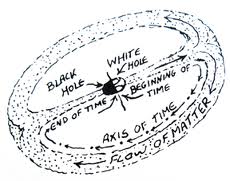
Itzhak has simplistic doodles scattered throughout the text which brings a “Randall Munroe” feel to the book- the use of simple pictures to illustrate complex and abstract ideas. This author definitely feels to me as if he was a bit ahead of his time in both his presentation and materials.

bentovdoodle

Bentov doodle from ritamarrpositivechange.wordpress.com

Itzhak’s explanation of “lens of consciousness”: “As consciousness evolves and information starts pouring in, the information is couched in a language best understandable to the person involved. For instance, a poet will be shown the nature of Creation in poetic images, an artist in visual symbols, and a mathematician in abstract equations; a nuts-and-bolts fellow like myself will have it shown to him as structure.” pg 5

I was reminded of Robert Monroe’s Journeys Out of the Body in which he puts emphasis on recording and comparing out-of-body experiences for consistency and real world applications to bring legitimacy to the practice.

I’ve heard that we’re all made of star dust and I really liked Itzhak’s description of it in this passage: “Stars collect into clusters or galaxies, and as they die, they explode and create cosmic dust, which again condenses into new stars and planets. Everything in the entire universe, including our bodies, is made of one cosmic substance. We contain atoms from the most distant galaxies and are thus connected to the whole universe.” pg 13

starsinthesky

Stars in the sky from wikipedia.org

Everything is vibration: “In short, consciousness in a vibratory state manifests itself as our familiar matter, from which the different forms that we see around us are made. The table, the flowers, the scent of the flowers, and our bodies are all made of rapidly vibrating consciousness.” pg 20 Wild!

A discussion of how to interact with devas (an ant deva to be precise, which is kind of silly, I realize), which Itzhak describes as “The name given to a being that is the rudimentary consciousness of any structure”: “To negotiate with her, the currency of exchange is love. Just send the ant deva a lot of love, which will stimulate her evolution. Even ant devas need love, in order eventually to know their Creator.” pg 33

Photo by Jimmy Chan on Pexels.com

In my meditations, I’ve frequently experienced what Itzhak describes in this next passage. It was nice to finally have a reason why: (While in a meditative state) “Wiggle your body. This causes a disturbance, a vibration, to spread … (This is similar to a fly falling into a spider web. The vibration of the web signals the spider and it shows up to investigate its dinner.) The deva .. appears immediately, looking worried and saying something like “What do you want?” or “Who are you?” pg 35

I’ll close with this excerpt of Itzhak’s philosophy: “There is nothing absolute and final. If everything were iron-clad, all the rules absolute and everything structured so no paradox or irony existed, you couldn’t move. One could say that man sneaks through the crack where paradox exists.” pg 78

If you enjoyed this book, you may want to take a look at Otherwhere by Kurt Leland or Multidimensional Man by Jurgen Ziewe. If you liked the doodles of complex concepts and want more of that, try Thing Explainer: Complicated Stuff in Simple Words by Randall Munroe.

Thanks for reading!

The Secret of the Soul: Using Out-of-Body Experiences to Understand Our True Nature by William Buhlman

The Secret of the Soul: Using Out-of-Body Experiences to Understand Our True Nature by William Buhlman

The Secret of the Soul is a great title for beginners who are looking to understand this, sometimes confusing, other times frightening, skill that we all seem to possess — the ability to exit our bodies in a kind of vision or trance.

Some call this the “out of body experience” or OBE.

Photo by Joshua Abner on Pexels.com

The first half of the book, Buhlman discusses OBEs, why they are important, and gives countless examples of actual OBEs that folks have had. The second part of the book gives concrete techniques and problem solving tips to assist readers in having their own OBEs.

One of my friends is a long distance runner who has had some OBEs during his ultra marathons. I thought of him in the section entitled “Combat and Trauma-Induced Experiences”: “It was while I was running in a marathon last year that I had a very strange experience. I was at about the eighteen-mile marker when I looked beside me and saw myself running. At first I thought it was someone who was my build and wearing the same shoes, but then I realized it was me!” pg 55

Buhlman has story after story like that.

Photo by anouar olh on Pexels.com

If you’ve never had an out of body experience of your own, the sheer variety and number of people who have fills you with confidence that you can.

I also liked Chapter 4, “Transformational Experiences”: For thousands of years spiritual masters have taught that the act of withdrawing from the senses is essential in order to consciously experience our spiritual self. pg 61

And the testimony from that chapter: “This is bigger then anything I can imagine; how can I tell people without sounding like a nutcase? This changes everything I ever thought I knew or thought was true.” pg 68

That’s the thing about powerful transformational experiences. Until someone has one him or herself, there’s not really anyway to explain it.

Chapter 6, “Extraterrestrial Contact and Abduction,” was the first time that I’ve read about aliens alongside traditional OBEs. Buhlman writes: “After reading more than two hundred such letters (from his OBE survey), I noticed a startling similarity: The letters describing extraterrestrial contacts and abductions were almost identical to the thousands of letters I have received describing out of body experiences. In fact, I often could not distinguish between letters.” pg 89

Photo by Francesco Ungaro on Pexels.com

In Chapter 7, A Brief History of Out-of-Body Experiences, the reader is given cultures from different time periods, all over the planet, that support and confirm the existence of out of body experiences.

These seem to suggest that OBEs are a “human” experience rather than a culturally specific one.

Take Emanuel Swedenborg’s words: “It has pleased the Lord to… open the interiors of my mind or spirit, whereby I have been permitted to be in the spiritual world with angels, and at the same time in the natural world with people, and this now (has happened for) twenty-seven years.” pg 113

I was surprised at how many of the historical figures presented here as having OBEs were scientists… I guess in my mind I’ve always drawn a line between the artsy/mystic types and the scientists. Line erased. 🙂

I’ll conclude with a few statements from the Appendix of the book, which was compiled from Buhlman’s extensive survey of people who had had OBE’s: “Self-initiated out-of-body exploration is a direct and powerful method to experience our true spiritual essence. It is an effective method to accelerate our personal growth and evolution. … This is achieved by personal spiritual experience and exploration beyond the physical limits.” Appendix pg 253.

Photo by Enrique Hoyos on Pexels.com

Couldn’t have said it better myself.

If you’re looking for more books on the topic of out-of-body experiences, check out Otherwhere by Kurt Leland, Journeys Out of the Body by Robert Monroe, or Multidimensional Man by Jurgen Ziewe.

Thank you for reading!

The Afterlife of Billy Fingers: How My Bad-Boy Brother Proved to Me There’s Life After Death by Annie Kagan

The Afterlife of Billy Fingers: How My Bad-Boy Brother Proved to Me There’s Life After Death by Annie Kagan

I think anyone who has lost a loved one wishes to talk to them again. Annie Kagan was granted that wish. She wasn’t a practicing channeler, so it came as a huge surprise to her when she heard her dead brother’s voice speaking to her from a spot above her head.

At the time that this happened, Annie was living a hermit’s life in New England only venturing out to kick ideas around at her writer’s group. So, that gave her the space and time to explore these communications rather than running to the doctor to have the voice medicated away.

Photo by William Alexander on Pexels.com

At first, she was reluctant to share what she was hearing, afraid that Billy’s voice was her mind’s way of holding the grief away or that other people would think she was going insane, but the information imparted became more and more specific until she couldn’t explain it away.

Through the experience and sharing it, Annie came to believe without a doubt that the spirit continues on after death. She took comfort from it and hopes, with this book, to share that comfort with others who may be grieving or afraid of death itself.

The Afterlife of Billy Fingers isn’t going to appeal to everyone. If you don’t believe that communications from beyond the grave are possible, I’d suggest passing on this book. And, towards the end of Billy’s travels into the afterlife, things get really far out as he lets go of his previous self and becomes the universe, embodying the entirety of reality.

Photo by Designecologist on Pexels.com

It reminded me of Be Here Now by Ram Dass, hippie to the extreme. But, that’s the type of spirituality I’m into, so I loved it.

The introduction by Raymond Moody describes Billy as a modern psychopomp, someone who guides the spirits of others through the afterlife: “The experiences Dr. Kagan relates are completely consistent with the kind of role walkers between the worlds played in antiquity. And that is no surprise to me. I think that such experiences are part of the collective psychological heritage of humankind- not artifacts of any one culture.” pg 11, ebook.

Billy was a drug addict and led a very hard life.

This is what he had to say about it: “How do I know my life wasn’t some punishment for my past transgressions? Well, because there’s no such thing. You’re not on earth to be punished. … That’s a human concept. Something man made up. Humans make up stuff and then they believe it”. pg 24, ebook.

A continuation along that line of thinking later in the book: “Beliefs are big on earth. People collect them. Some of these beliefs are helpful, but others just keep you running around trying to follow rules that others have laid down. They don’t have a lot of personal meaning. It’s a good idea to sort through your beliefs now and then and throw out the ones that don’t serve you.” pg 85, ebook

Photo by Pixabay on Pexels.com

Annie dealt with a bunch of her own issues in this book, like the fact that by writing this book, people were going to think she was “flaky”. At one point in the narrative, she has a toothache and starts to believe that she’s being punished for revealing universal truths that should be kept secret.

She eventually gets past that attitude, but, when it comes to the unknown, I think fear can be a major hurdle: “After my toothache and the painful root canal and awful infection that followed, I was scared. … who was I to be the one to prove there’s life after death? Maybe some secrets shouldn’t be revealed. Maybe I was breaking a sacred taboo, dabbling in a cosmic Pandora’s box.” pg 41, ebook.

Another of the Be Here Now moments: “In your world, as the earth moves around the sun, there’s nothing but shadow for a good part of the time. The mystery of life on earth cannot exist without the shadow element. You cannot have the sea without storms, the earth without quakes, the wind without tornados. … And sometimes- sometimes darkness is okay too. Don’t overlook the riches contained in the darkness. Life’s very temporary, so don’t let time just pass. Let the moments fill you- the ones you judge to be good as well as bad.” pg 77, ebook. Solid advice.

Let’s end with one more bit of wisdom: “People spend lots of time on things that make them unhappy- too much focus on the sand in the oyster. To cultivate joy, pay attention to what you like.” pg 116

Recommended for spiritual seekers and people who enjoy reading about near death experiences/channeled wisdom.

Some read alikes: Conversations with God: An Uncommon Dialogue, Vol. 1 by Neale Donald Walsch, My Son and the Afterlife: Conversations from the Other Side byElisa Medhus, Ask and It Is Given: Learning to Manifest Your Desires byEsther Hicks or, if you’re looking to introduce more joy into your life:Thank & Grow Rich: A 30-Day Experiment in Shameless Gratitude and Unabashed Joy by Pam Grout.

Thanks for reading!