Masks of Misrule: The Horned God and His Cult in Europe by Nigel Jackson

Masks of Misrule: The Horned God and His Cult in Europe by Nigel Jackson

My mind has been going in circles as I’ve pondered, for days, how to review this book. It is a poorly organized and bewildering publication that could be tremendously important for pagans or religious scholars who are looking for information about The Horned God.

“The Knell of Inbetweenness hath been struck,
The Bell of MISRULE soundeth;
Reverberating the Thirteen Angles,
Echoing through the Nine Spheres”

Photo by Luca Paul on Pexels.com

It begins with a foreword by Michael Howard speaking of the scarcity of information about a male god within the existing neo-pagan revival movement. Then, the author, Nigel Jackson, goes into what could almost be called a tirade against established religions and the current neo-pagan movement in a chapter entitled, “In the Sign of the Horns.”

“The old time is passed away and the ‘age between the ages’ is begun: the Aionic Twilight falleth over the world and the day of the cross and the mitre is wholly done with.” pg 11

Honestly, that type of tribalism and fear-mongering is a poor look for any type of spiritual movement. Why immediately alienate readers from other spiritual paths who are coming to your materials with an open mind and a willingness to learn?

Photo by Vladyslav Dushenkovskyi on Pexels.com

Despite his initial hostility, Nigel Jackson quickly turns his attention to what he believes are different aspects of a male pagan god, throughout history, and includes various rituals to invoke this ancient being.

As I mentioned earlier, it is a bewildering hodge-podge of material with only the thinnest of connecting threads between. Newcomers to occult matters or pagan practices may lose their way within the quickly shifting time periods, places, names and associated mythologies.

However, I found information in “Chapter Three: Cycles of the Midnight Hunt” and “Chapter Seven: Wudewasa, the Knowledge of the Green Man” that was completely new to me and interesting.

“It was held that when nocturnal thunder broke over the wildwood and the forked lightning-flash clove the darkness and the night-tempest roared and tossed the boughs, that the wild host of Woodwoses came forth in primal panoply, raging through the hoary oaks and pines, their eldritch voices mingling with the storm’s tumult.” pg 107

Photo by Pixabay on Pexels.com

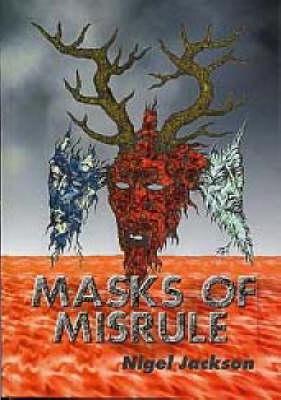
The printing of Masks of Misrule is a travesty for any lover of books. The font is irregular and fades, seemingly at random, within the text. The cover is ridiculous and does nothing to convey the seriousness with which the author treats his subject.

But if you set all of these concerns aside, some of the mythology contained within this book is entirely original, at least to me, and could be incredibly useful for seekers who are looking for a new movement within paganism that celebrates the male side of nature.

Thanks for reading!

The Spiritual Gift of Madness: The Failure of Psychiatry and the Rise of the Mad Pride Movement by Seth Farber

The Spiritual Gift of Madness: The Failure of Psychiatry and the Rise of the Mad Pride Movement by Seth Farber

In The Spiritual Gift of Madness, Seth Farber interviews half a dozen people who have had negative experiences with western psychology as well as experts in mental health. His thesis is the mental health system as it is values medication over other types of therapy and, because of this misguided focus, harms the very people it is attempting to help.

He is a champion of the Mad Pride movement, a group that seeks to celebrate and assist those suffering from mental health issues to embrace who they are rather than medicating it away.

Photo by Engin Akyurt on Pexels.com

“… helping the mad does not mean drugging or coaxing them into a state of “adjustment,” but rather appreciating the state of madness for what it is: an existential clearing in the jungle of our insane modern society that potentially leads into the realm of true sanity, which, in the world today, means a state of creative maladjustment.” pg 124

I should mention that Farber doesn’t use “mad” in a negative way, rather he uses it to highlight how individuals with different viewpoints from the rest of society are marginalized and sedated into silence. He puts forward the idea that insanity is believing everyone must view the world in the same manner or be ostracized for it. He holds up society’s repeated failures to handle issues like global warming to racial and gender equality as evidence of the insanity of the world.

“Now one of the things that’s so detrimental about the hospitalization is the power impact of being treated like a patient – people end up believing they’re chronically mentally ill.” pg 44

Farber believes mental illness is a transition to a new, potentially powerful state of being that, as a modern society, we quash before it’s completed. He points out that many of the great prophets and visionaries from history had, what we would now call, complete breakdowns before their epic breakthroughs.

Photo by Ryan Millier on Pexels.com

“… a few weeks of mania could give one access to a sense of understanding that it could take ‘years of meditation’ to achieve, access to visions of ‘the wholeness’ of the universe and ‘the interconnected nature of love, access to a sense of time and space that allows one to discern what is and what is not important.'” pg 21

Instead of medication and psychiatric facilities, Farber would like to see the creation of safe havens for people going through this process so they could assimilate whatever is going on in their minds before going back to the rest of society. That would be for the experiencer’s protection as well as the public.

I think Farber brings up important issues in this book. As someone who has struggled with mental illness, I’ve viewed the system from the inside and recognize some of the problems he points out. There’s the stigma of the diagnosis and the embarrassment of feeling separated from “normal”. There’s the expectation you will take your meds from the day you’re labeled until you die, no matter the side effects.

But, worst of all, is feeling like you can’t trust what’s going on in your head because it went so spectacularly wrong before and what’s to prevent it from going sideways again.

I agree some changes need to be made to the system and, as a society, perhaps we can do a better job minimizing stigma, maximizing communication, and helping people live in a happy and healthy manner that they choose.

However, I feel like Farber goes too far in his insistence that the “mad” are the future. That somehow they hold the keys to a paradise on earth if only we’d let them share their messages unfettered.

Photo by Oliver Sjöström on Pexels.com

In the midst of my psychosis in 2009, I wouldn’t have wanted any of the nightmares in my head to permanently affect my future or my family. If there are lessons to be learned from it, maybe it’s an individual message for the people undergoing the change rather than expecting it to be universal lessons, applicable for everyone.

But, that’s my two cents. I certainly don’t have all the answers, but The Spiritual Gift of Madness asks some interesting questions.

Recommended for seekers who are interested in a different way to both approach and treat those with mental illnesses or for those who have gone “through the looking glass” and are now viewing the world from the other side, like me and the people in this book and many, many others.

Thanks for reading!

The Universe Is Your Search Engine: A User’s Guide to the Science of Attraction by Anita M Scott

The Universe Is Your Search Engine: A User’s Guide to the Science of Attraction by Anita M Scott

The Universe is Your Search Engine is a new age, metaphysical book with anecdotes, suggestions and exercises to assist readers in utilizing the law of attraction in his or her own life.

Anita Scott compares the law of attraction to a universal “search engine.” What you put in, comes back to you kind of like Google for the mind.

Photo by Pixabay on Pexels.com

“While the Universe’s Search Engine delivers real-life experiences, it is not responsible for your quality of life. You are, because no one else can use your mind to think thoughts. You alone are the thinker of your mind, and it is your thoughts alone that trigger the search and the ensuing return of life experiences.” loc 310, ebook

The book is divided into three sections: the first handles different aspects of the law of attraction from science to energy and quantum physics. The next part goes into metaphysics, the body, purpose and more. The third part is a workbook that ties the first two sections together and is also scattered throughout the text.

“Fighting against what is elongates suffering, makes an issue bigger, and squanders your valuable energy.” loc 428, ebook

Photo by Jill Wellington on Pexels.com

I’ve read quite a few books like this- new age materials that teach your thoughts create your reality. I was honestly surprised how much I enjoyed this version of the teaching.

The publisher sent me an email offering a free digital copy of this book through NetGalley, I didn’t request it. And, I’m going to be blunt here, I was feeling rather unsure about it. I simply wasn’t in the right head space to read and review a new age book. But then, I thought, why not give it a chance and I’m glad I did.

This year, 2020, has been the worst. Prior to this mega-disaster of a year, I would have described myself as someone who created her own reality sometimes successfully, other times not so much, but I felt like I always had at least a glimpse of where my life was going.

This year has changed all of that. Now, I’m not certain I create my reality at all.

Current angst aside, I liked The Universe is Your Search Engine. I liked the empowering messages it shares. I like the exercises that encourage readers to find their purpose, focus their thoughts and joyfully move into a future of their own design.

Photo by Dina Nasyrova on Pexels.com

I’m just not sure I believe in it myself anymore. Maybe I’ll get back there some day.

Recommended for readers and seekers who are looking for information on the law of attraction. Anita Scott has written a beautiful, modern book about it. Give it a shot and see if it’s for you.

Thank you to NetGalley and the publisher for a free digital copy of this book. And thanks for reading!

Shinrin-Yoku: The Art and Science of Forest Bathing by Qing Li

Shinrin-Yoku: The Art and Science of Forest Bathing by Qing Li

“Shinrin-yoku means bathing in the forest atmosphere, or taking in the forest through our senses. This is not exercise, or hiking, or jogging. It is simply being in nature, connecting with it through our sense of sight, hearing, taste, smell and touch.” pg 12

Nature lovers or those aspiring to be nature lovers will find much to enjoy in Shinrin-Yoku: The Art and Science of Forest Bathing.

Photo by Jose Vega on Pexels.com

Qing Li reminds readers that the human race is a part of this world even if we have walled ourselves up in cities and covered the ground in concrete. Through various scientific studies, he proves again and again that by taking a time out and forest bathing people can sleep more deeply, experience less stress and think more clearly.

“We may not travel very far on our forest walk but, in connecting us with nature, shinrin-yoku takes us all the way home to our true selves.” pg 15

Not convinced? He provides evidence that patients at hospitals heal faster if the view outside their window includes a tree rather than a wall. People who exercise outside report the exertion they need to complete the workout is less and they enjoy the time more than those who churn out the miles on a treadmill.

“The average sleep time of participants after a two-hour forest walk increased by 15 percent, or fifty-four minutes. Participants were significantly less anxious after a two-hour walk in the forest.”

Photo by WARREN BLAKE on Pexels.com

Forest bathers have reported higher levels of creativity, writers find relief from the dreaded block, and the sense of connection caused by the practice has been known to increase feelings of gratitude.

“The researchers concluded that there ‘is a real, measurable cognitive advantage to be realized if we spend time truly immersed in a natural setting’, and found that spending time in nature can boost problem-solving ability and creativity by 50 per cent. Is it any wonder that Buddha found enlightenment sitting under a tree?” pg 106

Is there anything that forest bathing doesn’t help? How about your health or physical age?

“A group of Canadian, American and Australian researchers studying tree density and health in Toronto found that… having eleven more trees on a block lowered cardio-metabolic illnesses, like high blood pressure, diabetes and obesity, comparable to the effects on well-being conferred by being given a $20,000 a year pay rise or being 1.4 years younger.” pg 116

Photo by Johannes Plenio on Pexels.com

In addition to the information about forest bathing, this book contains beautiful photos of forests every couple of pages. Qing Li gives readers the instructions so, if they desired, they could hold their own traditional tea ceremony in the woods. He includes anecdotal information about aromatherapy, tips on how to bring the forest into your home, advice on how to incorporate beneficial natural sounds into your daily life and more.

I enjoyed this book very much. Highly recommended.

Promethea, Vol. 2 by Alan Moore

Promethea, Vol. 2 by Alan Moore

Promethea, Volume 2 was an incredibly disappointing follow-up to a promising comic series.

The reader continues to follow the efforts of Sophie, a student who has learned to channel the spirit of a being of enlightenment named Promethea, while battling demons and other nebulous, bad guys.

Photo by Francesco Ungaro on Pexels.com

We have yet to learn more about the villains of the story, except in brief asides, or Sophie’s allies, some sort of technological heroes.

This entry is bogged down with a lengthy metaphysical poem about the progression of tarot cards and an unexpected tantric sex primer.

Photo by Alina Vilchenko on Pexels.com

My quibbles with the tarot card piece is it is far too simplistic but also too long. Each card can be interpreted a number of different ways, and not just applied to principles of civilization. It is also a metaphor for the soul’s journey, which Alan Moore touches on, but, I feel, never truly explains.

Also, by presenting the whole thing through rhyme, I couldn’t help but draw comparisons to Dr. Seuss. I get what Moore was going for, but it didn’t work for me.

Meanwhile, I couldn’t help but wonder if the lead character in this story was a guy if we would have been subjected to the tantric stuff at all.

Photo by Roy Reyna on Pexels.com

I believe the earthly can be spiritual and the spiritual can be earthly. I think “kundalini rising” is just the lightning flash of inspiration in reverse. But a male hero being pressured into trading his body for secret knowledge? I don’t see it happening.

I liked the first entry of Promethea. I thought it was ground-breaking in the way it depicted a strong female character on a spiritual journey.

This second book simply isn’t of the same quality. Perhaps the series will redeem itself in the next entry. One can only hope.

The Alchemist’s Kitchen: Extraordinary Potions & Curious Notions by Guy Ogilvy

The Alchemist’s Kitchen: Extraordinary Potions & Curious Notions by Guy Ogilvy

The Alchemist’s Kitchen is an examination of alchemy — what it is, what symbols it uses and includes a cookbook of various recipes to use and practice the art on your own.

For as confusing a topic as alchemy is for me, Guy Ogilvy has put together the most succinct explanation of it I have ever read. I still don’t completely get it, but for the first time I was able to follow the general idea of it from beginning to end rather becoming completely lost and giving up in the middle.

Photo by Rodolfo Clix on Pexels.com

“The story of alchemy, at least in the West, is, in a nutshell, the story of gold and our relationship with it.” pg 2

Let’s not forget spiritual gold. The search for the Philosopher’s Stone seems to entail something of both the physical and the mystical, a curious mixture of both.

Ogilvy uses each section, which consists of one page, to completely explain a concept and then, on the opposite page, provides alchemical artwork to illustrate the concept. It is clear, concise, and it makes me crazy that I still don’t get most of it.

The most fascinating part to me was the author’s description of colors, planetary correspondences, and their purposeful arrangement in famous works of art like Raphael’s “The Crucifixion”. You can see it here: 
https://www.nationalgallery.org.uk/paintings/raphael-the-mond-crucifixion

Who knew Raphael was an alchemist? I didn’t.

Photo by Steve Johnson on Pexels.com

“There is a way of manipulating matter and energy so as to create what modern science calls a force-field. This force-field acts upon the observer and puts him in a privileged position in relation to the universe. From this privileged position, he has access to realities which are normally concealed from us by time and space, matter and energy. This is what we call the Great Work.” pg 38

Some of this book sounds like nonsense. But then I wonder why so many people have been obsessed with these practices for so long if there’s nothing to them? Oh right, probably because of the creating gold from dross part of it.

Photo by NaMaKuKi on Pexels.com

I’m still not one hundred percent convinced that alchemy isn’t anything other than a misunderstood metaphor for purely spiritual practices. But I’m still willing to dream and explore and entertain the idea that the magical might be concretely possible.

Recommended for readers who are dreamers, like me.

Thanks for reading!

The Four Sacred Secrets: For Love and Prosperity, A Guide to Living in a Beautiful State by Krishnaji, Preethaji

The Four Sacred Secrets: For Love and Prosperity, A Guide to Living in a Beautiful State by Krishnaji, Preethaji

In The Four Sacred Secrets, Krishanaji and Preethaji, a husband and wife team, help readers understand four principles for spiritual living. Each section of the book is divided into an explanation of the principle or secret and then details corresponding transformational journeys the readers can undertake to help them internalize and live each one.

“Our goal is to help you awaken to a power that is much greater than any technique you can master — a power that is available to each and every one of us. We need only unlock it. It is the power of a transformed consciousness.” pg 2

Photo by Karan Shah on Pexels.com

The secrets aren’t really “secret” in that they’ve been discussed in spiritual texts throughout human history. But each speaks to how someone’s consciousness can move away from one’s primal state of beauty. The authors believe there are two states in life — this beautiful state of oneness or not being in this state.

The simplicity of this method of teaching is that it is easy to tell if you are in a beautiful state or not. You can feel it. You simply know. It is the state that children walk in. They are themselves, unconditioned by worldly expectations or concerns. It is a state that points to oneness with life itself.

“I want us to be free from the idea that we are separate from one another. Free from the war we feel within ourselves and the world around us. Free from the suffering that makes our lives feel small and meaningless. I knew a beautiful life lived in a beautiful state of being was everyone’s destiny.” pg 12

Photo by Jonathan Petersson on Pexels.com

The secrets include living your spiritual vision, discovering your inner truth, awakening universal intelligence and practicing right action. The journeys to these secrets are all different, but I think a similar thread runs throughout — observation of current conditions without judgment. If you can figure out where you are and then you can see clearly what’s holding you back.

“Our society places a premium on doing, with very little care to our inner state of being. Few of us truly make creating a beautiful inner experience a priority in our lives, choosing instead to live as though our career, performance, appearance, status, or financial security is all that matters.” pg 23

This book contains all of the tools one would need to completely transform their inner world, including meditation instructions and mythological allegories.

The authors also share the real-life stories of many of their students, some of whom didn’t even realize they were in a state of suffering until they stopped a minute and observed themselves. The type of freedom from suffering that seems to follow these students’ transformations is astonishing. If only we could all feel that way, what a different world this would be.

Photo by Alex Green on Pexels.com

“So many of us have been taught that we must solve our problems if we want to be free of suffering. But the truth is the inverse: If you want to become free of your problems, start by allowing your suffering to dissolve.” pg 62

Recommended for spiritual seekers who aren’t sure where to start. The Four Sacred Secrets is a good place to start looking.

Thank you to the publisher for a free advance reader’s copy of this book. The brief quotations I cited may change in the final version of the book. Expected publication date is August 2019.

Thanks for reading!

The Astonishing Power of Emotions: Let Your Feelings be Your Guide by Esther Hicks, Jerry Hicks

The Astonishing Power of Emotions: Let Your Feelings be Your Guide by Esther Hicks, Jerry Hicks

“Beyond the five physical senses that you are actively aware of, there is another less-realized sense — the sense of emotion.” pg 20

Esther Hicks channeled this book from her “higher self,” an entity she calls Abraham. It is about how one can deliberately create their experience by being aware of their emotions. It also gives advice on how to focus on those things that make you feel good, because by doing so, Hicks believes it will “bring you into alignment” with your higher being. And, therefore, you’ll allow the goodness of creation to flow through you.

Photo by Emre Kuzu on Pexels.com

“Allowing yourself to become what life has caused you to desire is not about action. It is about the aligning of thought Energies. It is about focusing your attention in the direction of your desire rather than looking back at the current conditions that have given birth to your desire.” pg 25

My favorite part of this book was contained within the first 45 pages in which Abraham talks in a general way about emotions and their latent power. The rest of the book contained examples of how to apply this teaching to specific questions Hicks received at her various workshops.

I didn’t find the second portion as helpful because, first of all, it felt like we were focusing on current conditions. Secondly, the answer to every question was to soften the emotions by looking for things that made you feel good about in whatever subject was being discussed. Then, roll with that until the emotions shift. Honestly, it felt repetitive after the first two or three examples.

Photo by Quang Anh Ha Nguyen on Pexels.com

I suppose if one of the questions had applied directly to my life experience right now, then maybe I would have had a different view of this book. As it is, I prefer Ask and It Is Given: Learning to Manifest Your Desires to this.

Ask and It is Given deals with the topic in a more general way and I got more out of it.

I can understand the criticisms of Hicks as a life philosophy: that she teaches people to ignore their problems, to be selfish, to be utterly self absorbed. But wasn’t it a teaching of the Buddha that the first love you should attend to, before you can offer unconditional love to others, is self love. You build a base of love and everything else flows from that. I see Hick’s teachings as the same kind of thing — self love first.

I think another point to bring up before closing the discussion of this book is the idea that the Law of Attraction, so beloved of New Age teachers and authors, functions rather like gravity. You don’t have to teach someone how to utilize gravity because it just works. The Law of Attraction is the same kind of deal and isn’t that nice to know.

Photo by Mary Taylor on Pexels.com

So, no matter what you’re doing, thinking or feeling, you’re not going to float off into outer space because gravity has got both of your feet safely planted on the ground. I like to approach any teachings about the Law of Attraction the same way. I can play with ideas and techniques, but at the end of the day, it’s going to do its thing whether I’m paying attention to it or not.

Recommended for readers who like New Age materials or love the teachings of Abraham Hicks.

High Magick: A Guide to the Spiritual Practices That Saved My Life on Death Row by Damien Echols

High Magick: A Guide to the Spiritual Practices That Saved My Life on Death Row by Damien Echols

“Magick was out there in the world, and I could learn and practice it! That realization was like a bomb going off inside me. From that moment on, I pursued magick as if my life depended on it (and, in fact, later it did).” pg 11, ebook.

Damien Echols has penned a part-memoir/part-magic primer and, I believe, established himself as a new major voice in the Western Golden Dawn tradition. Many are familiar with Echols’ life. He was sentenced to die for a crime he didn’t commit. In High Magick, Echols shares the meditations and practices he used to keep his sanity and advance his spiritual development while behind bars.

Photo by RODNAE Productions on Pexels.com

It is a powerful book, not just because it is written in simple language and easy to understand, but because Echols is living proof that these techniques worked for him.

“Magick was the only thing in prison that gave my life purpose and kept me sane. Magick was the only thing I had to protect myself with. And that’s what this book is about — the practices that kept me alive for nearly two decades on death row.” pg 12

He shares some of the most basic practices like the Middle Pillar and Lesser Banishing Ritual of the Pentagram and, beyond the simple instructions of it, he gives the theory behind them. That’s helpful. Most of these kinds of books I’ve read don’t bother to go into the why’s. They’re too obsessed with the “how”.

“Every person on this earth is born with an entire universe of potential in them. Most people never cultivate the seeds of that potential, so the seeds go to waste and the people go through life wondering what went wrong, or blaming the world for everything that did go wrong. Magick waters those seeds to make that potential stir, grow, and flower.” pg 16, ebook.

Photo by Any Lane on Pexels.com

Echols avoids most “loaded” terms with an eye on appealing to every manner of reader. For example, he uses the term “energy” to describe the force behind the rituals he’s describing. I’ve heard it called many things and that particular word is a good one, I think.

He makes no unfounded promises. He simply offers a way to experience something that worked for him.

“Magick is both an art and a science. Some techniques are known for providing specific effects, but results vary, as they say.” pg 21, ebook.

An interesting side story: One of the librarians at my local library said “these types of books” (spiritual, nature-based, or “magic”) have been in high demand lately. She said there’s something of a renaissance going on in those who come to the library. They’re looking for something. It’s unique to each person, but she said libraries are purchasing more and more of this type of book in an effort to fill that need.

Photo by Matheus Bertelli on Pexels.com

“My grandfather used to say, “There’s more than one way to skin a cat.” I think most of you are familiar with the phrase, or at least an axiom with a similar message. It’s a curious way to remind ourselves that there’s more than one path to a particular destination…” pg 112, ebook

If you’re a reader looking for “this type of book”, I hope you find the right fit for you. Echols’ book should appeal to those looking for an introduction to the western occult tradition or simply the curious.

Thanks for reading!