The Sidhe: Wisdom from the Celtic Otherworldby John Matthews

The Sidhe: Wisdom from the Celtic Otherworldby John Matthews

“I knew then that something was going to happen in Ireland. I had no idea then just what an enormous and irrevocable change it was going to make to my life.” pg 5, ebook

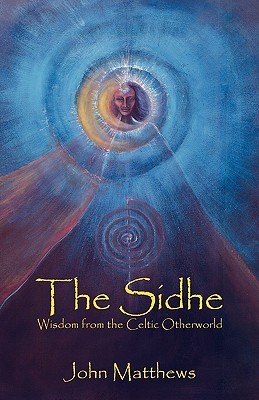
John Matthews received a call from a friend whose occupation is archaeology. The friend showed John into a barrow where he first saw the glyph that is on the cover of this book.

John claims that through meditation upon the glyph, he communicated with other beings whom he believes are ‘the Sidhe.’

“To truly know a thing is to become one with it. Just as to become one with it is to truly know it.” pg 27, ebook

Photo by cottonbro on Pexels.com

He shares the communications that he had through the glyph throughout the text. At the end, he includes six exercises that the beings gave him and encourages readers to try the practices for themselves.

Readers could potentially experience the connection John felt.

“Drawn by this feeling, I lay down beneath the branches of the old oak, and, as I had done countless times before, stared up through the branches at the patches of blue sky that showed through. As I did so a sense of stillness and peace descended upon me.” pg 36, ebook

Photo by Magda Ehlers on Pexels.com

The Sidhe: Wisdom from the Celtic Otherworld reminded me of the multiple works of Abraham Hicks or Seth Speaks: The Eternal Validity of the Soul. There’s probably a reason for that.

It could be that the channelers are tapping into a similar place. In this book, John calls it the “great net” of creation. I’ve heard it called, “Indra’s net,” among other names in other sources.

Whatever it may be, I find it interesting that the communications received are similar enough to draw comparisons.

“Among the greatest gifts we have observed in your race is the desire to know and to explore. This hunger has propelled you far along the path of the day and the path of the night. Hence, your journey is indeed one of exploration, not only in time and space, but in the dimensions of Spirit.”

Photo by Stefan Stefancik on Pexels.com

Of course, I had to try John’s method for myself. I’m always so curious about these kind of things.

Unfortunately, I fell asleep rather than having a memorable experience. I expect the fault was on my side, but perhaps I experienced something in my sleep- I just failed to remember it.

I do plan to give the meditation a try again in the future, when I’m not so sleepy.

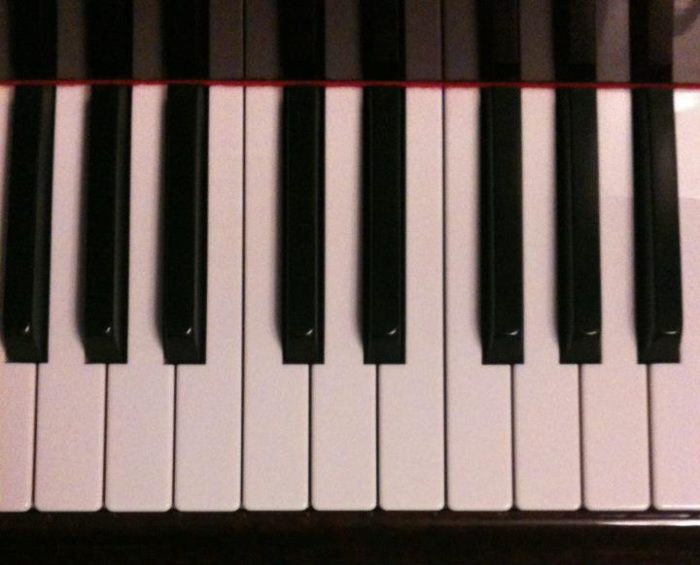
I was fascinated with the way the glyph looks like a treble clef with multiple circles. When John began to describe the Sidhe’s connection to music, I felt that comparison made sense.

“Much of our time is spent in the making of music- though for us it is more serious than a pleasant pastime, since it is part of our creative process in more than an abstract fashion.” pg 69

Playing music is one of the few activities that put me into a flow state. Perhaps I should try meditating that way.
Anyway, I recommend this book for the curious or spiritual seekers. If you try the exercises within, please do share your results. Maybe some day, the world will have more answers than questions about these ineffable things.

Or, maybe, we’ll open yet another door for endless discoveries. Either way, I’ll be interested to see what comes next.

Thanks for reading!

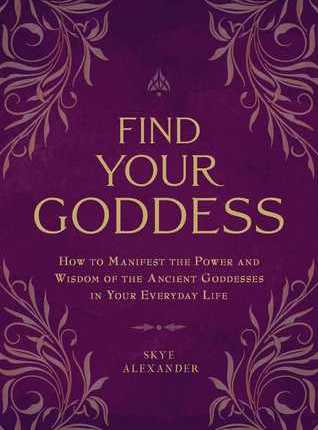
Find Your Goddess: How to Manifest the Power and Wisdom of the Ancient Goddesses in Your Everyday Life by Skye Alexander

Find Your Goddess: How to Manifest the Power and Wisdom of the Ancient Goddesses in Your Everyday Life by Skye Alexander

Find Your Goddess by Skye Alexander is a compendium of goddesses and their various aspects as well as attributions from all over the world. She covers the well-known goddesses from the Roman, Greek, Egyptian and Norse pantheons, and also delves into the lesser known (at least to me) Shinto, Hindu, and Native American deities.

And more.

Photo by Pranjall Kumar on Pexels.com

Some of the entries have corresponding artwork opposite the deity information- but not all. I wish every listing had some artwork because, as they say, a picture is worth a thousand words.

Though I picked this book up for entertainment’s sake, I could see this being a useful tome for spiritual seekers who are looking for a tradition that fits their inner reality.

On a different note, I could see gamers discovering the information contained in Find Your Goddess quite handy. Anyone looking to roleplay characters in their tabletop games or dungeon masters who want to craft a scene with new (to players) world powers could utilize this book.

Photo by lilartsy on Pexels.com

This could also be a useful reference book for pagans on the forefront of recreating rituals and knowledge bases from long ago. I find it interesting that once upon a time the goddesses in this book were recognized and worshipped, and now society has forgotten not just about the deity herself but also how she was honored or her role in keeping civilization together.

Many of the goddesses have roles in the home or schools- goddesses of the hearth, learning or heart. But some have spheres of influence that were primarily held by male gods, at least in the western world.

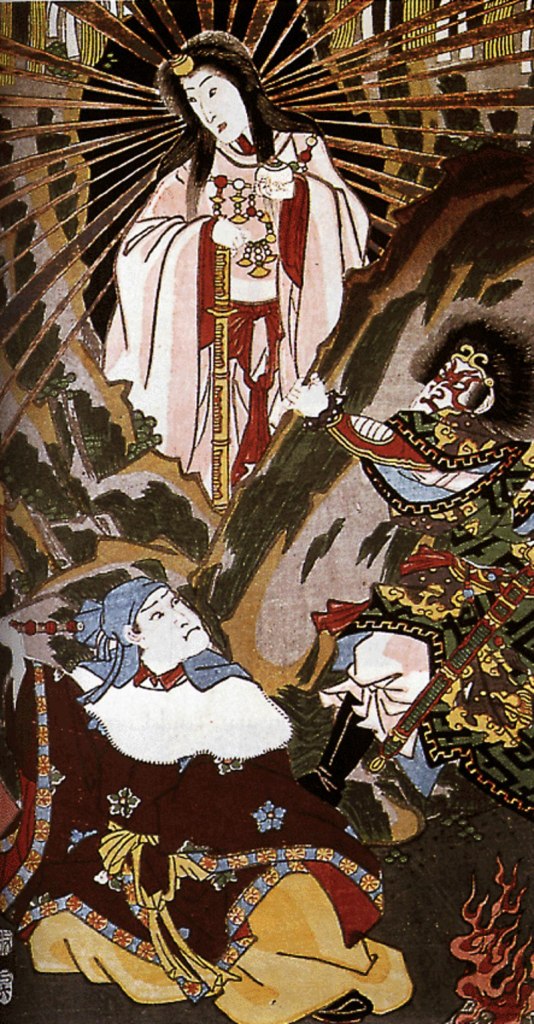
One of these that comes readily to mind is Amaterasu Ōmikami, a goddess of the sun and the Japanese imperial family. The Greek and Roman god Apollo has always occupied that role in my classically-educated mind.

Japanese Sun goddess Amaterasu emerging from a cave.

I enjoy considering other viewpoints because my own biases come to the forefront when I do so. Though I may not be able to rid myself completely of these biases, knowledge and wisdom helps me to see the blind spots. My hope is to know where they reside so I may easily brush them aside when they raise their ugly heads.

Highly recommended for pagans, spiritual seekers or readers with a curious mind, like me.

Thanks for reading!

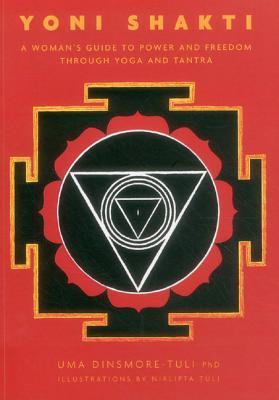
Yoni Shakti: A Woman’s Guide to Power and Freedom Through Yoga and Tantra by Uma Dinsmore-Tuli

Yoni Shakti: A Woman’s Guide to Power and Freedom Through Yoga and Tantra by Uma Dinsmore-Tuli

“When we unlock our sakti we re-connect with our capacity for inner joy and peace with ourselves: all our experiences begin to join up and make sense. Freeing our sakti in this way gives us the key back to our sexual selves, so that we may inhabit our whole being with authenticity and joy.” pg 508 ebook.

Author, yogini and tantrika, Uma Dinsmore-Tuli, shares yoga sequences, mantras, mudras and meditations to assist readers in becoming more aware of their inner selves.

Photo by Elina Fairytale on Pexels.com

What does this accomplish, you may be asking yourself. According to Dinsmore-Tuli, it’s the foundation of a mindful existence.

“All of the poses to unblock the life force energy are also very practical means to keep the creative and sexual energies in circulation so that they are available to nurture and enrich our creative, family, social and professional encounters.” pg 518, ebook

That sounds pretty good to me.

So, I tried some of the suggestions from this book which I had to cherry pick because there are dozens to try. And my results were unexpected and stunning.

Photo by Diego Madrigal on Pexels.com

After the first practice, I experienced an almost immediate increase in my sensitivity to my body’s energy and overall energy level. After the first week, this improved awareness led to some fascinating experiences during my meditations.

Apparently, practitioners of yoni shakti routinely encounter visions or spontaneous energy body knowledge. The goal is not to seek these experiences, but to be aware when they arise and dissipate, and then utilize them for greater self knowledge.

Using these teachings, I feel like I’m learning a whole new dimension to life- one that arises from practices of mindful awareness. Yoni Shakti is a good reference book for that journey.

Photo by Daniel Torobekov on Pexels.com

That being said, a majority of this book is repetitive to the point of unreadable. I realize Dinsmore-Tuli is passionate about the women’s movement in yoga, but she goes on so much about past abuses by gurus and organizations that it detracts from the delivery of the wisdom of the book.

I found myself skimming entire sections because they read the same in the previous chapter and the ones before it.

On the other hand, this book shines in its accounts of the women who were suffering and then rediscovered their power and ability to heal themselves through their yoga practice.

“There is a deep relief in knowing that other women have experienced the same losses, and a comfort in hearing others speak about what is so often unspoken. The sharing is healing.” pg 597

Recommended, with a few reservations, to spiritual seekers interested in yoga and tantra- particularly women.

Thanks for reading and namaste!

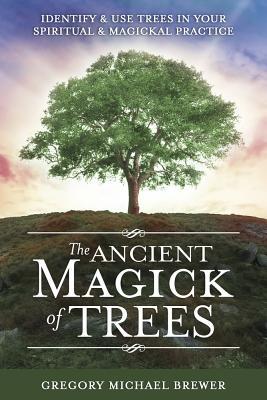
The Ancient Magick of Trees: Identify & Use Trees in Your Spiritual & Magickal Practice by Gregory Brewer

The Ancient Magick of Trees: Identify & Use Trees in Your Spiritual & Magickal Practice by Gregory Brewer

“Since the dawn of humanity, in all cultures and religions across the globe, trees have been revered not only as a life-sustaining source of food and medicine but also as a place where spirits dwelt, awaiting to reveal great mysteries to those who sought their wisdom, knowledge, and magick.” pg 2

Author Gregory Brewer examines the wonder and mystery that are trees from the pagan perspective in this book which is part informational, tree-related ritual/meditation suggestions, and reference.

Photo by Pixabay on Pexels.com

Understanding the symbolism of trees throughout countless cultures of human history is an enlightening study, but equally important is learning to form a personal connection with them in order to better comprehend the interaction of how the divine reveals itself to us through nature.” pg 243

The majority of the book is dedicated to descriptions and occult associations for different types of trees.

I read The Ancient Magick of Trees in order to learn more ways to invite nature into my life. The book has that but I found Forest Bathing: How Trees Can Help You Find Health and Happiness to be more immediately practical. I also connected more with the information in the forest bathing book.

Thanks for reading!

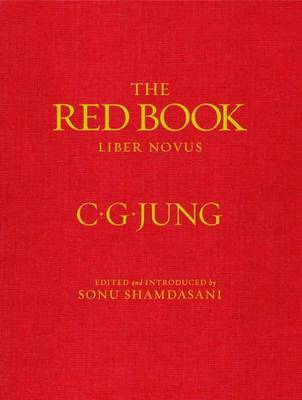
The Red Book: Liber Novus by C.G. Jung

The Red Book: Liber Novus by C.G. Jung

“The years, of which I have spoken to you, when I pursued the inner images, were the most important time of my life. Everything else is to be derived from this.” preface

The Red Book is a stunning publication. It is a physically large book which mimics Jung’s own handwritten copy which measured 11.57 inches by 15.35 inches.

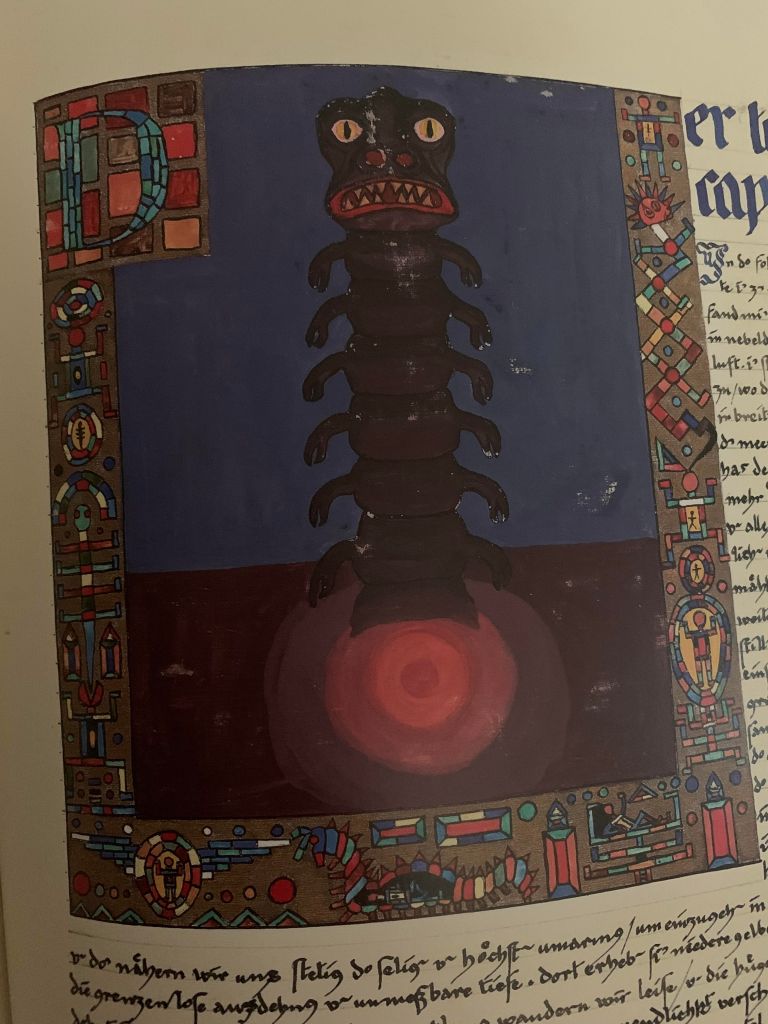
Carl Jung’s calligraphy

The contents are just as impressive. The first part is a brief history of Jung and his publications. The second contains pages of calligraphy in both German and Latin of his “active imagination” visualizations as well as sketches and paintings created by Jung to accompany the text.

The last section of the book is the English translation of the second part.

“Jung described his technique for inducing such spontaneous fantasies: ‘The training consists first of all in systematic exercises to eliminating critical attention, thus producing a vacuum in consciousness.'” pg 209

Painting from Carl Jung’s The Red Book

The visions themselves are interactions between Jung and voices or figures that he named his soul, gods and other archetypical figures.

“To this my soul spoke a word that roused my anger: ‘My light is not of this world.’ I cried, “I know of no other world.” The soul answered, “Should it not exist because you know nothing of it?” pg 240

As he stated in the preface, Jung felt as if his ‘confrontations with his subconscious’ affected his work for the rest of his life. It is a fascinating, little-examined side of a man who has had a huge effect on psychology and is credited, by some, as being one of the leading figures of the New Age movement.

The road to publication for this book is a story in itself. At first, Jung’s family carefully kept The Red Book in a safe deposit box to protect it as they recognized its value as a one-of-a-kind creation. They also believed that Jung wouldn’t have wanted its contents made public as he hadn’t left any specific instructions in his will about it.

Painting from Carl Jung’s The Red Book

However, researchers and scholars have since examined the text and found parts where Jung addresses, “my dear friends,” leading to the opinion that he did intend to share it with a wider audience. They also point to its importance to Jung’s following works as another reason why it should be published.

Whatever their reasoning, I’m so very glad his family and foundation made the decision to publish. This book is a treasure.

Curiously, The Red Book ends in an incomplete sentence.

Here it is:“I knew of nothing better than to write them down in a ‘precious,’ that is to say, costly book and to paint the images that emerged through reliving it all- as well as I could. I knew how frightfully inadequate this undertaking was, but despite much work and many distractions I remained true to it, even if another/possibility never…” epilogue

Painting from Carl Jung’s The Red Book

I wonder what he was going to write next.

Though I didn’t use Jung’s method of active imagination, I too have undertaken lengthy ‘confrontations’ of my subconscious and have come back with pages of material that read, in some ways, quite similar to this book.

Perhaps, one day, I will also find the courage to publish it.

Highly recommended for any readers interested in Carl Jung’s methods, archetypes or dream interpretation.

Thanks for reading!

The Untethered Soul: The Journey Beyond Yourself by Michael A. Singer

The Untethered Soul: The Journey Beyond Yourself by Michael A. Singer

Michael Singer reminds readers that we are not the thoughts that we habitually think or the bodies that we walk around in. He gives multiple tips on how to access the spiritual strength inside ourselves and how to view life through the wide lens of this non-attached perspective.

Singer writes that it is through this new way of looking at life that one can find enlightenment.

Photo by Supriyo Ghoshal on Pexels.com

The ideas that are shared in Untethered Soul can be found in countless other books on spiritual studies. This isn’t new information. But, I think, there is always room on my bookshelf for a book that reminds me of spiritual truths.

It is all too easy to get caught up in the day-to-day trivialities of life with its stresses and constant demands on our attention. If you take a breath and a step back, it’s surprising what you can see.

Photo by Engin Akyurt on Pexels.com

Perhaps the mammoth success of The Untethered Soul over other books in its genre is the exposure it received on The Oprah Winfrey show. Whatever the case, it is quite accessible to readers who haven’t considered these concepts before.

Recommended for spiritual seekers both seasoned and not.

Spirit Hacking: Shamanic Keys to Reclaim Your Personal Power, Transform Yourself, and Light Up the World by Shaman Durek

Spirit Hacking: Shamanic Keys to Reclaim Your Personal Power, Transform Yourself, and Light Up the World by Shaman Durek

Shaman Durek offers practices to spiritual seekers who are looking for ways to improve their lives through the use of shamanistic techniques. Like most new age or spiritual books, not everything in here resonated with me. But I will take a few key concepts and jettison the rest.

Photo by Abet Llacer on Pexels.com

For starters, I took issue with the title of this book, “Spirit Hacking”. It implies that there are some sort of tested and proven short cuts to bringing spiritual dimensions into one’s life. I think most readers are wise enough to know that such a thing doesn’t exist. To put that sort of label on a work is false advertising to delusional, depending, I suppose, on how much one believes one’s own hype.

On the other hand, if “Spirit Hacking” was simply an effort to connect with readers who sincerely want to believe in such spiritual short cuts then this book will probably fill some sort of gap in his or her journey to a desired “goal”.

Personally, I took the title as a type of warning flag before I read it. Tread softly here, Heidi, I said to myself. And question everything.

Photo by Darius Krause on Pexels.com

Shamanism, like other semi-organized movements, varies greatly depending upon who is imparting the wisdom and from what tradition. Shaman Durek touches upon topics I’ve studied from other sources such as there are different types of spirits, various rituals or practices to interact with these spirits and time isn’t as fixed as some imagine it may be. But he puts his own unique spin on the information.

I like the empowering side to shamanism. If you have lingering physical or emotional pain, these practices suggest that you can do something about it, today if you’d like. If you’d like to change the world, go within and change yourself, then the rest will follow.

I also like the idea that everything on the planet from plants to animals to places has a guiding spirit or intelligence. If only one knew the way to interact with these intelligences, life itself could become a guide into the mysteries of the spirit. That part of shamanism is pretty cool.

Photo by Aleksandar Pasaric on Pexels.com

On the other hand, I don’t like how some shamanistic movements act like established religions, insisting that their ways or traditions are the only way to go. In addition to the snobbery, I take issue with the manner in which some shaman teach their methods. They fail to distinguish between the real world and visionary space, leading adherents to confuse one with the other or worse, not draw any dividing lines at all.

Shaman Durek’s tone can be somewhat abrasive, but if readers are looking for basic shamanistic ideas, they can be found here. Recommended with reservations for new age spiritual seekers.

Other titles about shamanism that you may want to explore if you’ve read this: This Trip Will Change Your Life: A Shaman’s Story of Spirit EvolutionThe Way of the ShamanActive Dreaming: Journeying Beyond Self-Limitation to a Life of Wild Freedom or The Flying Witches of Veracruz: A Shaman’s True Story of Indigenous Witchcraft, Devil’s Weed, and Trance Healing in Aztec Brujeria.

The Wild Woman’s Way: Unlock Your Full Potential for Pleasure, Power, and Fulfillment by Michaela Boehm

The Wild Woman’s Way: Unlock Your Full Potential for Pleasure, Power, and Fulfillment by Michaela Boehm

“This book is a call to come back to our wild, undomesticated ‘original nature,’ which, combined with an untamed heart, knows what is true for each of us. It is a call to return to the inborn genius that guides our passion, whispers in our ear with longing, and reveals itself abundantly when we allow our bodies to show us the way.” pg 8, ebook

Michaela Boehm utilizes her years of therapeutic practice and tantric training in this self help book designed for the modern woman.

Photo by Gabriela Cheloni on Pexels.com

There are so many choices and life paths from high-powered careers to motherhood, that many women try to do it all.

“The good news: amidst such a multitude of options we are free to choose what resonates with us. The bad news: it’s confusing, overwhelming, time-consuming, fraught with many pitfalls, and requires constant discernment.” pg 9, ebook

It’s not possible to do and have it all, Boehm writes, and while they attempt it, women cut themselves off from their sensual natures. She has written this book to give women practices and rituals to bring them back from this disconnection into the power and knowledge of their bodies.

Photo by Maria Orlova on Pexels.com

“Relaxing the body; engaging with life, beauty, and nature; and gentle, nonlinear movement and dance are some of those physical practices we’ll be engaging in throughout this book.” pg 34, ebook

I didn’t connect with all of Boehm’s writing, but I have begun to practice a version of her “formless dancing” every day. The practice itself is simple. Turn on music with no words and a beat, and move your body however it feels like moving. It’s designed to release tension and unconscious clenching that happens when one becomes disconnected from their physical form.

“Once you understand your own reasons for any numbness, tension, and strain that you may carry in your body, you can easily undo the related habitual body patterns and restore yourself to a state of pleasurable aliveness and sensual well-being.” pg 50

Photo by Engin Akyurt on Pexels.com

I find it extremely relaxing. I probably look mad, shimmying and bouncing and swaying around, but it feels really good so who cares. 🙂

Highly recommended for readers looking to reconnect with their body’s innate intelligence or who are interested in different spiritual practices.

The Mysteries of Merlin: Ceremonial Magic for the Druid Path by John Michael Greer

The Mysteries of Merlin: Ceremonial Magic for the Druid Path by John Michael Greer

John Michael Greer, one of the most influential authors on Druidism in the modern age, takes a crack at reviving ancient traditions through ceremonies involving the mysterious figure of Merlin. As for his success at this integration, I think that’s up to individual readers to decide for themselves.

Photo by Carol Lemos on Pexels.com

I didn’t connect with the rituals myself, but the first part of this book which details the author’s research into mystery cults and mythology in general, was fascinating to me.

“… myths are things that never happened but always are. They express spiritual truths too profound to be communicated in any more direct way.” pg 12

Though this topic has been covered by a variety of different authors, perhaps most notably Joseph Campbell, Greer’s take on the subject is welcome and refreshing. His focus in this book is piecing together what the Pagan Celtic religion of Britain may have looked like through the fragmentary records and mythology that remain behind.

“Was Merlin, then, purely a god, and his appearances as a Dark Age prophet and wizard only garbled mythology? That is a surprisingly difficult question to answer.” pg 27

Photo by cottonbro on Pexels.com

Greer’s writing is accessible even for those who may not have a background of western occultism or paganism to draw upon. But, this book might be most useful for those who feel drawn to those spiritual paths because, as I mentioned before, the majority of this book is dedicated to detailing rituals that Greer has created for those traditions.

Seekers interested in the forgotten history of paganism in Europe, as I am, might be better served with another book. If I find one, I’ll let you know.

“Vortigern ordered the workmen to dig into the hill and they found the lake; once the water was drained away, the rocks appeared, and the dragons leapt out of them and began to fight each other. As they struggled, Vortigern asked Merlin what the combat meant, and the boy burst into tears and began to prophesy.” pg 22

Photo by Dimitry Anikin on Pexels.com

As for the actual historical personage of ‘Merlin,’ I think Greer’s interpretation of the sparse evidence is as good as any I’ve read which, admittedly, isn’t very much because there’s not much to go on.

And as for the retrieval of ancient traditions and mystery cults, perhaps new mythologies, like this book, need to be written. The old lineages may simply be lost forever.