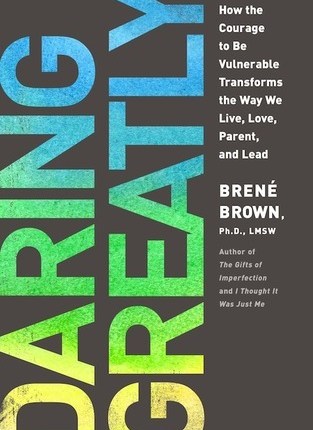
Daring Greatly: How the Courage to Be Vulnerable Transforms the Way We Live, Love, Parent, and Lead by Brené Brown

Daring Greatly: How the Courage to Be Vulnerable Transforms the Way We Live, Love, Parent, and Lead by Brené Brown

Brené Brown shares her twelve years of research into shame and gives tools on how to increase one’s vulnerability. In this way, she believes each individual can help change the culture of scarcity and pull the world back from a continual cycle of shaming.

We’ll build stronger and deeper relationships, strengthen families and have more productive work places. And, by doing this, we will each, in our own way, live in a manner that “dares greatly” every day.

“I also learned that the people who love me, the people I really depend on, were never the critics who were pointing at me while I stumbled. They weren’t in the bleachers at all. They were with me in the arena. Fighting for me and with me.” pg 56

Photo by RF._.studio on Pexels.com

I’m going to use the information in this book the most in my work life. As a writer, I attach far too much significance to my work product on the audience’s response to it rather than my own feelings about it. As Brown so clearly points out in this book, an outside response will never be good enough or big enough to fill the need that I am looking to fill with their words or their views. Or, if it is wildly praised, perhaps the next work won’t be, and then I’m right back to where I started.

“You still want folks to like, respect, and even admire what you’ve created, but your self-worth is not on the table. You know that you are far more than a painting, an innovative idea, an effective pitch, a good sermon, or a high Amazon.com ranking.” pg 64

This desire for connection and a feeling of worthiness, Brown says, comes from the need to survive by belonging to a group. Our brains have evolved to encourage us to belong and form connections. And when we don’t by not believing in our own self worth or experiencing shame, it is a physically painful emotion. People do all sorts of things to avoid feeling shame including pulling away or striking out. But, in the end, these connections are life itself.

“Buber wrote, “When two people relate to each other authentically and humanly, God is the electricity that surges between them.” pg 150

Photo by Pixabay on Pexels.com

As interesting as I found Brown’s research to be, she lost me when she began a discussion about how much vulnerability is enough or too much and walking the tightrope between extremes. So, be authentic, but don’t use it to manipulate people. A few sentences covers what Brown uses 50 pages to unpack.

“When we stop caring about what people think, we lose our capacity for connection. When we become defined by what people think, we lose our willingness to be vulnerable.” pg 169

Her message becomes a bit undefined and more general the further the book goes. That’s not to say it couldn’t be useful for readers who are looking for that type of information. I didn’t find it particularly engaging.

Like any self help book, I think sometimes authors and researchers can get lost in the weeds of the problem. I far more prefer to focus on the solution. In this case, that’s being brave enough to show up and be seen, demonstrating vulnerability and willingness to care about whatever is going on wherever we find ourselves throughout the day. As Brown reminds readers, it’s not about winning or losing, it’s about being there. And that’s a message worth spreading.

Photo by fauxels on Pexels.com

“To love ourselves and support each other in the process of becoming real is perhaps the greatest single act of daring greatly.” pg 110

I’m game. Are you?

Thanks for reading!

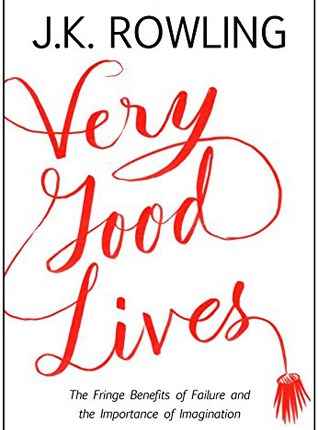
Very Good Lives: The Fringe Benefits of Failure and the Importance of Imagination by J.K. Rowling

Very Good Lives: The Fringe Benefits of Failure and the Importance of Imagination by J.K. Rowling

“It is impossible to live without failing at something, unless you live so cautiously that you might as well not have lived at all – in which case, you fail by default.”

J.K. Rowling gave the commencement speech at Harvard in 2008 and the result was a mini-masterpiece about life, the power of imagination, and failure.

Photo by Joe Digital & Co on Pexels.com

Though we all know now what a mammoth success she would go on to be, at one time, she was experiencing failure and poverty.

“Now, I am not going to stand here and tell you that failure is fun. That period of my life was a dark one, and I had no idea that there was going to be what the press has since represented as a kind of fairy tale resolution.”

I’ve had my own handful of rock bottom moments and, she’s right, it is no fun. But I too have found resilience and creativity that emerged from that darkness. It’s strange, when you’re pushed to your limits, you suddenly discover that there’s more to yourself than you ever realized.

“One of the many things I learned at the end of that Classics corridor down which I ventured at the age of 18, in search of something I could not then define, was this, written by the Greek author Plutarch: What we achieve inwardly will change outer reality.”

Photo by Pavan Maruvada on Pexels.com

Like Rowling, I studied the Classics because something about it spoke to me. When I told my dad that I was adding that course of study to my degree, he laughed and said, “Well, at least it will look impressive on your resume.” Even though I knew he was right in that there were very few jobs where I could use it, having a background in the Classics has taught me a lot about modern life.

I learned that people in antiquity, though they lacked the technology and lifestyle we enjoy today, still had the intensity of emotions and civilizations struggles that persist in the modern era. There were those who had and those who had not. There were crimes of passion, acts of kindness, politicians both corrupt and extraordinary.

Struggle, stress and failure is not something mankind invented when we produced the first smart phone. Classics gives you a long view on humanity and how far, or not far, we’ve come since.

We do not need magic to change the world, we carry all the power we need inside ourselves already: we have the power to imagine better.

Photo by josue Verdejo on Pexels.com

Brilliant. I recommend this small book as a graduation gift or for anyone who is having a bad day. It can act as a reminder that anyone can succeed at whatever their heart tells them is their path, despite any evidence to the contrary. And don’t be afraid of failure. Everyone will experience it at one time or another, but what matters most is what you chose to do next.

Thanks for reading!

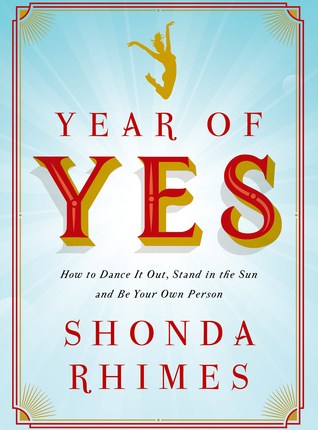
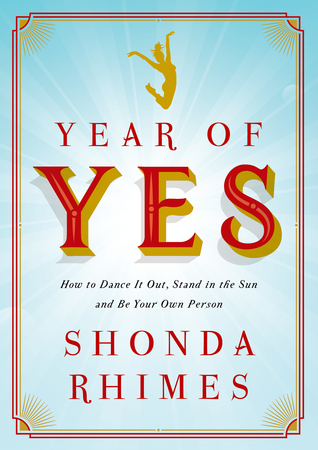
Year of Yes: How to Dance It Out, Stand In the Sun and Be Your Own Person by Shonda Rhimes

Year of Yes: How to Dance It Out, Stand In the Sun and Be Your Own Person by Shonda Rhimes
yearofyes

Shonda Rhimes’ heartfelt memoir about the power of embracing who you are and having the courage to set aside what you are not.

Though outwardly successful, Shonda was miserable. Between over-working and her introverted tendencies, she turned down every invitation and social event. The ones that she was forced to accept were anxiety inducing trials or complete blanks because of panic attacks.

Shonda didn’t even realize she was unhappy until, one Thanksgiving, her sister tells her that she doesn’t say yes to anything. Something clicks and Shonda embarks on a Year of Yes. Her results are astonishing and so is this memoir.

I have never watched a single episode of Grey’s Anatomy. I didn’t even realize that that was her show. You don’t need to be an aficionado to appreciate this book.

Shonda begins with some crushingly honest passages about her discomfort at sharing her life and her passion for writing. “Making stuff up is responsible for everything-everything I’ve done, everything I am, everything i have. Without the tales, the fiction, the stories I’ve spun, it is highly likely that right now, today, I’d be a very quiet librarian in Ohio.” pg 6, ebook. Not that there’s anything wrong with that. 🙂

Photo by Suzy Hazelwood on Pexels.com

The first part of this book was actually hard for me to get through because she was so obviously uncomfortable at creating a window into her heart and mind. She gets over it and so did I. “When it was first suggested to me that I write about this year, my first instinct was to say no. Writing about myself feels a lot like I have just decided to stand up on a table in a very proper restaurant, raise my dress and show everyone that I’m not wearing panties. That is to say, it feels shocking.” pg 12, ebook.

Shonda is just so relatable. Take this confession about motherhood: “I don’t know about you, but the mistakes and missteps I have made since becoming a mother… before kids, my confidence could not be dented. Now it’s shattered on a daily basis. I don’t know what I am doing.” pg 63, ebook. I know, right! Nobody knows what they’re doing. I take comfort in that.

Photo by Pixabay on Pexels.com

Throughout her year of challenging herself, Shonda discovers that she’s uncomfortable in her own skin because of her weight. This next passage is for anyone out there who has body image issues: “I believe everyone’s body is theirs and everyone has a right to love their body in whatever size and shape and package it comes in. I will fight for anyone’s right to do so. I will kick ass and take names if I have to. Your body is yours. My body is mine. No one’s body is up for comment. No matter how small, how large, how curvy, how flat. If you love you, then I love you.” pg 85, ebook. End of story.

I also liked how she came to a new understanding about how life works: “I’ve started to think we are like mirrors. What you are gets reflected back to you. What you see in yourself, you may see in others, and what others see in you, they may see in themselves.” pg 120, ebook. I’ve started to think that too.

The Year of Yes is recommended for readers who enjoy memoirs or for those folks out there whose lives are in need of an awakening- a shaking of the snow globe of your reality, if you will. Shonda said yes to things that scared her and discovered, on the other side of fear, a life truly worth living. I hope that we can all be as fortunate and as brave on our journeys.

Thanks for reading!

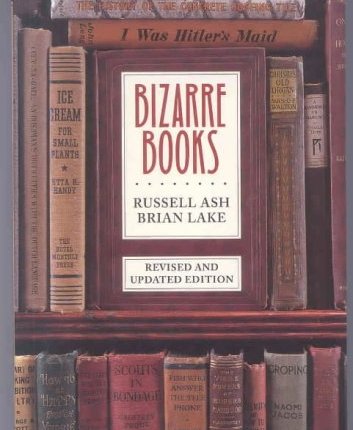
Bizarre Books: a Compendium of Classic Oddities by Russell Ash

Bizarre Books: a Compendium of Classic Oddities by Russell Ash
bizarrebooks

Though it relies too heavily on puns and doubles ententes, Bizarre Books is a humorous look at titles, subjects and author names in published materials. It is a must-read for any book lover or professional who deals with the printed word on a daily basis. *cough* Librarians. *cough*

“All the books recorded are real titles, with real authors. All of them were published with the serious intention of informing, not amusing. In this, they have signally failed.” introduction, pg 7.

I don’t think that ALL of them were meant to be informative. Take this entry from one of my favorite genres, science fiction: Planet of the Knob Heads. Stanton A. Coblentz. Science Fiction, Atlas Publishing, 1939. “Jack and Marjorie are brought to the distant world of their captors. In far Andromeda, they struggle against “favors” of the knob-heads – but hope fades as they face the High Knobule!” pg 40. Almost irresistible, isn’t it?

If science fiction isn’t your thing, how about this (I’m guessing) thriller: What Farrar Saw. James Hanley. Nicholson & Watson, 1946. “No story by Mr. Hanley is without its moral implications; here we have a glimpse of nightmare horror and chaos in a monstrous machine ridden world. It starts simply enough as chaos does. A young couple set off for a holiday in Scotland.” pg 44. Sounds at least as promising as The Girl on the Train, wouldn’t you say?

Photo by Suzy Hazelwood on Pexels.com

Those were some of the fictional books that caught my eye. On to the non-fiction. If it was on a shelf in front of me, I’d pick up Carnivorous Butterflies by Austin Hobart Clark, pg 62.

In the most ineffective category, the prize goes to: Atomic Bombing: How to Protect Yourself. Watson Davis, et al. New York: William H. Wise & Co. 1950. One of its suggestions was: “Curl up in a ball as you hit the ground.” pg 166.

By far, my most favorite selection is: The New Guide of the Conversation in Portuguese and English in Two Parts. Pedro Carolino.

Familiar phrases: Let us go on ours feet. At what o’clock is to get up? At which is this hat. Have him some children? pg 54. And so on. The authors dedicated another three pages to this gem alone.

Highly recommended from this bookworm. It made me laugh a lot and that is not easy to do.

Thanks for reading!

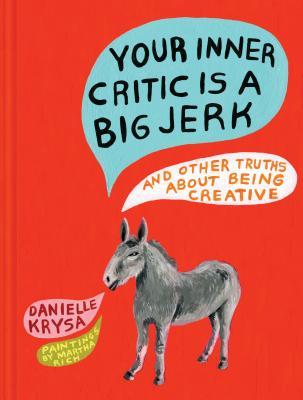
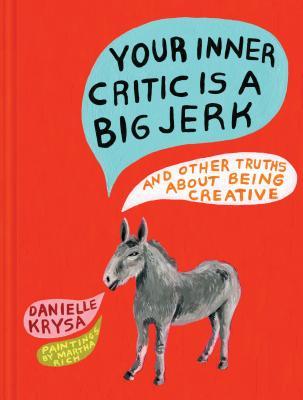
Your Inner Critic Is a Big Jerk: And Other Truths About Being Creative by Danielle Krysa

Your Inner Critic Is a Big Jerk: And Other Truths About Being Creative by Danielle Krysa
yourinnercritic

A quirky little book about how to inspire your own creativity and how to use your inner negative voice to its best advantage. Martha Rich’s art elevates what is actually rather simple text, but, on a more positive note, it is a quick read for those who may be short on time.

I couldn’t help but draw similarities between this book and Unmistakable: Why Only Is Better Than Best, which I read last week. Your Inner Critic is a Big Jerk deals with the sensitive parts of the creative process and breaking through your fears about how your art will be received.

Unmistakable is more about why you need to create the art that only you can create and how a bunch of different artists have managed to do just that. But, if you’re looking to jump start your creativity this year, pick up both of these because they actually complement each other fairly well.

One of my take-aways from Your Inner Critic is that it is never too late to start doing what you do: “Far too often, people tell me, “I wish I hadn’t given up on art [or dancing, acting, writing, music], but it’s too late now.” What! Why? I don’t believe that for a second. Many amazingly talented people didn’t hit their stride until their thirties, forties, or later.” pg 20

And Krysa goes on to list such luminaries as van Gogh, Money, and Julia Child. Can you believe that!

Even if you didn’t go to school to learn whatever art you feel compelled to create, you are still an artist. I’ve been pricked by that negative inner whisper once or twice and it was cathartic to learn that I’m not alone in that struggle and to finally put it to rest: “If you want to learn something new, go learn something new. Set yourself up to get this new skill in whichever way suits you best. You are what you know, regardless of when and where you did the learning.” pg 45

Some further reading: Unmistakable: Why Only Is Better Than Best or Creativity: The Perfect Crime

Thanks for reading!