DPS Only! by Xiao Tong Kong

DPS Only! by Xiao Tong Kong

Vicky lives with her brother, Vergil, who is a renowned e-sports player of the game “Xenith Orion.” Though Vicky loves to play video games too, she is too shy and self deprecating to tell him.

When an opportunity arises for Vicky to join an e-sports team of her own, she takes it, and uses a mask to conceal her identity. But she knows, it is only a matter of time until her secret comes out.

What will she do then?

I very much enjoyed this coming-of-age graphic novel. Readers get to see Vicky really coming into her own in the video game scene, while handling her personal relationships, particularly the one with her brother.

Photo by Florenz Mendoza on Pexels.com

This story touched on the potential sexism of e-sports. So few young women play, and when they do, they can draw all sorts of negative or toxic attention. Vicky avoids some of this with her costume, but other parts of it she can’t escape- like when one of the members of her brother’s team presses her for her phone number, though she doesn’t want to give it.

Or the negative comments arising from spectators to the tournament which are specifically directed to a female member of another team who isn’t hiding her gender behind a mask.

I experienced this type of thing first-hand in some of my gaming days. I was big into EverQuest in the early 2000’s. Luckily for me, that was before head-set communication during gaming was a thing, so, even though I played female avatars, most of the people I gamed with just assumed I was a guy.

Photo by Matilda Wormwood on Pexels.com

It was easy for me to hide. I never felt like I had to, like Vicky, but looking back on it all now, it saved me from negative attention for years.

News articles about e-sports have reported women comprise about half of casual gamers but only a handful of professional gamers. Here’s hoping more young women find the courage to follow their dreams!

The video game portions of this book were the most difficult to follow. It cut quickly from one character to the next with little explanation of what is going on except the kill.

Other than that, I thought this book was well done.

Highly recommended for reluctant readers, fans of video games, and readers who enjoy graphic novels.

Thanks for reading!

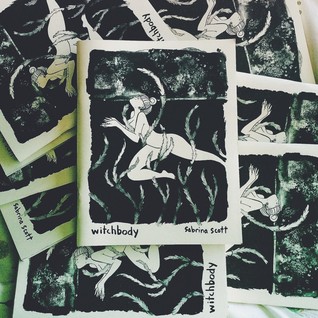
witchbody by Sabrina Scott

witchbody by Sabrina Scott

What is a “witchbody”?

Sabrina Scott defines this nebulous concept in graphic novel format.

Basically, to have a witchbody, the spiritual practitioner uses his or her senses and whole body to connect with everything in the world around her- be that a polluted parking lot or a clear mountain lake.

Scott touches on this idea that sometimes in our spiritual practices we only consider “pure” and “unpolluted” things as holy. They put forward the theory that, if we continue down this path, there may be nothing left to connect with as everything in existence mixes and mingles with everything else.

The spiritual is in the here and now, in the interaction of all things. I heartily agreed.

They wander through philosophy and other theories in the delivery of this message, which some readers may enjoy. I found myself wishing the text had a little more organization to it.

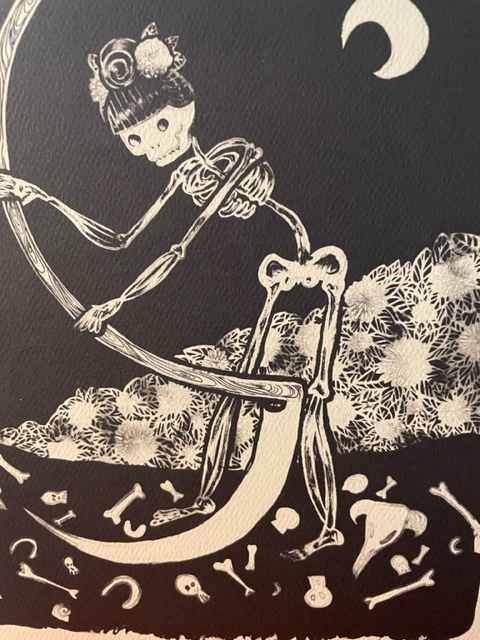
The art in this black and white graphic novel is beautiful. There is some non-graphic nudity- for librarians looking to categorize this book, I’d suggest in the adult graphic novel section.

As lovely as the art is, the lettering is close together and difficult to read in places. I think the author was going for the obviously hand drawn look, but I think they went one step too far. Otherwise, this book was enjoyable.

Highly recommended for spiritual seekers.

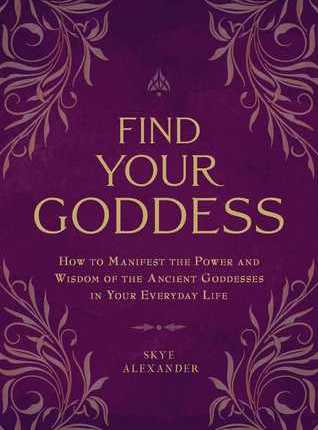
Find Your Goddess: How to Manifest the Power and Wisdom of the Ancient Goddesses in Your Everyday Life by Skye Alexander

Find Your Goddess: How to Manifest the Power and Wisdom of the Ancient Goddesses in Your Everyday Life by Skye Alexander

Find Your Goddess by Skye Alexander is a compendium of goddesses and their various aspects as well as attributions from all over the world. She covers the well-known goddesses from the Roman, Greek, Egyptian and Norse pantheons, and also delves into the lesser known (at least to me) Shinto, Hindu, and Native American deities.

And more.

Photo by Pranjall Kumar on Pexels.com

Some of the entries have corresponding artwork opposite the deity information- but not all. I wish every listing had some artwork because, as they say, a picture is worth a thousand words.

Though I picked this book up for entertainment’s sake, I could see this being a useful tome for spiritual seekers who are looking for a tradition that fits their inner reality.

On a different note, I could see gamers discovering the information contained in Find Your Goddess quite handy. Anyone looking to roleplay characters in their tabletop games or dungeon masters who want to craft a scene with new (to players) world powers could utilize this book.

Photo by lilartsy on Pexels.com

This could also be a useful reference book for pagans on the forefront of recreating rituals and knowledge bases from long ago. I find it interesting that once upon a time the goddesses in this book were recognized and worshipped, and now society has forgotten not just about the deity herself but also how she was honored or her role in keeping civilization together.

Many of the goddesses have roles in the home or schools- goddesses of the hearth, learning or heart. But some have spheres of influence that were primarily held by male gods, at least in the western world.

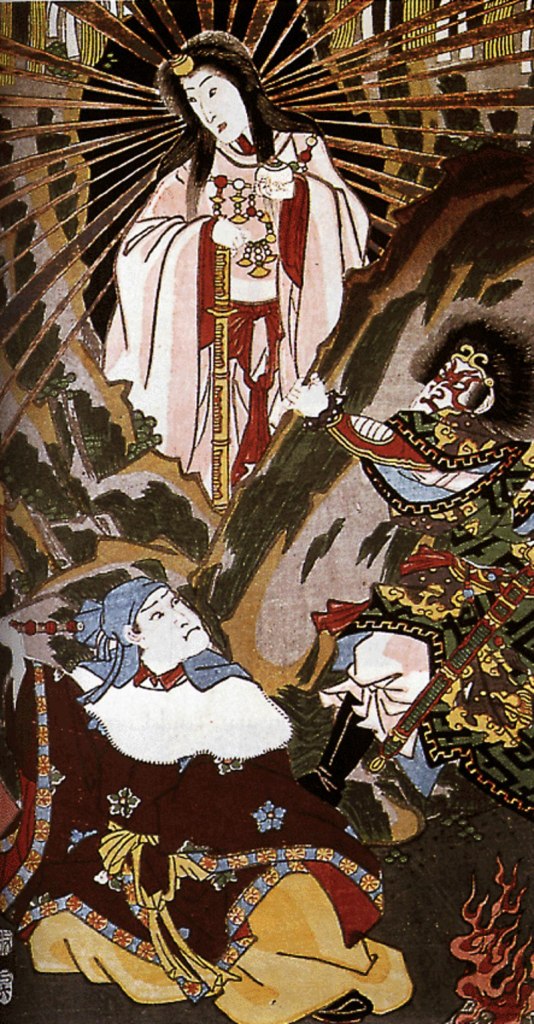
One of these that comes readily to mind is Amaterasu Ōmikami, a goddess of the sun and the Japanese imperial family. The Greek and Roman god Apollo has always occupied that role in my classically-educated mind.

Japanese Sun goddess Amaterasu emerging from a cave.

I enjoy considering other viewpoints because my own biases come to the forefront when I do so. Though I may not be able to rid myself completely of these biases, knowledge and wisdom helps me to see the blind spots. My hope is to know where they reside so I may easily brush them aside when they raise their ugly heads.

Highly recommended for pagans, spiritual seekers or readers with a curious mind, like me.

Thanks for reading!

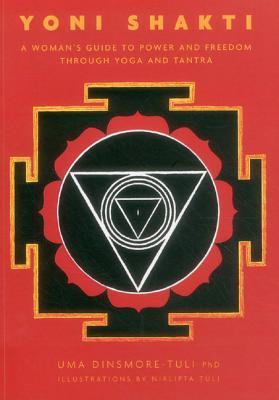
Yoni Shakti: A Woman’s Guide to Power and Freedom Through Yoga and Tantra by Uma Dinsmore-Tuli

Yoni Shakti: A Woman’s Guide to Power and Freedom Through Yoga and Tantra by Uma Dinsmore-Tuli

“When we unlock our sakti we re-connect with our capacity for inner joy and peace with ourselves: all our experiences begin to join up and make sense. Freeing our sakti in this way gives us the key back to our sexual selves, so that we may inhabit our whole being with authenticity and joy.” pg 508 ebook.

Author, yogini and tantrika, Uma Dinsmore-Tuli, shares yoga sequences, mantras, mudras and meditations to assist readers in becoming more aware of their inner selves.

Photo by Elina Fairytale on Pexels.com

What does this accomplish, you may be asking yourself. According to Dinsmore-Tuli, it’s the foundation of a mindful existence.

“All of the poses to unblock the life force energy are also very practical means to keep the creative and sexual energies in circulation so that they are available to nurture and enrich our creative, family, social and professional encounters.” pg 518, ebook

That sounds pretty good to me.

So, I tried some of the suggestions from this book which I had to cherry pick because there are dozens to try. And my results were unexpected and stunning.

Photo by Diego Madrigal on Pexels.com

After the first practice, I experienced an almost immediate increase in my sensitivity to my body’s energy and overall energy level. After the first week, this improved awareness led to some fascinating experiences during my meditations.

Apparently, practitioners of yoni shakti routinely encounter visions or spontaneous energy body knowledge. The goal is not to seek these experiences, but to be aware when they arise and dissipate, and then utilize them for greater self knowledge.

Using these teachings, I feel like I’m learning a whole new dimension to life- one that arises from practices of mindful awareness. Yoni Shakti is a good reference book for that journey.

Photo by Daniel Torobekov on Pexels.com

That being said, a majority of this book is repetitive to the point of unreadable. I realize Dinsmore-Tuli is passionate about the women’s movement in yoga, but she goes on so much about past abuses by gurus and organizations that it detracts from the delivery of the wisdom of the book.

I found myself skimming entire sections because they read the same in the previous chapter and the ones before it.

On the other hand, this book shines in its accounts of the women who were suffering and then rediscovered their power and ability to heal themselves through their yoga practice.

“There is a deep relief in knowing that other women have experienced the same losses, and a comfort in hearing others speak about what is so often unspoken. The sharing is healing.” pg 597

Recommended, with a few reservations, to spiritual seekers interested in yoga and tantra- particularly women.

Thanks for reading and namaste!

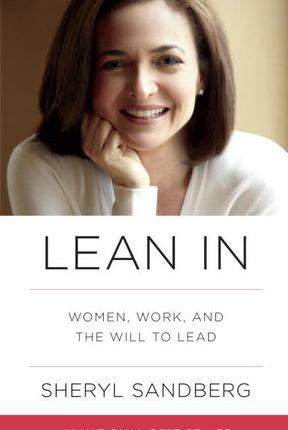
Lean In: Women, Work, and the Will to Lead by Sheryl Sandberg

Lean In: Women, Work, and the Will to Lead by Sheryl Sandberg

Sheryl Sandberg stresses the need for collaborative approaches and teamwork because both strategies lead to greater success and gender equality in business. She then takes that idea a step further and ventures to say that if this collaborative model could be applied both on the job, in relationships, and at home that this could change the world.

It probably could. I’m certainly willing to give it a try.

Photo by RF._.studio on Pexels.com

The part of Lean In that I was most receptive to was the discussion about the Queen Bee syndrome of females in upper management and how, sometimes, women keep other women down because of the attitude that “there can only be one”.

Probably because of my background, I’ve always approached friendships with other women with the mind set of a “world family” and do my best to help others with their needs in whatever capacity I can. I have rarely found a friend or business associate who responds with the same level of support. I suspect that this tendency in life to look out for number one is caused by the lack of unconditional love that a supportive family unit provides first developmentally as a child and then into adulthood.

It is no wonder that women, if made to feel inferior to other family members at home, react in an aggressive way when “competing” with other females on the job rather than reaching out a hand in welcome.

Photo by Tima Miroshnichenko on Pexels.com

I was fortunate to grow up in an all female household (plus Dad) so gender equality wasn’t an issue that I ever had to consider until I had a child of my own and had to make decisions about work and childcare. My sisters and I weren’t compared to brothers or ever told that we couldn’t have something that we wanted or be successful simply because we were female.

In fact, my mother’s father was on the forefront of the integration of females into the Air Force. He gave his daughter a male name (Allyn) because his thinking was that gender equality was going to shift to a more equal stance during her lifetime. But, it was going to take some time for attitudes to change. In the meantime, he wanted her resume and career to be judged and advanced on its merits, which, he figured, would be smoother and avoid all the pitfalls of sexism if recruiters thought she was a man.

Photo by Maryia Plashchynskaya on Pexels.com

Clever Grandpa and hooray for me that my mother had a positive, feminist role model for a father.

I’m also lucky in that, because of my many female siblings, I have a ready-made “sisterhood” of support. Many of the issues that Sandberg discusses in Lean In, I’ve encountered, but I was lucky enough to have solutions for in the embodiment of my family. I know that not everyone has that type of support in their career and personal life, and I fully appreciate that I’m spoiled in my lifestyle.

If you enjoyed Lean In, I’d suggest Spinster: Making a Life of One’s Own (a discussion of feminist issues in relationships and marriage) and Artemis: The Indomitable Spirit in Everywoman (a feminist dissection of a few mythological archetypes to empower women through the exploration of the subconscious mind).

Thanks for reading!

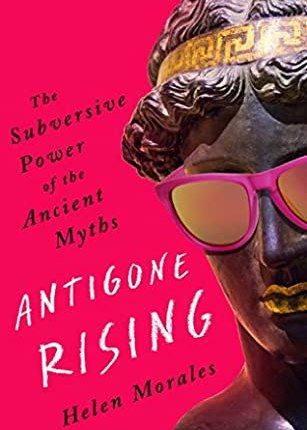
Antigone Rising: The Subversive Power of the Ancient Myths by Helen Morales

Antigone Rising: The Subversive Power of the Ancient Myths by Helen Morales

Helen Morales highlights troubling aspects of Greek and Roman mythology in a call-to-action to analyze and reimagine those myths for modern times.

As a classicist, I was familiar with most of the myths Morales examined. However, I was unaware of some of the toxic sub-context contained within them.

“My hope is that by tracing patterns and connections between ancient and modern beliefs and practices it will become easier to understand how misogyny operates and the ways in which classical antiquity plays a role (although it is not the only player and this is not its only role) in legitimating how misogyny operates today.” pg 14

Photo by Miggy Rivera on Pexels.com

The stories we tell ourselves are powerful. It shapes our expectations for our communities and the roles we occupy within them. Joseph Campbell pointed this out for the last generation. Perhaps Helen Morales will be the one to point it out for this one.

“The problem is that misogynist myths are more strongly culturally entrenched in our societies than myths that subvert them.” pg 148

But all hope is not lost. Creators from books to film to music videos are taking these myths and making them their own. With time, new interpretations will take hold.

Antigone is rising. Antigones (and Ismenes and Haemons) are rising.” pg 150

Photo by cottonbro on Pexels.com

Lest we forget, Morales reminds readers that ancient myths have been the inspiration for, among other things, “the Declaration of Independence and the US Constitution, trades union movements, Marxism, and the gay rights movement.”

It is all about how we interpret and tell the myths with each passing generation. Let’s choose carefully.

Thanks for reading!

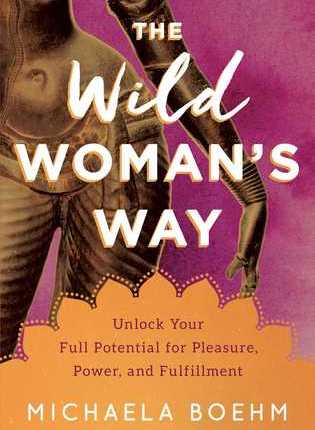
The Wild Woman’s Way: Unlock Your Full Potential for Pleasure, Power, and Fulfillment by Michaela Boehm

The Wild Woman’s Way: Unlock Your Full Potential for Pleasure, Power, and Fulfillment by Michaela Boehm

“This book is a call to come back to our wild, undomesticated ‘original nature,’ which, combined with an untamed heart, knows what is true for each of us. It is a call to return to the inborn genius that guides our passion, whispers in our ear with longing, and reveals itself abundantly when we allow our bodies to show us the way.” pg 8, ebook

Michaela Boehm utilizes her years of therapeutic practice and tantric training in this self help book designed for the modern woman.

Photo by Gabriela Cheloni on Pexels.com

There are so many choices and life paths from high-powered careers to motherhood, that many women try to do it all.

“The good news: amidst such a multitude of options we are free to choose what resonates with us. The bad news: it’s confusing, overwhelming, time-consuming, fraught with many pitfalls, and requires constant discernment.” pg 9, ebook

It’s not possible to do and have it all, Boehm writes, and while they attempt it, women cut themselves off from their sensual natures. She has written this book to give women practices and rituals to bring them back from this disconnection into the power and knowledge of their bodies.

Photo by Maria Orlova on Pexels.com

“Relaxing the body; engaging with life, beauty, and nature; and gentle, nonlinear movement and dance are some of those physical practices we’ll be engaging in throughout this book.” pg 34, ebook

I didn’t connect with all of Boehm’s writing, but I have begun to practice a version of her “formless dancing” every day. The practice itself is simple. Turn on music with no words and a beat, and move your body however it feels like moving. It’s designed to release tension and unconscious clenching that happens when one becomes disconnected from their physical form.

“Once you understand your own reasons for any numbness, tension, and strain that you may carry in your body, you can easily undo the related habitual body patterns and restore yourself to a state of pleasurable aliveness and sensual well-being.” pg 50

Photo by Engin Akyurt on Pexels.com

I find it extremely relaxing. I probably look mad, shimmying and bouncing and swaying around, but it feels really good so who cares. 🙂

Highly recommended for readers looking to reconnect with their body’s innate intelligence or who are interested in different spiritual practices.

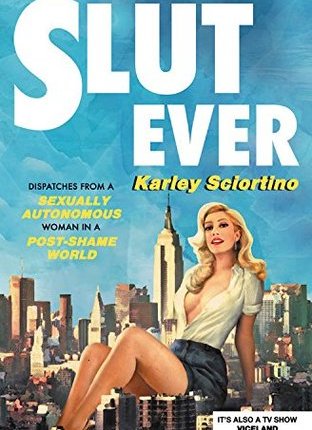
Slutever: Dispatches from a Sexually Autonomous Woman in a Post-Shame World by Karley Sciortino

Slutever: Dispatches from a Sexually Autonomous Woman in a Post-Shame World by Karley Sciortino

“Without question, if I weren’t a slutty as I am, my life thus far would have been far less interesting. … But my sluttiness has also been the cause of many existential bathroom-mirror moments.” pg 8, ebook

Photo by cottonbro on Pexels.com

Karley Sciortino, sex blogger and author, has led a self-described colorful life. It certainly comes through in this tell-all memoir.

Through her experiences, Sciortino has proudly embraced her sexuality and her place in society as a woman who knows what she wants in the bedroom, and takes it. This hasn’t been a simple path.

Part of her struggles are society’s views and programming about “slutty” women.

“It’s a no-brainer that we’re influenced by the people and stories that make up the culture around us. And it’s difficult to cite an example, either real or fictional, of a happy, healthy, promiscuous person – let alone a woman.” pg 8, ebook

The rest of her difficulties seem to stem from a lack of self knowledge or awareness. Sciortino isn’t afraid to tackle any and all issues head on in her own unique way.

“…my goal isn’t to be good or normal or accepted. My goal is to be free. (And maybe also to troll society a bit in the process, for good measure.)” pg 12, ebook

Photo by Nina Uhlu00edkovu00e1 on Pexels.com

It took me a couple chapters to get into this memoir. Sciortino’s writing style is frank to the point it sometimes feels abrasive, but it maintains an honest delivery throughout.

“My biggest revelation of the saga was that group sex is amazing for when you’re drunk, because you can just take a time-out whenever you’re bored or tired and someone else will literally take over for you. Genius.” pg 24, ebook

The early part of the book is fixated on sexual experiences and experimentation. As she delves deeper into her underlying motivations and psychology, Sciortino begins to get to the heart of matters. That’s when I felt this book became worth the read.

She had me asking myself some difficult questions: Why is sexuality such a complex issue? Why should people, in the privacy of their own homes and with proper consent, care what others think?

Photo by cottonbro on Pexels.com

Why are there different standards for men and women?

And why is sexuality, which can play such a large part of the happiness in our lives, so difficult to talk about? (For some, not Sciortino, obviously.)

Recommended for mature readers who don’t mind a nearly stream-of-consciousness style of writing as well as a thick skin to push through Sciortino’s delivery to get to the meaning behind the words – because there is meaning to be found.

Thanks for reading!

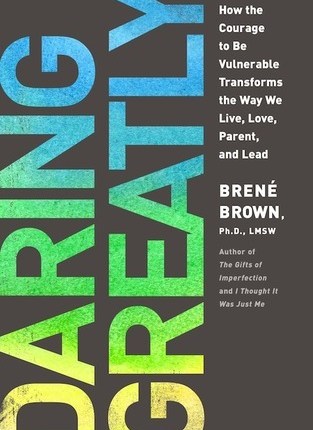
Daring Greatly: How the Courage to Be Vulnerable Transforms the Way We Live, Love, Parent, and Lead by Brené Brown

Daring Greatly: How the Courage to Be Vulnerable Transforms the Way We Live, Love, Parent, and Lead by Brené Brown

Brené Brown shares her twelve years of research into shame and gives tools on how to increase one’s vulnerability. In this way, she believes each individual can help change the culture of scarcity and pull the world back from a continual cycle of shaming.

We’ll build stronger and deeper relationships, strengthen families and have more productive work places. And, by doing this, we will each, in our own way, live in a manner that “dares greatly” every day.

“I also learned that the people who love me, the people I really depend on, were never the critics who were pointing at me while I stumbled. They weren’t in the bleachers at all. They were with me in the arena. Fighting for me and with me.” pg 56

Photo by RF._.studio on Pexels.com

I’m going to use the information in this book the most in my work life. As a writer, I attach far too much significance to my work product on the audience’s response to it rather than my own feelings about it. As Brown so clearly points out in this book, an outside response will never be good enough or big enough to fill the need that I am looking to fill with their words or their views. Or, if it is wildly praised, perhaps the next work won’t be, and then I’m right back to where I started.

“You still want folks to like, respect, and even admire what you’ve created, but your self-worth is not on the table. You know that you are far more than a painting, an innovative idea, an effective pitch, a good sermon, or a high Amazon.com ranking.” pg 64

This desire for connection and a feeling of worthiness, Brown says, comes from the need to survive by belonging to a group. Our brains have evolved to encourage us to belong and form connections. And when we don’t by not believing in our own self worth or experiencing shame, it is a physically painful emotion. People do all sorts of things to avoid feeling shame including pulling away or striking out. But, in the end, these connections are life itself.

“Buber wrote, “When two people relate to each other authentically and humanly, God is the electricity that surges between them.” pg 150

Photo by Pixabay on Pexels.com

As interesting as I found Brown’s research to be, she lost me when she began a discussion about how much vulnerability is enough or too much and walking the tightrope between extremes. So, be authentic, but don’t use it to manipulate people. A few sentences covers what Brown uses 50 pages to unpack.

“When we stop caring about what people think, we lose our capacity for connection. When we become defined by what people think, we lose our willingness to be vulnerable.” pg 169

Her message becomes a bit undefined and more general the further the book goes. That’s not to say it couldn’t be useful for readers who are looking for that type of information. I didn’t find it particularly engaging.

Like any self help book, I think sometimes authors and researchers can get lost in the weeds of the problem. I far more prefer to focus on the solution. In this case, that’s being brave enough to show up and be seen, demonstrating vulnerability and willingness to care about whatever is going on wherever we find ourselves throughout the day. As Brown reminds readers, it’s not about winning or losing, it’s about being there. And that’s a message worth spreading.

Photo by fauxels on Pexels.com

“To love ourselves and support each other in the process of becoming real is perhaps the greatest single act of daring greatly.” pg 110

I’m game. Are you?

Thanks for reading!