How to Talk About Places You’ve Never Been: On the Importance of Armchair Travel by Pierre Bayard

How to Talk About Places You’ve Never Been: On the Importance of Armchair Travel by Pierre Bayard
armchairtravel

How to Talk About Places You’ve Never Been is a funny little non-fiction book about the skill of conversing about places you’ve never actually been.

At first, I couldn’t figure out what tone the author was wanting to convey because he, quite seriously, discusses why and how to describe places that the reader has never been- a topic that I, before I read this, didn’t take seriously at all.

I eventually settled my inner dialogue’s tone to “slightly grizzled professor who is smiling while lecturing” and that seemed to fit the bill.

There’s a lot to enjoy in here like Marco Polo’s hilarious description of unicorns.

Polo is presented as an armchair traveler because he left out so many important details about the area he was describing (like the Great Wall) and, quite brazenly, made other stuff up: “They have great numbers of elephants and also great numbers of unicorns, which are not smaller than the elephants. Here is what they look like: they have the same hide as a buffalo, feet like an elephant, and they have very thick, black horns in the middle of their foreheads.” pg 9

Photo by mark glancy on Pexels.com

Oddly enough, that sounds rather like the Siberian unicorn, doesn’t it? Only problem is- they became extinct so long ago, that Polo would have never seen one.

The character Phileas Fogg from Around the World in Eighty Days by Jules Verne, goes around the world and never leaves his cabin to see the sights.

Bayard thinks this is an excellent strategy: “The idea of staying in your cabin for the entire journey highlights the importance of the imagination and reflection in our approach to place. These are activities that Fogg is able to commit himself to completely vis-a-vis the places passed through, with all the more energy because he doesn’t waste precious time visiting them.” pg 29

Chateaubriand went beyond simply trying to describe his travels in Ohio, he put an island into the middle of it in his “memoir.”

Photo by Ron Lach on Pexels.com

Bayard applauds his imaginative creation as precise accuracy of physical locations is not what is necessarily important to an armchair traveler:“As Jean-Claude Berchet recalls, (the island) was first situated in what is now Florida at the time of Travels in America. Migrating, it then made a foray into the Mississippi at the time of an 1834 manuscript, before, following its movement northward, it found itself here in Ohio, several thousand kilometers away, clearly justifying the epithet of “a floating island.” pg 57

Bayard’s reasons why the reader may, one day, have to convince someone that they had been somewhere that they actually had not been: “The first is adultery. … The second, murder, is fortunately less common, but any one of us might become confronted with the necessity of having to take this route to ensure our peace and quiet one day. pg 103

How exciting and dramatic! And here I thought this book was just about sitting in your chair and day dreaming. 🙂

Photo by cottonbro on Pexels.com

“It is impossible to hope to speak with any conviction of places you haven’t been to without a vivid imagination. The capacity to dream and to make others dream is essential to anyone wanting to describe an unknown place and hoping to capture the imagination of their readers and listeners.” pg 123

Dream on, readers, dream on!

If you enjoyed How to Talk About Places You’ve Never Been, you may want to pick up The Art of Travel by Alain de Botton or The Art of Non-Conformity: Set Your Own Rules, Live the Life You Want, and Change the World by Chris Guillebeau but, keep in mind, these books recommend that you actually go to the places, not just dream it.

I received this book through the Good Reads First Reads program. Thanks for reading!

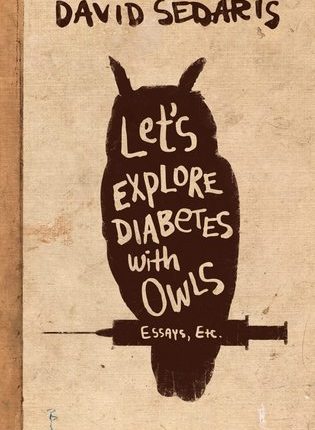
Let’s Explore Diabetes with Owls by David Sedaris

Let’s Explore Diabetes with Owls by David Sedaris

David Sedaris is a unique American humorist. Sometimes I love his essays and other times I hate them, so ranking a collection of his work fairly is difficult.

I listened to the audiobook of Let’s Explore Diabetes with Owls on my daily commute and he’s a wonderful narrator.

Actually, having read a handful of his other books, I’d recommend listening to him read his essays. His timing and inflections are perfection. He’s one of the few humorists who has literally made me laugh out loud.

The high points of this collection are Understanding Understanding Owls, Laugh Kookaburra, and A Guy Walks into a Bar Car. They’re unbelievably funny and have a lot of heart.

The low points were: Health-Care Freedoms and Why I want my Country Back, If I Ruled the World, and Dog Days. It’s as if he ran out of material and tacked the worst of it on the end.

Dog Days was awful and reminded me of Squirrel Seeks Chipmunk: A Modest Bestiary which I couldn’t stand. Vulgar prose just isn’t my thing, I guess.

Recommended for adult readers who are looking for a laugh and don’t mind some profanity and general silliness. More humorous books that I’ve enjoyed: Are You There, Vodka? It’s Me, Chelsea, Dad Is Fat, and It’s All Relative: Two Families, Three Dogs, 34 Holidays, and 50 Boxes of Wine.

Creativity: The Perfect Crime by Philippe Petit

Creativity: The Perfect Crime by Philippe Petit

In Creativity, Philippe invites the reader into his mind and attempts to dissect his creative process. For this to make any sense, you sort of have to let go of reality as you know it and step into his pipe dream world for the duration of the read.

Sometimes I was able to do this and followed his twisting train of thought to some fascinating conclusions, but other times I couldn’t. So, if you pick this one up, prepare yourself. It’s not for everyone.

I marked a couple of his ideas that resonated with me:“If you are an artist, you want to create a giant wall around yourself and, inside that wall, to follow your honesty and your intuition. What the audience will see is a man or woman who is a prisoner of his or her passion, and that is the most inspiring performance in the world.” pg 16 “To be a prisoner of passion”- I’ve never heard an artist described that way before.

Photo by ShonEjai on Pexels.com

In pages 20 to 26, Philippe essentially describes his brainstorming process as a paper version of Pinterest (my comparison, not his). He takes all of these words and pictures and files them according to some associations that his mind makes, then reassembles the results into art… somehow.

Read these pages if you want to explore how difficult it is for a creative type to write down his process in a manner that makes sense to anyone other than him or herself. It’s interesting but baffling.

“Another theory of mine: turning in circles and getting lost is important! You find yourself when you get lost.” pg 28 I embrace that theory as well.

“Go to school if you want to learn. Go to life if you want to feel.” pg 85 Loved that.

“Use your creative paranoia to be on the lookout for negativity; observe with a positive spirit: “What a beautiful disaster!” uttered the French architect Le Corbusier when he visited Manhattan for the first time.” pg 100

Photo by Trev Adams on Pexels.com

“Even if you are not a performer, even if you don’t have an act, do not think that you have nothing to rehearse! The art of living makes a performing artist out of you.” pg 122 We are all creators, painting our lives in wide strokes around us, even those of us who can’t draw a stick figure or walk on a rope between skyscrapers.

“Look in the mirror of fear and focus beyond it. What appears in the background is your path, awaiting.” pg 149 Something to keep in mind when life’s anxieties and impossibilities assail you.

Creativity: The Perfect Crime is one of a kind but if you liked it, I’d recommend reading PostSecret: Extraordinary Confessions from Ordinary Lives by Frank Warren (hundreds of people around the country decorate plain postcards with a secret that they’ve never revealed to another person- it shows the heights and depths of creativity and artistic catharsis) or How to Fly a Horse: The Secret History of Creation, Invention, and Discovery by Kevin Ashton (a more logical than emotional book about the creative process, how it works, and how everybody can create).

thewalkfilm

Speaking of Philippe Petit, did anybody else watch The Walk with Joseph Gordon-Levitt which was about his famous tight rope walk between the Twin Towers? 

If you read this book first, it makes so much more sense.

Thanks for reading!

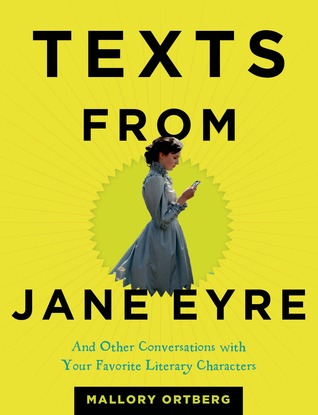
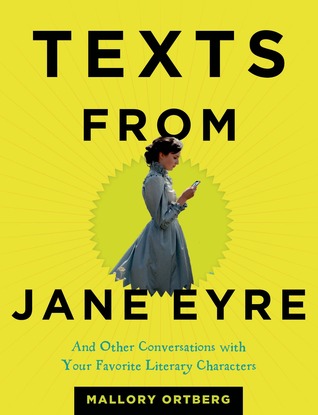
Texts from Jane Eyre by Mallory Ortberg

Texts from Jane Eyre by Mallory Ortberg
textfromjaneeyre

Though the premise was clever, Texts from Jane Eyre reads a lot like text message conversations in real life- shallow and repetitive after the first few lines.

Also, there wasn’t a synopsis included in these pages, so if you hadn’t read a classic or, if you’d read it so long ago that you’d forgotten most of it, you were out of luck.

The best of the lot was the Samuel Taylor Coleridge chapter that starts on pg 43 in which he’s on a ramble about the golden palace of Kubla Khan and then a delivery guy comes to the door and ruins his flow.

The worst was the Harry Potter chapter in which Ron and Hermione have a ‘conversation’ but Ron is written as a complete moron and she is confounded by his idiocy. Very mediocre and unworthy of either of those characters.

If you feel the need to read this one, check it out from the library. A related read if you enjoyed it: When Parents Text: So Much Said…So Little Understood.

Thanks for reading!

Get Your Sh*t Together: How to Stop Worrying About What You Should Do So You Can Finish What You Need to Do and Start Doing What You Want to Do (A No F*cks Given Guide) by Sarah Knight

getyoursht

Knight is an acquired taste, but I generally enjoyed Get Your Sh*t Together. Her self help books are full of useful tips, profanity, and irreverent humor so don’t pick this title up if you’re easily offended.

If you know someone who seriously needs to get their you-know-what together, this could be the title you’ve been waiting for!

Knight keeps it real from the first page: “(This book) is more of a let-me-help-you-help-yourself-help book, with “me” here to “help” when your “self” gets in the way. Let’s face it- if you could help yourself, you’d have done it by now, right? Also, unlike many traditional self-help authors, I am going to use the word sh*t 332 times (including several sh*tmanteaus of my own invention), so please do not go on Amazon saying you were expecting sunshine and kittens and got sh*tstorms and sh*ttens.” loc 31, ebook. And so on, and so forth.

I’ve also enjoyed The Life-Changing Magic of Not Giving a F*ck: How to Stop Spending Time You Don’t Have with People You Don’t Like Doing Things You Don’t Want to Do and I felt as if Knight shared more of herself in this offering than that one.

We learn that she had/has anxiety attacks and had to pull her life together because it was falling apart. Not many self help authors display their humanity and imperfections like that and I really appreciated her honesty.

Photo by Suzy Hazelwood on Pexels.com

Plus, readers get to reap the benefits of her hard won wisdom and we know it works because she got her stuff together enough to write the book.

I really like Knight’s various life philosophies, which she sprinkles throughout.

Here’s one of my favorites: “In my book- and in the Game of Life- you’re competing exclusively against yourself. Not other players, not even the computer. … Winning is getting what you want out of your time on planet Earth, whatever that entails. It could be the house, job, car, partner, or hairstyle of your dreams.” loc 502, ebook.

Be the best you that you can be and forget about the rest. Good advice.

Knight also gives a ‘nod’ to Marie Kondo’s internationally best selling title and Knight’s thoughts about it may appeal to more readers than the original material: “At this point, we’re living in a post-tidying society. … People get their tidying groove on for a few months, or even just a few weeks, and then… kinda lose the thread. … Why is that? Well, I submit that if they had their sh*t together in the first place, the tidying bug would have stuck.” loc 2547, ebook. Sound familiar to anyone?

Among the many life issues that Knight tackles, her thoughts on perfectionism struck particularly close to home for me: “When you accept that failure is an option, you move it from the realm of anxiety-inducing anticipation into a reality that you’ll deal with when (and more importantly, IF) that ever happens. Your energy is better spent on accomplishing goals in the here and now than on worrying about failure in the abstract.” loc 3049, ebook.

Recommended for people who need self help but don’t like reading self help, probably 18+ because of the language.

Sarah Knight will give you some life changing tips and along the way, you may learn some unique new uses for the word: sh*t. Some further reading: The Life-Changing Magic of Not Giving a F*ck: How to Stop Spending Time You Don’t Have with People You Don’t Like Doing Things You Don’t Want to Do, The Joy of Leaving Your Sh*t All Over the Place: The Art of Being Messy, and How to Be Dull: Standing Out Next to Genius.

Thank you to NetGalley and Little, Brown and Company for a free ARC of this book! And, thank you for reading.

Hand Drawn Jokes for Smart Attractive People by Matthew Diffee

Hand Drawn Jokes for Smart Attractive People by Matthew Diffee
handdrawnjokes

Sadly, the best part of this book is its inspired title: Hand Drawn Jokes for Smart Attractive People.

The rest is either clever, but not funny, or offensive depending on the page.

It’s a shame really- the artwork itself is great and it’s clear that Diffee is a talented cartoonist. I just didn’t connect with much of the work.

Out of all of it, my favorite cartoon was on page 188- Moses: The Teen Years where a young adult version of Moses is depicted staring into a mirror, carefully parting his long hair with a comb. The worst was the entirety of Chapter Eight: For Smart Attractive Indians and Eskimos and really soured this whole book for me.

Pick up at your own risk, I can’t really recommend it. Some graphic novels that I DO recommend: Penguins with People Problems or Shakespeare’s Guide to Parenting.

Thanks for reading!

How to Be Dull: Standing Out Next to Genius by Basil Morley, Esq.

How to Be Dull: Standing Out Next to Genius by Basil Morley, Esq.
howtobedull

How to Be Dull: Standing Out Next to Genius is one of the funniest books I’ve read this year.

I read a lot of self help, self improvement, self actualization books and How to Be Dull shines a hilariously dark spotlight on the myriad benefits of staying just as you are. The humor is dry and the delivery is completely serious and matter-of-fact, rather like a Monty Python classroom sketch.

It is also surprisingly educational.

Do you know why we remember Chaucer’s name but so very few of his contemporaries? : “…Chaucer succeeded by adapting Italian masters, appropriating a wide range of old folk tales, mixing them with Greek myth, writing in the vernacular rather than hoity-toity Latin or snooty French, and adding a wide range of characters to represent the whole of modern 14th century life from the top to the bottom… He was a true original, though one must admit his originality was made of things familiar mixed up, changed, innovated and slapped together in wholly unexpected ways.” loc 68, ebook.

It’s so true! People don’t want new stuff- they want old stuff repackaged to look new. How dull is that. Chaucer knew what was up.

This whole dull thing is very appealing to introverts: “Be dull. Be boring. Make no splash. Make no waves. Put your head down and do the work you wish to do and present such a bland face to the world that they leave you in peace to get on with it. Do not make the mistake of seeing this as some kind of capitulation. You are not defeated if you are dull. You merely refuse, wisely, to spend your precious time convincing others of your originality.” loc 105.

Photo by Pixabay on Pexels.com

Being left in peace to do what I want to do- now there’s a philosophy I can get behind.

If you were curious as to the enduring popularity of socialites who don’t seem to contribute in any meaningful way to society, Morley suggests that it is because of dull people just like you and me.

Imagine our importance! : “Be below notice. For you will find it easy to make your way unseen into important places, for the truth is the appeal of these ‘personalities’ is their true blandness. They are screens upon which we project our home movies of illusion. And they need dull people to make them sparkle.” loc 168, ebook.

I do enjoy an author who isn’t afraid to put in a good word for themselves: “How to explain this conundrum without falling into dullness myself and losing your attention? I do wish to teach you to be dull, but you must attend to my brief lesson long enough to say, ‘Yes I read that book and I rather liked it’ so you can recommend it on ReadGood or whatever those places are before you go back to sipping your own martini and forget all about my delicious tome.” loc 796, ebook.

Photo by MART PRODUCTION on Pexels.com

Ah, self promotion, the height of dullness. Now, back to my martini…

Let’s end with Morley’s exhortation to be a “shining example” to those who try to stand out from the crowd: “It helps one to know that whilst one appears to be useless and idle, one can congratulate him or herself on being a shining example to those who would wish to be extraordinary. It is the normal thing, or should I say the usual thing.” loc 923, ebook.

Know anybody who forgets to laugh about the silliness that is the self improvement rat-race? I have just found the perfect Christmas present for them. You’re welcome. 🙂

Photo by mentatdgt on Pexels.com

Some more humorous books about popular culture: The Joy of Leaving Your Sh*t All Over the Place: The Art of Being Messy or The Life-Changing Magic of Not Giving a F*ck: How to Stop Spending Time You Don’t Have with People You Don’t Like Doing Things You Don’t Want to Do. But, How to Be Dull is superior to either of those books because the author never wavers from his/her beautifully worded, high brow observations or resorts to vulgarity to make a point.

Thank you to NetGalley and Women’s League of Ale Drinkers Publishing for a free digital copy of this book. (What a great name for a publishing firm, by the way.) And, thank you for reading!

The Joy of Leaving Your Sh*t All Over the Place: The Art of Being Messy by Jennifer McCartney

The Joy of Leaving Your Sh*t All Over the Place: The Art of Being Messy by Jennifer McCartney

I laughed, but I’m not proud of myself. This satire for fans or non-fans of the book, The Life-Changing Magic of Tidying Up: The Japanese Art of Decluttering and Organizing by Marie Kondō, takes no prisoners in its scathing examination of the minimalist movement. As it clearly states in the intro, this is not a self help book. As a librarian, I’d add that it is under the Dewey Decimal classification 818s (humor) rather than the 130s (self help), so that claim would be true.

First, let’s make one thing clear, I’ve loved ‘de-cluttering’ various rooms in my house and finding those objects that ‘spark joy.’ But, I couldn’t help but laugh at the process of it through the lens Jennifer McCartney provides.

Here’s what she has to say about ‘life changing magic’: There’s nothing wrong with wanting to improve your station in life or making changes to things you’re unhappy with. I guess. But be wary of neat slogans and books that promise life-changing magic. The only real magic in the world is from unicorns and the high you get from poppers. pg 19

Photo by mark glancy on Pexels.com

I’ve never felt like a failure at the ‘tidying process’ but Jennifer’s book should appeal to those who do. Here’s her advice for how to ‘Be Free’: “Let go of caring, let go of guilt and feelings of failure. Breathe in good messy, breathe out boring tidy.” pg 28

In her book, Marie Kondo writes about thanking her small purse for its service at the end of every day. Jennifer has different ideas about the care and functionality of your handbag: “…you should always purchase the biggest purse you can carry. Here’s a good purse test: Can it fit a bottle of wine? No? Move on. Yes? Buy it.” pg 75

At times, Jennifer is downright dismissive of The Life-Changing Magic of Tidying Up: The Japanese Art of Decluttering and Organizing‘s teachings about every object having a “spirit” and she’s particularly vitriolic about the way Kondo rolls her socks. If that is going to bother you, you may want to skip this one.

Photo by Pixabay on Pexels.com

A humorous read alike: The Life-Changing Magic of Not Giving a F*ck: How to Stop Spending Time You Don’t Have with People You Don’t Like Doing Things You Don’t Want to Do by Sarah Knight. Warning: contains approximately a billion f-words.

Thanks for reading!

The Life Changing Magic of Not Giving a F*ck: How to Stop Spending Time You Don’t Have with People You Don’t Like Doing Things You Don’t Want to Do by Sarah Knight

The Life Changing Magic of Not Giving a F*ck: How to Stop Spending Time You Don’t Have with People You Don’t Like Doing Things You Don’t Want to Do by Sarah Knight

Since I just posted on Spark Joy, I thought that it was the appropriate time for a review of this one.

Full title, it’s a whopper and very descriptive of the book’s contents: The Life-Changing Magic of Not Giving a F*ck: How to Stop Spending Time You Don’t Have with People You Don’t Like Doing Things You Don’t Want to Do.

F-bombs aplenty in this parody of Marie Kondo’s international best seller about tidying. If you can look past the obvious language thing, Knight gives some fairly solid advice. She counsels readers to not care so much about what others think and give that mental energy to yourself. You’ll be surprised what you can accomplish.

“Please listen when I say that the shame and guilt you feel when you’re trying so hard to not give a f***? It’s usually not because you are wrong to not give that f***. It’s because you’re worried about what other people might think about your decision. And guess what? You have no control over what other people think.”pg 26

See? She reminded me of a more foul-mouthed Byron Katie.

Sometimes she manages to string together two whole sentences without the F-word. Check it out: “You can sidestep the prospect of hurt feelings entirely when you view your conflict through the lens of simple, emotionless opinion. NotSorry (Knight’s method) is all about simple, emotionless opinions.” pg 31.

Beyond managing your own mind, she branches out to give advice to parents: “One mother responded from the perspective of teaching her own kids what to give a f*** about: As someone who grew up in a household full of guilt, I think it’s important for our kids to know that they can make decisions about what to care about, and that they don’t need to pay attention to the approval or condescension of other people in deciding how to live their lives.”pg 92.

I can get behind that idea.

Then we move right along to shades of Eckhart Tolle and The Power of Now: A Guide to Spiritual Enlightenment with contemplating the meaning of existence and its temporariness: “The reality is, unless we’ve been given a ballpark figure by a reputable physician (and sometimes not even then), not a single one of us knows when we’re going to shuffle off this mortal coil. It’s morbid, but it’s true. Tomorrow you could get hit by a bus, or mauled by a pack of wolves, or be scared to death by a clown. When you think about it like that, don’t you want to make every second count? pg 184.

Sarah Knight’s book, in my opinion, doesn’t have the life-changing magic of the other book, but she’s got some interesting thoughts that I believe are true and, sometimes, rather funny. But make sure to bring your sense of humor with you when you pick this one up because the author doesn’t give a … well, you know.

Thanks for reading!