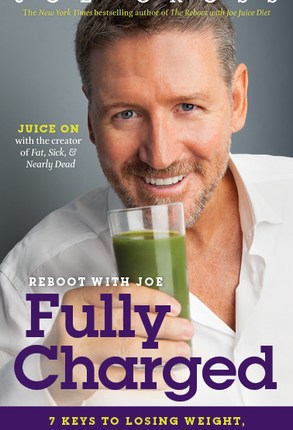
Reboot with Joe: Fully Charged: 7 Keys to Losing Weight, Staying Healthy and Thriving by Joe Cross

Reboot with Joe: Fully Charged: 7 Keys to Losing Weight, Staying Healthy and Thriving by Joe Cross

Fat, Sick, and Nearly Dead is one of the main reasons why I bought a juicer and have attempted to incorporate more plants into my diet. I’m not hardcore about it, but I try.

I didn’t know that Joe from that documentary is named Joe Cross and that he’s written multiple companion books for that film. This one, Reboot with Joe: Fully Charged, is excellent.

What I love about Joe is that he’s realistic. He doesn’t expect that he will eat perfectly for the rest of his life- he just wants to do the best that he can today then repeat the process tomorrow.

Photo by Wendy Wei on Pexels.com

He pushes the big lifestyle changers: diet, exercise, and rest but not in an extreme, unobtainable manner. In addition to common sense ideas about health and diet, Joe has spent years building an online community to support those who are working on major life changes. http://www.rebootwithjoe.com/weight-loss/

When you read this book, you also read examples of people who have turned their lives around with juicing and exercise. It’s inspiring and could be life changing for many people.

I also like that Joe included some of his go-to juicing recipes towards the back of the book. I’ve tried quite a few different juices, but I haven’t found any that I particularly liked. It’s always nice to have some new options that have appealed to other people in the past.

If you enjoyed Reboot with Joe: Fully Charged, I highly recommend his two documentaries: Fat, Sick, and Nearly Dead & Fat, Sick, and Nearly Dead 2. Also, I’d recommend the documentary Forks Over Knives which has a couple companion cookbooks out now.

A big thank you to the Goodreads First Reads program and NetGalley for free copies of this book.  And, thank you for reading!

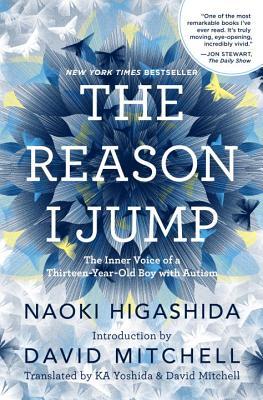
The Reason I Jump: The Inner Voice of a Thirteen-Year-Old Boy with Autism by Naoki Higashida

The Reason I Jump: The Inner Voice of a Thirteen-Year-Old Boy with Autism by Naoki Higashida

Description from Goodreads: “You’ve never read a book like The Reason I Jump. Written by Naoki Higashida, a very smart, very self-aware, and very charming thirteen-year-old boy with autism, it is a one-of-a-kind memoir that demonstrates how an autistic mind thinks, feels, perceives, and responds in ways few of us can imagine. Parents and family members who never thought they could get inside the head of their autistic loved one at last have a way to break through to the curious, subtle, and complex life within.”

The reviews on this one from my Goodreads friends are very mixed and I understand why. The Reason I Jump touches on a very emotional topic.

I’m not an expert on autism so I am completely unqualified to determine if Naoki wrote this book with or without help or the over arching truth of his experiences. However, as a reader, I thought that some of Naoki’s words were very beautiful.

Naoki talks about difficulties in communicating his feelings, the beauty of nature, the impossibility of controlling his emotions or repetitive actions- knowing that he’s not behaving “normally” but not able to do anything about it.

“Please don’t judge us from the outside only. I don’t know why we can’t talk properly. But it’s not that we won’t talk- it’s that we can’t talk and we’re suffering because of it.”pg 24, ebook.

It seems to me that everyone’s lens of perception is different and we can learn from each other if we share our own unique viewpoint. I certainly learned about Naoki’s inner world from this book.

Thank you for reading!

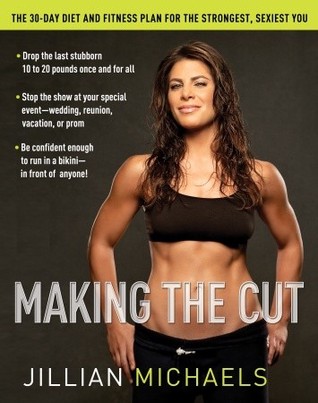
Making the Cut: The 30-Day Diet and Fitness Plan for the Strongest, Sexiest You by Jillian Michaels

Making the Cut: The 30-Day Diet and Fitness Plan for the Strongest, Sexiest You by Jillian Michaels

“Making the Cut” is a collection of recipes, workout tips, and insider training techniques from Jill Michaels, one of the trainers of the television program: The Biggest Loser. She’s hardcore and this book is a reflection of that.

Definitely not for everyone, myself included, I’d only recommend it to those who are already in very good shape. Let me make one thing clear, I’m not in “bad” shape, but I am not at the level required to complete these exercises.

Photo by Pixabay on Pexels.com

So, I nearly killed myself trying to do Day 1 of the circuit training. I have a predictable cycle with fitness books. I read them, get all fired up about changing my diet and amping up my workouts, try it for awhile, then give up.

This one, at least, was so hard and I was hurting so bad that I gave it up right away rather than drawing it out to its inevitable conclusion. Her clean eating tips are solid and I’ve added a lot more fresh fruits and veg to my table, but, the workouts are just too hard.

I had my husband helping with the timer and figuring out what I was supposed to do at each step because her descriptions of the exercises are all gathered together in an index at the end. He was encouraging me to stop after the first two minutes, but I insisted on doing at least ten- silly me.

The weird frog push-ups were an impossibility from the start. I almost broke my nose when I tried to lower my face to the floor. I had to laugh, it was ridiculous.

My only saving grace was that I was using the equipment at my home rather than the gym. If I had humiliated myself like that in public, I might not have been able to give this book the “liked it” three stars.

Some read alikes, for those fitness buffs who just can’t get enough! : This Is Why You’re Sick and Tired: by Jackie Warner, Get Me Skinny by Tony Arreola or, if you’re tired of the exercise and diet merry-go-round: Down Size: 12 Truths for Turning Pants-Splitting Frustration into Pants-Fitting Success by Ted Spiker or Confessions of an Unlikely Runner: A Guide to Racing and Obstacle Courses for the Averagely Fit and Halfway Dedicated by Dana L. Ayers.

Thanks for reading!

Confessions of an Unlikely Runner by Dana Ayers

Confessions of an Unlikely Runner by Dana Ayers

Confessions of an Unlikely Runner filled me with hope. Hope that one day, I too with my sporadic training style and bookworm tendencies, could stumble my way through a race longer than a 10k at, if not respectable pace, then at least a step above sedate. Ayers is funny, candid, and self effacing in Confessions, her sports memoir.

She gives tips and tricks from her many years of race running as well as humorous stories to comfort and amuse struggling athletes. I liked her writing style immediately. It’s down to earth and genuine. This book is appropriate everyone but I think that the beginner to intermediate runners will enjoy her humor the most.

Ayers’ thoughts about running: “Running as helped me deal with coworkers and break-ups, has taught me what I’m capable of physically and emotionally, has introduced me to some fascinating people, and has taught me how to accept support. Of course, it’s also gotten me electrocuted…” pg 3

How she stumbled into marathon running: “I honestly don’t remember how I decided on a marathon as my weight-loss enabler. I searched through old emails and found one I’d written on November 15, 2009, to my friend Kami. The subject line just said, “Marathon,” and the email started with, “I may want to do one. Haha.” pg 17

On running at the back of the pack: “But being slow has its perks. Races are like mullets: business in the front, party in the back.” pg 28 Cracked me up.

On cross-training, here Ayers describes her first CrossFit class: “At some point during my last rep, my contact lens slipped off my eye. Even my eyeballs are working in this class. I had to walk back out past the MMA testosterone ring to get to the ladies’ room to fix it, and that’s when I realized I could no longer straighten my arms. I was walking like a T-Rex and couldn’t help it. I won’t be joining a CrossFit gym anytime soon.” pg 91

I’m seriously considering purchasing one of my sisters this book- it’s hilarious and uplifting. If you enjoyed Confessions of an Unlikely Runner, you may also like Down Size: 12 Truths for Turning Pants-Splitting Frustration into Pants-Fitting Success by Ted Spiker or Running Like a Girl by Alexandra Heminsly.  Thanks for reading!

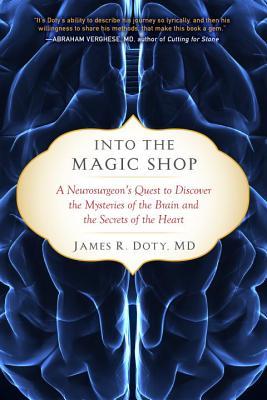
Into the Magic Shop: A Neurosurgeon’s Quest to Discover the Mysteries of the Brain and the Secrets of the Heart by James R. Doty

Into the Magic Shop: A Neurosurgeon’s Quest to Discover the Mysteries of the Brain and the Secrets of the Heart by James R. Doty

This book is James Doty’s memoir. He had a tragic childhood with parents who, for various reasons, were not present for him. Then, after an encounter with a total stranger, James was taught meditation, creative visualization, and positive thought practices that changed his life.

As he comes of age, he dismisses the compassion related portions of his childhood training and focuses instead upon the money and prestige that it brings as he pursues a career as a neurosurgeon. It’s a fascinating and educational account.

Photo by Vidal Balielo Jr. on Pexels.com

I was particularly taken with the near-death experience portion of the book. James approached that experience as an atheist so I felt that made his opinion on it rather different than other accounts I’ve read.

Some of the bits that I want to remember (advance reader’s copy cited so the final published book may contain slightly different wording):
“Some of the wisest patients and people I have ever met have been children. The heart of a child is wide-open. Children will tell you what scares them, what makes them happy, what they like about you and what they don’t. There is no hidden agenda and you never have to guess how they really feel.” pg 3

Photo by Juan Pablo Serrano Arenas on Pexels.com

“Everyone has a story, and I have learned that, at the core of it, most of our stories are more similar than not.” pg 60  But not everyone tells their story.  Thank you, Dr. Doty, for telling yours.

“When our brain changes, we change. That is a truth proven by science. But an even greater truth is that when our heart changes, everything changes. And that change is not only in how we see the world but how the world sees us. And how the world responds to us.” pg 151  I think that this is one of the great mysteries of life.

About his near death experience: “At the time I felt the warmth of a light and a sense of oneness with the universe. I was enveloped in love, and while it didn’t transform my religious beliefs, it informed my absolute belief that who we are today doesn’t have to be who we are tomorrow and that we are connected to everything and everyone.” pg 203

Photo by Pixabay on Pexels.com

“There’s a reason stock traders are using meditation techniques; these techniques help them become not only more focused but, sadly in some cases, more callous. This is what Ruth warned me about before she taught me to visualize. Yes, we can create anything we want, but it is only the intelligence of the heart that can tell us what’s worth creating.” pg 231 A powerful lesson, but one, I think, that can only be learned through personal experience.

If you enjoyed this book, try Proof of Heaven: A Neurosurgeon’s Journey into the Afterlife by Eben Alexander or The Power of the Heart: Finding Your True Purpose in Life by Baptist de Pape.

Thank you to the Goodreads First Reads program for an advance reader copy of this book.  And, thank you for reading!

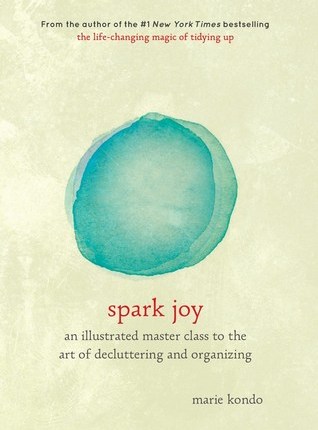
Spark Joy: an illustrated master class on the art of organizing and tidying up by Marie Kondo

Spark Joy: an illustrated master class on the art of organizing and tidying up by Marie Kondo

Spark Joy is author Marie Kondō’s follow up to her internationally best-selling title, The Life-Changing Magic of Tidying Up: The Japanese Art of Decluttering and Organizing.

Kondo’s not for everyone — some of her ideas are very different like treating your possessions as if they have spirits of their own and sorting items by smell — but I like her.

I think it’s because she is obviously very passionate about what she teaches. Her excitement seems to seek from the pages of her book.

This companion novel is an excellent book by itself, but, in my opinion, you won’t be able to fully appreciate it unless you’ve read Kondō’s first title. She doesn’t as completely explain her tidying methods in this book as she took the time to in the last. But there was still so much to enjoy here.

She encourages individuals to embrace what they love, even if society doesn’t love it too, like in this section called Save Your Cosplay for Indoors“…a surprisingly high percentage of my clients have costume-like clothes. To name just a few, I have encountered a Chinese dress, a maid’s outfit, and a belly-dancing costume. … If it brings you joy, but you can’t see yourself wearing it outside, there’s no reason you shouldn’t wear it inside.” pg 25-26

Kondo has a pretty philosophy of living: “I’m convinced that things that have been loved and cherished acquire elegance and character. When we surround ourselves only with things that spark joy and shower them with love, we can transform our home into a space filled with precious artifacts, our very own art museum.” pg 47

One of my favorite parts of both books is Kondo’s theory about socks. It makes me smile: “The socks you wear at home are particularly important because they are the contact point between you and your house, so choose ones that will make the time you spend there even more enjoyable. Balling your socks and stockings, or tying them into knots, is cruel. Please put an end to this practice today.” pg 98 🙂

As much as I enjoy Kondo’s quirkiness, I don’t embrace all of her theories.

For example, I’m still trying to talk myself out of the mountains of books that I have around the house. I have this dream that one day, I’ll have an enormous library with shelves so high that I’ll need a ladder with rollers to climb up and reach the books at the top.

Here’s what Kondo has to say about tidying up the books: “When you’re left with only those books that you love, you’ll discover that the quality of information you receive changes noticeably. The room you make by discarding books seems to create space for an equivalent volume of new information. You’ll soon see that the information you need comes just when you need it, and when it does, you’ll find that you respond to it immediately in a new pattern of behavior that wasn’t possible when you were hoarding books and neglecting the information they contained.”pg 126

Sigh.

Here’s a helpful tip for sorting piles of stuffed animals: “Energy resides in the eyes, which is why it’s best to cover them when discarding something. Once their eyes are hidden, stuffed toys and dolls look much more like objects, and that makes it far easier to part with them. The simplest solution is to place a cloth or piece of paper over their faces.” pg 164-165

Consider some of the most used items in your life for the royal treatment: “…my criterion for deciding which items require royal treatment… is this: the item’s proximity to your body. Items such as forks or undergarments, which come in direct contact with delicate parts of our bodies, should be treated as a rank above the rest whenever possible.” pg 183

Good to know.

And finally: “Tidying is a special event. If you give storage your best effort, experimenting with different ideas and enjoying the whole process, you’ll find that it goes very smoothly. Treat it like a game. Each idea you try will bring immediate results, and you can readjust anytime you like.” pg 206

If only I had that sort of passion for tidying…

Marie Kondo is inspiring but I don’t know if I will ever achieve the emotional highs that she seems to find from it. The best part of this book is: she makes me willing to try.

Other tidying (or anti-tidying) books I’ve reviewed can be read here:

Remodelista: The Organized Home by Julie Carlson

The Joy of Leaving Your Sh*t All Over the Place by Jennifer McCartney

Thanks for reading!