Purple Cow: Transform Your Business by Being Remarkable by Seth Godin

Purple Cow: Transform Your Business by Being Remarkable by Seth Godin

The world has changed. There are far more choices, but there is less and less time to sort them out.” pg 13

Seth Godin, prolific author of business blogs and books, shares his insights about why a product must be remarkable to cut through the noise and get an audience’s attention. He opines that this remarkable “Purple Cow” quality is the only way a business can succeed in the modern world, as the old methods of mass marketing through expensive television ads is going the way of the dodo.

Photo by Jan Koetsier on Pexels.com

“Something remarkable is worth talking about. Worth noticing. Exceptional. New. Interesting. It’s a Purple Cow. Boring stuff is invisible. It’s a brown cow.” pg 3

The trouble with this remarkable stuff is that there is no clear method to create it. It is a “I’ll-know-it-when-I-see-it” type situation. For businesses looking to up their Purple Cow-factor, there are very few directions in this book, other than, it’s important to be a purple cow. I could see that unclear quality being frustrating for some readers.

“The old rule was this: Create safe, ordinary products and combine them with great marketing. The new rule is: Create remarkable products that the right people seek out.” pg 21

The “right people” being the influencers or the early adoptors of whatever type of product it is that you’re selling. Marketing to the niche, rather than mass marketing to the crowd, is, according to Godin, the best strategy for the new world of marketing.

Photo by Mike Chai on Pexels.com

Take Goodreads, for example. Publishers want to get their advance reader copies into the hands of those who talk to their friends about what they’re reading and are passionate about books, the readers who exhibit “otaku”. Godin defines “otaku”: “Otaku describes something that’s more than a hobby but a little less than an obsession.” pg 94

The obsessed, passionate readers talk about what they’re reading to the extent that they start an “ideavirus”, which Godin talks about in another book. In this way, Godin says, you build momentum for whatever remarkable product you’re selling. They can’t help but talk about it because of its fascinating qualities. As this movement builds, the books end up on readers’ favorite shelves, eventually becomes a Reader’s Choice pick, and then the book sells itself.

The products that aim for the largest audience are bland and have had their remarkable edges filed off. And, that’s bad, according to Godin.

“The system is pretty simple: Go for the edges. Challenge yourself and your team to describe what those edges are (not that you’d actually go there), and then test which edge is most likely to deliver the marketing and financial results you seek.” pg 101

Photo by Christina Morillo on Pexels.com

There are definitely dated portions of this book and, as I said, it is nebulous. To get meaning out of it, readers need to distill the underlying ideas and apply them to your unique business. But, I still learned things.

The reason I read Godin is he encourages readers to think differently. He gets my creative circuits firing. I like that.

Recommended for readers who may need a creative jump-start for whatever remarkable product they’re creating. This book isn’t a road map, but it could be a compass.

Thanks for reading!

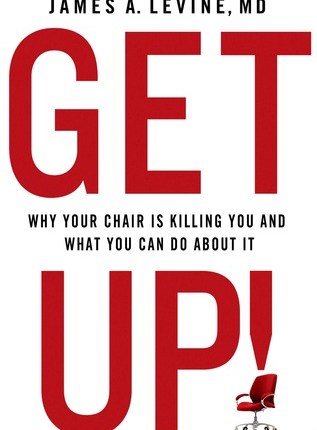
Get Up!: The Dire Health Consequences of Sitting and What We Can Do About It by James A. Levine

Get Up!: The Dire Health Consequences of Sitting and What We Can Do About It by James A. Levine

James Levine shares the disastrous consequences of a sedentary lifestyle and has created a clarion call for the modern world.

“When you first contemplate a book about the harm of sitting, you may view it as absurd. How can chairs possibly kill anyone? … However, this book summarizes 40 years of science — the work of scores of scientists and physicians from around the world. The scientific conclusion is clear: Humans are not designed to sit all day long, from a physiological, medical, creative or psychological perspective.” pg 4

Photo by Andrew Neel on Pexels.com

This book scared me. Levine provides study after study proving his hypothesis and the results are shocking.

“From birth through death there is a predictable, programmed timetable of movement. We transition from the frenetic nature of childhood, to the organized movement of adulthood, through the stillness of aging.” pg 13

But don’t worry. The body and mind are more flexible than people realize.

“Because the brain is constantly adapting, it takes about three weeks for brain change to occur. A chairaholic can become a walker in three weeks. But watch out! A walker who begins to sit can just as easily become a chairaholic.” pg 46

Photo by Daniel Reche on Pexels.com

There are concrete steps you can take to incorporate more movement into your life. The first step is to realize there’s a problem.

Next, look for ways to increase your “NEAT” energy. NEAT stands for “non exercise activity thermogenesis”. Basically, it means, make an effort to move more during your every day routine — cleaning the house, running after the kids, walking the dog, etc.

That seems to be a key for kicking the sitting problem to the curb. In Levine’s studies of urban life compared to agriculture living, that was the difference he noted between the two populations. People living the agriculture lifestyle move all the time. The urban lifestyle… not so much.

“The differences were so large that it staggered us — when you live in an urban setting, even if you are lean, you move half as much as people living in agricultural regions. The decline in calorie burn with urbanization could entirely explain the obesity epidemic worldwide.” pg 60

Photo by Maria Orlova on Pexels.com

Fear not, urban dwellers. There are solutions to upping your NEAT energy, even if you are required to be at a desk for the majority of the day. One of these, that I invested in the moment I finished reading this book, is the desk treadmill. Another option is the standing desk.

Both of these tools help you move while still getting your job done.

This book contains more helpful suggestions than simply buying new lifestyle equipment. For example, Levine also suggests a leisurely walk after every meal.

“If people sit after a meal, their blood sugar peaks like a mountain for about two hours. If, however, people take a 15-minute walk at 1 mph after a meal, the mountains become safe, gentle, rolling hills. With a 1-mph walk after a meal, blood sugar peaks are halved.” pg 68

Photo by Daria Shevtsova on Pexels.com

I think I can manage that.

The line that firmly established Levine’s hypothesis in my mind is: “If you see a saber-toothed tiger charging toward you, you don’t fire off an email, you get up and run!” pg 81

It’s that simple. Humans did not evolve to live the way that we’re living. I’m taking steps to change that now. Who’s with me?

Thanks for reading!

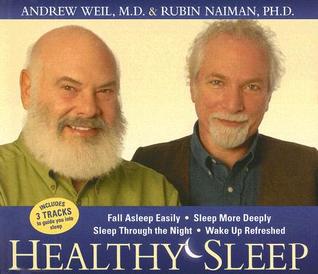
Healthy Sleep by Andrew Weil, Rubin R. Naiman

Healthy Sleep by Andrew Weil, Rubin R. Naiman

Doctors Andrew Weil and Rubin Naiman have created an audiobook to help cure the various troubles one may have while falling to sleep.

I liked their multimodality approach to a problem that everybody seems to have. They start with an exercise to help you figure out what type of sleep problem you may be facing. They discuss the differences between “rest” and “sleep”, which I had never considered. They also talk about how to structure your bedroom to give yourself the best opportunity for sleep.

Photo by Ketut Subiyanto on Pexels.com

Dr. Weil gives some natural suggestions for sleep like maintaining a consistent diet and exercise routine, going to sleep the same time every night, realigning your body with the natural rhythms of the outdoors, and more. He also discusses holistic remedies and the doses he recommends to his patients with potential side effects.

There are also multiple meditations to assist with relaxation and then sleep. As Dr. Naiman points out in the program, one does not truly “go to” sleep as it’s not a location or something you can “catch”. Sleep is more about stepping back and allowing your body to naturally do its thing.

The doctors also go into the importance of dreaming for the health of the psyche. If you’re not sleeping, there’s some underlying issues that your consciousness may not have time to deal with during the waking day. Managing your sleep is more than a benefit for your health, it is also vitally important for your mental health too.

Photo by Vecislavas Popa on Pexels.com

In addition to sleep for individuals, they talk about sleeping with a partner and the special challenges that can bring. I could see this being particularly helpful for sleep-challenged couples and is another aspect of the sleep environment that I hadn’t necessarily considered before.

Highly recommended for people who are looking to increase or improve the quality or quantity of their zzz’s.

Thanks for reading!

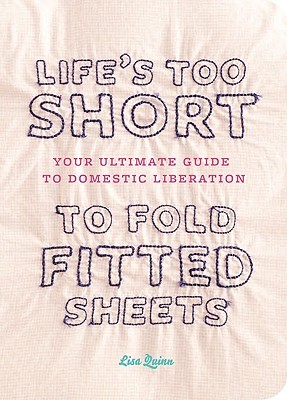
Life’s Too Short to Fold Fitted Sheets by Lisa Quinn

Life’s Too Short to Fold Fitted Sheets by Lisa Quinn

“Hello, my name is Lisa Quinn, and I am a recovering Martha Stewart junkie.” pg 7, ebook

Do you have a job, children, spouse, house, or none of those things and just want everything to look perfect all the time? Want to be the consummate host or hostess without working and stressing throughout the event? Are you wondering how they get it to look so perfect in the magazines?

Lisa Quinn, the author of this book, confesses to wanting it all. But she came to the realization that it is an impossible goal and she was losing her mind in the chase. This humorous self-help book is about embracing reality and understanding that it’s ok, really, to not be perfect.

Photo by cottonbro on Pexels.com

“It’s my assertion that the real key to happiness is getting rid of your inner control freak, redefining what’s real and important in your life, and then lowering your standards for everything else.”

I think that’s solid advice. I, like many, used to demand more of myself than I could give in my housework, from my family, from everybody really. It made me a little bit crazy for a time. But then, I realized, it wasn’t worth it. The effort, the cost — both in time and emotions — and everything else, led to these moments that were forgettable once they were done.

I realized I would much rather dwell in the imperfect moment than forever be chasing the unattainable gem of a perfect moment. Because it never really comes, does it.

This book embraces the idea that no one is perfect. And it’s a lot kinder to realize that your life doesn’t have to look perfect to be incredibly enjoyable.

Photo by medium photoclub on Pexels.com

Quinn gives easy-to-follow tips on how to decorate, host parties, clean, cook and more. My favorite tip being to spray a good smelling cleaner near the door of your home before an event. You may not have hit every surface in the house but it will smell like you have. Genius really.

“House Keeping Myths Debunked… Myth #1: You must fold your fitted sheets. The real definition of insanity is folding a fitted sheet the same way over and over again and expecting it to result in anything other than a migraine and a huge turban. Quit stressing about it. Just wad it up the best you can, and shove it in the closet.pg 39, ebook

She keeps it real with the mega-popular topic of decluttering, pointing out that the easiest way to control the mess is to think about everything you bring into your home.

“Resist the temptation to buy little knickknacks, pillows, throws, and paintings just because you like them. That is not reason enough. Each item you bring into your home should be special. It should have a purpose and a specific place in your home.” pg 64, ebook

Photo by Rachel Claire on Pexels.com

I also enjoyed her variations of recipes that can be done with a deli-cooked chicken. Talk about easy…

“Listen, if I’m able to convince just one other mom out there to take herself a little less seriously a little more often, then I’ve succeeded at what I set out to do.” pg 108, ebook

This book isn’t just for moms. It’s for everyone who needs to cut themselves some slack and just shove those dumb sheets in the closet. I won’t tell.

Thanks for reading!

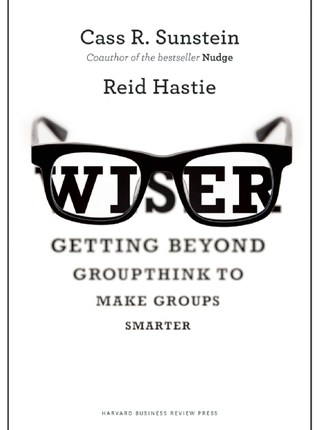
Wiser: Getting Beyond Groupthink to Make Groups Smarter by Cass R. Sunstein

Wiser: Getting Beyond Groupthink to Make Groups Smarter by Cass R. Sunstein

Authors Cass Sunstein and Reid Hastie examine many of the problems that beset groups and how to best address them for optimal group performance.

Written in a style that is more academic than approachable, Wiser uses the findings of multiple researchers to come to its conclusions. This book may be useful to managers who are desiring to set up a group at their own place of employment and want to start on the best foot.

“Do groups usually correct individual mistakes? Our simple answer is that they do not. … We also ask a second question: Can groups correct individual mistakes? Our simple answer is that they can. We aim to explain how.” pg 2

Photo by Canva Studio on Pexels.com

I picked this book up because, frankly, I wanted to know why anybody would utilize groups in a work setting. Every one that I have ever sat on has been either a disaster or inefficient. I was hoping Wiser would help me see the appeal that group-thinking seems to have for some.

And it did. But it also opened up my eyes to the myriad reasons why my experiences had been so bad. I had just assumed groups didn’t work. As it turns out, things are more complicated than that.

“The basic lesson is that people pay a lot of attention to what other group members say and do — and that they do not end up converging on the truth. In fact, they often ignore their own beliefs and say that they believe what other people believe.” pg 28

There can also be problems with authority figures in a group setting: “If the group contains one or more people who are known to be authorities or who otherwise command a lot of respect, then other group members are likely to silence themselves out of deference to the perceived or real authority.” pg 35.

I’ve seen that happen multiple times. The whole purpose of the group is thrown off. It has often frustrated me, leading me to think we may as well have saved our meeting time and had the boss issue a directive.

Photo by Andrea Piacquadio on Pexels.com

Groups also have to keep in mind the idea of “cascades” or ideas taking a hold early in the process and then taking over the rest of the group’s time: “For their part, many groups end up with a feeling of inevitability, thinking that they were bound to converge on what ultimately became their shared view. Beware of that feeling too, because it is often an illusion. The group’s conclusion might well be an accident of who spoke first…” pg 60

Groups can polarize themselves, driving their members to extremes they wouldn’t otherwise reach without members that think like them. To combat this, leaders should make sure groups are diverse.

In a perfect world, groups are equivalent to their best members, aggregate all of the information each individual brings to the table, utilizes experts properly and creates an almost mystical “synergy” where, as the authors say, “the whole is more than the sum of its parts.”

Photo by fauxels on Pexels.com

The trick is getting the group to work like that. As I said, I’ve never seen it. This book brings me hope that perhaps one day I will.

The failures of groups often have disastrous consequences — not just for group members, but for all those who are affected by those failures. The good news is that decades of empirical work, alongside recent innovations, offer a toolbox of practical safeguards, correctives, and enhancements. With a few identifiable steps, groups can get a lot wiser.” pg 214

Thanks for reading!

Spark: How to Lead Yourself and Others to Greater Success by Angie Morgan, Courtney Lynch, Sean Lynch

Spark: How to Lead Yourself and Others to Greater Success by Angie Morgan, Courtney Lynch, Sean Lynch

Spark is a manual to help an individual or a business develop leadership skills. The important attributes are outlined in each chapter with highlighted stories provided by the authors’ own life experiences. The salient points of the different topics are simply and clearly listed at the end of each chapter as well as further resources.

“Our society values leadership — craves it, for that matter. Yet we don’t teach it in formal education.” pg 9, ebook.

Photo by Sora Shimazaki on Pexels.com

The title itself “Spark” refers to those who know they carry the seeds of greatness within themselves and are willing to learn how to make those seeds bloom. As the authors are quick to point out, there are a lot of misconceptions about leadership.

One of them is that people are born leaders and only certain people can lead. They say, and I believe this too, that anyone can become anything they set their minds too. This book helps provide the necessary skills to make that process simpler.

“No one else can make or anoint you a leader. The only way to become a Spark is to make yourself into one.” pg 24, ebook

I thought it was an interesting that these skills are taught to our military personnel but are not stressed as much in the private sector. The main reason the authors started their leadership business was because they noticed leadership was required in business but no one was teaching it. I suppose that’s true, but I’d never considered it before because I had assumed that leaders were born that way.

“… invest the time in seeking to uncover your values, and you’ll be led to discover any misalignment between your expectations of yourself and your actions. The next step is having an honest conversation with yourself so that you not only understand where, when, and why you’ve compromised your values in the past but also recognize the changes you need to make to lead more consistently with your intentions.” pg 42, ebook

Photo by Cade Prior on Pexels.com

I think some of the suggestions in Spark might discomfort those who haven’t taken the time to look and evaluate their own character. Or accept responsibility for reoccurring issues in their experience.

“Overwhelmingly, we all seem to agree that we live in a pass-the-buck culture. Pointing to others as the reason for a problem is a typical response.” pg 69, ebook.

And, taking responsibility for a problem gives you the power to change it. Because, at the end of the day, you can’t control somebody else’s actions — despite how much we may want to.

The chapters I, personally, liked the most were about how to “build your confidence” and “demonstrate consistency”. The information in that section felt the most relatable because it deals with the humanity of leaders. We all fail sometimes or experience self doubt. What matters is how you handle that and continue onwards.

Photo by Ono Kosuki on Pexels.com

Which brings me to my last thought about this book, as I mentioned earlier, the authors insist leaders make themselves. If you want to learn these skills, you can. If you want to make change in your organization, you can. What you can’t do is force other people to become leaders if they don’t want to be.

I think the power in becoming a leader or a “spark” is the example you hold up to others who have the same aspirations. As for the rest, I suppose they can provide the background against which your brilliance shines.

Thanks for reading!

Virtually Human: The Promise and the Peril of Digital Immortality by Martine Rothblatt

Virtually Human: The Promise and the Peril of Digital Immortality by Martine Rothblatt

Dr. Martine Rothblatt, an expert in medical ethics, takes the time to imagine a future in which artificial intelligence is real and the potential problems that could arise from such interactions.

Photo by Alex Knight on Pexels.com

Unfortunately, I found Virtually Human to be virtually unreadable.

The introduction sounded promising enough — a description of the robot that Dr. Rothblatt created and its capabilities — but then Dr. Rothblatt launches into an abstract conversation about what is consciousness. She applies her definition to hypothetical artificial intelligences, which haven’t been created yet, and proceeds into a dizzying array of potential scenarios involving mindclones and “bemans”.

She talks about potential marriages between people and machines, various types of AI — some dysfunctional, some not — voting rights, reproduction rights, and more. It all reads like a discussion of very dry, very abstract human rights law mixed with a smidgen of science fiction, but not enough to be engaging.

Photo by Pixabay on Pexels.com

Dr. Rothblatt certainly knows her stuff, but is seemingly unable to impart her knowledge in an approachable manner. Perhaps, I should say, this is a book that would probably be enjoyed by scholars interested the subject.

I suppose this might be more interesting when such technology actually exists, but in the meantime, it seems rather pointless to be asking ourselves if mindclones should have the right to vote or not. I’m not convinced that by asking ourselves unanswerable questions we’ll be better prepared for when/if this sort of thing actually occurs. Maybe we’ll just have to take life as it comes.

I received a free copy of this book through Goodreads First Reads.

Thanks for reading!

The Dale Carnegie Leadership Mastery Course: How To Challenge Yourself and Others To Greatness by Dale Carnegie

The Dale Carnegie Leadership Mastery Course: How To Challenge Yourself and Others To Greatness by Dale Carnegie

The version I listened to of The Dale Carnegie Leadership Mastery Course, published in 2001, has not necessarily aged well, but still had some applicable lessons for business leaders.

On the positive side, this audio program encouraged me to examine my own leadership style, something I’d never considered before. Are you a innovative or organizational leader? Do you bring people together or drive them apart, intentionally or unintentionally? What is your risk tolerance and why?

Photo by RODNAE Productions on Pexels.com

In addition to introspection, this program asks you to plan for the future based on your strengths and take steps towards those dreams. What are your goals, personally, professionally and for your current company? What would you like to see happen to your company after you die?

It also examines a leader’s entire life with the idea of success isn’t success if you lose your family and important relationships while building your career or vice versa. Are you capable of taking time off? Do you devote time to those who are most important to you at home and at work?

Those are just a few of the positive aspects of this program. On the other end of the spectrum, the music between sections is hilariously dated, almost like motivational elevator music. And there seemed to be what amounted to hero-worship of Dale Carnegie slipped in between the lessons or at the end of sections.

For example, in the lesson on handling disasters and poor decisions as a leader, the program was discussing a CEO’s almost universally hated idea of putting a thermometer on soda dispensers and having the price of a drink go up as the temperatures rose. The narrator closed the section with a statement like: “If Dale Carnegie had been at that meeting, he would have suggested the price of a drink go down as the temperatures went up.” (Cue motivational elevator music.)

Photo by Karolina Grabowska on Pexels.com

I don’t want to dismiss Carnegie’s extensive contributions to the realm of business and leadership skills, but he was human too. To assume he would have been able to turn around some spectacularly bad corporate decisions with just his mere presence struck me as a bit ridiculous.

In that same vein, some of the fable-like stories put into the lessons for emphasis felt heavy-handed, particularly one where a father expected too much of his son. It was a lesson about empathy but it was over the top.

As I said, I did learn some valuable skills from this audiobook and continue to ponder some of the lessons it presented. At the same time, I did have a few giggles at material that, I don’t believe, was ever intended to be satirical. Recommended for those interested in building their leadership acumen, but prepare yourself for a few misses in the presentation.

If you’re interested in non-fiction, business and self improvement books, here are a few I’ve recently reviewed:

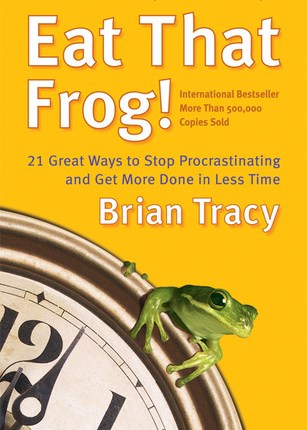
Eat That Frog!: 21 Great Ways to Stop Procrastinating and Get More Done in Less Time by Brian Tracy

The Lost Prosperity Secrets of Napoleon Hill by Napoleon Hill

The Art of Exceptional Living by Jim Rohn

Thanks for reading!

Eat That Frog!: 21 Great Ways to Stop Procrastinating and Get More Done in Less Time by Brian Tracy

Eat That Frog!: 21 Great Ways to Stop Procrastinating and Get More Done in Less Time by Brian Tracy

Brian Tracy gives simple and easily acted-upon suggestions for stream lining and maximizing your productivity. The title itself, Eat That Frog!, refers to completing the biggest, ugliest task you may have on your plate on any given day. If you do whatever that is first (the frog), in the morning when you’re at your most energetic and before anything else distracts you, then at least you can say you got something done today. Most everything else will seem almost easy by comparison… at least, that’s the theory.

Photo by Pixabay on Pexels.com

At first, I thought all of the ideas in this book sounded almost too simple. But as the short audiobook continued, it became more clear just why Tracy is considered one of the leaders in his field of expertise.

Taken altogether, this book gives someone the tools to turn their life around (if they’re in a bad place) or take them to the next level, if they’re already on their way. It’s not just about learning tools to boost your efficiency, it’s also about discovering what you do best and then prioritizing doing THAT to the best of your ability.

The most intriguing idea in here, to me, was “practice creative procrastination”. As we couldn’t possibly get everything done that we ever have to do in one day, by doing the things that MUST get done, you can procrastinate on the things that won’t sink the ship if they’re left undone. You’re doing things, yet not doing things and feeding the inner procrastinator. It’s like having your cake and eating it too.

I’m not a big procrastinator. What I am is a collector of ideas and methods. I’m always open to improving myself or the way that I do things. In fact, I can be too gung-ho when it comes to implementing some of the ideas I read in self-help books. For example, a couple years ago I changed my life through “the magic of tidying up” and was so successful at removing the knick-knacks littering the house that my husband thought I was moving out.

Photo by Susanne Jutzeler on Pexels.com

But seriously, I can take things to the extreme. So, I’m encouraged that this book mainly consists of writing lists, scheduling and prioritizing tasks. That shouldn’t freak out the hubby.

And I do find myself doing other, less important things when a big, fat frog of a chore is staring me in the face. At least now, I’m aware of what I’m doing and knowledge is the first step on the road to change.

Recommended for readers looking for a few simple tips to maximize their productivity.

Thanks for reading!