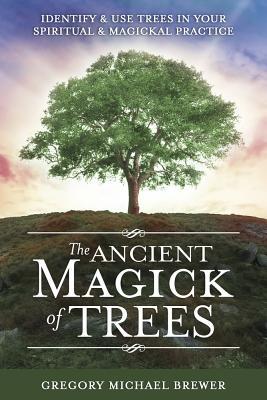
“Since the dawn of humanity, in all cultures and religions across the globe, trees have been revered not only as a life-sustaining source of food and medicine but also as a place where spirits dwelt, awaiting to reveal great mysteries to those who sought their wisdom, knowledge, and magick.” pg 2
Author Gregory Brewer examines the wonder and mystery that are trees from the pagan perspective in this book which is part informational, tree-related ritual/meditation suggestions, and reference.
Understanding the symbolism of trees throughout countless cultures of human history is an enlightening study, but equally important is learning to form a personal connection with them in order to better comprehend the interaction of how the divine reveals itself to us through nature.” pg 243
The majority of the book is dedicated to descriptions and occult associations for different types of trees.
I read The Ancient Magick of Trees in order to learn more ways to invite nature into my life. The book has that but I found Forest Bathing: How Trees Can Help You Find Health and Happiness to be more immediately practical. I also connected more with the information in the forest bathing book.
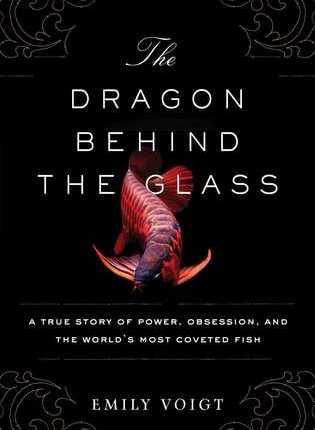
The Dragon Behind the Glass documents journalist Emily Voigt‘s descent down the rabbit hole of fish collecting, money, power, and scientific exploration in some of the most remote locations in the world.
“A pair of whiskers juts from its lower lip, and two gauzy pectoral fins extend from its sides, suggesting a dragon in flight. This resemblance has led to the belief that the fish brings prosperity and good fortune, acting as a protective talisman to ward off evil and harm.”
Though it starts off with a major hook, Voigt takes the reader to a crime scene where a pet store owner appears to have been killed for his shelf of rare fish, the book begins to meander after that and never gets back to the compelling pace of the opening.
That is not to say there aren’t some fascinating history and fish-related trivia tidbits. In fact, the majority of the book consists of that.
“… the keeping of pets reflects our hunger for status symbols, for what the philosopher Jean-Paul Sartre called the ‘carnal, clinging, humble, organic, milky taste of the creature,’ which underlies all luxury goods. The modern pet shop first appeared in American cities in the 1890s; and with it began the mass importation of exotic animals from Asia and South America.” pg 21, ebook.
Voigt explores the history of aquariums, pet-crazes throughout history, and the ascendance of the arowana as the pet fish of choice in the East. Complicating matters, the arowana has become incredibly rare in the wild, partially due to its desirability among collectors, but also because of the destruction of its native habitat.
“The most highly coveted – or at least the traditional favorite – is the legendary Super Red, native to a single remote lake system in the heart of Borneo. … As late as 2008, researchers with Conservation International reported that rural Cambodians were still eating greens, even as wild populations plummeted due to over-harvesting for the aquarium trade.” pg 30, ebook
Like other rare and precious commodities, the interest and money surrounding the arowana has led to some shady dealings. I wasn’t too surprised by the alleged criminal activity Voigt describes among collectors. But I was flabbergasted by the fierce competition among some scientists in the rush to catalog and name the increasingly rare fish.
Perhaps that’s naive of me. Scholars jockey for prestige as much as anyone else. I suppose I’ve never stopped to think about it.
I was also surprised by how many species are out there that science has not studied yet.
“When I first set out to report on the Asian arowana, I figured I would start by finding the researcher studying the species in the wild- only to realize no such person exists. The popular illusion that modern science has the entire living world covered, that there is an expert analyzing every crevice, is far from true.” pg 205, ebook
Recommended for readers who are interested in a detailed study of fish, travel and history. It’s a slow-paced adventure, and not for everyone, but there are some treasures to be found if you stick with it.
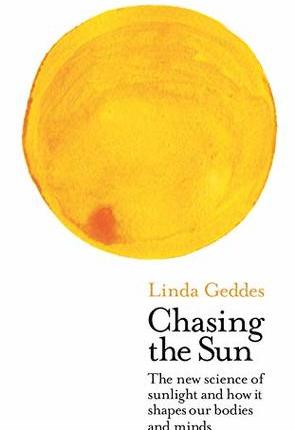
Chasing the Sun reminds readers of the importance of the sunlight in shaping some of the body’s processes, regulating mood, and the surprisingly deleterious effects that not enough sun, or not adhering to the body’s natural rhythms, can have.
I picked up this book because I’ve been having trouble sleeping and thought maybe this would have some helpful tips. It did, but I felt like most of this information I had heard before in some form or another. I suppose it is nice to have a reminder to get ample sunlight during my daily routine. I have experienced bouts of seasonal affective disorder in the past and know first hand how it can affect your mood.
It is rather depressing how far removed modern society has made itself from nature. Linda Geddes points out this gap and how the ancients, and some members of our era, made better use of this natural resource.
I enjoyed the history lessons about the Romans and their solariums. They used “heliotherapy” to treat a variety of illnesses. I also enjoyed the studies about the potential effectiveness of “chronotherapy” for patients suffering from certain mental disorders as well as learning about efforts to increase their sunlight by towns that receive little light during the day. For example, there’s a town in Norway that put mirrors on top of the nearby mountains in order to direct more sunlight their way.
As we know more about the importance of sunlight, I’m certain we’ll see more efforts to incorporate this information into our daily routines. And it affects things we may not even consider from school start times to a good night’s sleep.
Recommended for readers who want to learn more about how the sun affects our lives and some of the newer scientific research about the same.
The Alchemist’s Kitchen is an examination of alchemy — what it is, what symbols it uses and includes a cookbook of various recipes to use and practice the art on your own.
For as confusing a topic as alchemy is for me, Guy Ogilvy has put together the most succinct explanation of it I have ever read. I still don’t completely get it, but for the first time I was able to follow the general idea of it from beginning to end rather becoming completely lost and giving up in the middle.
“The story of alchemy, at least in the West, is, in a nutshell, the story of gold and our relationship with it.” pg 2
Let’s not forget spiritual gold. The search for the Philosopher’s Stone seems to entail something of both the physical and the mystical, a curious mixture of both.
Ogilvy uses each section, which consists of one page, to completely explain a concept and then, on the opposite page, provides alchemical artwork to illustrate the concept. It is clear, concise, and it makes me crazy that I still don’t get most of it.
“There is a way of manipulating matter and energy so as to create what modern science calls a force-field. This force-field acts upon the observer and puts him in a privileged position in relation to the universe. From this privileged position, he has access to realities which are normally concealed from us by time and space, matter and energy. This is what we call the Great Work.” pg 38
Some of this book sounds like nonsense. But then I wonder why so many people have been obsessed with these practices for so long if there’s nothing to them? Oh right, probably because of the creating gold from dross part of it.
I’m still not one hundred percent convinced that alchemy isn’t anything other than a misunderstood metaphor for purely spiritual practices. But I’m still willing to dream and explore and entertain the idea that the magical might be concretely possible.
Recommended for readers who are dreamers, like me.
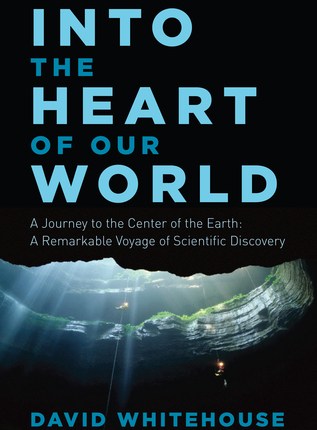
Into the Heart of Our World-A Journey to the Center of the Earth: A Remarkable Voyage of Scientific Discovery is a mind boggling, hypothetical journey into the world beneath our feet. Whitehouse, an astronomer, has bottled the wonder that he feels for the stars and channeled it into exploring the depths below. Though the science in this book went above my head at times, I enjoyed learning about Earth and its secrets. Into the Heart of Our World would make a great documentary.
Here are the parts that I loved the most: Whitehouse was discussing the chemical composition and age of some of the oldest rocks on earth: “If the life of the Earth was represented by a day then mankind appeared just twenty seconds before midnight. These rocks have been waiting since about 1 a.m.” pg 52, advance reading copy
On a discussion of plumes beneath the Earth’s surface: “The big question is: can we see mass extinction events on the way up? Some scientists believe we can by looking for the plumes. Such a thing is seen in the south-west Pacific near the Fiji Tonga subduction zone. It’s 700 km deep, has a structure consistent with a massive temperature anomaly and may be rising. It could render the Earth uninhabitable for humans and it will reach the surface in an estimated 200 million years.(!!!!!?!????!!)” pg 146, advance reading copy, emphasis mine
About the core of the Earth: “”The core…is larger than the planet Mars and far more alien. It has one-sixth of the volume of the Earth yet one-third of its mass, and it is liquid, dense yet not thick. If you donned super-protective gloves you could run your hands through it like water. It is this liquid- molten iron, nickel, and a few other elements- that profoundly affects the nature of our planet and protects us from the harshness of the cosmos. In the mantle we suspect that there may be aspects of the subduction cycle that are important for life on the surface. But in the liquid core we have no such doubts. We are certain that life on our planet could not have survived without it, for out of its liquid motions emerges our great protector- the Earth’s magnetic field.” pg2 158-159, advance reading copy. Who knew?
In a discussion of the magnetic field, some medieval beliefs about magnets:“In the thirteenth century Bartholomew the Englishman (c. 1203-72), author of the book On the Properties of Things, said that ‘This kind of stone restores husbands to wives and increases elegance and charm in speech. Moreover, along with honey, it cures dropsy, spleen, fox mange, and burns… when placed on the head of a chaste woman causes its poison to surround her but if she is an adulteress she will instantly remove herself from bed for fear of an apparition.” pg 167, advance reading copy. Behold the power of magnets.
One last bit of Into the Heart of Our World that was special to me on a personal level: “The oldest working seismograph, over a hundred years old but still fully operational, can be found at the university of Gottingen. It is the work of Emil Wiechert (1861-1928) who was the world’s second professor of geophysics.”pg 80-81, advance reading copy. My husband, a Geiger, is related to the man who created the Geiger counter. I’ve always felt that my family was a bit lacking when it came to scientific contributions. But now, I find out, there’s a geophysicist in the family! In your face, Geigers! :p
If you enjoyed Into the Heart of Our World, you may want to read What If by Randall Munroe or Rust: The Longest War by Jonathon Waldman. A big thank you to Goodreads First Reads program for a free advance reading copy of this book. And, thank you for reading!
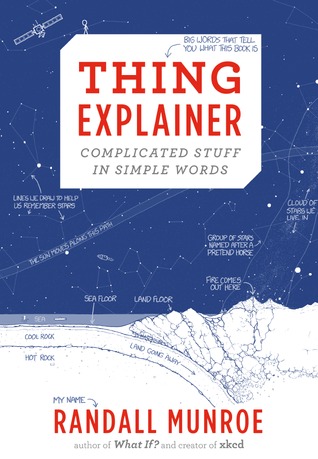
Randall Munroe uses stick figures and simple diagrams to explain abstract and difficult concepts. It’s brilliant really.
Thing Explainer: Complicated Stuff in Simple Words is inspirational for educators who struggle to make complex concepts accessible.
I’ve run into this problem when trying to create fliers to describe, simply and succinctly, the process that you use to check out ebooks from the library. It feels like an impossible task.
Munroe shows in this clever book, that anything is possible to explain simply and with stick figures.
From Lifting Rooms (elevators) to Our Star (the sun), Munroe explains it all with only ten hundred (1000!) of the most commonly used words in the English language.
Every page is a gem, but I particularly loved The Pieces Everything is Made of (The Periodic Table of Elements) pg 47-48 and The US’s Laws of the Land (United States Constitution) pg 14.
Though simple enough for a child to understand, the cartoons contain small puns and inside jokes that adults will enjoy too. So, I recommend this non-fiction book for everybody.










 The Help Desk Book Blog