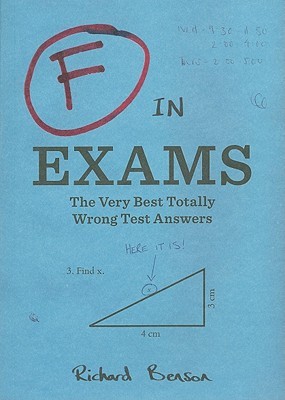
Necessity is the mother of invention. When these students didn’t know the answers, they pulled out all the stops to come up with something- sometimes with hilarious results.
At other times though, I despaired for the future…
I think that F in Exams would be enjoyed the most by current or former educators.
I read some of these aloud to my husband who used to be a college professor and he laughed so hard that he had tears in his eyes. Then, it led to a conversation about not knowing the answers on tests and making stuff up to fill in the blanks.
He admitted that he had done so once in a marketing class and the prof had given him points for his creativity.
Honestly, I don’t think I’ve ever attempted joking my way into a better grade. This book makes me wish that I had, just once.
His favorite: Question: “What was Sir Francis Drake known for? Answer: Sir Francis Drake circumsized the world with a 100 foot clipper.”
My favorite: Question: “Clair was well prepared for her interview. Explain how Claire may have prepared herself for the interview. Answer: Had a bath and put on her lucky pants.” There’s a lot to be said for a pair of lucky pants.
F in Exams would make excellent reading material for a doctor’s office or any other place where you need to spend a few moments relaxing (ahem, powder room?), in which case, you should buy your own copy. Otherwise, I’d recommend borrowing this short little book from your local library as I’m sure that I’m not going to feel the need to pick it up again.
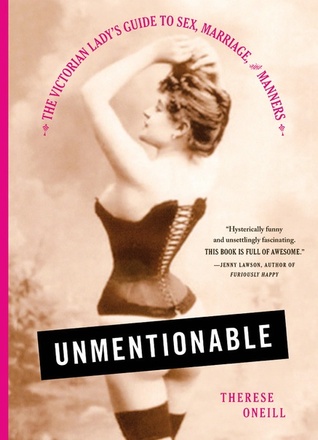
Unmentionable made me truly appreciate how good I have it compared to my female ancestors.
This clever little book examines the gross, disturbing, and, at times, hilarious “unmentionable” facets of a Victorian woman’s life and also, their powerlessness in society when compared to their male counterparts.
The women’s rights portion sounds grim, but Oneill’s writing keeps it light. I learned so much and was entertained too.
For example, I don’t consider modern cities to be very clean, but Oneill explains in her book, that they are shining examples of cleanliness compared to what came before: Some would argue that the nineteenth century was one of the filthiest times in all of Western history, particularly in any urban, developed area. … Ankle deep in filth, I said, but forgive me, I was inaccurate. You will wish the filth terminated at your ankles. Foulness is everywhere. Grime and rot cling to the very air, the buildings, the people; even the soap is made out of lard and poison.” pg 20, ebook.
All that dirt, but bathing was considered bad for your health and even, depending upon your religious upbringing, immoral! I’ve never read a historical fiction that describes the foul stench of the streets or the crowd upon it… now, I know better. Thanks Unmentionable!
Make up and other personal care products used to be either oily goop or filled with poisonous substances that could kill you or permanently wreck your face.
With this in mind, Oneill gives us a new take on the story of Jezebel: “She painted her face, and tired her head [fixed her hair], and looked out at a window.” “Some think this means Jezebel planned to seduce her way out of this problem; others think she was facing death with composure and dignity. At any rate, her eunuchs saw that they were on the wrong team and shoved her out the aforementioned window, and dogs ate her face. Which reinforces the assumption that her face was coated in sinfully delicious animal fat.” pgs 67-68, ebook.
Because women really had no other choice, being the ideal wife and mother was no laughing matter: “Your only job now that you are a nineteenth-century wife is to do everything within your power during every waking moment to make his life so sweet and full that he will literally dread the glory of Christ’s return, if only because it will mean parting from your secret strudel recipe and the unmatched craftsmanship of your trouser hemstitch.” pg 130, ebook.
So, unreasonable expectations of perfection abounded at home.
Women, especially single, unmarried ones, weren’t supposed to go anywhere alone: “Etiquette for Ladies reminds us that no woman has any business being alone in a museum, a library, or any other such den of unwholesomeness. Wherever you are going, your behavior once you arrive should remain every bit as self-aware-but-pretending-not-to-be as when you were in transit.”pg 165, ebook.
The library is a “den of unwholesomeness”… ha!
But the worst of the era, in my opinion, was the medical community’s attitude towards women. At that time, we hadn’t figured out how the female body worked and didn’t connect the idea that people need intellectual stimulation and purpose for a life well lived.
That lead to the lumping of every female complaint under the title, “Hysteria”: “First I would like to tell you what hysteria actually was. Which is incredibly difficult. Because the only honest definition I can give you is “a misdiagnosis.” Epilepsy, diabetic shock, neural disorders, post-traumatic stress disorder, postpartum depression, and bipolar disorders do not necessarily cause similar symptoms, but they were all commonly diagnosed as hysteria.” pg 173, ebook. So, pretty much, everything then.
Oneill reminds the reader that many of the rights, and indoor plumbing, and personal care products that we enjoy today are because of the demands for a better life by women who lived during the Victorian era.
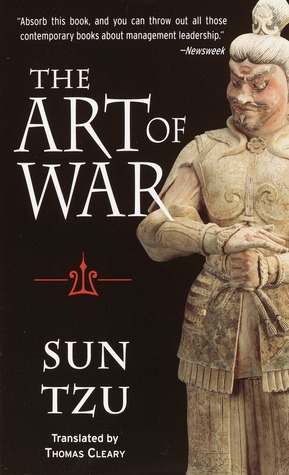
Frankly, I got tired of my husband quoting this and having no idea what he was talking about. So, Heidi-the-Hippie-Librarian picked up The Art of War. I must love him a great deal because this was so not my thing though I valiantly struggled my way through it. I’d say about three quarters of the book was commentary and translation quibbles on the text itself, which is really rather brief and kind of pretty in a “this is how you kill a bunch of people” sort of way.
My big take-aways from this were: 1 Pay attention to where you are and what’s going on around you all the time, especially in war. And also be super sneaky about what you’re going to do. “..concealing courage under a show of timidity presupposes a fund of latent energy; masking strength with weakness is to be effected by tactical dispositions. Thus one who is skillful at keeping the enemy on the move maintains deceitful appearances, according to which the enemy will act.” loc 1143
2 If you have to fight, do it fast because it’s too expensive to do for long.“There is no instance of a country having benefited from prolonged war.” loc 822, ebook.
3 Everybody uses spies and if you don’t, then you’re going to lose because the other guy is for sure using spies.
4 Be flexible and make the call as things happen. Don’t stick to orders from an emperor who’s really far away because he doesn’t know what the heck is going on like you do. “Water shapes its course according to the nature of the ground over which it flows; the soldier works out his victory in relation to the foe whom he is facing. Therefore, just as water retains no constant shape, so in warfare there are no constant conditions.” loc 1296, ebook.
5 Know who you are and who you’re fighting. This knowledge makes you strong so other people can’t determine your future. Use it to win your war.“The art of war teaches us to rely not on the likelihood of the enemy’s not coming, but on our own readiness to receive him; not on the chance of his not attacking, but rather on the fact that we have made our position unassailable.” loc 1542, ebook.
6 Have a vision beyond what is right in front of you and guide yourself toward it, one good decision at a time. “To see victory only when it is within the ken of the common herd is not the acme of excellence. Neither is it the acme of excellence if you fight and conquer and the whole Empire says, “Well done!” To lift an autumn hair is no sign of great strength; to see the sun and moon is no sign of sharp sight; to hear the noise of thunder is no sign of a quick ear. What the ancients called a clever fighter is one who not only wins, but excels in winning with ease.”loc 1011-1030, ebook
7 The place that you fight is very important as well as the officer who is calling the shots and telling you which way to go. If either of these things suck, you’re in trouble. “The natural formation of the country is the soldier’s best ally; but a power of estimating the adversary, of controlling the forces of victory, and of shrewdly calculating difficulties, dangers and distances, constitutes the test of a great general.” loc 1886, ebook.
8 Knowing small details about the enemy is very important. For example, if the dudes you’re going to war against put their pots and pans away, they’re planning on dying in battle. Who knew, right? “When an army feeds its horses with grain and kills its cattle for food, and when the men do not hang their cooking-pots over the campfires, showing that they will not return to their tents, you may know that they are determined to fight to the death.” loc 1752, ebook.
So, that’s The Art of War. Now back to my regularly scheduled reading. 🙂 And, thank you for reading.
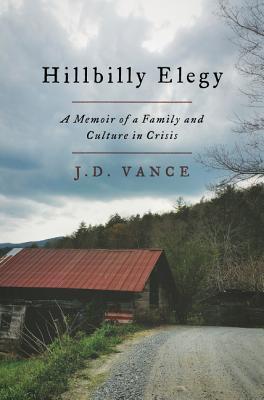
This is an intense memoir of J.D. Vance’s childhood and eventual rise.
It reminded me of Angela’s Ashes except that instead of Ireland, it took place in Kentucky/Ohio and the drug of choice was prescription pills rather than alcohol.
I was astonished that J.D. not only survived, but thrived. He credits his grandparents with saving his life, but a lot of different factors came together at the right time to propel him out of his dead end hometown.
This is that story.
In his own words: “Whatever talents I have, I almost squandered until a handful of loving people rescued me. That is the real story of my life, and that is why I wrote this book. I want people to know what it feels like to nearly give up on yourself and why you might do it.” pg 8, ebook.
My favorite parts of this book were the crazy, hillbilly history of his grandparents. They reminded me a lot of my own grandfather, who was a hell raiser in his time too.
In this passage, J.D.’s grandma (Mamaw) is teaching him how to take a punch to the face: “…when I asked her what it felt like to be punched in the head, she showed me. A swift blow, delivered by the meat of her hand, directly on my cheek. “That didn’t feel so bad, did it?”… This was one of her most important rules of fighting: Unless someone really knows how to hit, a punch in the face is no big deal.” pg 61, ebook.
My grandpa discouraged any kind of physical fighting since I was a girl and this went against his thoughts about what was appropriate for females. But, he told me stories about when he fought as a child, and he said he used bricks instead of his fists because it “evened the odds- those boys were bigger than me and there were more of them”.
At heart though, my grandpa was a peaceful man, unlike Mamaw.
His favorite show in his twilight years was Pawn Stars, Mamaw’s was The Sopranos: “In her old age, with limited mobility, Mamaw loved to watch TV. …her favorite show by far was the HBO mob story, The Sopranos. Looking back, it’s hardly surprising that a show about fiercely loyal, sometimes violent outsiders resonated with Mamaw. Change the names and dates, and the Italian Mafia starts to look a lot like the Hatfield-McCoy dispute back in Appalachia.” pg 116, ebook.
Throughout the family stories related in Hillbilly Elegy, J.D. weaves a fascinating examination of hillbilly culture: “It would be years before I learned that no single book, or expert, or field could fully explain the problems of hillbillies in modern America. Our elegy is a sociological one, yes, but it is also about psychology and community and culture and faith.” pg 124-125, ebook.
J.D. has many epiphanies in this book. Here’s one of my favorites: “… there’s something powerful about realizing that you’ve undersold yourself- that somehow your mind confused lack of effort for inability. This is why, whenever people ask me what I’d most like to change about the white working class, I say, “The feeling that our choices don’t matter.” pg 151, ebook.
And, as much as this book highlights the problems in hillbilly America, it is also a call to action through greater self knowledge and personal responsibility.
J.D. asks some really tough questions: “How much of our lives, good and bad, should we credit to our personal decisions, and how much is just the inheritance of our culture, our families, and our parents who have failed their children? How much is Mom’s life her own fault? Where does blame stop and sympathy begin?” pg 195, ebook. I would say, with ourselves. All great change comes from within, at least, in my experience, I have found this to be true.
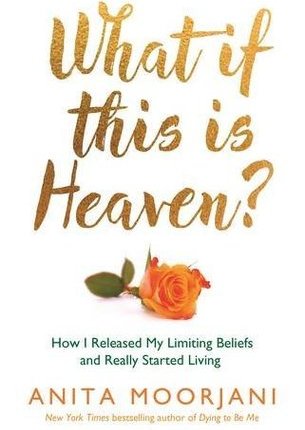
I was so excited to read What If This Is Heaven?: How I Released My Limiting Beliefs and Really Started Living. Moorjani’s first book, Dying to Be Me, was one of the first accounts of near death experience that I read. In it, she details how she was on her death bed, experienced the world beyond, and then came back to fulfill her life’s purpose.
When she came back, the tumors in her body disappeared and she’s been fine ever since.
It’s an astonishing and uplifting reminder of who we are as eternal beings and why we’re all here. What If This is Heaven is a continuation of this message in that, now, Moorjani is a teacher and lecturer on the topics of spirituality, healing, and self actualization. It’s wonderful.
And, it’s different enough from the first book that readers don’t feel like they’re re-reading the same messages. Moorjani has evolved and I’m very interested to see where life takes her from here.
Here are some passages that I loved: “A major reason why I chose to return to this life during my NDE (near death experience) was because I understood that heaven is a state and not a place, and I wanted to experience, firsthand, the heaven that this life could actually be.”
“Remember, your only work is to love yourself, value yourself, and embody this truth of self-worth and self-love so that you can be love in action. That is true service, to yourself and those who surround you.”
“On the physical plane, we see love as an emotion, something we have for some people and not others. But the truth is that unconditional love is a state of being, and it’s our birthright. Once we begin to tap into that, we realize is has the power to transform all of our relationships simultaneously- including our relationship with ourselves- for the better.”
“… illness is our body’s way of communicating with us and showing us a better path. Yes, we may die from cancer- or from countless other things- and each of us will die from something at some point. But death is not the enemy. What often is the enemy is the way we view illness…”
Some fascinating teachings about the positive aspects of the ego are included in here: “The ego gives us our sense of identity, our individuality. It’s what allows us to know who we are as individuals and to express our uniqueness. If our ego weren’t necessary, we wouldn’t have been born with it.”
There’s so much more to enjoy in What if This is Heaven beyond these small bits. I highly recommend this read for spiritual seekers and those who are interested in self actualization. If you enjoyed this book, you may want to read Moorjani’s other book, Dying to Be Me or Co-creating at Its Best: A Conversation Between Master Teachers by Wayne Dyer and Abraham Hicks.
A big thank you to NetGalley and Hay House for the opportunity to review this book! They sent me a free digital ARC for review purposes. And thank you for reading!
Awakening from the Daydream: Reimagining the Buddha’s Wheel of Life is an accessible and modern reworking of the Buddhist Wheel of Life.
I took a course on Buddhism in college (seems like a million years ago now) and I remember being deeply affected by the Wheel of Life then- the original version.
For thousands of years, Buddhist practitioners have been studying the mind, how it perceives the world, and how it creates a perpetual cycle of suffering. The original Wheel captures this in extraordinary detail. David Nichtern’s re-imagining of it is brilliant.
I think that this could be very helpful for many people. It’s similar to artists updating and customizing Tarot decks. Sometimes, new images spark new ways of looking at situations and new solutions arise.
Nichtern is clearly an expert on this topic but he never ventures beyond the basics of the teaching into spaces that beginners can’t grasp. His philosophic writing is understandable and relatable. I appreciated that because not all Buddhists texts are simple reads- Stages of Meditation by the Dalai Lama comes to mind.
“Tradition says that the Buddha directed the creation of the original Wheel painting, which he commissioned as a gift to teach Dharma to an Indian king. When the king who received the painting contemplated it and fully understood its meaning, he attained enlightenment- he brought the suffering caused by unconscious habitual patterns to an end… The image of the Wheel survives not just because it sustains tradition, but because the message it conveys is powerful and timelessly relevant.”
Nichtern reminds us in this book that Buddha gave the painting to a king not a monk. This shows that we can live in the world and also transcend it. These teachings are for everyone.
Nichtern discusses the Buddhas contained in each part of the picture- in the suffering areas and outside of it: “There is also usually a Buddha standing outside of the Wheel, representing transcending the six realms altogether. Such people are said to be free from imprisonment in the six realms- free of karma- and only appear in the six realms in order to teach and liberate the beings within the realms out of compassion. Sometimes we are fortunate enough to meet people who remind us of this kind of possibility.” People, I would say, like Nichtern himself.
How to find opportunity in the midst of suffering: “The abject misery that we experience in the hell realm mindset offers us the opportunity to relate to the suffering of others… This isn’t to say that we simply forgive the harmful behavior of others. Instead, we can use our own intense experiences of hatred or depression to realize a deeper truth about all of us living beings in general: none of us are immune from this.” None of us.
Nichtern offers meditation practices for beginners or more experienced folks. Here is a snippet of his advice: “…it is good to help manage people’s expectations. Meditation can include boredom, irritation, discomfort, frustration, grasping, aggression, a discursive waterfall of thoughts and emotions coming and going, and perhaps occasionally a sense of peace and acceptance of things as they are. In a nutshell, it can and will include all the aspects of who we are and of what our lives are actually made.” He also offers concrete suggestions on how to find instructors.
I recommend Awakening from the Daydream for anyone interested in Buddhism, at all levels of knowledge, but this would probably be most helpful for beginners to intermediate practitioners.
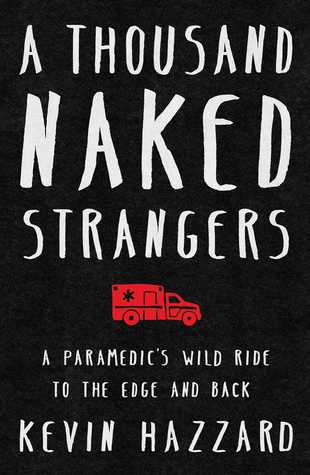
This is Kevin Hazzard’s memoir- he was a journalist, until 9-11, and then, he decided that he needed to work a job that gave more back to society. So, he decided to become an EMT and, eventually, a paramedic. This is the sometimes insane, sometimes touching, and, many times, yucky record of his ten years in that profession.
It is shocking, but I learned a lot about the physical and emotional toll the job takes on these professionals.
Frankly, I’m surprised that anyone is able to do this job. I know that I couldn’t.
A Thousand Naked Strangers invites the reader to examine their own mortality or, if not examine it, just remember it like a literary memento mori.
I, like most other people, want to pretend that I’m going to live forever when I know I’m not. A Thousand Naked Strangersdoesn’t allow room for that.
Hazzard’s stories can be ridiculous, gruesome, or uplifting. This book has a little bit of everything.
Why Kevin decides to become an EMT: (his first day of class) “…Alan (the instructor) tells us, right out of the gate, if we’re not sure we can handle this, now is the time to leave. A couple of people laugh as though the mere suggestion is ridiculous, but I’m not one of them. I didn’t grow up wanting to be an EMT, nor do I know if I’ll like it. What I do know is I want to get hip-deep in things that matter.” pg 19 ebook.
He certainly manages to do that.
Learning the ropes: “It’s all so new, so foreign, so much like that period of childhood- first or second grade, maybe- when you’re old enough to know you’re alive and one day will die, yet young enough to still believe that a thin vein of magic runs just beneath the surface.” pgs 26-27 ebook.
I still feel like that, most of the time.
Why Kevin stays: “Every word the radio breathes into the stale air of the station sets me on fire. EMS is the greatest show I’ve ever seen, except it’s not a show, it’s all real. No, it’s more than that- it’s reality distilled and boiled down to its essence.” pg 59 ebook
At times, I had trouble connecting with this memoir. He almost felt too excited to be out there… inviting disaster because he was going to be the one to pick up the pieces. I’ve never felt like that.
Why it’s so hard to read A Thousand Naked Strangers: “In a job where it’s possible to scoop up a stranger’s brain, it’s important to have levity. But after a while, I lose the ability to judge which stories to tell my friends and which go beyond the limits of good taste.” pg 90 ebook. That’s it- in a nutshell.
Finally, how Kevin’s job is sort of like everyone else’s: “Like a recurring dream, every working day holds the same frustrations, and the working days never change, they just stretch out for all eternity. For months I’ve wondered how it will end. Maybe I’ll reach my limit and quit.” pg 206 ebook
I think, anyone who works a job for any amount of time, feels like this at some point or another. Kevin’s job was simply more intense and invited that type of introspection more quickly.
My book club picked this memoir as its monthly read. I’m not certain I would have ever chosen to read it otherwise. But, I’m glad I did.









 The Help Desk Book Blog