The Art of Exceptional Living by Jim Rohn

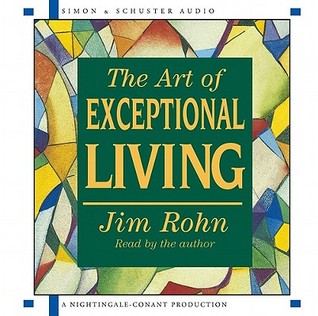
The Art of Exceptional Living by Jim Rohn

Nearly every house valued over $200,000 has a library in it. Now why do you think that is?

Jim Rohn, motivational speaker and business genius, was a kinder, gentler Tony Robbins. Originally from Iowa, he uses common sense and a storytelling style in an effort to encourage listeners to improve their lives. This audiobook presentation is a mix of live presentations and studio-recorded bits. Personally, I think he was better in front of a live audience, but there was plenty to take away from in both sections.
Photo by Ihsan Aditya on Pexels.com

Here’s some of what he shares in this audiobook:

Read, learn, journal. Write down what works and what doesn’t. Write down your goals and then take a minute to look at the passing days, weeks and months and see what you’ve accomplished.

Eat healthy and take that walk around the block. If you don’t, you may seriously regret it, maybe not today or tomorrow but in the years to come, you’ll wish you took a minute to invest in yourself.

Work hard at your job and you’ll make a living. Work hard on yourself and you’ll make a fortune!

Photo by Taryn Elliott on Pexels.com

Rohn insists that anyone can be exceptional. He says success in business (and life) comes from small positive steps taken consistently over time. That type of approach really works for most any goal or dream you may have.

Read contracts all the way through, every time. It seems like a simple thing, but it can take you down some dark roads if you don’t read the fine print. He learned that the hard way.

Don’t stop reading and be a lifetime learner. Stay curious. Stay involved.

And take pictures. Part of your legacy to the next generation can be the pictures and documentation you’ve made of your life.

Photo by Kaique Rocha on Pexels.com

I can’t tell you how many times I’ve listened to this audiobook. It’s one of my go-to programs when life has me down. Jim Rohn believed you can accomplish anything that you set your mind to do. He makes listeners believe that too. Highly recommended for anyone who wants to learn “the art of exceptional living.”

Thanks for reading!

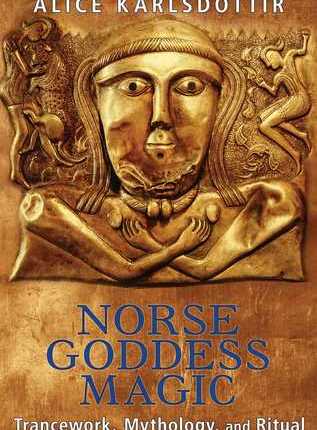
Norse Goddess Magic: Trancework, Mythology, and Ritual by Alice Karlsdóttir

Norse Goddess Magic: Trancework, Mythology, and Ritual by Alice Karlsdóttir

This is a new age, non-fiction book about trance work, which can loosely be described as deep meditation. I practice a type of meditation called “pathwalking” which is basically just another word for the same kind of practice. This book is about someone who focuses on the Norse religion exclusively.

I read Norse Goddess Magic not for the details about the Norse pantheon (which admittedly I know very little about, so it was very interesting and educational) but mainly for the author’s experience in trance work. To my disappointment, she spends pages and pages explaining what going into trance is, how she does it, and then only a few paragraphs in each chapter detailing an actual trance.

Photo by Lucian Potlog on Pexels.com

I wanted the book to be mainly trance work. That is what made it unique and original- her personal sojourns into “another world” and what she brought back. The rehashing of all of the old mythologies were, as I said, interesting, but if I wanted to read them, I could have picked up any book about Norse mythology.

I also felt like Alice spent a lot of time explaining why trance work is a valid method of information gathering and defending her opinion on why she believes that. I agreed with her completely so I just read through the pages thinking- preaching to choir, get to the trances! So, that was a frustration.

A part of the book that I disagreed with was Alice’s assertion that it is “difficult” to go into trance. In my experience, if you believe something is difficult to do be that hypnosis, meditation, whatever- you’re putting stumbling blocks on your path that don’t need to be there. Going into trance is as simple as watching your breath flow in and out. If you breathe, you can go into trance. I felt like she did a disservice to beginners with that particular teaching.

Photo by Daisa TJ on Pexels.com

I felt like Alice’s trances were so closely focused on one goddess or aspect of the goddess, that she didn’t really get all that she could out of her trance work or interactions in the other worlds. She read all of this information to prime her subconscious mind and then… it felt like not much happened.

To be fair, she did see the person she was looking for, describe their physical characteristics, express the emotion that they evoked in her, and then, maybe, have a brief interlude with them. In my personal trance work, there’s more interaction in the world itself but that could be the difference of our focus.

Alice said from the start that she wanted to know more about these different goddesses and form a working relationship with them whereas I’m just curious to see what’s out there. I’ve run into Roman gods and goddesses, Native American figures, Tibetian locations, some Egyptian and Hindu gods… but again, I’m not focused on one or another of the world religions. With an open mind, it’s incredible the types of things that you see.

Photo by carol wd on Pexels.com

So, I don’t believe in priming your mind with symbols before you do your work. Pick where you’re going or who you want to see, and just go. Personally, I use the symbols on the Tree of Life or tarot cards. Believe that you can do it. Figure out what works for you. And do it.

Then write it down so that I can read it. 🙂 Because I will.

Thanks for reading!

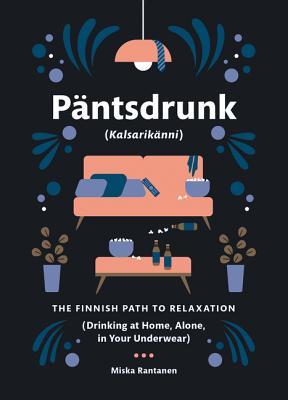
Päntsdrunk (Kalsarikänni): The Finnish Path to Relaxation (Drinking at Home, Alone, in Your Underwear) by Miska Rantanen

Päntsdrunk (Kalsarikänni): The Finnish Path to Relaxation (Drinking at Home, Alone, in Your Underwear) by Miska Rantanen

Päntsdrunk, a satirical self help read, seemed fairly straight-forward to me. To keep your cool, occasionally you should take a page out of the Finnish playbook and put on your most comfy underwear, grab your favorite alcoholic beverage and chill out. But then Miska Rantanen had to write something to fill up the rest of the pages. There was quite a lot of filler material.

Päntsdrunk doesn’t demand over-the-top arrangements. Affordability and democracy are its hallmarks. It’s quick acting and suitable for all who have reached the age of majority.” pg 16

Photo by Mitchell Henderson on Pexels.com

Rantanen talks about how Finland developed this coping mechanism from a couple of different factors: freezing weather, long distances between cities and towns, and very little sunlight near the winter solstice.

“The Finnish term kalsarikanni is a simple compound word: kalsari (underwear) + kanni (state of inebriation). This pithy idiom crystallizes the essential: at its simplest, pantsdrunk means imbibing alcohol in one’s underwear at home without any intention of going out. The term’s ingenuity lies in everything it doesn’t imply.” pg 21

But pantsdrunk practitioners don’t have to stay in or solitary. You can drink as a couple, with friends, with a couple of friends. As the night wears on, you can go from pantsdrunk to plus pants at the club or bar, if the mood lends itself that way. The trick is to go with the flow of the evening and enter a state of total relaxation.

“As a philosophy, pantsdrunk is not in conflict with lagom and hygge. Au contraire. They all spring from the same Nordic origins and share the same ultimate goals: optimal peace of mind, joie de vivre, comfort, equilibrium, and recuperation as embodied in a snug coziness.” pg 22

Pantsdrunk is not about getting blasted as fast as possible. It’s a slow slide into mellow.

Photo by Mitchell Henderson on Pexels.com

“At its most minimal, pantsdrunk is a device for balancing life and work. It can, however, be expanded into a lifestyle and worldview. The beauty of pantsdrunk lies in its possibilities.” pg 27

I’m not sure about some of the statistics Rantanen cites in his book, but he claims Finland is one of the stablest, safest, most educated countries in the world. And he credits the practice of pantsdrunk with part of this fantastic result.

Heidi, you may say, what could your problem be with pantsdrunk? Anyone who has dealt with an alcoholic can easily point out the potential roadblocks to happiness with this. Also, there’s addiction issues to consider. None of which can be dealt with if you’re indulging in this behavior by yourself and aren’t aware there’s a problem.

Rantanen does say that if pantsdrunk becomes a conscious choice every day to deal with stresses, that a reshuffling of your life may be in order. He also suggests counting bottles or cans to keep tabs on how much you’re consuming. Or gauging how well you’ve managed to balance drunk and relaxed by your hangover the next day.

Photo by Chris F on Pexels.com

I’m not entirely convinced this is possible. Rantanen also talks about how pantsdrunk has gotten a bad rap with some films depicting people drinking in their underwear alone as sad and pathetic rather than empowered and relaxed.

One of the most uplifting performances (of pantsdrunk) can be seen during the credits of Bridget Jones Diary (Maguire 2001), when Bridget Jones (Renee Zellweger) belts out the quintessential pajama playback solo while sloshed on red wine. pg 76.

But wasn’t that one of her lowest points?

Recommended for brave readers over 21 who mostly have their lives together, but need to allow themselves to chill out now and then.

For other satirical self-help reads, please see the following reviews:

Get Your Sh*t Together by Sarah Knight

Check out Sarah Knight’s latest self help: You Do You

How to Be Dull by Basil Morley, Esq.

And thanks for reading!

Weird Illinois by Troy Taylor, Mark Sceurman, Mark Moran

Weird Illinois by Troy Taylor, Mark Sceurman, Mark Moran

Weird Illinois is a mix of stories, speculation and ghost lore from my home state, Illinois. And it is really weird.

The chapters cover topics from local legends and lore to bizarre beasts and roadside oddities. But I’m not sure how true it is.

The road-side attractions seem to be the “most real” part of this book, but the legends and ghost stories could be simply myths or urban legends.

Photo by Simon Berger on Pexels.com

It makes me want to put together an investigation, or several, to go find out what is true or not. That is part of the charm of this book.

My favorite chapter was about the “bizarre beasts” of Illinois which is a collection of animal oddity or cryptozoological stories from the area. I really want to see the “Albino Squirrels of Olney” mentioned on page 95.

I was creeped out by the stories of the “Murphysboro Mud Monster” on page 84. That’s not very far from here!

Photo by Athena on Pexels.com

I think this book could be useful for travelers who are looking for entertainment that is off-the-beaten path in Illinois or trivia fans.

Make sure to read it with a discerning mind, as I said, I’m not certain how much of this is “non-fiction.” I can say: it’s good fun.

Thanks for reading!

You Do You: How to Be Who You Are and Use What You’ve Got to Get What You Want by Sarah Knight

You Do You: How to Be Who You Are and Use What You’ve Got to Get What You Want by Sarah Knight

The self-styled “anti-guru” Sarah Knight adds another volume to her quirky, profanity-laden self-help series with You Do You.

The focus, as you can guess from the title, is the art of allowing your authentic self to shine through without feeling guilt or being so far out of the social norms that you border on “psychopath.”

You Do You is about accepting your strengths and your flaws, whether those flaws are self-identified, or just things that you’re perfectly happy about but that other people seem to have a problem with. Or, should I say, that you WOULD be happy about, if you felt a little more confident in yourself…” loc 146, ebook.

Photo by Kat Jayne on Pexels.com

And, like the previous books, Knight doesn’t stint on the bad words. She admits she kept the title clean so a certain publication *cough* New York Times *cough* would print the all the words of the title in their sought after Best Seller list.

Which Knight has made before… but had her titles censored for their content.

“The advice in this book boils down to one simple mantra: Stand up for who you are and what you want. How do you do that? Stop letting other people tell you what to do, how to do it, or why it can’t be done.” loc 188, ebook.

I enjoyed You Do You, but I felt it wasn’t as strong as Knight’s other titles because she spends so much time rehashing material she has already covered elsewhere.

That being said, I like Knight’s style, her famous diagrams and her illuminating stories. This is an author who has been there, done that and cussed about it.

Photo by Anna Nekrashevich on Pexels.com

My favorite diagram in You Do You is Knight’s “ouroboros” or symbolic, conjoined serpent of wisdom picture. The text with the cute doodle says: “Is it right or wrong? You won’t know unless you have the confidence to take a risk and find out. If you regret your decision, then accept the consequences, swallow the lesson, and start over. With confidence.” loc 1995, ebook.

Verges on mystic Eastern wisdom, doesn’t it?

She encourages all readers everywhere to let the strange sides of yourself out- within certain boundaries. Don’t hurt anybody. Don’t take advantage of people. Be reasonable within your freakishness.

“Now, with those ground rules established, I do declare that we, as a society, should celebrate weirdness in all its forms- and that the right to be weird should be inalienable- just like the right to life, liberty, and the pursuit of happiness.” loc 2130, ebook.

Photo by Gratisography on Pexels.com

“You do you” and let everybody else do them. It’s that simple. It’s that hard.

Sarah Knight may be a bit of an acquired taste. Please don’t read unless you have a high tolerance for bad words and, dare I say, mild snark.

But, if you are someone in need of encouragement to let your freak flag fly, look no further.

Thank you to NetGalley and Little Brown and Company for a free digital copy of this book. And thank you for reading!

Read my reviews of Sarah Knight’s other titles:

The Life Changing Magic of Not Giving a F*ck by Sarah Knight

Get Your Sh*t Together by Sarah Knight

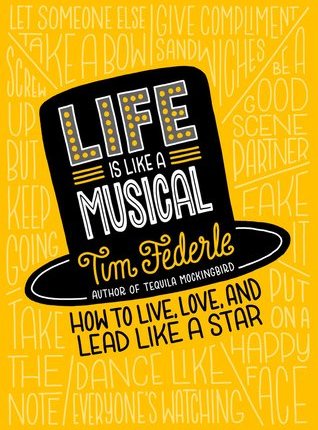
Life Is Like a Musical: How Broadway Can Help You Live Your Best Life by Tim Federle

Life Is Like a Musical: How Broadway Can Help You Live Your Best Life by Tim Federle

Life is Like a Musical is a cute, self-helpish book, full of the wisdom Tim Federle gleaned from years of experience on the stage.

“Basically, think of this book as ‘Don’t Sweat the Small Stuff’ with jazz hands.” Introduction.

Photo by Anastasiya Gepp on Pexels.com

Tim’s advice is common sense, but I appreciated it anyway. Make your weaknesses your strengths. Be nice to everybody. Pay attention. Don’t try to be a perfectionist, and so on.

He pairs these nuggets with his life stories. So, it’s part-memoir, part-self help.

“When Bob Fosse had a bald spot, he put on a stylish hat. Where’s your bald spot? Or blind spot? Or thing that you can barely accept about yourself? Go put a hat on it, and make it something wonderful.” pg 23. There’s nothing wrong with advice like that.

Photo by cottonbro on Pexels.com

First off, the key to approximately 90 percent of adulthood is appearing more interested in something than you actually are. Seriously.” pg 31.

Truth bombs, people.

Don’t give your power away. Remember who you are: “Please, never forget you’re the leading character in your own life. Read that sentence again: You aren’t the supporting cast. You’re it, baby.” pg 48.

And most importantly of all, have a sense of humor about the whole thing.

“Forgive yourself when you screw up. Develop a sense of humor that allows you to snort-giggle before anyone else can.” pg 139.

Photo by Tim Mossholder on Pexels.com

None of us are getting out of this thing called life alive. We may as well make the most of it.

I enjoyed this book. I was also a huge fan of his drink recipe book mixed with classic book titles: Tequila Mockingbird: Cocktails with a Literary Twist.

Recommended for people who are looking for a peppy voice to get them back on track and singing throughout the soundtrack of their own lives. This read will do the trick.

Thanks for reading!

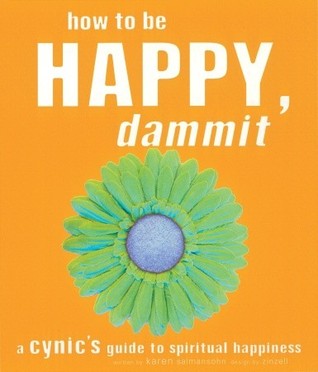
How to Be Happy, Dammit: A Cynic’s Guide to Spiritual Happiness by Karen Salmansohn

How to Be Happy, Dammit: A Cynic’s Guide to Spiritual Happiness by Karen Salmansohn

How to Be Happy, Dammit is a succinct, brightly colored treatise on enlightenment. Coming in around 230 pages with only a few words per page, this is a book that can be read over the course of a lunch hour or *ahem* during other short breaks in your life on a porcelain throne.

Photo by Andre Furtado on Pexels.com

It doesn’t use an abundance of coarse language (see title), but it does utilize a few words to get the point across.

The book is broken down into short life lessons that feed into the next. “Life Lesson 1: Pain exists. Life can hurt. Like a lot. Even when you’re good, you can get whacked. Without apology. Without explanation.” pgs 14-15.

That’s the life lesson about being born. Can’t really argue with that.

My child was born wailing before she was even entirely out. I was wailing too, for different reasons of course, but life can hurt. No doubt.

I found meaning in “Life Lesson 6: Never go shopping for kiwis in a shoe store. Some people just don’t have what you need. So why waste time, banging on their doors, ringing their bells, demanding service?” pgs 38-39.

Photo by PhotoMIX Company on Pexels.com

I think I’m still learning that one.

“Life Lesson 19: This is a world of duality: of good and bad, yin and yang, decaffeinated and caffeinated. So you must always be prepared!” pg 112. Decaffeinated? Poor souls…

In the chapter on self-programming, we get this wisdom: Life Lesson 27: The world is your mirror.” pg 174.

Photo by Mauru00edcio Mascaro on Pexels.com

I don’t think folks realize that either.

Recommended for people who are interested in spirituality, but don’t necessarily have a lot of time or patience for more touchy-feely books. How to Be Happy, Dammit delivers on its title. Now let’s all go be happy. Dammit. 🙂

Thanks for reading!

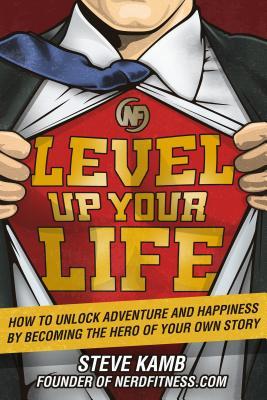
Level Up Your Life: How to Unlock Adventure and Happiness by Becoming the Hero of Your Own Story by Steve Kamb

Level Up Your Life: How to Unlock Adventure and Happiness by Becoming the Hero of Your Own Story by Steve Kamb
levelup

Steve Kamb, the creator of nerdfitness.com, offers behavioral games and community support to assist readers in becoming their best self. It’s the self help genre meets gamification.

Steve was addicted to video games, miserable at his job and disappointed with life. “I still love those games and movies and enjoy the entertainment they provide. They’re a part of who I am as a person. The problem was that they had become a way to avoid the unhappiness in my real life while also allowing me to continue doing nothing about it.” pg xi

The game that had him hopelessly hooked was EverQuest. “What had begun as a fun way to blow off some steam after school or work quickly became an addiction.” pg 5.

So, Steve took what he loved best about the game- the levels, the endless quests, the secrets- and created an online community in which the members support each other to become the best whatever-it-is you want to be through just those things.

Photo by RODNAE Productions on Pexels.com

Essentially, Steve takes the hero’s journey, as described by Joseph Campbell, and crafts a way to implement that into your life through your own preferences. “Life is meant to be lived on your own terms.” pg 23

I picked this up because I recently read a behavioral game book and I wanted to see what the theory would look like in action. Steve has done a solid job making his game completely customizable.

He provides examples between the chapters of people who have used his game to “level up” their lives. The results are impressive.

“The truth is that most people fear change. They, themselves, might want to change but don’t want to put forth the effort and energy to make it happen.”pg 57.

With Level Up Your Life, Steve gives readers the tools to make their lives into a game of their choosing. Recommended for gamers and the young at heart.

Thanks for reading!

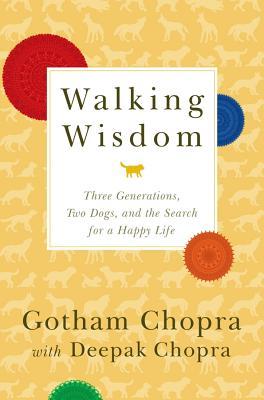
Walking Wisdom: Three Generations, Two Dogs, and the Search for a Happy Life by Gotham Chopra

Walking Wisdom: Three Generations, Two Dogs, and the Search for a Happy Life by Gotham Chopra

Gotham Chopra, the son of Deepak Chopra, shares what he has learned through the ownership of his crazy dog, Cleo, and becoming a father for the first time. He also deepens his relationship with his own father when his mother has to spend an extended time away in India.

It’s a hodgepodge of a book with the themes differing from chapter to chapter. I generally enjoyed it but felt like it was a bit scattered.

Photo by Spoortesh Honey on Pexels.com

I remembered Gotham from all of the Channel One news I watched during junior high and high school. I thought it was a waste of time (even then, I would have rather been reading), but I remembered him.

A few years ago, I watched the documentary he made about when his father joined a monastery- he mentions this at the end of Walking Wisdom. I was intrigued by the dynamic between them in the documentary.

Gotham seemed to focus on his father’s foibles, like his addiction to his phone and his frequent trips to Starbucks. I thought those parts were unfair, but the window into his strange, spiritual/rock star world was one I couldn’t forget.

Photo by Maksim Goncharenok on Pexels.com

My favorite parts of this book were similar to that documentary. I loved learning about Gotham and Deepak’s close friendship with Michael Jackson. The best part was when Gotham brought his pup, Cleo, to meet the mega-star. It’s very surreal.

I also liked learning about how Deepak’s family handles his active mind and constant spiritual seeking. Gotham describes being his father’s “guinea pig” for different experiments from meditation to yoga to spoon-bending.

Gotham’s non-traditional upbringing gave him a quirky lens through which he views the world. It also has made him a master meditator.

Recommended for dog lovers and those curious about what goes on behind the scenes of Deepak Chopra’s life. If you can’t stand books that skip from one topic to another, you may want to choose a different read.

Thanks for reading!