Eckhart Tolle’s “The Everyday and the Transcendent”: a Podcast Review

Eckhart Tolle’s “The Everyday and the Transcendent”: a Podcast Review

While I was on my daily walk, I listened to “The Everyday and the Transcendent” a podcast on Spotify in Eckhart Tolle’s “Essential Teachings” series.

Was it worth the listen? I say yes.

I enjoy learning from Eckhart occasionally but not all the time. He has a soothing voice and his stream-of-consciousness delivery style is hypnotizing.

However, after a couple hours of his teachings, they all begin to sound exactly the same. And that’s because his core message never changes- which isn’t a bad thing.

Photo by Sebastian Voortman on Pexels.com

Beware self help or spiritual gurus who hold up a carrot of further secrets. As my hairstylist said after visiting an aura cleanser for the first time, “You can overdo stuff like that.” By which she meant, pouring piles of money into someone’s hands to “fix” something you can’t even perceive.

The cool thing about Eckhart’s teachings is you can begin practicing and perceiving what he’s talking about right this second, no matter your situation or state-of-mind.

For example, in this podcast, a practical tool he offers for spiritual insight is to simply observe what he calls your “inner body”. His focus, which he says he’s used over the years to great success, is to monitor what the energy of his hands are doing.

Photo by Meryl Merlin on Pexels.com

How do you do that? Simple- feel your hands. Act like you’re going to pick up a pencil, but don’t move. There! You can feel that can’t you.

Do this multiple times a day or just once in awhile and you’ll begin taking your focus away from what Eckhart calls “thought forms” and enter the state of “the now”.

This particular podcast deals with “the everyday” which Eckhart describes as your job, your family, your home, all of the trappings of the physical life. He says most people never move beyond the everyday. We can get lost in the world around us, which he reminds us, are simply projections that we create through our perceptions.

Photo by Ricardo Esquivel on Pexels.com

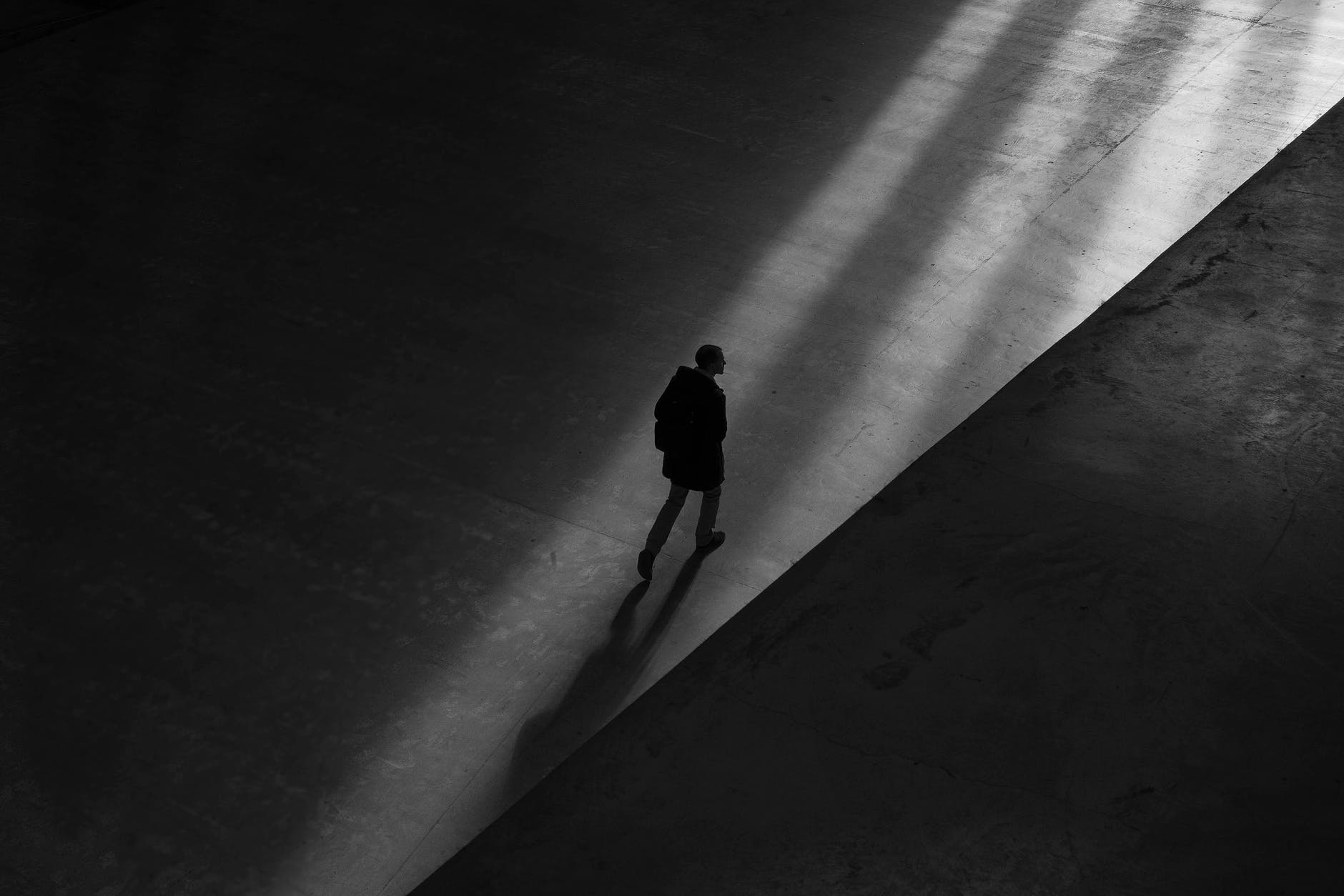
He describes the everyday as a horizontal line- a visualization that I found very helpful.

When you are lost in anxiety or fear, you’re moving either forwards or backwards on this line and not staying in the present moment, which is where the second part of his visualization comes in.

Eckhart describes “the transcendent” as a vertical line that intersects the horizontal line of daily living. He says we travel upwards and downwards on this line through our thoughts as we go about our lives.

Photo by eberhard grossgasteiger on Pexels.com

The thing is: most of humanity isn’t aware that we’re doing this. We unconsciously move about our day, responding in a kneejerk way to things we perceive as “happening to” us. And, Eckhart says, they actually are “happening to” us because we aren’t aware we are doing it.

If only we could realize our own internal processes, then, he says, we would realize that nothing really “happens to” you. It is all movement along the metaphorical everyday and the transcendent lines of our lives.

Photo by Anna Roguszczak on Pexels.com

We break the power that thoughts have over us and enter into the timeless state of the Now. The holy grail, so to speak, of spiritual experiences.

Highly recommended for spiritual seekers who are looking for practical ways to practice being present. Thanks for reading!

If you’re interested in Eckhart Tolle’s further teachings, here my book review of his “Stillness Speaks”:

And you can listen to the podcast yourself here:

The Art of True Healing: The Unlimited Power of Prayer and Visualization by Israel Regardie, Marc Allen (Editor)

The Art of True Healing: The Unlimited Power of Prayer and Visualization by Israel Regardie, Marc Allen (Editor)

Israel Regardie is a little-known thought leader of western occultism. In this book, “The Art of Healing,” Dr. Regardie explains a few meditation techniques in a way that anyone from beginners to advanced practitioners can understand.

I remember reading somewhere (not this book) about Dr. Regardie’s internship with Aleister Crowley and how he realized Crowley wasn’t teaching him anything beyond the superficial when it came to occult matters.

Photo by Luis del Ru00edo on Pexels.com

He ended up breaking away and being one of the leaders of a new approach to occultism-
which brings me back to this book.

The meditation techniques will feel quite familiar to anyone who has practiced chakra meditations or color visualizations on the body.

“By these means, the healing force is distributed to every part of the body. No single atom or cell in any organ or limb is omitted from the influence of its healing, regenerative power.”

Photo by PhotoMIX Company on Pexels.com

The curious part of this book is that Dr. Regardie uses five centers of energy down the center of the body instead of the more standard seven of eastern occultism.

Of course, as Dr. Regardie states, these exercises are in no way a substitution for competent medical care or therapy when necessary – but they are a wonderful addition to it, for they are able to aid the healing process in a great many mysterious, profound, and positive ways. intro

I’m not entirely sure why he does this though I am familiar with the Middle Pillar exercise (which is what the technique is called). Perhaps he’s basing the whole practice off of a teaching Crowley created for his occult studies.

Dr. Israel Regardie and the Middle Pillar exercise.

Whatever the reason, I think it is a noteworthy and definite change from other meditations I’ve practiced.

Highly recommended for readers looking for new meditation techniques and who are interested in western occultism. Another book you may want to pick up if you are into these topics is High Magick: A Guide to the Spiritual Practices That Saved My Life on Death Row.

Damien Echols‘s style of writing reminds me of Dr. Regardie in both its refreshing simplicity and honest assessment of the Great Work.

Thanks for reading!

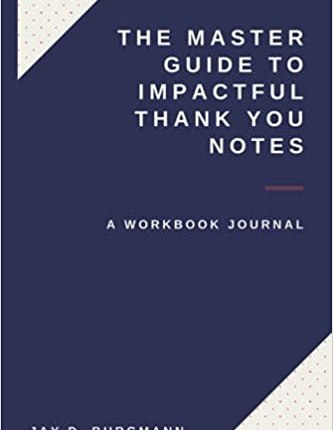
The Master Guide to Impactful Thank You Notes by Jay D. Burgmann

The Master Guide to Impactful Thank You Notes by Jay D. Burgmann

“An effective follow-up with a prospect, client, boss, work associate, friend, or even relative accomplishes two things; first, it gives you the occasion to recap your event, and second, provides the opportunity to celebrate actions or accomplishments from it.”

Photo by cottonbro on Pexels.com

Thank You notes are a big deal for me during the month of December. At the beginning of the month, I have my birthday and at the end there’s Christmas- the mother of all holidays that require thank you notes.

For full transparency, I received a free copy of this book from the author Jay D. Burgmann after his brother conducted a lovely and gratis ‘understanding Medicare’ event at my local library. Afterwards, Jay suggested I schedule an event based off his book and I just may.

The book itself is clearly self published. The author didn’t chose a font that appeals, at least to me. Occasionally, when he wants the reader to know the text is important, he goes into the faux pas of all caps.

I don’t know about you, but I personally don’t like being shouted at- even in literature form.

Photo by Andrea Piacquadio on Pexels.com

Like this: “KEY POINT- IT DOESN’T HAVE TO BE PERFECT. SAYING THANKS IS MOST IMPORTANT. A WELL WORDED MESSAGES MAKES IT EVEN MORE POWERFUL. BEAUTIFYING IT WITH GOOD STATIONARY IS A NICE TOUCH”

Beyond the superficial, this self-described “workbook journal” is very helpful, especially for younger readers who have either never been educated about the importance of saying thank you, or don’t care.

Burgmann highlights the note as an important networking tool. He recalls a visit to the office of someone he wrote a thank you note to and says the client framed his handwritten note and had it on the wall of her office.

It was that impactful. And it’s easy to understand why.

Photo by u0158aj Vaishnaw on Pexels.com

Beyond the emotional appeal which Jay focuses on, expressing gratitude is one of the great strategies in the New Age law of attraction. What you think and speak about, so the teachers say, you bring about- perhaps in ways and means you never could imagine.

Burgmann, with this short book, joins the ranks of these educators and gurus. Saying thank you is important. Knowing how to write it is important.

Highly recommended for everyone. Don’t be put off by the format, focus on his message.

Lauren Berger the ‘Intern Queen’ shares how to write an excellent Thank You note. You can find internships and read her blog at http://Internqueen.com

And thanks for reading!

Feng Shui For Today: Arranging Your Life For Health & Wealth by Kwan Lau

Feng Shui For Today: Arranging Your Life For Health & Wealth by Kwan Lau

Feng Shui for Today was a fairly simple and succinct beginner’s guide to the art of feng shui.

What is feng shui?

“This book is concerned with the Chinese folk art of arranging objects to enhance harmony and good luck, called feng shui. This ancient knowledge enables us to seek peace and new growth through our relationship with the objects around us…” pg 11

Photo by Dan Hadley on Pexels.com

When was this art form started? No one knows! As the author points out in the section entitled, ‘A brief history of feng shui’:

“… (feng shui’s) close association with the ancient Chinese lodestone compass has led some to think it may have begun around the time the compass was invented, an accomplishment traditionally credited to the Yellow Emperor, the great mythological hero-priest-ruler of ancient China, who is supposed to have lived around 2700 b.c. There is no historical proof for this attribution…” pg 17

Despite not knowing its origins, historians can tell the art has been around for so long because so many buildings were built facing the south which is considered the “most auspicious direction.”

Photo by Zhu Peng on Pexels.com

“Traditional Chinese walled cities, temples, and other important structures were usually oriented to face the south. The Forbidden City is Beijing was built on a precise north-south axis, with all its major halls facing the south.” pg 34

Kwan Lau goes on to explain feng shui’s ties to mythology, the elements of traditional Chinese medicine, the four directions, and the stars.

It was surprisingly complex.

“Readers should not be dismayed by the complex interplay of all these symbols and associations. The folk art of feng shui draws information from a wide range of sources and a rich tradition of ancient cosmological thought, and for this reason it can be daunting for the beginning practitioner.” pg 48

There’s way too much to incorporate all of the information I learned in this book all at once. I think the aspect of feng shui I’ll start with in my own life is furniture placement.

Photo by Max Vakhtbovych on Pexels.com

I was dismayed to discover the couch I was sitting on while reading this book was in the “death” region of the feng shui layout of my front room. However, on a positive note, it faces south, which is very good and has a wall instead of a window behind it.

Perhaps some furniture moving is in order.

The world is a less threatening place with a happy, well-balanced home at the center of it. And sometimes, moving your furniture can change your life.” pg 108

Recommended to readers interested in the art- both newcomers to the topic as well as practitioners who want a reference book on the ‘Nine Stars, Eight entrances, and Bagua Combination Method’ of feng shui.

Thanks for reading!

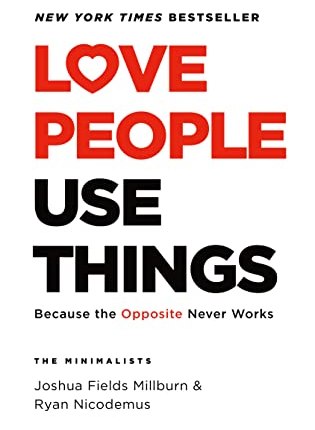
Love People, Use Things: Because the Opposite Never Works by Joshua Fields Millburn

Love People, Use Things: Because the Opposite Never Works by Joshua Fields Millburn

‘The Minimalists,’ Joshua Fields Millburn and Ryan Nicodemus, share their life journeys towards intentional living using seven different areas of focus: stuff, truth, self, values, money, creativity and people. Readers are invited to use the lessons they have learned to enact positive change in their own lives.

I, like many, had preconceived notions about what minimalism is. I thought it was about creating a living space that has like one chair, one table, and a cup with a single sharpened pencil in it. You can see the room, can’t you. In my mind, that was minimalism- bare to the point of ridiculousness.

Photo by Waldemar Nowak on Pexels.com

Millburn addresses this misconception early on in the book.

“Minimalists don’t focus on having less, less, less; they focus on making room for more: more time, more passion, more creativity, more experiences, more contribution, more contentment, more freedom.” pgs 35-36

Sounds pretty good to me, Josh. So how do we get there?

“Minimalism is a practice of intentional living. While it starts with the stuff, it’s ultimately a stewardship program for one’s life.” pg 124-125

I’ve recently experienced some major changes in my life, which include relocating to a new home and moving almost a decade’s worth of stuff. During the process, I took the time to try on every piece of clothing in my wardrobe and, to my not-unexpected dismay, about three-quarters of the clothing no longer fit.

Photo by Tembela Bohle on Pexels.com

It was simply a matter of donating the old clothes then. But I found myself hesitating to do so. I’ve lived a lot of life in those clothes and just holding them brought back so many memories.

I realize the memories aren’t in the items, they’re in me. Millburn points out that it’s easy to make that mistake.

“While it’s true that our memories are not in our things, it is also true that sometimes our things can trigger memories inside us.” pg 20

He recommends taking pictures of these treasured items so you can continue to access the memories at will while still making room for growth.

Because that’s what all of this minimalism stuff is geared towards: Living an intentional life so you can grow with the values that you’ve chosen for yourself. What you’re aiming for is growing like a cultivated flower about to bloom rather than a tumor that spills out uncontrolled in all directions.

Photo by Jess Bailey Designs on Pexels.com

“Growth is a critical component of a meaningful life- as long as it’s responsible growth- because continual improvement makes us feel alive and brings purpose to our actions.” pg 170

To do so, we must first confront the reasons why we’re holding on to all these items in the first place.

Fear is a common theme with people who are starting to confront their stuff. We’re afraid to pull back the curtain because we’re afraid not of the stuff itself, but of the work that must be done to live a more rewarding life after getting rid of it.” pg 102

And for me that’s the crux of the issue- fear. What am I afraid of? I’m afraid of living a life that doesn’t match up with my values. I fear change, not because it might be negative but because it pulls me out of my little routines into a place of uncomfortable uncertainty.

Your fears are probably quite different from mine, but the point is that you have them. Do you know what yours are?

Highly recommended for readers interested in self improvement, self help or the minimalist movement. Thank you to the publisher for a free advance reader’s copy of this book.

And thanks for reading!

The Red Book: Liber Novus by C.G. Jung

The Red Book: Liber Novus by C.G. Jung

“The years, of which I have spoken to you, when I pursued the inner images, were the most important time of my life. Everything else is to be derived from this.” preface

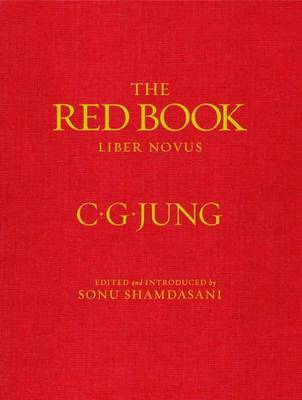
The Red Book is a stunning publication. It is a physically large book which mimics Jung’s own handwritten copy which measured 11.57 inches by 15.35 inches.

Carl Jung’s calligraphy

The contents are just as impressive. The first part is a brief history of Jung and his publications. The second contains pages of calligraphy in both German and Latin of his “active imagination” visualizations as well as sketches and paintings created by Jung to accompany the text.

The last section of the book is the English translation of the second part.

“Jung described his technique for inducing such spontaneous fantasies: ‘The training consists first of all in systematic exercises to eliminating critical attention, thus producing a vacuum in consciousness.'” pg 209

Painting from Carl Jung’s The Red Book

The visions themselves are interactions between Jung and voices or figures that he named his soul, gods and other archetypical figures.

“To this my soul spoke a word that roused my anger: ‘My light is not of this world.’ I cried, “I know of no other world.” The soul answered, “Should it not exist because you know nothing of it?” pg 240

As he stated in the preface, Jung felt as if his ‘confrontations with his subconscious’ affected his work for the rest of his life. It is a fascinating, little-examined side of a man who has had a huge effect on psychology and is credited, by some, as being one of the leading figures of the New Age movement.

The road to publication for this book is a story in itself. At first, Jung’s family carefully kept The Red Book in a safe deposit box to protect it as they recognized its value as a one-of-a-kind creation. They also believed that Jung wouldn’t have wanted its contents made public as he hadn’t left any specific instructions in his will about it.

Painting from Carl Jung’s The Red Book

However, researchers and scholars have since examined the text and found parts where Jung addresses, “my dear friends,” leading to the opinion that he did intend to share it with a wider audience. They also point to its importance to Jung’s following works as another reason why it should be published.

Whatever their reasoning, I’m so very glad his family and foundation made the decision to publish. This book is a treasure.

Curiously, The Red Book ends in an incomplete sentence.

Here it is:“I knew of nothing better than to write them down in a ‘precious,’ that is to say, costly book and to paint the images that emerged through reliving it all- as well as I could. I knew how frightfully inadequate this undertaking was, but despite much work and many distractions I remained true to it, even if another/possibility never…” epilogue

Painting from Carl Jung’s The Red Book

I wonder what he was going to write next.

Though I didn’t use Jung’s method of active imagination, I too have undertaken lengthy ‘confrontations’ of my subconscious and have come back with pages of material that read, in some ways, quite similar to this book.

Perhaps, one day, I will also find the courage to publish it.

Highly recommended for any readers interested in Carl Jung’s methods, archetypes or dream interpretation.

Thanks for reading!

Why Good People Do Bad Things: Understanding Our Darker Selves by James Hollis

Why Good People Do Bad Things: Understanding Our Darker Selves by James Hollis

“Expressed in its most functional way, the Shadow is composed of all those aspects of ourselves that have a tendency to make us uncomfortable with ourselves.” pg 9

Jungian analyst James Hollis examines “shadow work” from the perspective of an individual to couples then communities and all the way up to the collective unconscious.

He’s at his best when he’s illuminating how the Shadow works at an individual level. When he goes beyond that into couples or groups, I thought he began to generalize to the point where the book was no longer helpful on a practical level and moved more into the realm of philosophy.

Photo by Sunsetoned on Pexels.com

Hollis brought the book back into the self help genre by providing a final chapter full of questions for “reflection” by the reader. The purpose of this inner gazing is not just self knowledge, says Hollis, but also wholeness at a soul level.

“This book operates from a central thesis that is relatively unknown to the general public but is a truism for depth psychology, namely, that the human psyche is not a single, unitary, or unified thing, as the ego wants to believe. It is diverse, multiplicitous, and divided… always divided.” pg xi, preface.

I read Why Good People Do Bad Things in conjunction with a philosophy class off of The Great Courses Plus (Wondrium) called “Understanding the Dark Side of Human Nature” by Daniel Breyer. The two complemented each other quite well.

“Can the reader imagine that something inside you wishes to ‘talk’ to us? As a result of this conversation, consciousness is strengthened, new energies are available, and each person lives a richer life, one that is more authentically one’s own.” pg 192

Photo by Bianca Salgado on Pexels.com

This isn’t what I would call a ‘fun’ read. In fact, I had to take Why Good People Do Bad Things in sections, put it down for awhile, and come back to it, again and again.

I don’t mind self knowledge. I’ve done dozens of meditations where I look at aspects of myself and come back with a different understanding of who I am than before I started.

The difficulty is looking into the bits that I don’t want to see. Like I said, I can manage it in small doses. It isn’t somewhere I’d want to live.

It is understandable why so few attempt Shadow work. It is much easier to scapegoat others, blame, and feel superior to them.” pg 203

Photo by Umberto Shaw on Pexels.com

Recommended for any seekers who are looking for a psychologist’s take on Shadow work. This book might be the push that you need to brave that darkness. But beware, there’s someone in there who may have been waiting to talk to you for a long time and you might not like what they have to say.

Thanks for reading!

The Art of Comforting: What to Say and Do for People in Distress by Val Walker

The Art of Comforting: What to Say and Do for People in Distress by Val Walker

“Qualities like gentleness, patience, warmth, and empathy can be so undervalued in this day and age that when we need to sit down with someone devastated by a loss or turbulent change in their lives, we often feel unsure about what to say or do.” pg 7, ebook.

Author Val Walker discovered first-hand that there is a lack of knowledge about offering comfort in the modern age. She was going through a divorce and relocation, and had no one to confide in. She said her friends and family members were either too busy to give her some of their time or they gave her a type of attention she didn’t desire- like mouthing platitudes or giving unwelcome advice.

Photo by Nikita Khandelwal on Pexels.com

Walker realized that society has lost its ability to do something as simple as listen and be present. She wrote this book to help others offer this gift to those around them.

“Presence. Unshakable, steady, tender, and empathic presence. Soft strength. That was comfort.” pg 10, ebook

She dispels many myths about what comforting may look like, including my concern that I never know what to say when someone shares their inner turmoil with me.

“Myth: Comforters always know what to say. We don’t have to know the right thing to say. Sometimes there is really nothing that can be said.” pg 21, ebook

Photo by cottonbro on Pexels.com

After that, Walker interviews mental health professionals from many different modalities, offering different ways that these comforters approach and soothe those around them. From creating art to writing to simply watching television together, there are so many opportunities to spend time and connect with someone in need.

“The language of comforting is a language like any other- it can be learned but, once mastered, can become as effortless as breathing. And if our words and gestures are warm, empathic, and respectful, they will help to create a safe space for the comforter and the one being comforted to inhabit.” pg 81

Photo by Jonathan Borba on Pexels.com

The past year has been devastating for so many. I picked up this book because I never know what to say when someone comes to me with pain or disappointment or heartbreak.

Walker has reassured me that sometimes the best help anyone can give another is to say nothing at all but to offer the gift of your presence and attention. Because at the end of the day, another word for ‘comfort’ is ‘love’. And we all know how to do that already, right?

Thanks for reading!

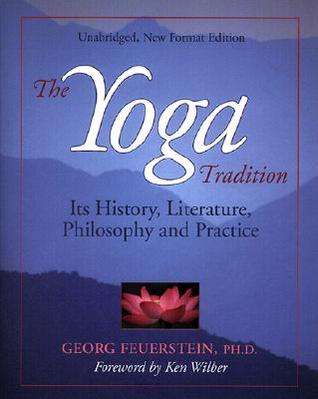
The Yoga Tradition: Its History, Literature, Philosophy and Practice by Georg Feuerstein

The Yoga Tradition: Its History, Literature, Philosophy and Practice by Georg Feuerstein

The Yoga Tradition is a reference book for the history and practical methods of yoga in its myriad forms throughout time and different religious traditions.

“In its oldest known form, Yoga appears to have been the practice of disciplined introspection, or meditative focusing, in conjunction with sacrificial rituals.” pg 27

Photo by Lucas Pezeta on Pexels.com

From these ancient beginnings, author Georg Feuerstein takes readers on a fantastical and spiritual journey through the various branches of yoga including Raja, Hatha, Bhakti, Jnana and more. He’s printed original texts, along with analysis of them, throughout the book to provide context and origin materials for each tradition.

What emerges in The Yoga Tradition is stunning in its complexity as well as sheer variety of methods, beliefs and practices.

“Long before the word yoga acquired its customary meaning of ‘spirituality’ or ‘spiritual discipline,’ the sages of India had developed a body of knowledge and techniques that aimed at the transformation and transcendence of ordinary consciousness. This stock of ideas and practices formed the matrix out of which grew the complex historical phenomenon that later came to be called Yoga.” pg 65

Photo by Karolina Grabowska on Pexels.com

Beyond sharing the history, philosophy, and practice of yoga, Feuerstein encourages modern scientists to look closely at the traditions in these pages to see what benefits could be gained from the ancient knowledge.

“Gradually, modern medicine and psychology, aided by advanced scientific concepts, methods, and instrumentation, are rediscovering some of the amazing facts that yogins have talked about and demonstrated for centuries.” pg 400

In my mind, that is one of the most exciting aspects of this book- what humanity could possibly learn about the enduring mystery of consciousness itself through the application of modern methods of study to ancient techniques.

Highly recommended for anyone interested in yoga and looking for a scholar’s thorough dissection of its history and forms. Your search can begin and end with this title.

Thanks for reading!