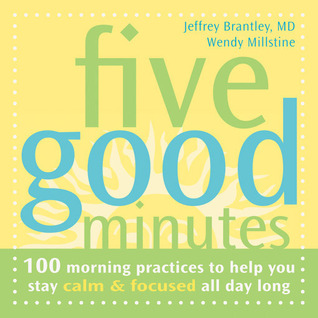
Five Good Minutes: 100 Morning Practices to Help You Stay Calm and Focused All Day Long by Jeffrey Brantley, Wendy-O Matik, Wendy Millstine

Five Good Minutes: 100 Morning Practices to Help You Stay Calm and Focused All Day Long by Jeffrey Brantley, Wendy-O Matik, Wendy Millstine
fivegoodminutes

Things have been stressful in my neck of the woods, so I picked up Five Good Minutes to help me cope.

I’m in the fourth month of having my house on the market and my husband has been looking for employment for over a year. Yeah, I’m feeling it…

Five Good Minutes is simple enough for beginners to the mindfulness/meditation practice and filled to the brim with suggestions for ways to focus in the morning and get your day off on the right foot.

The best part of this book is that there is something for everyone- it is that broad. The techniques that it uses varies from visualizations to mindfully drinking your morning cuppa.

The worst part of the book is that, because it covers so much, that it doesn’t really talk about anything in depth. If you’re looking for detailed methods of meditation and relaxation, this is not the book for you.

Why the focus on early in the day?: “The morning is the best time to break away from old habits of thinking and feeling and to set a new direction for yourself and how you will be in your day. Any exercise in this book- done in the morning- has the power to impact greatly on your experience throughout the day, if you allow it!

Photo by Felipe Borges on Pexels.com

Personally, I’ve found that I’m at my best in the mornings- well, once I blink the sleep out of my eyes. My mind is clearer and I can focus for longer periods of time.

But, if you’re more an afternoon/evening type person, don’t let the title of this book stop you. I think that these practices could be beneficial at any time of the day.

My favorites were- the Five-Fingered Peace pg 32: In which you use your hands almost as a rosary and remember awesome things that have happened to you.

Freedom from Tension pg 58: In which you scan your body and focus your relaxation on the stressed out bits.
Photo by Alexandr Podvalny on Pexels.com

Your First Sip of Tea pg 94: or coffee, for me. Take your time and mindfully drink your morning pick-me-up.

A Shot of Faith pg 186: You use visualization to picture a problem turning out perfectly.

And finally, Cultivate Gratitude pg 206: “This practice invites you to turn toward the good in your life and to express gratitude as recognition grows.”.

If none of those spoke to you, there are 95 others for you to choose from.

Recommended for stressed out people everywhere and those who are interested in bringing a bit of mindfulness or meditation to their day but don’t know where to start. Some further reading: Thank & Grow Rich: A 30-Day Experiment in Shameless Gratitude and Unabashed Joy, Meditations for Breaking the Habit of Being Yourself, or 10% Happier: How I Tamed the Voice in My Head, Reduced Stress Without Losing My Edge, and Found Self-Help That Actually Works. Peace and thanks for reading!

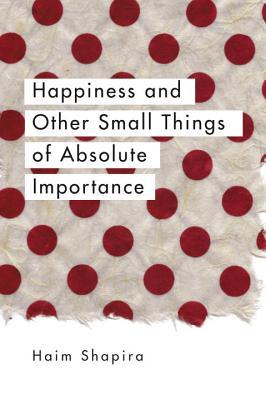
Happiness and Other Small Things of Absolute Importance by Haim Shapira

Happiness and Other Small Things of Absolute Importance by Haim Shapira
haimshapira

Happiness and Other Small Things of Absolute Importance does not resemble a self help book as much as it does a long, meandering lecture by your favorite professor.

Shapira talks about happiness, the passage of time, love, death, money, and so much more by tying it to classic literature and his own musings. I loved it.

There is little that Shapira doesn’t cover in these pages and, when you’re done, you feel as if you’ve just had a long discussion with a very dear friend.

“This little book is meant to change your perspective on almost everything in your life- and primarily the concept of happiness. … As serious and life-changing as the voyage to the land of the Things That Matter may be, it’s no less important to enjoy the ride.” loc 27, ebook. Shapira succeeds with flying colors.

His humor shines through his words. There aren’t any laugh-out-loud moments, but I found myself grinning throughout: “There’s empirical proof that How-To-Be-Happy Books are useless. If just a shred of the promises made in many of those books came true, the world would be knee-deep in incomprehensible quantities of bliss. We all know that this is not the case.” loc 73, ebook. True story.

My favorite parts were about the importance of a positive mind-set and love.

Photo by Sharon McCutcheon on Pexels.com

This passage is about being positive: “Anyone who has lived on this planet long enough knows that pessimism is the natural way to think. It requires no effort, like a rock rolling downhill. It’s much harder to push the rock up the hill, to think positively. Just see the effort it takes to think like (Winnie the) Pooh, to find a bit of magic and grace in everything. That is a mission worthy of the wise.” loc 387 I agree.

I also found the sections on anger and forgiveness to be very meaningful.

Here, Shapira is talking about the futility of being angry and how we can learn to control our tempers, rather than have them control us: “My wife, a chemical engineer by profession, has reached an important understanding. In nature, she told me, each substance has a typical, unique and fixed boiling point. We can artificially change it, however, by using other substances that act as inhibitors, thereby raising the boiling point. For example, anyone who cooks knows that salted water takes longer to boil than water alone. The same applies to people. Their boiling points can be raised. Wisdom can be salt for our water…” loc 610, ebook.

Recommended for spiritual seekers, happiness chasers, and anyone who wants to learn more about themselves. This book is a gem.

Some similar reading, if you liked this: How to Talk About Places You’ve Never Been: On the Importance of Armchair Travel, The End of Self-Help: Discovering Peace and Happiness Right at the Heart of Your Messy, Scary, Brilliant Life, or The Power of the Heart: Finding Your True Purpose in Life.

Thank you to NetGalley and Watkins Publishing for a free digital copy of this book.  And, thank you for reading!

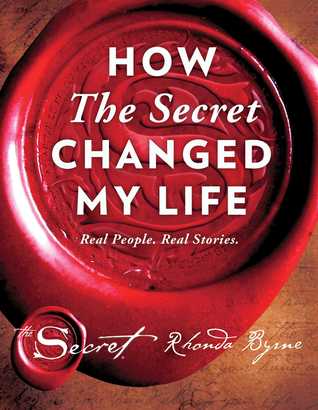
How The Secret Changed My Life: Real People. Real Stories. by Rhonda Byrne

How The Secret Changed My Life: Real People. Real Stories. by Rhonda Byrne
secretchangemylife

How the Secret Changed My Life adds nothing new to the Secret franchise, but it’s still fun to read if you enjoy hearing success stories about people who utilized the Law of Attraction.

The criticisms of it have been voiced elsewhere and more eloquently: that it is predominantly focused on material things and that it stresses being happy at any cost.

That being said, I liked the stories.

I liked hearing about how people hit rock bottom and then changed their lives for the better. I really liked hearing that you can do or have or be anything that you want. Who wouldn’t?

Here’s Rhonda in the introduction: “I want you to know how easily you can change your life, and it’s not by running around trying to force it into the shape you want. You change your life in the only way you can ever change it: change your mind, and then your life will change.” loc 47, ebook.

All true change comes from within, I do believe that. Until I typed this out, I didn’t realize just how many times she used the word “change” in those two sentences. Counting back I see… five times? That’s a lot of change, people.

I feel like this book warns the reader away from negative emotions, but they serve a purpose too. It gives you a starting point- if you know what you don’t want, then you know what you do.

I’m not suggesting that you wallow in negative emotion, but feeling it, acknowledging it, then moving on isn’t as bad as this book makes it out to be.

Photo by Andre Furtado on Pexels.com

In this passage, Rhonda is suggesting the use of “Secret Shifters” to control your mood: “The Secret Shifters… are things you can focus on whenever you find yourself feeling angry, frustrated, or any other negative emotion, in order to change those negative feelings in an instant. They might be beautiful memories, future events, funny moments, nature, a person you love, or your favorite music.” loc 409, ebook.

I say: feel whatever you’re feeling and trust that your emotions will eventually rise again like a cork in water. Helping yourself along with “Secret Shifters” or gratitude lists or whatever is fine, but for goodness sake, don’t force it. “What you resist, persists.”

I really agreed with this next passage: “Most of us have the wrong idea about happiness. We believe that if we get everything we want, and if life continually goes our way, we will be happy. And from that belief, we create all the excuses in the world for why we can’t be happy right now. … It’s those very excuses that are preventing you from being happy now.” loc 457, ebook.

I used to do that- looking forward to circumstances or events and ignoring where I was. The journey really is the point, so why not be happy now?

Recommended for readers who are looking for a quick, uplifting read about the Law of Attraction or for those who are interested in getting started but don’t necessarily believe or know how it works. The latter, in particular, may find a great deal of worth in these pages.

As I said, I liked it, but I’d also recommend reading Abraham Hick’s books too: to learn the value of negative emotion, not be afraid of feeling your full emotions, and to learn not to practice affirmations unless you’re feeling “in the zone” so to speak.

Additional reading: The Vortex: Where the Law of Attraction Assembles All Cooperative Relationships and Co-creating at Its Best: A Conversation Between Master Teachers.

Thank you to NetGalley and Atria Books publishing for a free copy of this book!  And, thank you for reading.

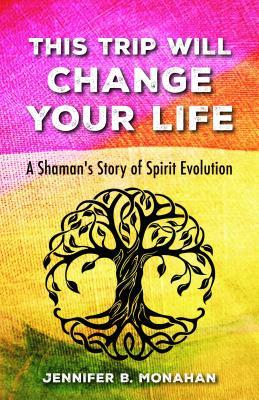
This Trip Will Change Your Life: A Shaman’s Story of Spirit Evolution by Jennifer Monahan

This Trip Will Change Your Life: A Shaman’s Story of Spirit Evolution by Jennifer Monahan
tripwillchangeyourlife

This is a firsthand account of Jennifer Monahan’s discovery of her spiritual path and budding abilities as she becomes a modern day shaman.

From the introduction: “Let me start off by saying that I’m nobody special- or at least not any more special than every other person on the planet. But I do believe in magic. And the power of the universe in our lives. This is a story about magic- everyday magic that exists in everyone’s life but that for many goes unnoticed and unappreciated.” loc 26, ebook.

I think that everyone has potential, but sometimes they don’t tap into it because they can’t see how or don’t realize that they can. Jennifer Monahan empowers the reader through her example.

Shamanism, though ancient, feels New Age.

Take this teaching about the mind: “The purpose of the mind, Antonio said, is to train it so that it focuses on those things that make the spirit sing and bring it joy- and to let everything else just slip on by without letting it get caught in the mind… Doing this enables people to live in a state of happiness, peace, and self-love.” loc 153, ebook.

That’s the message of Thank & Grow Rich: A 30-Day Experiment in Shameless Gratitude and Unabashed Joy, Ask and It Is Given: Learning to Manifest Your Desires, The Secret… I could go on. Perhaps the New Age teachers are on to something :).

My favorite parts of This Trip Will Change Your Life were the messages that Jennifer received during meditation and what she experienced during her vision walks. It is always positive, loving, supportive or healing wisdom that is shared.

Photo by Tobi on Pexels.com

Here’s the universe speaking to her while she breathes: “You don’t have to do anything. Just be. Radiate love out from your core. Focus on that and on being present. Be accepting of people- that is the first step. You’re doing that now; keep it up. Share your joy- find it! Tap into your life.” loc 503, ebook.

I can see this book not appealing to everyone: Jennifer has a few moments of “far out” behavior like talking to her crystals and receiving their wisdom, but if you believe that everything contains a spirit (the philosophy in The Life-Changing Magic of Tidying Up: The Japanese Art of Decluttering and Organizing comes to mind) then it is not such a stretch to entertain the idea that one could communicate with inanimate objects.

Western Qabalists have taught for centuries that everything has a guiding intelligence and that to tap into it, you just have to clear your thoughts, ask, and be ready for the response. But, if you don’t have a fairly open mind about such things, this might not be the book for you.

Overall, I loved the message of this book and the approachable way that Jennifer explains shamanism. “The realization that I’ve come to is that the basic human need is to be loved. And that love needs to come from within. When we feel love for ourselves, we are happy and feel good. We can then send our love unconditionally out into the world.” loc 751.

Highly recommended for those who are curious about shamanism or finding one’s spiritual calling- whatever that may be.

Recommended read alikes: the books I linked above as well as The Flying Witches of Veracruz: A Shaman’s True Story of Indigenous Witchcraft, Devil’s Weed, and Trance Healing in Aztec Brujeria by James Endredy (another modern shaman), The Way of the Shaman by Michael Harner(classic text, gives plenty of general knowledge and practices) or Active Dreaming: Journeying Beyond Self-Limitation to a Life of Wild Freedom by Robert Moss (incorporates the shamanistic practices of the Aborigines for a modern audience).

Thank you to NetGalley and She Writes Press for a free digital copy of this book! And, thank you for reading.

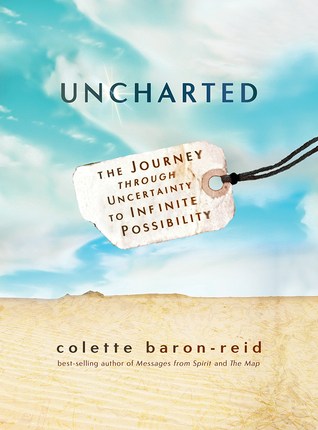
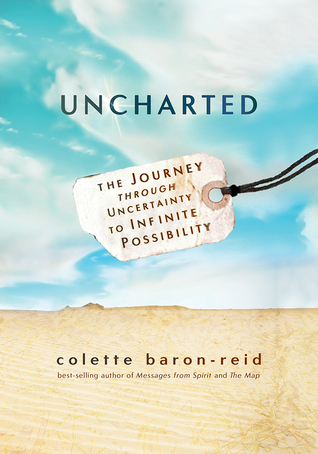
Uncharted: The Journey through Uncertainty to Infinite Possibility by Colette Baron-Reid

Uncharted: The Journey through Uncertainty to Infinite Possibility by Colette Baron-Reid
uncharted

In Uncharted, Colette Baron-Reid guides the reader with journaling, visualization, personal stories, and meditation exercises through unexplored realms of the spirit as a method for greater self knowing and actualization.

I enjoyed this book, but it felt a bit all over the place. Let me explain what I mean by examining some of the many subjects discussed:

In the introduction, Colette begins by giving some background information into what’s been going on with her for the past couple of years.

One of those big changes is that she is now channeling an group of beings, whereas, prior to this, she wasn’t.

In this passage, she’s talking about the entity helping her to write Uncharted: “It’s like “they” had the puzzle pieces, and when I was ready for them, they dropped them down on the page for me to discover. I’m not realizing that this is, in essence, what channeling an “entity” is. It’s something I never quite understood, and I’m afraid I didn’t respect its power as I should have. So I hereby surrender my inner critical cynic who doubted others when they shared their channeling stories. I get it now.” loc 55, ebook.

She calls this/these entities, Fred. Throughout the book, Fred pops up and shares a message or clarifies something. I felt as if the channeled messages could have composed a whole other book in addition to this one.

Plus, it’s clear that she’s still honing her ability to talk and understand to this inner knowing. Anyway, it “muddied the waters,” so to speak, of Uncharted from nearly the first page.

Colette doesn’t think much of the ego or what she calls the “small self”:“When you view the world through the limits of your small self, you see only the separated parts of the material world. You are guided by your personal narratives that tell you who you are based on your past experience, ambitions, and goals that were set within the Realm of Form. You’re oblivious to being part of one big matrix of interconnectedness. You forget where home is, and you feel lost.” loc 634, ebook.

Photo by Sachin C Nair on Pexels.com

I’ve read all sorts of different teachings about the ego, but I’ve started to lean towards Abraham Hick’s thoughts on the matter. They teach that the ego is the lens through which the divine within you perceives reality and that our desires are breadcrumbs along the path to eternal joy if we allow ourselves to realize them.

Hicks also says that (paraphrasing): “If you only remembered how much you wanted to be in these bodies, you wouldn’t be so quick to fault yourself and your desires. You are the leading edge of thought- you take spirit beyond which it has ever been before.”

In my mind, that is the function of ego: to express our unique personality. Isn’t the desire to be free of ego also a desire driven by the ego?

I did like Colette’s definition of co-creation, which is one I’d never heard before: “Here’s how it works between you and Spirit. You, as an individual, are always cocreating. The divine creative force is always there with you, along with spirits and allies who enthusiastically join in as you co-create reality. And you are never alone.” loc 712, ebook. Encouraging, I think.

Photo by Mayu on Pexels.com

I also liked the lesson on fate, our internal “stories” and the subconscious mind: “Listen, it’s not fun to admit that while your story about yourself has been influenced by other people and things that just seemed to happen “to” you, it was also co-written by you personally to a large degree. Fate played a role, to be sure, but you can take much greater control over your “fate.” As Carl Jung is supposed to have said, “Whatever is not brought from the unconscious into the awareness seemingly comes to us as fate.” loc 1568, ebook.

The fact that shadow dwells hand in hand with light is something that I’ve learned through my own meditation practice.

Here’s what Colette has to say about it: “In the Realm of Light, we recognize that light always exists in duality with a shadow- there’s no avoiding it. There is always a dark side to everything, a contrast between what is nourishing and loving and what is draining and entangled in fear, anger, or hatred. Those emotions will always exist, but they don’t have to overwhelm you or scare you away from the process of co-creation and transformation.” loc 1892, ebook. I believe that is true.

As for the movement through Colette’s “realms”, it reminded me of shamanistic work by Robert Moss. I’m not sure about the order in which she explores things (seems like every teacher has a different way to do it), but I think that, if your intention is greater self knowledge and if you practice what Colette teaches, you will find it.

In fact, if you try just a fraction of what she suggests in Uncharted, you will learn something about yourself. She gives plenty of exercises to attempt in here if one particular method doesn’t speak to you.

Recommended mainly for the New Age enthusiasts because of the subject matter, methods, and channeled material, but also for anyone who is curious about finding and embodying one’s authentic power.

Some similar reads: Thank & Grow Rich: A 30-Day Experiment in Shameless Gratitude and Unabashed Joy by Pam Grout, Ask and It Is Given: Learning to Manifest Your Desires by Esther Hicks, and Active Dreaming: Journeying Beyond Self-Limitation to a Life of Wild Freedom by Robert Moss.

A big thank you to Hay House and NetGalley for a free digital copy of this book!  And thank you for reading.

Ghostland: An American History in Haunted Places by Colin Dickey

Ghostland: An American History in Haunted Places by Colin Dickey
ghostland

Incredibly scary and a perfect read for the month of October, Colin Dickey examines ghosts, haunted buildings, and other urban legends throughout the United States. But, it’s not just about ghost stories, he also delves into the true histories of everything from cemeteries to asylums.

When I picked up Ghostland I thought: how creepy can the US be, it hasn’t been around all that long, comparatively speaking. And I found out: really, really creepy.

You don’t have to believe in ghosts to enjoy this book. Here’s what the author had to say in the intro: “Even if you don’t believe in the paranormal, ghost stories and legends of haunted places are a vital, dynamic means of confronting the past and those who have gone before us. Ultimately, this book is about the relationship between place and story: how the two depend on each other and how they bring each other alive.” loc 23, ebook.

I learned a lot of quirky, historical details about the United States. For example, did you know that Spiritualists were a huge part of the suffrage movement?: “Early suffrage meetings were heavily populated with mediums and trance speakers; in some places it was difficult to find suffragists who weren’t also Spiritualists. Spiritualism had given many of these women practice and confidence in speaking to groups with authority; by allowing others (the dead) to speak through them, American women began to speak for themselves in greater numbers. Spiritualism was only one of many factors and social movements that drove women’s suffrage, but it was a vital and important one.” loc 961-978, ebook.

One night, my ride home from work was late and I found myself alone in the library with all of the lights off and it was so spooky. I felt like I was being watched and jumped at every little creak in the stacks.

In this passage, Dickey explains why: “Few things are more unsettling than being somewhere emptied out, after everyone else has left. If you’ve ever worked a closing shift, or as a security guard, you know the way a place can change after the doors are locked and the lights are dimmed, when the lighting so carefully designed to spotlight the latest gadgets goes slack, when the mood lighting gets moodier. It’s as though you don’t belong there.” loc 1250, ebook

Photo by Lennart Wittstock on Pexels.com

The most disturbing moments, for me, were the true history portions of the narrative: “Early madhouses were often revealed to be nightmares of abuse and neglect. Reports of incontinent patients hosed down with icy water, naked women chained haphazardly to the walls, fleas and rats rampant, and other horrors gradually prompted a desire for something more sanitary and humane.”loc 2205, ebook. Eeeek. Is it any wonder that these places are haunted?

Dickey includes a poem by Goethe in his examination of the “ruins” of Detroit: “Goethe wrote in 1827: “America, you have it better Than our old continent, You have no ruined castles And no ancient basalt. Your inner life remains untroubled By useless memory And futile strife.” That was then. Now, almost two hundred years later, we’ve started to catch up to old Europe. We have plenty of ruined castles now, plenty of wasted strife to call our own.” loc 3217, ebook. I would have disagreed with that sentiment but then I readGhostland. Now, I know better.

Recommended for folks who are looking for a spooky, non-fiction read for Halloween or any other time that you’re looking for a good scare. Pick this one up with a hot drink and a warm blanket… you’re going to need it. Some read alikes: Hunt for the Skinwalker: Science Confronts the Unexplained at a Remote Ranch in Utah by Colm A. Kelleher (one of the scariest books I’ve ever read) or Mysteries and Monsters of the Sea by Fate Magazine (similar to Ghostland but nautically themed).

Thank you to Viking Publishing and NetGalley for a digital copy of this book for review purposes!  And, thank you for reading.

The Out of Body Experience: The History and Science of Astral Travel by Anthony Peake

The Out of Body Experience: The History and Science of Astral Travel by Anthony Peake

I found this to be a fascinating study into the various forms of out of body experiences and the science behind them. Unfortunately, the second half of the book that deals with quantum mechanics and multiple dimensions went over my head.

So, The Out of Body Experience may lend itself more towards engineers and mechanical-minded types rather than artists, but that’s ok. Engineers need interesting books to read too. 🙂

Photo by eberhard grossgasteiger on Pexels.com

Peake is very clear about the goals of this book: “In its pages I will review the evidence that such altered states of consciousness are subjectively real experiences; I will delve into the science by which consciousness can seemingly locate itself outside of the body and I will, finally, present my own hypotheses as to what may be happening when a person experiences such perceptions.” loc 98, ebook.

I felt like he accomplished all of that, but I was left with a sense of confusion/awe rather than clarity/awe. I had the same feeling when I tried to listen to a lecture by Amit Goswami. I knew enough to know that I had no idea what he was saying.

In this passage, he’s talking about shamanistic out of body experiences, something I do know a bit about: “Indeed, in my discussions with my shaman contacts, it became clear that what is encountered is a series of worlds full of archetypes pulled up from the deepest areas of the subconscious mind. However, what is of significance is that these beings seem to have motivations of their own, as if they have an existence independent of the shamanic traveller.” loc 261, ebook It is pretty trippy stuff.

Peake also tackled why remote viewers have trouble proving the validity of their experiences with verifiable facts in lab settings: “I am absolutely convinced that Ingo Swann believes he actually perceives information by remote viewing. In his books and articles he comes across as a genuine and honest individual, but the evidence seems to contradict this. … In my opinion he is remote reviewing, but not doing so in this dimension.” loc 1157, ebook.

Photo by Pixabay on Pexels.com

Frankly, I always wondered about that too — why can’t remote viewers see whatever they want whenever they want or why are they sometimes completely wrong? The US military spent a pile of money developing a protocol that only works some of the time, but, the fact that it works at all blows my mind.

Peake presents the hypothesis that lucid dreaming and out of body experiences are two sides of the same coin: “The hypnagogic and hypnopompic states are really the same phenomenon that places consciousness in that liminal region between sleep and wakefulness. The only difference is in the circumstances. The hypnogogic state is experienced on going to sleep and the hypnopompic state is experienced on waking up. We define an OBE when a subject is unaware of their soma.” loc 1541-1558, ebook.

So, in layman’s terms I think he’s saying: out of body experiences happen when you’re awake, lucid dreaming happens when you’re asleep, but otherwise it is the same type of non-ordinary consciousness.

One more interesting fact, just one though, because otherwise my brain might explode:“Now, the fascinating thing about (the) electromagnetic spectrum is that the human eye can only see a very small section, the part we call ‘visible light’… If the electromagnetic spectrum were a roll of movie film that stretched for 2,500 miles (this is the distance between London and Jerusalem), the visible spectrum would be the size of one film frame, about three inches. This is just how little we human beings see of the real universe that is out there and yet most of us believe that ‘seeing is believing’! If we could see radio waves we would see a sky full of galaxies, not stars.” loc 2024, ebook.

Can you imagine — a sky full of galaxies? I can.

Recommended for the seriously scientific minded.

If you’re more into the history of the phenomena rather than the science, just stop reading before the second half of the book.

Some of the reads mentioned in here that you may want to pick up: Journeys Out of the Body by Robert A. Monroe,Wisdom of Near-Death Experiences by Penny Sartori, or for some general remote reviewing information: The Seventh Sense: The Secrets of Remote Viewing as Told by a “Psychic Spy” for the U.S. Military by Lyn Buchanan.

Thank you to NetGalley and Watkins Publishing for a free digital copy of this book for review purposes!  And, thank you for reading.

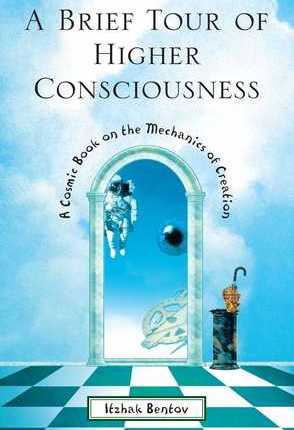
A Brief Tour of High Consciousness: A Cosmic Book on the Mechanics of Creation by Itzhak Bentov

A Brief Tour of High Consciousness: A Cosmic Book on the Mechanics of Creation by Itzhak Bentov

If you’ve been following this blog for awhile, you know now that I really enjoy “fringe” non-fiction that chronicles out of body experiences and remote reviewing.  This is another of those books.

If you’re not into those topics, my apologies in advance. 🙂

A lighthearted yet profound guide to the realms of higher consciousness and the ultimate nature of reality.

Goodreads
Photo by Pixabay on Pexels.com

My research into consciousness exploration continues with A Brief Tour of Higher Consciousness by Itzhak Bentov.

Having predominantly read books like this by artists (Jurgen Ziewe and Kurt Leland come to mind), it was refreshing to have a first person narrative by an engineer. Itzhak’s lens of perception is so different than my own- I loved it.

There is a part towards the end, What is a Hologram, and a chapter by another author, Essay on Cosmology by Edward Apgar, that I didn’t resonate with at all. But, perhaps for the most scientifically-minded, those parts will be your favorite.

hologram

Hologram image from nationaldefensemagazine.org

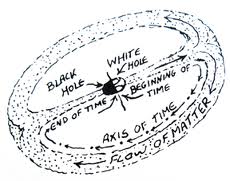
Itzhak has simplistic doodles scattered throughout the text which brings a “Randall Munroe” feel to the book- the use of simple pictures to illustrate complex and abstract ideas. This author definitely feels to me as if he was a bit ahead of his time in both his presentation and materials.

bentovdoodle

Bentov doodle from ritamarrpositivechange.wordpress.com

Itzhak’s explanation of “lens of consciousness”: “As consciousness evolves and information starts pouring in, the information is couched in a language best understandable to the person involved. For instance, a poet will be shown the nature of Creation in poetic images, an artist in visual symbols, and a mathematician in abstract equations; a nuts-and-bolts fellow like myself will have it shown to him as structure.” pg 5

I was reminded of Robert Monroe’s Journeys Out of the Body in which he puts emphasis on recording and comparing out-of-body experiences for consistency and real world applications to bring legitimacy to the practice.

I’ve heard that we’re all made of star dust and I really liked Itzhak’s description of it in this passage: “Stars collect into clusters or galaxies, and as they die, they explode and create cosmic dust, which again condenses into new stars and planets. Everything in the entire universe, including our bodies, is made of one cosmic substance. We contain atoms from the most distant galaxies and are thus connected to the whole universe.” pg 13

starsinthesky

Stars in the sky from wikipedia.org

Everything is vibration: “In short, consciousness in a vibratory state manifests itself as our familiar matter, from which the different forms that we see around us are made. The table, the flowers, the scent of the flowers, and our bodies are all made of rapidly vibrating consciousness.” pg 20 Wild!

A discussion of how to interact with devas (an ant deva to be precise, which is kind of silly, I realize), which Itzhak describes as “The name given to a being that is the rudimentary consciousness of any structure”: “To negotiate with her, the currency of exchange is love. Just send the ant deva a lot of love, which will stimulate her evolution. Even ant devas need love, in order eventually to know their Creator.” pg 33

Photo by Jimmy Chan on Pexels.com

In my meditations, I’ve frequently experienced what Itzhak describes in this next passage. It was nice to finally have a reason why: (While in a meditative state) “Wiggle your body. This causes a disturbance, a vibration, to spread … (This is similar to a fly falling into a spider web. The vibration of the web signals the spider and it shows up to investigate its dinner.) The deva .. appears immediately, looking worried and saying something like “What do you want?” or “Who are you?” pg 35

I’ll close with this excerpt of Itzhak’s philosophy: “There is nothing absolute and final. If everything were iron-clad, all the rules absolute and everything structured so no paradox or irony existed, you couldn’t move. One could say that man sneaks through the crack where paradox exists.” pg 78

If you enjoyed this book, you may want to take a look at Otherwhere by Kurt Leland or Multidimensional Man by Jurgen Ziewe. If you liked the doodles of complex concepts and want more of that, try Thing Explainer: Complicated Stuff in Simple Words by Randall Munroe.

Thanks for reading!

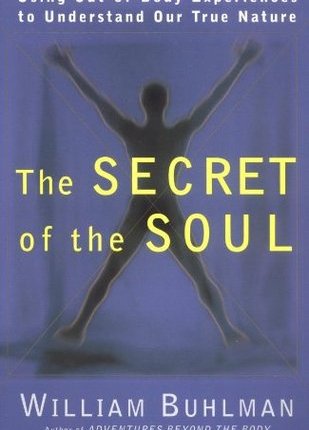
The Secret of the Soul: Using Out-of-Body Experiences to Understand Our True Nature by William Buhlman

The Secret of the Soul: Using Out-of-Body Experiences to Understand Our True Nature by William Buhlman

The Secret of the Soul is a great title for beginners who are looking to understand this, sometimes confusing, other times frightening, skill that we all seem to possess — the ability to exit our bodies in a kind of vision or trance.

Some call this the “out of body experience” or OBE.

Photo by Joshua Abner on Pexels.com

The first half of the book, Buhlman discusses OBEs, why they are important, and gives countless examples of actual OBEs that folks have had. The second part of the book gives concrete techniques and problem solving tips to assist readers in having their own OBEs.

One of my friends is a long distance runner who has had some OBEs during his ultra marathons. I thought of him in the section entitled “Combat and Trauma-Induced Experiences”: “It was while I was running in a marathon last year that I had a very strange experience. I was at about the eighteen-mile marker when I looked beside me and saw myself running. At first I thought it was someone who was my build and wearing the same shoes, but then I realized it was me!” pg 55

Buhlman has story after story like that.

Photo by anouar olh on Pexels.com

If you’ve never had an out of body experience of your own, the sheer variety and number of people who have fills you with confidence that you can.

I also liked Chapter 4, “Transformational Experiences”: For thousands of years spiritual masters have taught that the act of withdrawing from the senses is essential in order to consciously experience our spiritual self. pg 61

And the testimony from that chapter: “This is bigger then anything I can imagine; how can I tell people without sounding like a nutcase? This changes everything I ever thought I knew or thought was true.” pg 68

That’s the thing about powerful transformational experiences. Until someone has one him or herself, there’s not really anyway to explain it.

Chapter 6, “Extraterrestrial Contact and Abduction,” was the first time that I’ve read about aliens alongside traditional OBEs. Buhlman writes: “After reading more than two hundred such letters (from his OBE survey), I noticed a startling similarity: The letters describing extraterrestrial contacts and abductions were almost identical to the thousands of letters I have received describing out of body experiences. In fact, I often could not distinguish between letters.” pg 89

Photo by Francesco Ungaro on Pexels.com

In Chapter 7, A Brief History of Out-of-Body Experiences, the reader is given cultures from different time periods, all over the planet, that support and confirm the existence of out of body experiences.

These seem to suggest that OBEs are a “human” experience rather than a culturally specific one.

Take Emanuel Swedenborg’s words: “It has pleased the Lord to… open the interiors of my mind or spirit, whereby I have been permitted to be in the spiritual world with angels, and at the same time in the natural world with people, and this now (has happened for) twenty-seven years.” pg 113

I was surprised at how many of the historical figures presented here as having OBEs were scientists… I guess in my mind I’ve always drawn a line between the artsy/mystic types and the scientists. Line erased. 🙂

I’ll conclude with a few statements from the Appendix of the book, which was compiled from Buhlman’s extensive survey of people who had had OBE’s: “Self-initiated out-of-body exploration is a direct and powerful method to experience our true spiritual essence. It is an effective method to accelerate our personal growth and evolution. … This is achieved by personal spiritual experience and exploration beyond the physical limits.” Appendix pg 253.

Photo by Enrique Hoyos on Pexels.com

Couldn’t have said it better myself.

If you’re looking for more books on the topic of out-of-body experiences, check out Otherwhere by Kurt Leland, Journeys Out of the Body by Robert Monroe, or Multidimensional Man by Jurgen Ziewe.

Thank you for reading!