/ˌkrēāˈtivədē/ noun. the use of the imagination or original ideas, especially in the production of an artistic work. “firms are keen to encourage creativity”
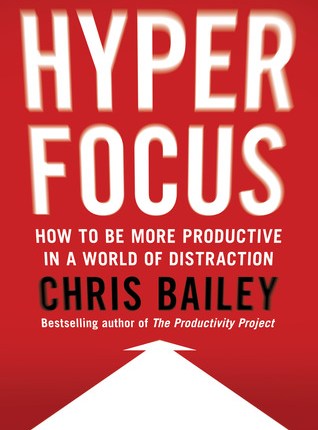
Most of his advice on how to improve your focus was common sense: drink a cup of coffee, rid your environment of distractions, only check your email once an hour.
The brilliance of this book is his method of codifying attention. He compares two types of attention, hyperfocus and scatterfocus.
Hyperfocus is fairly self explanatory – you only focus on one thing and redirect your attention if it wanders.
Scatterfocus is the mode that most of us wander around in every day. But, Bailey says, you can harness this type of focus too.
Use this method of focusing when you’re trying to be creative or looking for connections between seemingly unrelated ideas. It is the focus that sometimes hits in the shower, a ah-ha moment that changes the way you view reality.
I feel like there’s no real way to control that type of focus, other than to be self aware while you’re in it. However, I found Bailey’s suggestion intriguing. Perhaps if I set aside time each day to consciously let my mind wander, I will have a different view on it.
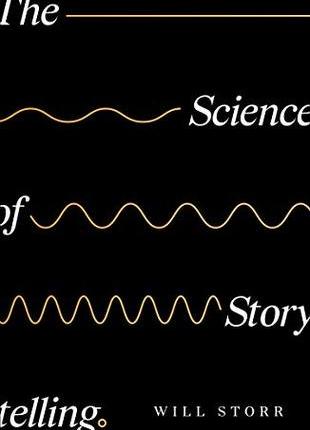
In The Science of Storytelling, Will Storr reminds readers our brains are hard-wired for stories and how best to utilize this in our own writing endeavors.
Through the use of various writing tools based on scientific research, Storr demonstrates how to appeal to an audience, keep them hooked and connected to the characters.
For example, Storr writes the use of change in storytelling grabs readers’ attention because human beings are always on the look out for it. Change can be good or bad- it’s life itself. Our brains look for change as a survival mechanism and this trait can be used to entice readers so they come back for more story.
“This is what storytellers do. They create moments of unexpected change that seize the attention of their protagonists and, by extension, their readers and viewers.” pg 13, ebook
Change is also something that people try to control (they can’t but they try). This universal pattern is called, ‘the theory of control’. When readers see traits they share with characters in stories, they become invested in the outcome which keeps them reading. Or when readers see traits they don’t believe they have, but do, they’re hooked.
There’s a lot of hooking going on, which is a good thing when you’re writing a story. 🙂
“A character in fiction, like a character in life, inhabits their own unique hallucinated world in which everything they see and touch comes with its own unique personal meaning.” pg 41, ebook
Storr suggests creating complex characters and writes that the story almost creates itself with a properly drawn character. A complex character has flaws, a personality, misunderstandings with others in the story.
Also, going back to the ‘change’ theme, complex characters are generally passing through a ‘change of status’ of some kind. This ignites curiosity in the reader. It makes readers ask themselves, ‘What’s going to happen next?!’
“The place of maximum curiosity- the zone in which storytellers play- is when people think they have some idea but aren’t quite sure.” pg 18, ebook
Work Rules!: Insights from Inside Google That Will Transform How You Live and Lead by Laszlo Bock is a behind the scenes glimpse into the “People Operations” of Google, the mammoth internet company.
Laszlo explains Google wasn’t always a global leader. It started out like every other company- with a couple of dedicated people and a big dream.
After some background, Laszlo gives step-by-step ways to improve your own business, whatever that may be, from the inside-out while remaining true to the mission that led to the creation of your company in the first place.
It’s clear from this book that Google is an engineer-dominated workplace. Every decision from hiring to employee perks is tested and the numbers are crunched to justify the expense, time spent, etc.
To be honest, psychology tests, graphs, and in-depth analysis isn’t really my thing. I enjoy a more artsy approach to the world and so the nitty-gritty of Laszlo’s work wasn’t that interesting to me.
In <i>Work Rules</i>, I was hoping for more insider stories than engineering problems, but that’s not how the book was written.
That’s not to say that there isn’t value to be had in this read. My take-away chapters were “It’s Not All Rainbows and Unicorns” and “What You Can Do Starting Tomorrow.”
In ‘It’s Not All Rainbows and Unicorns,’ Laszlo gives the reader moments in Google’s history when their policies didn’t really work and how they got through the crisis. It was heavy on dramatic stories and I enjoyed it quite a lot.
In ‘What You Can Do Starting Tomorrow,’ Laszlo boils down his previous chapters into ten steps for businesses to take right now. If you don’t have time to dig through the entire book, ‘What You Can Do Starting Tomorrow’ gives you a pretty thorough overview.
If you enjoyed <i>Work Rules!</i>, you may enjoy The Happiness Advantage by Shawn Achor. Shawn explains, in an engaging manner, many of the principles that Google has adopted to improve their employees’ quality of life.
I received a free advanced reader’s copy of this book through Goodreads First Reads. FTC guidelines: check! And thank you for reading.
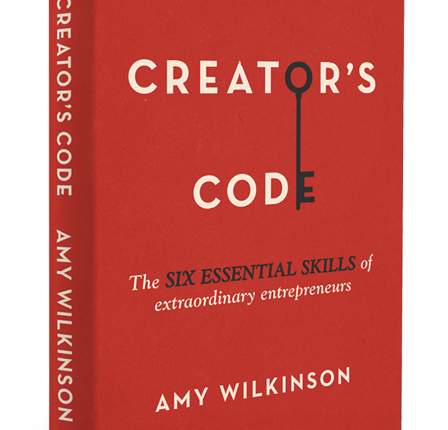
For The Creator’s Code, Amy Wilkinson interviewed over 200 wildly successful entrepreneurs and narrowed down the skills that they used to create their businesses to an “essential” six.
These essentials are the keys to the “creator’s code,” she writes.
My favorite chapter from The Creator’s Code is Chapter 5: Network Minds- Solve Problems Collectively. We’ve recently instituted some collaborative projects where I work and I’m excited to see this creative skill in action.
Also, I enjoyed the portion of the book where Wilkerson explored businesses trying to integrate computer games into the work day in order to encourage co-workers to help each other as well as to instill a sense of play into the creation process.
I wish that my library management system could be tweaked to do something like that. Imagine how fun that would be! Playing computer games in order to boost productivity.
In some ways, this book reminded me of Napoleon Hill‘s Think and Grow Rich. He also interviewed hundreds of wealthy people to understand their mind set. However, unlike the New Age, positive thinking slant of Hill’s work, Wilkinson relies on scientific studies as well as real world results.
Of the two approaches, I personally favor Napoleon Hill’s, but readers of a more scientific mind-set might enjoy this book more.
While we’re on the subject of read-alikes, I also read [book:How to Fly a Horse: The Secret History of Creation, Invention, and Discovery|20342540] by Kevin Ashton and it shared some of the stories from The Creator’s Code.
It felt slightly repetitive because of this. Otherwise, I may have given The Creator’s Code five stars instead of four. It felt like I was covering the same material. Despite this bookish deja vu, The Creator’s Code is very well researched.
So, if you’ve already read the other book, don’t be hesitant to pick this one up too. It was just not ground-breaking reading for me- my reviewer’s bias, I suppose.
There are some differences between the two works: How to Fly a Horse focuses on the history of the creative process and uses that knowledge to encourage the average Joe to be creative today.
The Creator’s Code has distilled the essential nature of creation and lists guidelines that can be used for success in business, art, science, whatever.
Though both encourage creation, Wilkinson gives actionable steps to take at the individual level whereas Ashton focuses more on the big picture.
If you enjoyed The Creator’s Code, I highly recommend How to Fly a Horse by Kevin Ashton and Think and Grow Rich by Napoleon Hill. Both of these works share the themes of success in business through creativity exploration.
I received a free copy of this book through Goodreads First Reads. FTC guidelines: check! And thank you for reading!
“When we unlock our sakti we re-connect with our capacity for inner joy and peace with ourselves: all our experiences begin to join up and make sense. Freeing our sakti in this way gives us the key back to our sexual selves, so that we may inhabit our whole being with authenticity and joy.” pg 508 ebook.
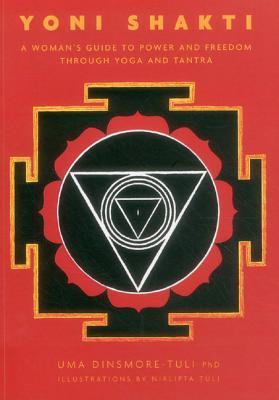
Author, yogini and tantrika, Uma Dinsmore-Tuli, shares yoga sequences, mantras, mudras and meditations to assist readers in becoming more aware of their inner selves.
What does this accomplish, you may be asking yourself. According to Dinsmore-Tuli, it’s the foundation of a mindful existence.
“All of the poses to unblock the life force energy are also very practical means to keep the creative and sexual energies in circulation so that they are available to nurture and enrich our creative, family, social and professional encounters.” pg 518, ebook
That sounds pretty good to me.
So, I tried some of the suggestions from this book which I had to cherry pick because there are dozens to try. And my results were unexpected and stunning.
After the first practice, I experienced an almost immediate increase in my sensitivity to my body’s energy and overall energy level. After the first week, this improved awareness led to some fascinating experiences during my meditations.
Apparently, practitioners of yoni shakti routinely encounter visions or spontaneous energy body knowledge. The goal is not to seek these experiences, but to be aware when they arise and dissipate, and then utilize them for greater self knowledge.
Using these teachings, I feel like I’m learning a whole new dimension to life- one that arises from practices of mindful awareness. Yoni Shakti is a good reference book for that journey.
That being said, a majority of this book is repetitive to the point of unreadable. I realize Dinsmore-Tuli is passionate about the women’s movement in yoga, but she goes on so much about past abuses by gurus and organizations that it detracts from the delivery of the wisdom of the book.
I found myself skimming entire sections because they read the same in the previous chapter and the ones before it.
On the other hand, this book shines in its accounts of the women who were suffering and then rediscovered their power and ability to heal themselves through their yoga practice.
“There is a deep relief in knowing that other women have experienced the same losses, and a comfort in hearing others speak about what is so often unspoken. The sharing is healing.” pg 597
Recommended, with a few reservations, to spiritual seekers interested in yoga and tantra- particularly women.
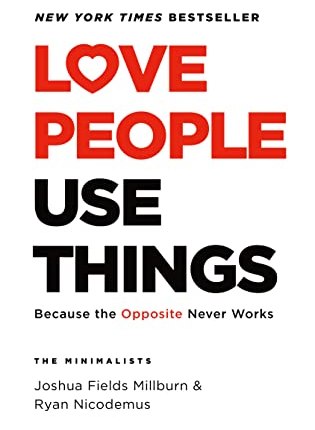
‘The Minimalists,’ Joshua Fields Millburn and Ryan Nicodemus, share their life journeys towards intentional living using seven different areas of focus: stuff, truth, self, values, money, creativity and people. Readers are invited to use the lessons they have learned to enact positive change in their own lives.
I, like many, had preconceived notions about what minimalism is. I thought it was about creating a living space that has like one chair, one table, and a cup with a single sharpened pencil in it. You can see the room, can’t you. In my mind, that was minimalism- bare to the point of ridiculousness.
Millburn addresses this misconception early on in the book.
“Minimalists don’t focus on having less, less, less; they focus on making room for more: more time, more passion, more creativity, more experiences, more contribution, more contentment, more freedom.” pgs 35-36
Sounds pretty good to me, Josh. So how do we get there?
“Minimalism is a practice of intentional living. While it starts with the stuff, it’s ultimately a stewardship program for one’s life.” pg 124-125
I’ve recently experienced some major changes in my life, which include relocating to a new home and moving almost a decade’s worth of stuff. During the process, I took the time to try on every piece of clothing in my wardrobe and, to my not-unexpected dismay, about three-quarters of the clothing no longer fit.
It was simply a matter of donating the old clothes then. But I found myself hesitating to do so. I’ve lived a lot of life in those clothes and just holding them brought back so many memories.
I realize the memories aren’t in the items, they’re in me. Millburn points out that it’s easy to make that mistake.
“While it’s true that our memories are not in our things, it is also true that sometimes our things can trigger memories inside us.” pg 20
He recommends taking pictures of these treasured items so you can continue to access the memories at will while still making room for growth.
Because that’s what all of this minimalism stuff is geared towards: Living an intentional life so you can grow with the values that you’ve chosen for yourself. What you’re aiming for is growing like a cultivated flower about to bloom rather than a tumor that spills out uncontrolled in all directions.
“Growth is a critical component of a meaningful life- as long as it’s responsible growth- because continual improvement makes us feel alive and brings purpose to our actions.” pg 170
To do so, we must first confront the reasons why we’re holding on to all these items in the first place.
“Fear is a common theme with people who are starting to confront their stuff. We’re afraid to pull back the curtain because we’re afraid not of the stuff itself, but of the work that must be done to live a more rewarding life after getting rid of it.” pg 102
And for me that’s the crux of the issue- fear. What am I afraid of? I’m afraid of living a life that doesn’t match up with my values. I fear change, not because it might be negative but because it pulls me out of my little routines into a place of uncomfortable uncertainty.
Your fears are probably quite different from mine, but the point is that you have them. Do you know what yours are?
Highly recommended for readers interested in self improvement, self help or the minimalist movement. Thank you to the publisher for a free advance reader’s copy of this book.
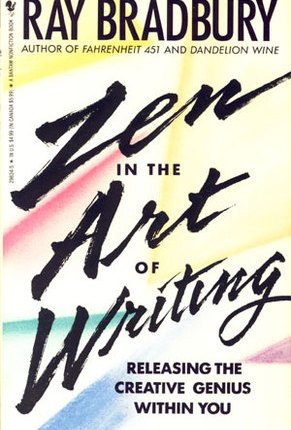
Ray Bradbury, a titanic author of American science fiction, shares remembrances and anecdotes from his lifetime. Within the essays, Bradbury shares both his passion for writing and the methods with which he accomplished it.
“And what, you ask, does writing teach us? First and foremost, it reminds us that we are alive and that it is a gift and a privilege, not a right. … Secondly, writing is survival.” pg 12, ebook
From his childhood days in Waukegan, Illinois, to penning screen plays in Ireland, Bradbury mined his life experiences with his subconscious mind and unearthed, so to speak, the stories that he wrote.
Ray Bradbury
“And when a man talks from his heart, in his moment of truth, he speaks poetry.” pg 32, ebook
Bradbury also highlights the importance of writing at least a little bit every day. Through his habit of writing an essay a week, Bradbury cranked out hundreds during his lifetime. Though he admits not all of them were brilliant, each one brought something to his experience, whether that was honing his craft or creating avenues towards other brighter stories.
Recommended for aspiring authors or any reader who is a fan of Bradbury. This book shines a spotlight on both the man and his creations.
“All too late it is beginning to be realized, slowly indeed but no less surely, that the historic evolution of dress and personal ornament offers a wide field for methodical study; that it is in fact a science and can be made to subserve worthier ends than those of mere amusement.” pg 11, ebook
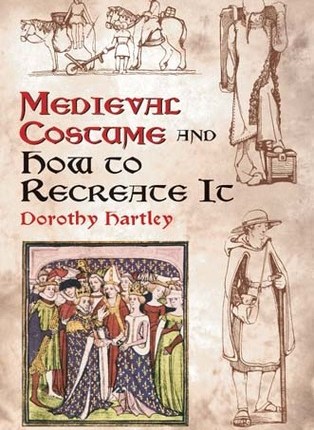
Medieval Costume and How to Recreate It by Dorothy Hartley is more of a history book than practical manual for dressing as a historical figure, unless the reader happens to have a very highly developed tailoring ability.
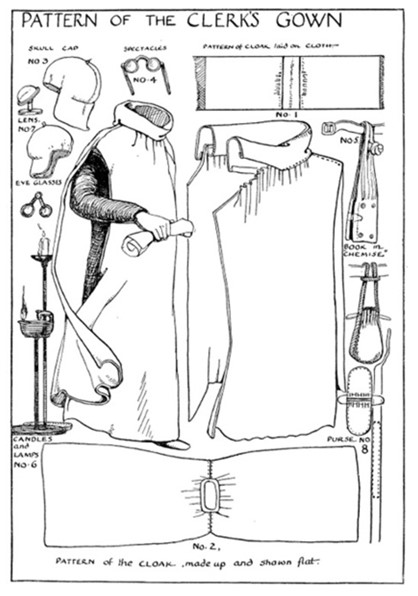
From the book.
At least, more than I currently have.
That being said, the divisions of different types of historical costumes into profession is inspired. As author Dorothy Hartley explains, at the beginning of the book, professions had a huge affect on how medieval persons looked. Think doctor compared to butcher compared to musician or priest.
“After the careful restrictions of religion and royalty, musicians are refreshingly loose, and may wear anything. Since there is no definite costume for musicians we have concentrated on robes and sleeves that give free play to the arms.” pg 74, ebook
In addition to the visible clothing, this book delves into the garments worn under historical clothing, which was a topic I hadn’t considered before. But, as Hartley writes, dressing as a historical figure gives the roleplayer the opportunity to both entertain and educate through the details of the costume.
For example, the thickness and type of the fabrics that go into hose have an obvious function as well as a proper place on timeline of historical costumes.
“To the casual enquirer it will no doubt seem a curious anomaly: it is none the less a fact that in the majority of costume-books no portions of man’s apparel are slurred over in so haphazard a fashion as those under the above heading.” (hose and breeches) pg 80
This book is a learning experience but, as I mentioned, also a practical one if you already know how to construct a shirt or are curious about how to make a cloak hang correctly.
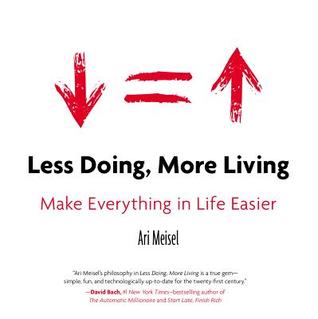
“The idea of Less Doing is to reclaim your time and- more important- your mind, so you can do the things you want to do.” pg xv
Ari Meisel, a self-professed “achievement architect”, outlines ways to streamline your chores, finances, and more in order to free up time for the activities, and people, that are most important to you.
“I don’t want you to run errands, ever ever ever again. They’re not efficient, and there’s no way to make them efficient.” pg 69
Many of his suggestions are common now, like setting up an automatic delivery from Amazon for your regularly needed household items like toilet paper and paper towels. But when I considered that this book was published in 2014, then it seemed like a stroke of genius.
However, that won’t necessarily be useful to readers who are looking for more updated suggestions to make their lives that much more efficient- except for a few of his timeless strategies. For example, measure and monitor how much time it takes you to do things so then you can figure out where your time is going to.
Not rocket science, but helpful.
The one suggestion of his that I found most intriguing was his idea of creating an ‘external brain’. Basically, you write notes, diary entries, clip electronic articles and organize it in a program (he likes Evernote) so that you can access it again quickly if you would like.
“… you can create an ‘external brain’ that stores everything reliably, offers instant access, and frees your mind for more interesting work.” pg 18
I thought this approach could be very helpful for someone like me who reads and researches different topics all the time, for the fun of it, but also for professional content creators who are looking for their next blog post or YouTube video, etc.
How much easier would it be to be able to access all of your previous research rather than having to start over from scratch each time?
On the other hand, there is a massive amount of time required to both create this external brain and keep it updated. I suppose the investment only makes sense depending on what you’re eventually going to use the database for.
Recommended with reservations for readers who are looking for ways to streamline their lives.

























 The Help Desk Book Blog