Random House Word Menu is a useful reference tool for anyone looking to be precise in her writing or conversation.
The book is divided into subject areas like ‘the sciences,’ ‘social order,’ ‘cognition,’ and much more. After each word, a brief description is given.
In some ways, Random House Word Menu feels quite similar to the ubiquitous Dewey Decimal system used by librarians.
With this book in hand, I could see researchers being able to find specific volumes more easily because the search terms are at his fingertips. He would then be able to give that information to a librarian, or utilize it himself if he knows the library system, in order to find exactly what he needs.
However, I tried to look up the word, ‘librarian,’ in the Word Menu and it wasn’t there! Oversight or purposeful act- you tell me.
I suppose author Stephen Glazier wouldn’t want to give too many tools to those book dragons. Who knows what they would do next…
Highly recommended for reference purposes. The only thing that would make this better would be if the book was digital and could be updated with minimal time, effort and resources. Until then, the physical tome will have to suffice.
“A clearly defined medieval book has a unique personality, and part of what we have been doing in our visits to collections has been to engage with manuscripts as individuals and to discover what they can tell us, which can be learned from nowhere else.” pg 569
Meetings with Remarkable Manuscripts is more than a scholarly look at medieval manuscripts. It is a book for anyone who appreciates the intersection of art, history, politics, religion, and the rediscovery of forgotten things.
Readers learn about the tremendous amount of materials and effort that went into creating the manuscripts as well as why they were created, and for whom. These details are incredibly revealing.
“The 1,030 leaves of the Codex Amiatinus would have utilized skins of 515 calves or young cattle.” pg 82
Christopher de Hamel attempts to trace the history of the books from their creation to the present. He visits libraries and museums across the world, relating stories of gorgeous buildings and caretakers both cautious and casual.
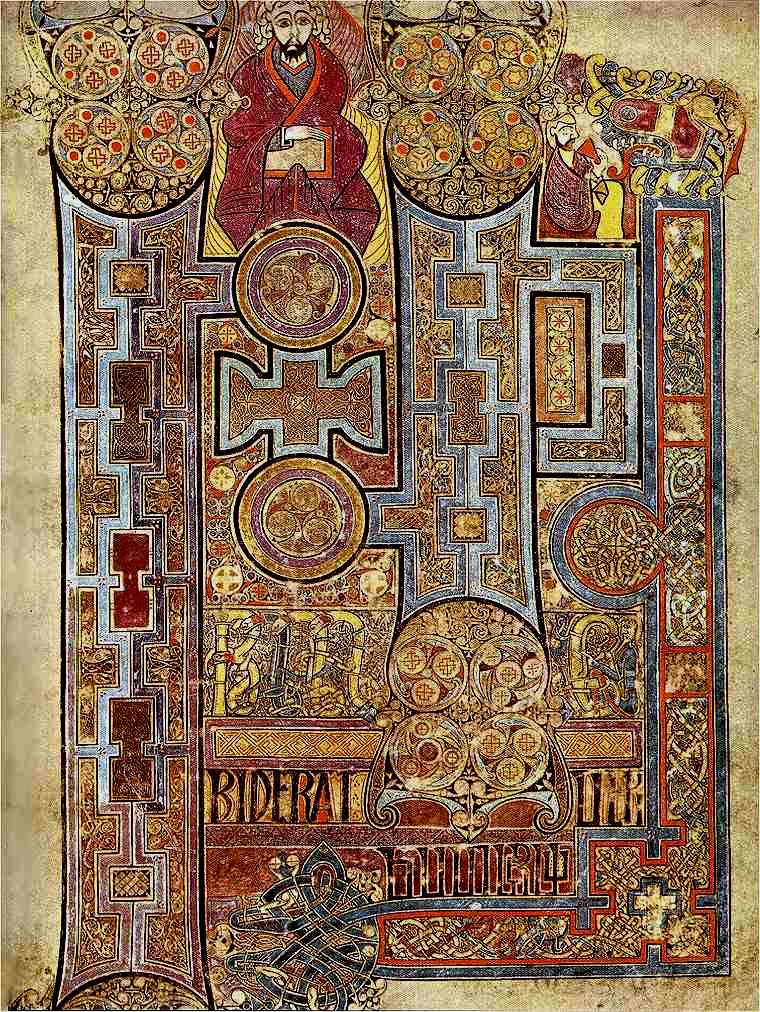
“The Book of Kells is so precious and so immediately recognizable that Bernard explained that it would be inappropriate to allow it into the reading-room.” pg 102
De Hamel has chosen twelve books from different centuries. As the reader progresses through time, the development of binding techniques, art, layout styles and more unfolds before her eyes. It is like viewing a series of snapshots about humanity, revealed through manuscripts.
A majority of the books are about religion, others war, and still others are concerned with the movement of the stars through the sky. Curiously, at least to this modern reader, the books weren’t necessarily created for the purpose of reading.
“Gospel was a work of art. It was a sacred object and a tangible symbol of divinity, enclosed in a cumdach, for sanctifying a church, for carrying in processions, for swearing oaths, and for veneration. … Mere reading was secondary.” pg 128
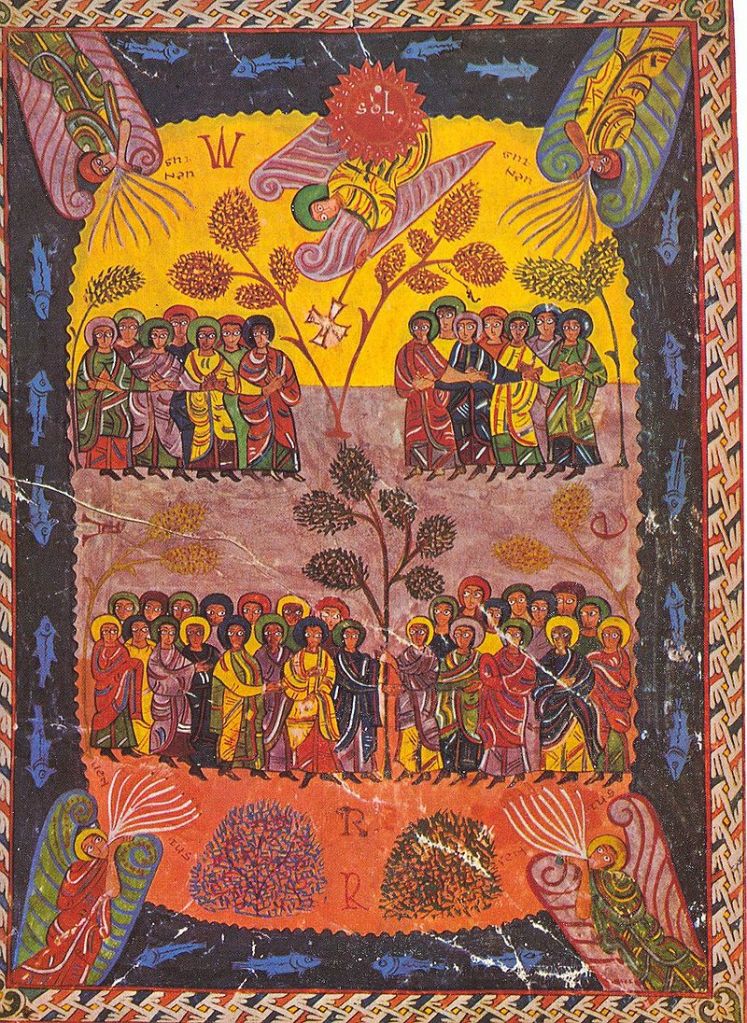
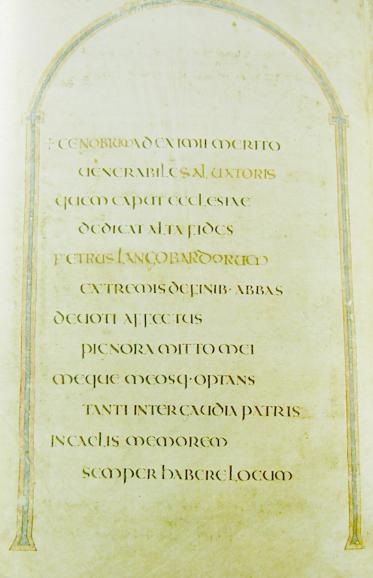
My favorite part of Meetings with Remarkable Manuscripts is the photo of the cover of each manuscript at the beginning of each chapter and the pictures of the pages scattered throughout the text.
“Those who meet famous people often remark afterwards how unexpectedly small the celebrated personage was in reality.” pg 17
This is a book that celebrates bibliophilia. The author lovingly describes what it feels like to handle the manuscripts, critiquing the art and admiring the meticulous calligraphy. He makes you feel like you were there too.
One small criticism, this is a dense read and though de Hamel does his utmost to make the topic accessible, occasionally it ventures into the niche, though fascinating, world of medieval manuscript scholarship. But he never veers too far from the path.
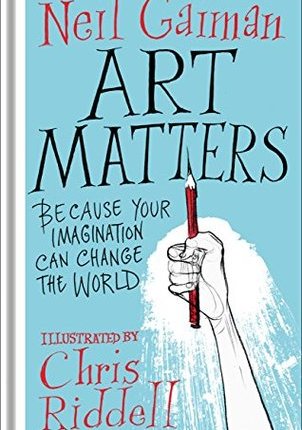
Neil Gaiman and Chris Riddell have created a manifesto for readers, librarians and content creators. This little book celebrates everything having to do with reading, freedom of information and ideas, and how to start creating the life of your dreams, even if you don’t know where to start.
It was compiled from Gaiman’s prolific back catalog of speeches, poems and various other writings about creativity.
“The world always seems brighter when you’ve just made something that wasn’t there before.”
I feel like this should be required reading — especially the parts about how to respond to intellectual disagreements. I think Gaiman penned these words after the bombing at Charlie Hebdo, and they still ring true.
“I believe I have the right to think and say the wrong things. I believe your remedy for that should be to argue with me or to ignore me. And that I should have the same remedy for the wrong things that I believe you think.”
And, of course, I was partial to all of the praise directed towards librarians and libraries, having been a librarian once myself. Sometimes people ask me if I ever think libraries will be closed because “they’re just a building with books” or “they’re a waste of taxpayer money”.
This is how I wished I had replied: “Libraries are about freedom. Freedom to read, freedom of ideas, freedom of communication. They are about education, about entertainment, about making safe spaces and about access to information.” How could that ever possibly go out of style?
Gaiman also gives attention to the bookworms of the world. We make it a better place through our reading and daydreaming and daydreaming about reading. Also, our epic library patronage is a good thing.
“We have an obligation to read for pleasure. If others see us reading, we show that reading is a good thing. We have an obligation to support libraries, to protest the closure of libraries. If you do not value libraries you are silencing the voices of the past and you are damaging the future.”
Gaiman shares a bit about how he became the universally beloved author he is today. Step one, you’ve just got to get started.
“If you have an idea of what you want to make, what you were put here to do, then just go and do that and that’s much harder than it sounds and, sometimes in the end, so much easier than you might imagine.”
He confesses that he lied on early resumes to get his foot in the door. But, after his later success, he went back and worked at all of the places he had claimed before. That way, he didn’t see himself as lying but as “chronologically challenged.” I loved that he took the time to make things right.
Gaiman also has some interesting views about no-start dreamers. He says the saddest thing to him are friends that say they’re too committed to follow their dreams. There’s bills to pay, mortgages and families to support and they can’t take the dive to do whatever it is they’ve always dreamed of doing.
He said he dodged that particular roadblock by skipping a well-paying job or two early in his career, so that he didn’t get too comfortable doing something other than writing. I thought that was an interesting strategy. Creating is about having the courage to just do it, no matter what and not stopping until you’re doing it.
“Somebody on the internet thinks what you do is stupid or evil or it’s all been done before? Make good art.”
The good news is there are more platforms than ever before to get your creations in front of the people who will care about them.
“The gatekeepers are leaving their gates. You can be as creative as you need to be to get your work seen. YouTube and the web (and whatever comes after YouTube and the web) can give you more people watching than television ever did. The old rules are crumbling and nobody knows what the new rules are. So make up your own rules.”
My own life right now points to the truth of that. I left a guaranteed paycheck and employer provided health care to write for my husband’s YouTube channel. We’re not only succeeding but we’re having a lot of fun doing it.
Thank you, Gaiman and Riddell for this beautiful book. I hope it encourages creators everywhere to take the leap.
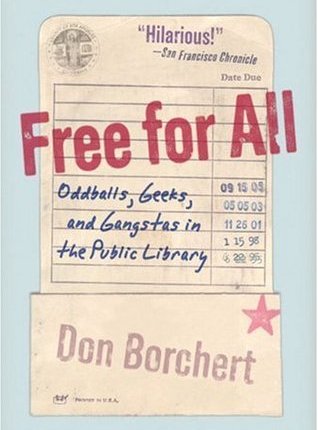
Free for All is an accurate depiction of life as a librarian in a public library.
Sometimes, the job is funny. Other times, it’s incredibly sad. If you’ve never worked in a library system, this book will reveal some of the secrets of a librarian’s day-to-day life.
Before I worked at a public library, I thought it was a quiet, organized mecca for students and bookworms. Now, that I’ve spent some time on the librarian-side of the desk, I know better. My idea of a library was far too simple.
It is a study hall, archive, playroom, home for the homeless, kitchen, bank, movie theater, video game store, newspaper kiosk and so much more. I guess the appropriate question is: what doesn’t a library do?
And a public librarian is so much more than just a librarian. She is a counselor, a computer wizard, a curator of excellent and free entertainment.
She talks to the lonely, uplifts the lost and helps the public navigate the dangerous waters of the internet.
If I ever cease writing for a living, look for me at the library. Odds are, I’ll end up back there.
Perhaps some of the policies at Don Borchert’s library have changed, but at the time that he wrote this book, they charged 50 cents to put a hold in for a patron. This policy shocked me, as my library always offered that service for free.
Borchert cheerfully documents the difficulties with summer reading people vs the school year regulars. It’s a real problem.
Both are excellent and realistic non-fiction books about the trials, tribulations, and, sometimes, life-enhancing satisfaction of working at the library.
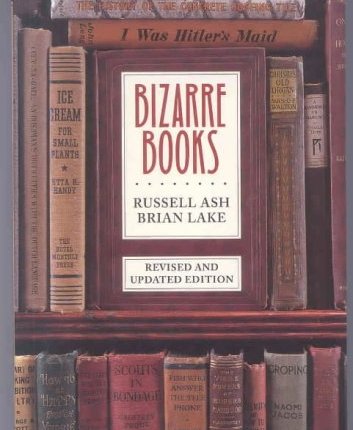
Though it relies too heavily on puns and doubles ententes, Bizarre Books is a humorous look at titles, subjects and author names in published materials. It is a must-read for any book lover or professional who deals with the printed word on a daily basis. *cough* Librarians. *cough*
“All the books recorded are real titles, with real authors. All of them were published with the serious intention of informing, not amusing. In this, they have signally failed.” introduction, pg 7.
I don’t think that ALL of them were meant to be informative. Take this entry from one of my favorite genres, science fiction: Planet of the Knob Heads. Stanton A. Coblentz. Science Fiction, Atlas Publishing, 1939. “Jack and Marjorie are brought to the distant world of their captors. In far Andromeda, they struggle against “favors” of the knob-heads – but hope fades as they face the High Knobule!” pg 40. Almost irresistible, isn’t it?
If science fiction isn’t your thing, how about this (I’m guessing) thriller: What Farrar Saw. James Hanley. Nicholson & Watson, 1946. “No story by Mr. Hanley is without its moral implications; here we have a glimpse of nightmare horror and chaos in a monstrous machine ridden world. It starts simply enough as chaos does. A young couple set off for a holiday in Scotland.” pg 44. Sounds at least as promising as The Girl on the Train, wouldn’t you say?
Those were some of the fictional books that caught my eye. On to the non-fiction. If it was on a shelf in front of me, I’d pick up Carnivorous Butterflies by Austin Hobart Clark, pg 62.
In the most ineffective category, the prize goes to: Atomic Bombing: How to Protect Yourself. Watson Davis, et al. New York: William H. Wise & Co. 1950. One of its suggestions was: “Curl up in a ball as you hit the ground.” pg 166.
By far, my most favorite selection is: The New Guide of the Conversation in Portuguese and English in Two Parts. Pedro Carolino.
Familiar phrases: Let us go on ours feet. At what o’clock is to get up? At which is this hat. Have him some children? pg 54. And so on. The authors dedicated another three pages to this gem alone.
Highly recommended from this bookworm. It made me laugh a lot and that is not easy to do.
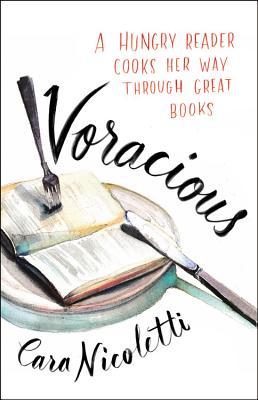
Voracious is so much fun. It is a foodie’s honest and open-hearted memoir in which she weaves literary themed recipes each chapter and gives a brief summary of the novel that included it.
The chapters from Cara’s childhood were some of my favorites because they were so relatable. “I cooked and read my way through awkward middle school years, first love, devastating heartbreaks, loss, and change. As I grew older, though, reading and cooking became the forces that broke me out of my shell, allowing me to form strong relationships and connect to the world around me.” pg 5, ebook.
Or this part, when she and her friends find Grimm’s Fairy Tales in the attic: “We were heavily into mysteries and ghost stories at the time, and when we found the book we were certain that we had discovered some dark secret that my parents had tried to keep under lock and key.” pg 13, ebook.
I know that feeling- when I was ten or eleven, I found a copy of Alfred Hitchcock’s Mystery Magazine that Grandma had loaned to my mother and I had read half of it before Mom discovered me, contently turning pages in the summer sun.
She took it away saying, “This is too old for you.” Some humbug mothers, hmph. I learned to hide when I was reading anything that I thought she wouldn’t want me to. Can’t keep a bookworm down.
In this passage, Cara talks about the culinary conundrum of gingerbread houses: “You toil and sweat, smelling good smells and touching sticky dough and mixing sweet icing for hours and your only reward is visual. It seems so wrong.” pg 15, ebook. I’ve always thought that too!
If I try any of the recipes in here, it’s going to be: If You Give a Mouse a Cookie- Brown Butter Chocolate Chip Cookies (pg 34, ebook) or To Kill a Mockingbird: Biscuits with Molasses Butter (pg 93, book).
I think that some of the huge list of offerings in this book are only for “brave” kitchen people. Cara includes recipes for homemade doughnuts, ice cream, chocolate eclairs… things that I don’t think I’ll ever gear myself up to attempt. But, she makes me want to try and I suppose that is half of the battle.
Highly recommended for anybody who likes to eat, read, or do both at the same time. I would guess that’s pretty much everybody.
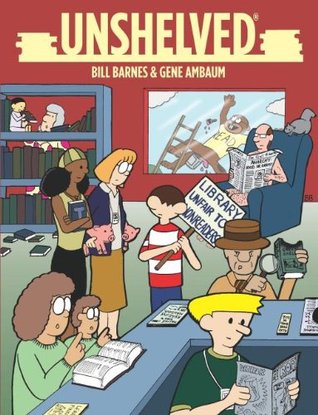
I enjoyed Unshelved, a comic about a public library, its librarians, and the ridiculousness that goes on when the library is open. But, sometimes the cartoon hit too close to home. I’ve been treated and spoken to like Dewey at the information desk, tons of times. So, librarians beware. Some of these are almost too true to be funny. On the other hand, I like my job, so I’ve never responded like Dewey. It’s cathartic, reading his sarcastic responses to ridiculous questions and situations.
My library has this book classified as young adult and I feel that it is an appropriate categorization. There’s nothing in here that I would find objectionable for a younger teen to read but some of the interpersonal problems may go over the head of a 12 year old.
Favorite character: Buddy the Book Beaver! Of course.
Favorite cartoons: The one where Merv writes a brochure to get more teens to come to the library pg 33 (My department is responsible for the young adult room, so I really appreciated the humor).
When the patron asks Dewey if he has any pens when he’s standing next to a pile of pens (Happens to me all the time). bottom of pg 41
And finally, when Dewey starts dispensing Eastern philosophy to the library patrons: “Search without searching. Look for nothing and find everything. Read the book but don’t look at the words.” top of pg 103. That’s probably me in about thirty years.
If you enjoyed Unshelved, you may want to pick up Rex Libris, Volume I: I, Librarian (Rex Libris, #1-5) by James Turner (another librarian themed comic) or The Black Belt Librarian: Real-World Safety & Security by Warren Graham (non-fiction book on how to deal with difficult patrons or security risks at the library). Thank you for reading!








 The Help Desk Book Blog