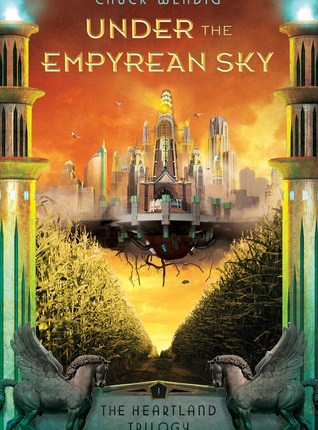
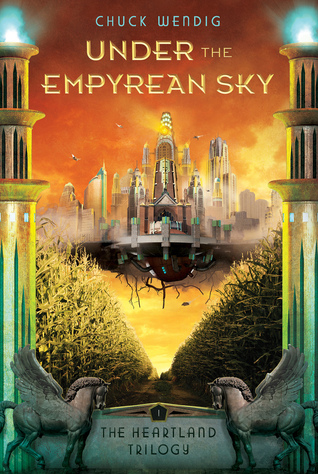
 Under the Empyrean Sky is the story of Cael and his friends, Rigo and Lane. They live in the Heartland, an agrarian world of genetically modified corn where no other crops thrive because of the aggressiveness of the new crop. There is little to no opportunity for education or work because the Empyreans, a separate section of their society that cruises overhead on their giant, flying machines, controls every aspect of their life from the food that they eat to who they can marry. Cael is the head of a scavenger crew who, in the course of their work day, stumbles across a forbidden garden and their lives change course forever.
This story was exciting. From the first scene of a race between scavenger crews for a malfunctioning piece of farm equipment to the end with an inevitable clash with the Empyrean, the story unfolds at a breakneck pace. If Cael isn’t dodging the local Overseers, he’s sneaking into quarantined cities or trying to harvest illicit vegetables. I loved how this novel was nearly constant action.
The dystopian world that Wendig creates feels scary and out of control. The plants, that the Heartlanders are forced to cultivate, attack them. The Empyreans, who aren’t properly introduced in this novel but I assume that they will be in future books, are outlandishly rich, extremely powerful through their advanced technology, and completely removed from the reality on the ground. The local authorities take advantage of the power of their position to line their own pockets at the expense of their neighbors. The reader feels Cael’s fury at his inability to control his life and the unfairness of the situation into which he was born.
It’s a small thing, but I didn’t like how the first half of the book was told nearly exclusively from Cael’s point of view and then towards the second half, the viewpoint began to bounce around between Cael and his friends. I think I would have enjoyed the story more if the narrator had remained the same throughout or had switched around from the beginning.
Another small complaint about the story is that the Empyrean lottery to join the ruling class on their air ships felt a lot like The Hunger Games or The Giver but with the outcome being presumably positive instead of a death match. Maybe it’s time for YA dystopian literature to move away from the lottery scenario.
That being said, fans of The Hunger Games or other survival/dystopian stories may really enjoy Under the Empyrean Sky. It’s fast-paced and surprising in its twists and turns. I sincerely hope that Cael’s story turns out well, but with the enormous odds stacked against him, it seems almost impossible that it could. I guess I’ll have to read the next book and find out.
I received this book as part of the Goodreads First Reads giveaway program.
Thanks for reading!

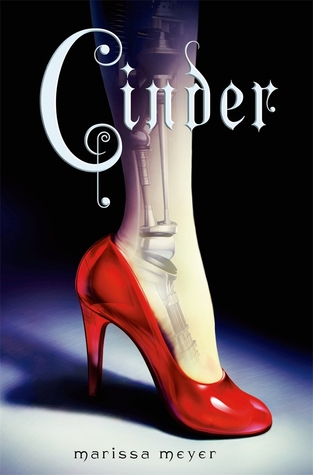 Typical young adult fantasy in that the ‘big twist’ was obvious from the start, but this story still has some charm. Cinder is a cyborg mechanic who wants to go to the ball, but she doesn’t have the time or money to do so. She lives in a world where cyborgs are despised, but tolerated. Humankind is suffering from a plague, one which strikes without warning and leaves the affected dead within days. There’s a draft for cyborgs to be tested upon in order to find a cure for this disease but Cinder is lucky in that her number hasn’t been drawn yet.
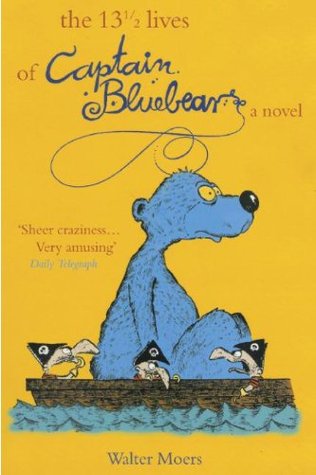 This book was very strange. It reminded me of Charlie and the Great Glass Elevator by Roald Dahl. Moers writes page after page of strange creatures, worlds, and circumstances that are only connected because Bluebear passes through them. And, like in Dahl’s book, I felt like the author was always hinting about a greater truth behind the story, as if The 13 1/2 Lives of Captain Bluebear was more a gigantic allegory than a children’s book. I enjoyed the fantastic nature of it but I didn’t like the long lists of creatures that read more like crazy encyclopedic entries than an actual story with characters.
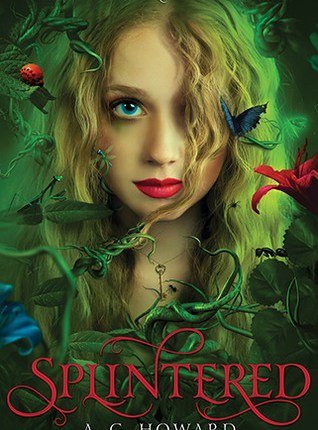
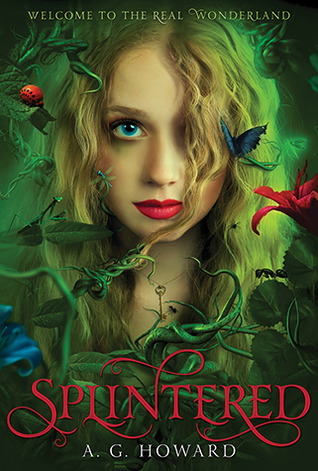 Alyssa is a descendant of Alice Liddell- the Alice who inspired Carroll to write his tale of white rabbits and fantastical creatures. But, Alyssa has a family secret: the women of her bloodline go insane when they come of age.
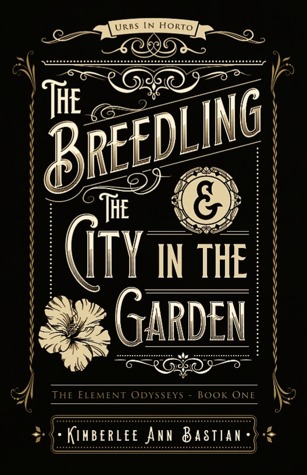 Bartholomew is a Breedling- an immortal spirit that guides the souls of the mortal dead to their eternal homes. He is tasked by his masters, the Fates, to find the Creators of the world, who have gone missing. Bartholomew finds the ones he’s seeking, but then refuses to reveal their location and as punishment, he is sealed in a prison until he changes his mind or the end of time, whichever comes first. But, magically, Bartholomew escapes and finds himself in 19th century Chicago in the company of two boys who are named Charlie and Jimmy. Bartholomew must find a certain mortal to bind his spirit to this world or he will end up back in his timeless prison. He also must complete his original quest- to find the Eden Wanderer. But, he must accomplish all of this without the mortals knowing who he really is or what he is really seeking. Will he succeed?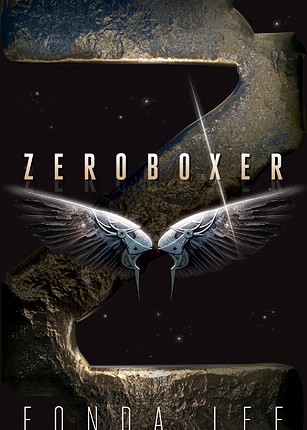
 At first, I thought that Zeroboxer was just Rocky in space, but as the story developed, I realized that it was more than that. Zeroboxer is also an examination of genetic ethics and, like most science fiction, poses some serious ‘what if’s. What if humanity begins to settle the universe- will they divide themselves into different races depending upon their planet of origins? What if the settlers develop their own system of government- how will humankind negotiate the potentially choppy waters of intergalactic politics? What if humanity could use gene therapy not just to eliminate disease but also to create a sort of super human? Fonda Lee has imagined a future filled with flawed but well-meaning people that feels very similar to our own and is, perhaps, not as far into the future as one may imagine.

 Templar: a graphic novel about the dissolution of that famous order and the struggle for the legendary treasure that they left behind. A couple of weeks ago, I read the first book in this series and I enjoyed it more than this complete volume. It was the ending that diminished my enjoyment of it the most, which I won’t get into because I don’t want to ruin it for anyone, but that was really my issue. Mechner ties up the major plot points, but I didn’t like how he did it- at all.
 The Help Desk Book Blog