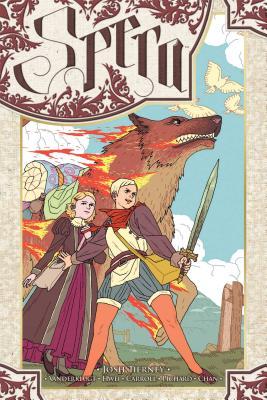
Spera is the story of two princesses, one who likes to sword fight and explore and another who likes to read and stay inside. One day, the tomboy princess, whose name is Pira, turns up in Lono’s (the reader) kingdom and says that her father the king is dead. They have to get away now to save Lono’s life. Where will two young princesses go to hide? A magical land called Spera. And so, the adventure begins.
I think that Spera tried to tell an engaging fairy tale with built in gender role options to educate impressionable young girls about who and what they can choose to be, but it didn’t quite work. Graphic novels need more than an interesting characterization idea- to engage reluctant readers, they need to tell a great story. Spera never gets there. The underlying message is sound- let children be who they are. Don’t point girls towards a book or boys towards a sword just because that’s their gender. But frankly, that’s it. The rest of the story, minus a run in with a creepy child, is kind of a non-starter.
Multiple authors contributed to this book so that’s a plus in my mind. Every chapter the reader gets a different artistic interpretation of Pira, Lono, and the fire spirit, Yonder. I gave Spera an extra star on Goodreads just for the artwork. As an adult, I found the variety enjoyable but I could see it being confusing for younger readers. They may not understand why the characters look so different every couple of pages.
If I was asked for a graphic novel recommendation for young girls that has fantasy elements, I’d skip Spera and point readers towards Princeless #1 by Jeremy Whitley.
There are spoilers further on in this review. Please, dear readers, do not read this if you haven’t had a chance to read the book yet. Thank you 🙂
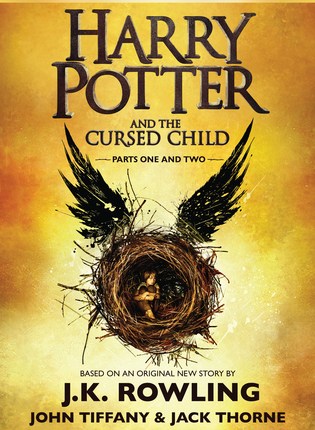
I had a disagreement with my husband about this book. He’s of the opinion that J.K. Rowling said she wasn’t going to write anymore Harry Potter stuff and that she should just let the seven books remain as they are- like a magnum opus. He was irritated that, with the film coming out in November, and this play being performed, and that new set of Pottermore stories that are being published, it seems like Rowling is just out for more money.
I, on the other hand, just kept saying, “But, it’s Harry Potter!” “But, it’s her creation and she should do whatever the heck she wants with it!” “But, it’s Harry Potter!” Neither of us convinced the other, so I just gave up trying to talk him into reading it and read it myself. I read it through in one sitting and cried and just adored it.
It’s funny- I’d never read a play before and this year I’ve read two, Hamilton: The Revolution and now this. I thought that it’d be annoying with the character listings and stage directions, but, as you read, all of that melts away and you’re just left enjoying the story.
And what a story it is! ***If you have not read it, do not read past this point. I have to talk about things that may ruin your enjoyment of the story and you do not want that. Here’s your warning. You’ve been warned. Seriously. Do yourself a favor and stop now!!!*** Ok. Who else thought that Ron was written like a complete moron in this? I mean, I know he wasn’t the brightest crayon in the box, but come on! He’s bumbling around, constantly eating… at least in the other books, he had moments of brilliance. I was completely let down by the way his character was developed. But, that is really my only complaint in the whole thing.
Hermione continues to be awesome in all the timelines- as it should be. She was always my favorite. I don’t know if it is because she’s a girl, or reads a lot, or both those things, or what. Minister of Magic? Of course! We all knew that she was going straight to the top.
Now Harry… he had Ginny have an interesting relationship. I thought that there’d be more affection and less judgement between the two of them, but maybe that was just me reading between the lines. Also, who else was relieved that Harry finally had a moment to confront Dumbledore and say, totally paraphrasing, “What the heck! I was a kid and you knew all of these terrible things were going to happen, that I’d probably have to die, and you didn’t say a thing! That was not your best moment.” I think we’ve all thought that.
So… FINALLY! It was quite a release. And then, that moment, when he’s there for the death of his parents as an adult- totally understanding what was going down but unable to change it because it would ruin the timeline forever? Oh my gosh, you guys. I don’t cry when I read, but this one had me sobbing. It was so poignant and heartbreaking…
Also, in the alternate timeline when Snape was still alive… aaaaaah! Loved it.
Let me put some of my favorite quotes in here and end this review. I could gush for pages if you let me.
GINNY: “People always look when you three are together. And apart. People always look at you.” pg 14, ebook. Can you imagine having that kind of notoriety? I guess a real world equivalent would be if you were a Kardashian or something… ugh.
DRACO: “I don’t care what you did or who you saved, you are a constant curse on my family, Harry Potter.” pg 58, ebook. Who else missed Draco? Raise your hands, friends…
SCORPIUS: “I, uh, I opened a book. Something which has- in all my years on this planet- never been a particularly dangerous activity. … DELPHI: “She’s weaponized it. She’s weaponized her library.” pg 63, ebook. Good old, Hermione. Fighting back with books.
I’ll leave you with the wisdom of Dumbledore: “Harry, there is never a perfect answer in this messy, emotional world. Perfection is beyond the reach of humankind, beyond the reach of magic. In every shining moment of happiness is that drop of poison: the knowledge that pain will come again. Be honest to those you love, show your pain. To suffer is as human as to breathe. … Those that we love never truly leave us, Harry. There are things that death cannot touch. Paint.. and memory.. and love.” pg 185 & 186 ebook.
Now to see the play performed! If you loved the original series, you will probably get a huge kick out of this. Recommended for ages 10+ or younger, if they can handle some intense magical sequences.
Dear readers, there are some spoilers in this review, but they’re necessary for a thorough discussion of the comic. Please, if you haven’t read this one yet, go pick it up from your local library and then come back to this review. Thank you 🙂
The Princeless series continues to deliver strong female characters, beautiful (child appropriate) artwork, and storylines with meaning. Each time Adrienne and Bedelia venture out to rescue one of Adrienne’s sisters, a facet of relationships is dissected and examined. This volume dealt with abusive relationships and gender roles in government.
Now, it’s not that cut and dry on the surface- the story itself is really fun and engaging. Adrienne and Bedelia have to survive a cannibalistic tribe of goblins in a monster infested swamp in order to reach Angoisse’s tower. On the way, they befriend unlikely allies and encounter a plant-like terror.
While this is going on, Adrienne’s brother, Devin, refuses to embrace traditional gender roles and activities, which continues to infuriate his tyrannical father. Their relationship illustrates the eternal struggle between parent and child. Parents think they know better and push their child in the direction they believe they should go, while children want to follow their natural inclinations. In the push-pull dynamic, somehow everything works out fine, but with more bad feelings on either side than there need to be.
The abusive relationship portion is tactfully presented in the interactions between Angoisse and Raphael. Sometimes people act a certain way because they want something out of you, other than your company. Kids get it. But in an era of Twilight idealization, I think the presentation of a “vampire” who acts out of self-interest rather than undying love is an important topic to discuss.
Teen relationships are just as thorny and prone to abuse as adult relationships and, because they are some of the first experiences that teens have, they have the potential to color the rest of that person’s lifetime and set the stage for the relationships to come.
Angoisse is a victim of Raphael but also her own beliefs. She’s always thought that she needed a man to complete her and she was going to do whatever it took to keep that relationship intact, even to the point of giving up her humanity or betraying her own family.
It didn’t take a very smart predator to see that she could be manipulated through her feelings. Sadly, such people actually exist. Thank you, Princeless for opening a door to the discussion of how to remain true to yourself in relationships and a powerful example of how to leave the ones that have soured.
The story is not too complex and adult readers may find it rather simplistic (unless you dig deeper into the underlying meaning), but it’s perfect for the 8 to 12 year olds. This comic will appeal to reluctant readers of either gender. I highly recommend it.
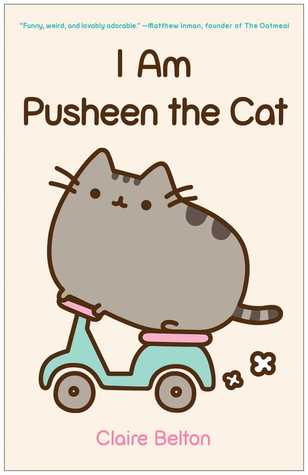
As I’ve mentioned in a few other reviews, my nine year old hates to read. It breaks my heart. I’m constantly searching for titles to pique her interest and I struck gold with this little book, I am Pusheen the Cat.
Usually, when I bring a book home from work for her, she takes one look at the title and then puts it on her desk…where it sits, until I have to take it back to the library again. This one was a completely different experience. I handed it to her. She sat down. She opened the book and read it cover to cover right then. I was blown away. Seriously, you could have picked my jaw up off of the floor.
There’s no story to this book. It’s just a series of cutsie pictures of Pusheen and her sister, Stormy. There are, however, some tricky vocabulary words thrown in like “inconvenience” or “procrastinator”. I was in mommy/librarian heaven, helping her sound out the words and explaining what they meant. I can’t say enough how much it meant to me to find something she liked, no, loved.
For me, I am Pusheen the Cat is a three star book at most. It’s cute, sure, but that’s about it. For my child, however, this is the holy grail of graphic novels. If you have a reluctant reader, I can’t recommend it highly enough. In fact, I may pay this book the ultimate compliment (in my mind) and purchase a copy of it for my home. Coming from a public librarian, that’s high praise indeed. Thanks for reading!
My search for reading material that my daughter will enjoy continues. I happened to stumble across When Crocs Fly by Stephan Pastis in the ‘Read Now’ section of NetGalley and gave it a read through.
When Crocs Fly combines the sarcastic put downs and delivery of Garfield with the physical humor of Looney Toons. The jokes are mainly puns, misunderstandings, or a combination of both. The longest scenes are only two pages, so Pastis never really writes a story- it is more a collection of vignettes, which could be perfect for readers with shorter attention spans.
But, if your child is reading this, make sure that they have strong language skills. Whenever the crocs speak, their voice is written phonetically, which could be problematic for beginner readers. I think it’s the equivalent of trying to read cursive handwriting… just different enough to cause a problem.
Some beloved characters from other comics make very brief cameos in this. I won’t say which ones because that would ruin the fun!
Though I didn’t have any laugh out loud moments in this one, my favorite page was ‘The Trophy from the Ping Pong League’ (pg 85) where it’s labeled as ‘Best Participation by Someone in our League who can Breathe and has Participated.’ When Crocs Fly has clever ways of skewering reality, but I’m afraid that the more subtle jokes will go over the kiddie’s heads and I don’t think that adults would really enjoy this one. It’s clearly aiming for a younger set.
I’d recommend it for ages 10+, personally, but it really depends on the maturity level of the child reading it. Big thanks to Netgalley for the free digital copy and thank you for reading!
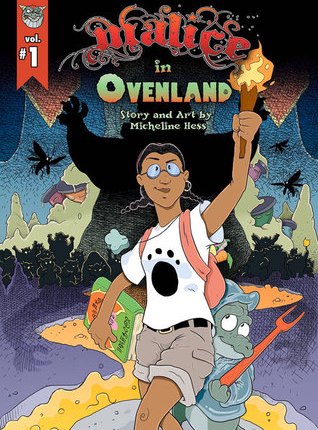
Malice in Ovenland by Micheline Hess is a graphic novel for children. Lily Brown’s mom tells her to clean the kitchen- and her adventure begins.
An excellent pick for reluctant readers, this story is a cute, gross, and, endearing romp through a fantastical world hidden behind an oven.
Lily’s heroic journey reminded me of the comic series, Princeless by Jeremy Whitley. In Princeless, the heroine tires of waiting for a prince to come save her, so, she sets about saving herself.
Lily is no wilting flower either, despite her name. 🙂
With art and a storyline appropriate for the pre-teen crowd and an empowered female protagonist, I could see this being a great addition to any juvenile’s graphic art collection.
What I enjoyed most about Malice in Ovenland were the homages to other great works of children’s literature.
The obvious one, of course, is to Alice in Wonderland but I also caught shades of the Lord of the Rings in the poem included at the end of Chapter 1.
The moment that Crumb comes to visit Lily in the dungeon reminded me of when Taran met Gurgi in the Black Cauldron.
The Queen’s advisor, named Crispodemus, reminded me of Nicodemus the rat from the classic children’s story,Mrs. Frisby and the Rats of NIMH by Robert O’Brien. (One of my all-time favorites, by the way)
And finally, The Royal Rangers reminded me of the Beagle Boys from Duck Tales– bumbling, minimally intelligent thugs, who would be harmless if they weren’t so determined to be bad.
Malice in Ovenland would be a great title for a reluctant reader or a reluctant eater. The story, in addition to the adventure, teaches kids to not be afraid to try new things- either food or life related.
It’s a message that can’t be repeated enough.
The humor is mainly gross-out or potty-related but, as a mother of a soon-to-be-10 year old, that’s exactly where her humor is at right now. It’s perfect for the audience that it is seeking.
Big thanks to NetGalley for providing me with a free digital edition of this title for review purposes and thanks for reading!
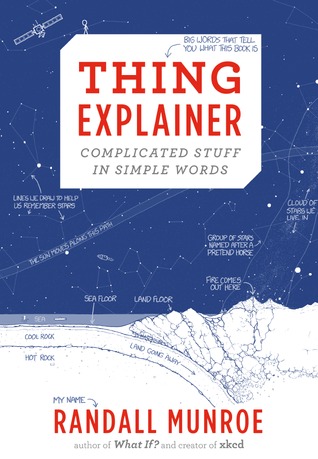
Randall Munroe uses stick figures and simple diagrams to explain abstract and difficult concepts. It’s brilliant really.
Thing Explainer: Complicated Stuff in Simple Words is inspirational for educators who struggle to make complex concepts accessible.
I’ve run into this problem when trying to create fliers to describe, simply and succinctly, the process that you use to check out ebooks from the library. It feels like an impossible task.
Munroe shows in this clever book, that anything is possible to explain simply and with stick figures.
From Lifting Rooms (elevators) to Our Star (the sun), Munroe explains it all with only ten hundred (1000!) of the most commonly used words in the English language.
Every page is a gem, but I particularly loved The Pieces Everything is Made of (The Periodic Table of Elements) pg 47-48 and The US’s Laws of the Land (United States Constitution) pg 14.
Though simple enough for a child to understand, the cartoons contain small puns and inside jokes that adults will enjoy too. So, I recommend this non-fiction book for everybody.
Warning: this is a book you either love or hate. Consider yourself warned.
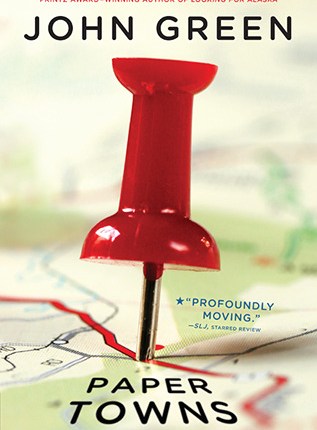
I fell more on the “hate” side of this equation but, surprisingly, enjoyed the film. This young adult, coming-of-age tale has elements of mystery to it.
Quentin has always loved Margo. One night, she wakes him up and they go on a wild tear about town, righting perceived wrongs and causing all sorts of hijinks.
Right off the bat, the reader is thrown into Margo and Quentin’s lives and we’re exposed to some of their worst traits rather than their best. Usually, people behave their best when you first get to know them and then, as they become comfortable with you, they let some of their more questionable sides out.
The whole “rolling around the neighborhood at night and causing mayhem” takes place right at the start of Paper Towns. It isn’t fun because we don’t really know these characters yet.
It’s easier to forgive adolescent hijinks when you know and love the people who are doing them, but we’ve got almost zero time to form a connection before they’re breaking laws.
I think I would have given up on Paper Towns if I hadn’t watched John Green’s TedTalks video on the topic. If you haven’t seen it yet, here it is:https://youtu.be/NgDGlcxYrhQ
Quick summary of Green’s video: The basic idea behind a paper town (a made up town on a map) was copyright protection. The coolest part is that the mapmakers took something that wasn’t real and made it real because they presented it that way for so long.
I know that John Green can write amazing, sympathetic characters. He chose not to in this book and I’ve been rolling it around my brain, wondering why.
I think that Green wrote the characters in this story like a paper town.
At first, he presents the main characters as over-the-top clichés of what teenagers could be. The reader isn’t necessarily meant to bond with them at this point, they’re not real, they’re just “people on paper.”
Then, through the second part of the book, let’s call it the “clue finding” part, Green slowly reveals more and more of the real parts of their characters just as Quentin finds more and more clues to where Margo has gone.
Through their hopes and dreams, relationships, daily struggles and hopes, they’re becoming more real.
Finally, in the last third of the book, as we join the characters on their mad rush to find Margo, they’ve become real. Real enough to have some close life-threatening moments on the road. Though they started out fake, Green built enough substance for the characters so that they have heft and dimension.
That’s my theory on why Green wrote such awful characters: he meant to. But, I still never liked any of them very much, even after they became “real.”
I liked Green’s prologue: “The way I figure it, everyone gets a miracle. Like, I will probably never be struck by lightning, or win a Nobel Prize, or become the dictator of a small nation in the Pacific Islands, or contract terminal ear cancer, or spontaneously combust. … My miracle was this: out of all the houses in all the subdivisions in all of Florida, I ended up living next door to Margo Roth Spiegelman.” pg 15 ebook.
“Margo always loved mysteries. And in everything that came afterward, I could never stop thinking that maybe she loved mysteries so much that she became one.” pg 23 (ebook)
And that was the high point in this book for me. It was all downhill afterwards.
Here’s the passage that helped develop my theory about Green writing paper characters in Paper Towns: “… she looks like Margo Roth Spiegelman, this girl I have known since I was two- this girl who was an idea that I loved. And it is only now, when she closes her notebook and places it inside a backpack next to her and then stands up and walks toward us, that I realize that the idea is not only wrong but dangerous. What a treacherous thing it is to believe that a person is more than a person.” pg 406 (ebook)







 The Help Desk Book Blog