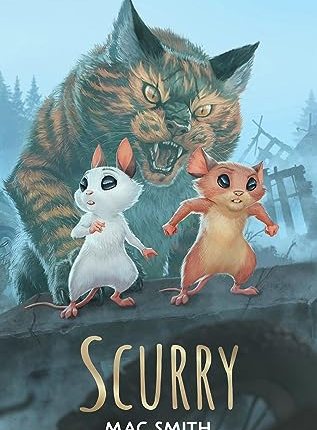
Wix is a mouse with a major problem: there aren’t enough resources to feed the colony he lives with. He braves hungry cats and birds, mysterious foxes and roaming wolves, as well as a myriad of other dangers in his quest to find food for his people.
Pict is the daughter of the leader of the colony whose name is Orim. Pict longs to be out in the wilderness but her many duties keep her at home. This is her life until something extraordinary happens and then she must go forth to warn Wix, as well as the others, about what has transpired.
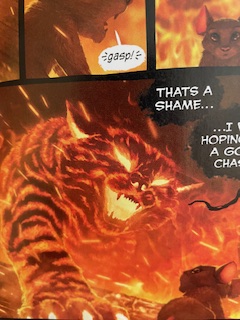
The story in this graphic novel has been told before. However, the artwork that accompanies the tale is beautiful. I especially liked the panels that contain flames. The light that shines on the characters brings additional depth to the drawings. It is worth picking the book up for that alone.
From the book’s cover, I learned Scurry was initially a webcomic. It definitely deserved getting its own printed medium.
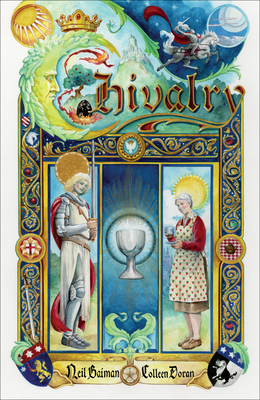
Chivalry is a delightful fantasy short story by Neil Gaiman and illustrated by the talented Colleen Doran.
The story itself is simple: an elderly woman discovers the Holy Grail at a second-hand shop and takes it home. A knight comes questing for the grail and she is unwilling to give it up.
Does everything end up happily ever after for everyone in our tale? Read and see…
I loved the artwork of this story. Doran uses beautiful colors to highlight the art. Some of the pages are done like medieval folios, they were my favorite.
In the notes at the end of the book, Doran shares she wanted to make the whole book like an illuminated manuscript but she discovered that was unworkable. The pages she did do in that style are breath taking.
Highly recommended for fantasy and comic book fans.
**Spoiler alert: for those who haven’t had the chance to read this classic tale. Please read before you enjoy this review!**
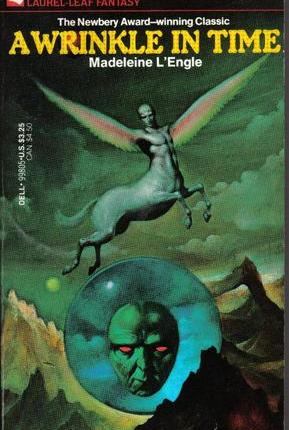
A Wrinkle in Time begins in a deceptively normal way: on a night with wind-tossed trees and a howling rain storm. From there, award-winning author Madeleine L’Engle takes readers literally to the stars and beyond in this extraordinary coming-of-age fantasy novel.
I first read about the adventures of Meg, Charles Wallace and Calvin when I was eleven or twelve years old. It was during my early bookworm phase, when I was still learning there were genres that I enjoyed more than others.
I was swept up in the adventure part of this story- facing down the shadows and ‘It’ in my subconscious mind and heart. I remember thinking the Aunt Beast portion of the story was boring and being disappointed Meg’s father was a real man with flaws rather than a superhero who could solve all of her problems.
Looking back on that interpretation now, I see my own burgeoning psychological development and the belief that my parents were some kind of godlike beings- something that most if not all children pass through at some point or another. When did you discover that your parents were real and fallible, just like you?
However, listening to the audiobook as a fully grown adult with a daughter of my own, I was struck by Meg’s strength and bravery. It takes a great deal of inner resolve to face down society’s expectations and the numbing experience of living soullessly every day, following someone else’s school or work schedule and agenda. (A real life version of the pulsing, all-encompassing brain of L’Engle’s fantasy world.)
How many days have I awoken only to race off to the hamster wheel of the work week- toiling away so the highly-paid minds of the CEOs could rest easy, knowing that the company was producing product (whatever industry that may be) and providing value for the shareholders? More than I’d care to admit, before I discovered the safe haven of the librarian’s world.
In my own effort to find my calling, I was reminded of Meg’s struggles to survive her encounter with It, not just survive but decide how her body and mind should function. In some ways, the modern work experience feels like someone else dictates how many breaths you should take per minute or what rhythm your heart should beat.
I had the good fortune of listening to an audiobook that has L’Engle speaking a brief introduction and then an afterword read by one of L’Engle’s granddaughters.
The granddaughter (I’m embarrassed I don’t remember her name) shared the details and struggles of L’Engle’s life- including the rejection of her manuscript by numerous publishing houses and the shade some readers threw her way for their own interpretations of her story. Some claimed the book was too overly Christian while others thought it promoted witchcraft. Her granddaughter said L’Engle was baffled by the hate mail.
Photo by Abstrakt Xxcellence Studios on Pexels.com
Curious how a reader’s lens of perception shapes the experience you have with a book. As I mentioned earlier, as a child I thought this book was a grand adventure. As an adult, I see it as a metaphor for living in the modern world.
I’m keen to have my own reluctant reader try this book and share what she thinks about it.
Recommended for everyone but especially those who find themselves a beat or two out of step with the proverbial Its of the modern world. This book reminds you that you’re not alone.
I enjoyed the book more than the movie- but here’s the trailer for those who like movies more than books.
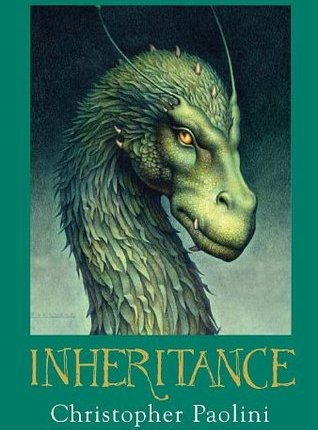
Christopher Paolini brings his fantasy series for young adults to an end with Inheritance, the fourth and final book in The Inheritance Cycle.
Eragon, Saphira, the Varden and their various allies including elves, dwarves and urgals, make their way to Uru-baen, the capital of the evil Galbatorix’s empire, in a thrilling set of battles that bring a conclusion to the struggle between the characters of this world.
If you’ve been following my reviews as I made my way through this series, you’ll note that this is the highest rating (four stars) I’ve given any of the books. I could tell that Paolini brought all of the skills that he learned in writing the first three books to this one.
The characters are well-developed as he’s had thousands of pages to make them that way. The battles are nail-bitingly awesome.
The fallout after the main confrontation is long enough to tie up loose ends, but not so long that I was tired of reading about the world.
And it is a fun world to visit. Paolini took his cues from the classics of fantasy to craft his own world so that it feels familiar in a comforting way to fans of fantasy fiction.
But that familiarity cuts both ways. Paolini doesn’t move far from the expected tropes in the creation of his story. There were a few large reveals in Inheritance that I wanted to be more imaginative than the twists that Paolini crafted.
That being said, I did enjoy this book more than all the others. Once I started the final hundred pages, I couldn’t put the book down.
I think this series could be a lot of fun for young readers. Despite its predictability, there is much to enjoy in The Inheritance Cycle. Older readers or the young at heart might want something that veers a little more off of the expected paths.
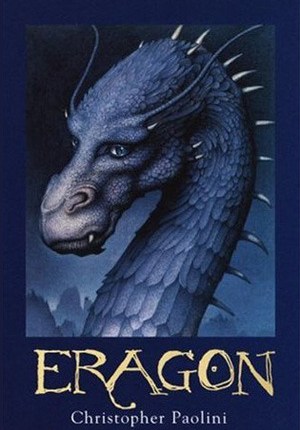
Eragon follows the exploits of a boy, a dragon, and their fight against an evil king, and his henchmen, who would plunge the world into darkness.
Prophecies of revenge, spoken in a wretched language only he knew, rolled from his tongue. He clenched his thin hands and glared at the sky. The cold stars stared back, unwinking, otherworldly watchers.” pg 14, ebook
Though it is written for children, Eragon is a charming tale that I thoroughly enjoyed as an adult reader. The pace was snappy, the characters were written quite well, and the story itself was a fun, adventure and fantasy.
“Eragon found the stone both beautiful and frightening. Where did it come from? Does it have a purpose? Then a more disturbing thought came to him: Was it sent here by accident, or am I meant to have it?” pg 16, ebook
I did a little research about the author, Christopher Paolini, and was surprised to discover that this was one of the first books he published and he was in his teens when he wrote it. How impressive is that?
“Dragons will constantly amaze you. Thing… happen around them, mysterious things that are impossible anywhere else.”
There were a couple things I didn’t enjoy about Eragon, but they didn’t ruin my appreciation for the overall story. For example, I wanted Saphira the dragon to have a different personality. She has some character traits that I felt were incongruous with how an immensely powerful, magical being would act.
When I think carefully about it, what a silly quibble to have with a story based in fantasy. But readers will have their preferences, and I like to picture dragons as either wise and benevolent, Buddha-like beings or demonic treasure hoarders along the lines of Smaug.
Paolini’s version of them is different from both of these extremes. He makes dragons fallible, like humans. Which, at the end of the day, makes this a better story for children. A lesson like, even the most powerful among us can make mistakes or experience unpleasant emotions like jealousy, is a good lesson to learn.
“These books are my friends, my companions. They make me laugh and cry and find meaning in life.” pg 153, ebook
Some works of fiction, after enchanting countless readers, become classics, a touchstone of culture for generations. I would submit “Peanuts”, created by Charles Schulz, as one of these classics.
The existential struggles of the boy named Charlie Brown, the adventures (real and imagined) of his beagle, Snoopy, and the rest of the Peanuts gang, seem timeless.
Charlie Brown wants to fly his kite, but it is always getting “eaten” by the “kite-eating tree.” He pitches for a baseball team that never wins. He tries to kick a football, but it is always removed at the last moment.
I first read Peanuts in dusty paperback books kept in the spare bedroom at my grandparents’ house. Through lazy Sunday afternoons or the occasional sleepover, I learned the names of all the Peanut characters and their defining traits.
My favorite was Schroeder, the virtuoso on his tiny piano. I even had a watch with piano keys on the plastic band and Schroeder on the watch face, pounding out his music as the second hands ticked by. I loved that watch so much – I wore through the plastic wristband, replaced it, and wore through it a second time.
When I read Peanuts Treasury, it transported me back to a time when my biggest concern was finishing my homework before the end of the weekend and to a sense of comfort that family members who loved me were just in the next room. It was a nice escape from the current reality, where my biggest concerns seem so impossibly out-of-my-hands and loved ones are all in their separate spaces.
Recommended for readers who are looking to spend a few hours away from this world and in the life of a boy who never succeeds and never ever gives up.
The Girl Who Circumnavigated Fairyland in a Ship of Her Own Making is a modern take on more traditional fairy tales wherein a child finds a way to another world and comes back changed.
I first read the title of this book in Catherynne Valente‘s much more adult novel, Palimpsest. I think it was mentioned as sitting on someone’s book shelf. I remember thinking how I wish I could read that book too. Imagine my surprise to discover it was actually a book in the real world. Of course, I had to pick it up.
“You seem an ill-tempered and irascible enough child,” said the Green Wind. “How would you like to come away with me and ride upon the Leopard of Little Breezes and be delivered to the great sea, which borders Fairyland?” pg 2
How could any heroine refuse an invitation like that?
The main character of this tale, a girl with the curious name of September, has read enough books to know a once-in-a-lifetime chance when she sees it. Though she doubts, at first, that she is the appropriate girl for the adventure.
“In stories, when someone appears in a poof of green clouds and asks a girl to go away on an adventure, it’s because she’s special, because she’s smart and strong and can solve riddles and fight with swords and give really good speeches, and… I don’t know that I’m any of those things.” pg 14
Part of Valente’s fairytale, like most good fairytales, is how September realizes how special she actually is — one of the conclusions heroes tend to arrive at during their various journeys.
September’s journey is a danger-filled jaunt through a land under the thumb of a smartly-hatted villain named the Marquess. September meets curious characters along the way including a trio of witches, a wyvern who claims his father is a library, and a boy from under the ocean with dark eyes and a secret.
The story contains plenty of winks and nods to anyone who loves reading: “Stories have a way of changing faces. They are unruly things, undisciplined, given to delinquency and the throwing of erasers. This is why we must close them up into thick, solid books, so they cannot get out and cause trouble.” pg 36
Aeve, a princess of Mancastle, is locked in a tower by her father, King Mancastle, for her refusal to chose a husband. Aeve’s younger sister, Gwyneff, is free to roam the castle, until she turns twelve and is subjected to the same fate as Aeve.
But Gwyneff doesn’t understand her sister’s choice and blames her for their father’s time-consuming efforts to find a new husband for Aeve and his absence.
“Aeve ruins everything. If she’d married, father wouldn’t go out hunting new princes. He’d be here. All the men would.”
When King Mancastle and his men venture out to find a more suitable groom, and meet a foe they cannot overcome. One of the men returns to report to the women left behind — a curse has been laid on the castle and monsters will “be drawn as to a beacon”.
“For not only was King Mancastle cursed, but so was his domain. This castle shall be a beacon to terrifying monsters until the wizard’s curse is lifted.”
The blacksmith’s wife, Merinor, takes up the Lady of the Lake’s sword and becomes king. She and the women begin preparations to defend themselves from the approaching monsters. And thus our tale begins…
The artwork in Ladycastle is beautifully drawn with bright colors. I enjoyed the premise of the story. But Ladycastle doesn’t quite fulfill its promise in this volume.
In the beginning of each section, the ladies’ inner monologue reads like a Disney or classic Broadway song, purposefully so. It’s distracting and derivative. I get that this work was attempting to point out the inherent bias of the other works, but I feel it takes away from the originality of this one.
The dark ages were brutal on women. I get it. Each lady in Ladycastle has a backstory of abuse or neglect from the man who ran her life, except for Gwyneff who hadn’t yet attained an age to be given away by her father for political purposes.
I liked how this comic flips that gender-issue on its head, the women rule the roost now. But the delivery of the lesson is heavy-handed, especially in the first two sections of the book.
As other readers have noted, there is a stab at diversity in this book, but no inclusion of LGBTQ characters. I can’t see any reason for this over-sight.
Recommended for readers who enjoy graphic novels, but with the reservations listed above. I felt like this topic was handled more deftly in the graphic novel for children, Princeless, Vol. 1: Save Yourself.
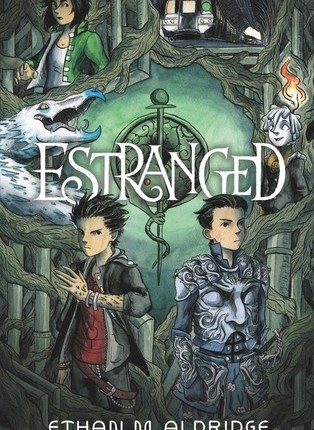
A cute graphic novel for middle graders that features a changeling, his human counterpart, their human sister and a golem made out of wax.
“There hasn’t been a human in High Court in a century. That makes you special, doesn’t it?” “Oh, they never let me forget that. It’s always ‘the human childe’.”
But trouble brews when a disgruntled elf turns the king and queen of the High Court into rodents. Then, she goes after the “Childe”. In response, he seeks out his changeling twin in the world above or the real world. And that is where our adventure begins.
“The only home I’ve ever had has been taken! This was meant to be my home, my life, and it was taken before I was old enough to remember it!” “I’ve got nothing, nowhere to go! I have as much right to be here as you!”
Along the way, they have to face goblins, magic statues, a witch and a treasure-hungry dragon. The plot is a bit simplistic but it is perfect for children who like fantasy and urban fantasy.
In fact, I picked this book up at the local game shop for my daughter and she read it in one sitting, which is a miracle because she’s a reluctant reader. I’m always looking for stories or formats that appeal to someone who enjoys video games more than books.
She absolutely loved it and said I HAD to read it. I asked why and she said, “Because it’s just awesome.” She loved the magic and world Ethan Aldridge has created. She also loved the artwork. Her favorite character, and mine, was Whick, the brave wax golem who accompanies the Human Childe from the court below to the world above and back.
The story also touches on the sometimes difficult relationship between a brother and sister. There’s a good message about taking care of your family that I resonated with.
In conclusion, I loved that my Human Childe loved it. Highly recommended.



















 The Help Desk Book Blog