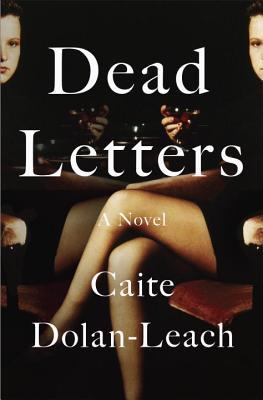
Dead Letters by Caite Dolan-Leach

Dead Letters by Caite Dolan-Leach

Dead Letters is a mystery and psychological thriller about a dysfunctional family and two unhealthily entwined twins. It is also about how relationships with those closest to us can be an unending source of unhappiness, if that is what we choose.

Ava has felt stifled by her family. Her mother has dementia, her father left them to start another family and conflict with her twin sister, Zelda, has dominated her existence. She now lives in Paris, when she receives an unexpected email from her mother… Zelda is dead.

The whole thing was so very Zelda. Too Zelda. When I finally reached my mother on the phone, she slurrily told me that the barn had caught fire with Zelda trapped inside. pg 8

Photo by Harrison Haines on Pexels.com

From the very beginning, Ava has her doubts about Zelda’s “accidental” death. Then, when the police reveal evidence that points towards a murder, things begin to spiral out of control.

Adding to the confusion, Ava and Zelda are/were identical. The whole community confuses one sister for the other. Even their own mother, whose mind is slipping away, calls Ava by her dead sister’s name.

Alcohol contributes its own fog to this story as Ava deals with her childhood demons while tangling with some new ones.

Not wanting to acknowledge consciousness in that desperate, dry-mouthed morning-after horror, I’m eventually forced to crack open my eyes. Jolted awake in suddenly sober distress, I blink owlishly and struggle to open my exhausted, quivering eyes, which are agonizingly dry, filched of liquid. … I should quit drinking, I reflect. It’s not the first time I’ve had this thought. pg 170

Photo by Charlotte May on Pexels.com

And, of course, there’s the highschool sweetheart hanging around and the relationship that ended very badly, as if Ava doesn’t have enough going on.

The mystery of this story isn’t all that mysterious, but the characters and the slow unwinding of the past are superb. I read this book almost in one sitting the day before Thanksgiving and it made me appreciate my own fairly-functional family much more.

Our mother had started her mimosas somewhat earlier, and I knew from her glassy eyes and gingery steps that Nadine was approaching the danger zone, the state between mildly and mindlessly drunk wherein she could marshal enough sobriety to do real damage but was uninhibited enough to not care how much damage was inflicted. pg 116

We can’t control what’s happened to us in the past, but moving forward, our lives are what we make of them. Look at the stories you tell yourself and examine why you do the things you do. You wouldn’t want, like the characters in this tale, to be controlled by incessant competition, booze or your weight on a scale, would you?

Photo by Charlotte May on Pexels.com

Caite Dolan-Leach doesn’t turn over every stone, leaving some of the characters’ pasts foggy. But she leaves hints everywhere and allows readers to fill in the blanks.

A criticism: some of the twists in the story are too perfectly orchestrated, and I doubted that such things would be possible, even with intricate planning and if you knew someone as well as you know yourself.

I’ll certainly have plenty to talk about at book club tonight. It was a good pick and I’d recommend it for other groups who read psychological thrillers. There’s a lot to unpack: the family dynamic, mystery, thrills, romance, layered characters and alcohol, so much alcohol.

Thanks for reading!

Under the Harrow by Flynn Berry

Under the Harrow by Flynn Berry

Nora’s sister is dead. Through the fog of her grief, one thing is clear: Nora is going to find out who did it. And she’s going to make him pay.

The sky foams, like the spindrift of a huge unseen wave is bearing down on us. Who did this to you, I wonder…” pg 9.

Photo by u0410u043bu0435u043au0441u0430u043du0434u0440 u041fu0440u043eu043au043eu0444u044cu0435u0432 on Pexels.com

As she frantically tries to piece together the last days of Rachel, her sister’s life, Nora discovers things she never knew about her secretive sibling. There are some secrets that should have gone to the grave…

“He might have come in the house on one of the days he watched her. She left a key under the mat, he could have let himself in when she was at work or asleep.” pg 62

Like other thrillers, Under the Harrow slowly dishes out the clues to the mystery and introduces elements of danger just when the reader is starting to feel comfortable.

“There are too many people I don’t recognize, which I hadn’t expected. I thought I would be able to note any strangers. Whoever did it might come today.” pg 69

Photo by Max Flinterman on Pexels.com

It also flirts with the “unreliable narrator” trope. Not in an annoying, over-done way, but, just enough so it makes the reader question the bits of information we are receiving.

Is what we’re learning true or only true in Nora’s mind?

“I wanted both of us to forget what we had learned. For the past five years, I’ve pretended that we did forget, and ignored any signs otherwise.” pg 83.

Readers experience Nora passing through the stages of grief, sometimes making better choices than other times. She desperately misses her sister.

“It is so easy to think about her. Each memory links to another one, and time doesn’t seem to pass at all. I sit for hours remembering, until the first commuters, unbearably sad, begin to arrive, waiting in the darkness on the platform for the early train to London.” pg 111

Photo by Leon Warnking on Pexels.com

Recommended for readers who enjoy thrillers and quick reads. At less than 250 pages, you can finish this book in one afternoon. I did. 🙂

Thanks for reading!

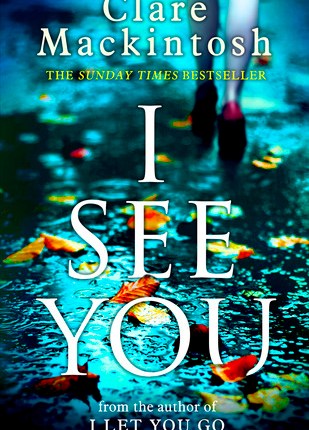
I See You by Clare Mackintosh

I See You by Clare Mackintosh

I See You is a tense thriller with fairly good execution that stumbles on its ending.

It takes place in London. The scary parts mainly take place on the public transport system.

“…I don’t know how you do this every day.” “You get used to it,” I say, although you don’t so much get used to it as simply put up with it. Standing up on a cramped, malodorous train is part and parcel of working in London.” pg 42.

Photo by Jean-Paul Wright from Pexels

Zoe Walker sees her photo, or what she believes is her photo, in the papers on her way to work. It’s weird and scary because she didn’t submit her photo to the press.

“Routine is comforting to you. It’s familiar, reassuring. Routine makes you feel safe. Routine will kill you.” pg 51.

Kelly is a member of the police. She has secrets in her past and reasons to prove herself.

“Kelly thought of all the crime prevention initiatives she’d seen rolled out over her nine years in the job. Poster campaigns, leaflet drops, attack alarms, education programs… Yet it was far simpler than that; they just had to listen to victims. Believe them.” pg 83.

Photo by sum+it from Pexels

When Zoe comes to Kelly with her concerns and her photo in the paper, she sounds crazy. But she finds a sympathetic ear with Kelly.

Can they figure out what is going on before its too late?

I read this title for book club. And even though I was disappointed in the ending, this story scared me. It also scared some members of the club.

I was frightened partly because I don’t usually read this type of book. But, it also felt so real to me.

Photo by Lennart Wittstock from Pexels

We are creatures of habit, after all. It certainly made me consider taking a different route to work. You never know who could be watching…

Recommended for brave readers who don’t shy away from unsatisfying endings. Thanks for reading!

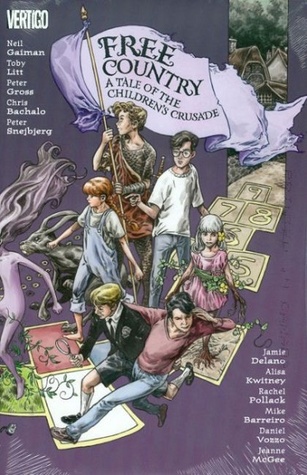
Free Country: A Tale of The Children’s Crusade by Neil Gaiman, Alisa Kwitney, Peter Snejbjerg (Illustrator)

Free Country: A Tale of The Children’s Crusade by Neil Gaiman, Alisa Kwitney, Peter Snejbjerg (Illustrator)
freecountry

A fantastic tale about two dead detectives, who are trying to solve a missing person case. It sounds macabre but it’s actually a fairy tale.

Neil Gaiman includes this in his introduction: “I asked Alisa Kwitney, who cowrote much of the second half of The Children’s Crusade, if there was anything she wanted me to point out and she said yes. I should tell people that in the double-page spread with the mermaids and the magic, she had instructed artist Peter Snejbjerg to draw a very young Nail Gaiman reading a book, oblivious to the wonders around him.”

I made sure to check on that page- and there he was. If you read this too, make sure to look for Neil in the full-page spread depicting Free Country.

The premise of this tale is like Peter Pan, but with a twist. There’s a land where children can live in peace and harmony and never grow old… but at what cost.

“Look at them, who call themselves adult- they eat, they work, they sleep. Their pleasures are gross and ugly, their lives are squalid and dark. They no longer feel, or hurt, or dream. And they hurt us. They say every adult has successfully killed at least one child, heh? Free Country is the refuge. In the past, it was the refuge only for the most fortunate of the few. But those days are ending. It will soon be the home of every living child.”

Photo by Alex Smith on Pexels.com

If I had known the catalog of Vertigo comics, I may have enjoyed this more. But, you don’t need to be an aficionado of comics to enjoy Free Country. It can be a stand-alone graphic novel with plenty of chills and thrills along the way.

It was for me.

Recommended for adults to like twisted tales with a fairy-tale flavor or for 16+ because of the potentially disturbing content.

Thanks for reading!

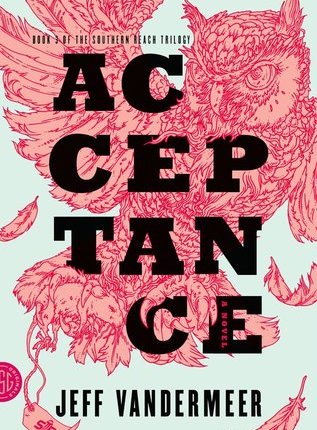
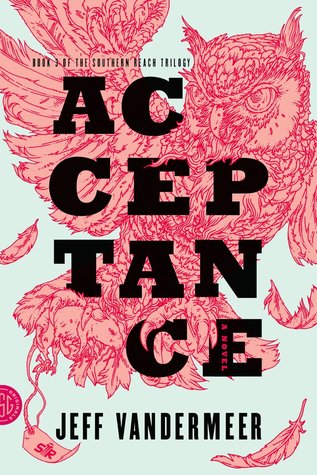
Acceptance (Southern Reach, #3) by Jeff VanderMeer

Acceptance (Southern Reach, #3) by Jeff VanderMeer
acceptance

Acceptance answers any lingering questions that the reader may have concerning Area X. I found it much more satisfying than the second entry. But, I don’t think that either the second or third book approached the brilliance of the first.

Beyond the revelations about Area X, this book also explains some of the relationships between characters. “Sometimes.. other people gave you their light, and could seem to flicker, to be hardly visible at all, if no one took care of them. Because they’d given you too much and had nothing left for themselves.” pg 60.

The reader discovers some major surprises. I won’t say anything else because… no spoilers!

Jeff VanderMeer’s descriptive passages are beautiful, something that all three books shared: “Soon after the storm, the trail they followed wound back to the sea along a slope of staggered hills running parallel to the water. The wet ground, the memory of those dark rivulets, made the newly seeded soil seem almost mirthful. Ahead lay the green outline of the island, illumined by the dark gold light of late afternoon.” pg 108.

And Area X is as mysterious as ever: “In the lengthening silence and solitude, Area X sometimes would reveal itself in unexpected ways.” pg 178. And also: “Never has a setting been so able to live without the souls traversing it.” pg 241.

I am glad that I took the time to read all three books. I think that VanderMeer’s entire concept of Area X is brilliant.

The series as a whole is strange but wonderful. Admittedly, the second book is the weakest and I barely made it through it. But, in hindsight, it fills in some blanks that contribute to the bigger picture.

Recommended for readers who like their science fiction with a large side of horror/suspense.

Thanks for reading!

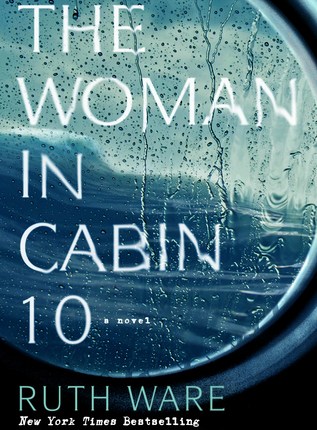
The Woman in Cabin 10 by Ruth Ware

The Woman in Cabin 10 by Ruth Ware
cabin10

A so-so mystery with an unreliable narrator that takes place, for the most part, on a boat. It was ok thriller, but I would never have read it without the encouragement of my book club.

In the desperate search for “the next Gone Girl“, The Woman in Cabin 10was put forward as an option. I think that’s unfair. The next Gone Girlor Hunger Games will be so clearly original and ground-breaking that it couldn’t be titled the next fill-in-the-blank.

And, with that sort of hype, it put an expectation on this story that it didn’t live up to. But, that’s not The Woman in Cabin 10‘s fault.

It was clear to me that Ruth Ware had experience as a journalist. Her character, Lo Blacklock, is completely believable in that regard. But, I found that I didn’t like her much. She puts too much pressure on herself to succeed.

“I had to get myself together before I left for this trip. It was an unmissable, unrepeatable opportunity to prove myself after ten years at the coalface of boring cut-and-paste journalism. This was my chance to show I could hack it…” pg 20.

But, if she had taken the time to stay home and recover from her PTSD, what sort of thriller would that be? So, off she goes, onto a billionaire’s exclusive boat.

“…it was pretty nice. I guess you had to get something for the eight grand or whatever it was they were charging for this place. The amount was slightly obscene, in comparison to my salary- or even Rowan’s salary.” pg 47.

Then, in classic thriller fashion, she hears a scream in the night, sees something that no one, even she, believes and is now stuck in an enclosed space with a potential killer.

Even with that set-up, I didn’t get into the story. Lo is overly-dramatic and doesn’t take the time to think things through. I found myself wishing that she would slow down and start keeping a complete written record rather than running from one disastrous encounter to the next.

“I lay there, cudgeling my battered brain to try to work it out, but the more I tried to ram the bits of information together, the more it felt like a jigsaw with too many pieces to fit the frame.” pg 242.

She jumps to conclusions and accuses or dismisses people nearly on a whim. I’d read a passage and then say to myself, “Come on, is that really the best you could do?” Now, that’s hardly fair as she’s exhausted, terrified and traumatized. But still. That’s what I thought.

Plus, the “unreliable narrator” thing has been done. In this story, Lo’s unreliable because she has anxiety and drinks a lot to forget that fact. That sounds like almost everyone I know.

Recommended for fans of mystery. It is enjoyable, but don’t make my mistake and expect too much complexity from The Woman in Cabin 10.

Thanks for reading!