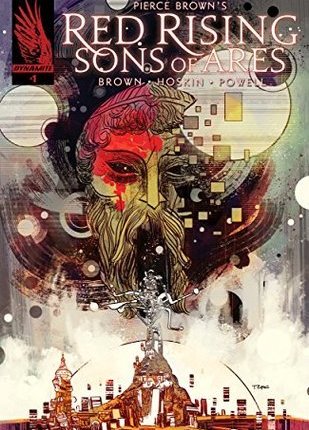
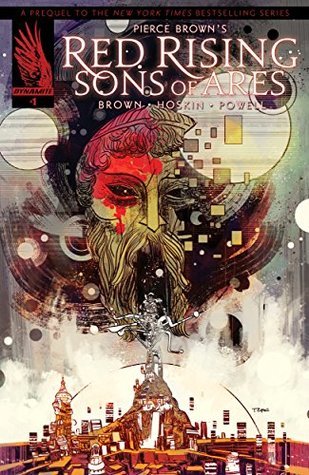
A comic that claims is going to give us the backstory of the Sons of Ares. But, in this entry, it just rehashes what goes on in the Gold school with an intro and conclusion teaser.
For anyone who hasn’t had the chance to read Red Rising, you’d need that backstory. For someone like me, who has, I wanted more new details. I didn’t get them.
I suspect that these comics, another coming out in June, are whetting the appetites of readers for the 2018 debut of Iron Gold. (Can’t wait, by the way.)
The story takes place in a world I’ve come to love. But, it was only 32 pages and that was not enough.
On the other hand, I actually bought this comic. I wasn’t patient enough to recommend it for purchase at the library and then wait to see if they picked it up. I had to have it NOW. That says something for how much I love it. Having worked as a librarian, I take my book purchasing very seriously.
If you’re not a die-hard fan like me, you may want to wait until the libraries get their hands on it. As I said, this entry doesn’t give the reader much beyond a small window into Brown’s world. If you’re satisfied with crumbs, buy it now.
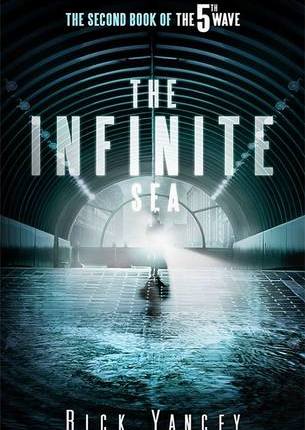
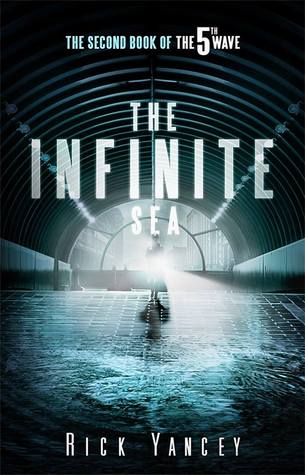
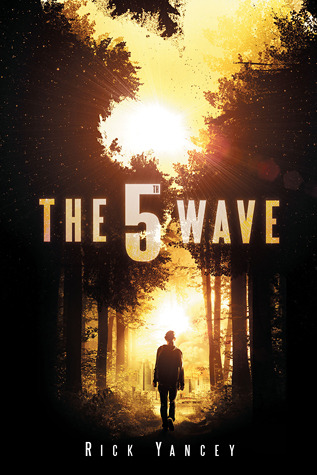
Gritter and more disturbing than The 5th Wave, Cassie, Ben, Ringer, et al are still trying to survive the end of the world. The mystery of the aliens increases. The manner in which the war against humanity is waged sinks to new lows. Yancey takes the story on some unexpected turns and I liked them.
The pace of this story is relentless and the lines are blurred between the “good guys” and the “bad guys.” It gives you a tension headache if you don’t take a break from it every couple of chapters. At least, it did for me. “Anyway, no debt is ever fully repaid, not really, not the ones that really matter. You saved me, he said, and back then I didn’t understand what I had saved him from. … Now I was thinking he didn’t mean I saved him from anything, but for something.” pg 128.
But for what! Yancey answers most of the questions he introduced the reader to in The 5th Wave. He also weaves in some complications. I won’t say anything about those… but they’re very serious and deadly. “No one can be trusted,” I said. “Not even a child.” The cold bored down to my bones and curled inside the marrow.” pg 148.
“I understand the game within the game now: There is nothing private, nothing sacred. There is no part of me hidden from him. My stomach churns with revulsion. He’s violated more than my memories. He’s molesting my soul.” pg 188. The aliens still seem to have the upper hand with the technology that can peer into people’s minds. With all of the creepy things in these books, that bit bothered me the most.
Will our intrepid teenage-survivalists solve the mystery of what the invaders want or what they are before everyone is dead? I don’t know… but I’m going to read the last book and find out. Recommended for young adults or the young-at-heart who enjoy dystopian/mystery thrill-rides.
Major spoilers ahead. Please do not read if you haven’t read this book.
The 5th Wave is about the end of the world and aliens, yes, but it also explores why life is worth living.
Cassie didn’t know how good she had it until the alien spaceship appeared in the sky and life was never the same. First, there was chaos, but now it is clear that the aliens want to exterminate everyone. And, if they just want the planet for themselves, why are they waging war in such a sadistic manner? It is a mystery and Cassie is going to figure it out.
I was really into the narrative when Rick Yancey chose to change characters and continue the story from a different point of view. I felt that it was unnecessary and broke the flow.
Also, and this is another pet peeve of mine, must every young adult dystopian contain romance as a major part of the plot? The Hunger Games, Divergent, I could go on… and this. You’d think the teens would be far too busy staying alive to fall in love, but that’s clearly not the case from the literature.
I really liked the manner in which Yancey introduces his aliens. First, you get to see their results on humanity. Then, he drops breadcrumbs about how they got here. It’s creepy. “There will be no awakening. The sleeping woman will feel nothing the next morning, only a vague sense of unease and the unshakable feeling that someone is watching her. … And what the shadow has come for- the baby within the sleeping woman- will feel nothing. The intrusion breaks no skin, violates not a single cell of her or the baby’s body.” pg 17, ebook. So scary.
I read a few reviews in which this book was accused of being a copycat of The Host and I feel that it deserves a comment. They are similar in that they both contain aliens, both are dystopians and both have the alien consciousness inside human consciousness. But, those are very broad strokes. The details of the books are different enough and I feel that Yancey has his own plans for his story.
In The Host, the aliens feel more misunderstood and benevolent than the scary creatures in The 5th Wave. This book has a lot more action, The Host is more nuanced. To be fair, superficially, they seem too similar for that to be a coincidence. But in reality, they are as different as Star Wars and Dune. Wait a minute, bad comparison? 🙂
Here’s one of my favorite passages: “Forget about flying saucers and little green men and giant mechanical spiders spitting out death rays. Forget about epic battles with tanks and fighter jets and the final victory of us scrappy, unbroken, intrepid humans over the bug-eyed swarm. That’s about as far from the truth as their dying planet was from our living one. The truth is, once they found us, we were toast.” pg 19, ebook.
Also this one, for obvious reasons: “.. I have a thing about books. So did my father. … While the rest of us scrounged for potable water and food and stocked up on the weaponry for the last stand we were sure was coming, Daddy was out with my little brother’s Radio Flyer carting home books.” pg 33, ebook. Seriously. If the apocalypse ever comes, I’m going to camp out in the library, Station Eleven style. Who’s with me?
Recommended for people who like dystopians and intense survival scenes and aren’t annoyed by angst-y teen romance. The 5th Wave is one scary alien story. They’re here and they’re out to get you and everyone you know! And, so far, they’re doing a VERY good job.
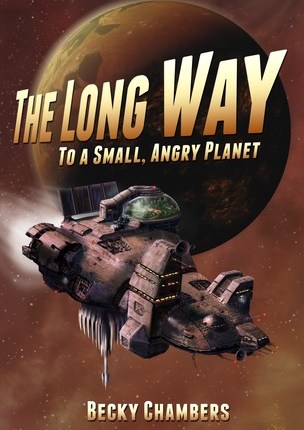
I recently finished The Long Way to a Small, Angry Planet for a second time and was again impressed by the author’s character building.
A small criticism I have is the lack of adventure in the tale. Becky Chambers does such a great job creating characters the reader cares about, but then does so little with them.
Still recommended for readers who enjoy light-hearted science fiction.
Review from first read-through: This is a charming, character driven, space opera-ish, science fiction novel about a crew, made of a bunch of different species, who man a ship that drills holes in space.
The focus of this story is on the relationships of the crew, their histories, and a big job that is going to take them to a distant part of space where very few have gone.
At first, I was concerned this book was going to be too heavy on the technology or psychics, but, have no fear readers, very little technical thinking is required in The Long Way to a Small, Angry Planet, which, after a few I’ve read lately, was just what I was looking for.
I loved the different species that Chambers imagined for this universe. From lizard-type aliens to a giant caterpillar with an otter head to a simian creature who shaves his blue fur into concentric shapes, there’s a lot of characters to keep track of but they’re so different that it’s not confusing. It is just plain fun.
Even the AI of the ship, the Wayfarer, is a character named Lovelace: “There were other Lovelaces out there, of course. Her core software platform could be purchased through any AI dealer. There were probably dozens of versions of her traveling through the galaxy- maybe hundreds, who knew. But they weren’t her.” pg 58. Indeed.
The reader gets to learn about space travel and the various ports of call through the eyes of Rosemary, the newest member of the crew, who is carrying a dark secret about her past:
“Rosemary hurried after her crewmates, anxious to not get lost. … Getting lost wasn’t what scared her, exactly. It was more the prospect of getting mugged. Or harassed. Or stabbed. She’d seen a few people that definitely looked stabby.” pgs 109-110. “Looked stabby” made me giggle.
This bit had me laughing too. I had never taken the time to consider what might happen if a cold-blooded creature ate something that was freezing cold: “We’re grown-ups, we can have ice cream for lunch if we want.” “Let’s not,” Sissix said. “Right. I forgot,” Kizzy said, and laughed. “Ice cream makes her mouth go slack.” pg 140
There are a few bits of life advice hidden in this story: “All you can do, Rosemary- all any of us can do- is work to be something positive instead. That is a choice that every sapient must make every day of their life. The universe is what we make of it. It’s up to you to decide what part you will play.” pg 232.
This last section contains my favorite line from the entire book: “She lived up there, in that vast expanse of color. Every day, she saw planets and comets and stellar nurseries right up close, plain as weather. Yes, there was something about being planetside that made it feel different. Perhaps stars were supposed to be viewed from the ground. pg 291-292.
“Perhaps stars were supposed to be viewed from the ground” is it. I have never traveled in space and may never get the chance to, but The Long Way to a Small, Angry Planet transports you, if just for a short time, into worlds far beyond ours.
I highly recommend it for folks who enjoy light, character-driven science fiction as there is nothing too heavy or disturbing to be found here.
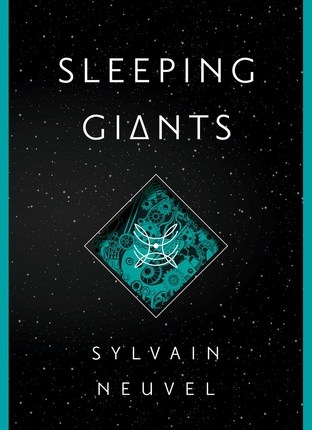
In Sleeping Giants, a large, metal object shaped like a gigantic hand is found in South Dakota. It glows with its own light and scientists have no idea what it is made of or what it can do. And so, the mystery and adventure begins.
I enjoyed the story a lot but not how it was written. Neuvel tells Sleeping Giants through a series of “case files” or question and answer sessions between the main characters and a mysterious, all-powerful figure who is manipulating the scenario from behind the scenes.
This method of storytelling seemed especially ridiculous during some of the action scenes, when Neuvel had the characters talking to each other on the phone, describing what was happening to them as it occurred.
But, otherwise, the Q & A setup gave readers a behind-the-scenes look at what was going on in the character’s minds and allowed for a lot of personality development.
I wish that Neuvel had switched back and forth between traditional storytelling and the “case file” thing, so that he could both tell the story and have the in-depth character portions. Maybe he could do something like that in the next book.
I was nervous that Sleeping Giants was going to be more science fiction than fantasy, but it wasn’t. There are only a few mind-boggling moments when the scientists are trying to figure out mathematics with a base of 8 rather than a base of 10.
Mostly, The Sleeping Giants asks the questions: what would happen to humanity if something very strange and not of our civilization was discovered on earth? What would that mean for world politics? And how, on an individual level, would everyone involved handle it?
Kara Resnik, a pilot, was my favorite character in this story. She’s impulsive, passionate, and honest.
In this passage, she’s talking about the possibility of leaving the project before it’s completed: What would I do anyway? Go about my business as if nothing ever happened? I couldn’t even talk about it to anyone. This is gonna sound incredibly selfish, but I’d get bored to death unless someone started World War III or something.” pg 54
The moral dilemma for the scientists involved in the project is interesting.
In this passage, lead scientist Rose Franklin talks about the fact that the technology discovered could be used for good or ill, depending on who controls it and how that makes her complicit in their actions, because she’s the one figuring out how it works: “What I’ve been trying so hard to deny is that I’m loving every minute of it. … I’m a scientist, and this is what I breathe for. If I had learn to live with that, I might be able to sleep again.” pg 167
If you enjoyed Sleeping Giants, you may want to pick up The Many Selves of Katherine North by Emma Geen (in which, advanced technology raises moral questions) or The Interminables by Paige Orwen (in a dystopian world, humanity tries to save itself from inter-dimensional creatures, but maybe some solutions aren’t worth the cost).
Big thanks to the Goodreads First Reads Program for a free copy of this book. And, thank you for reading!
In The Many Selves of Katherine North by Emma Geen, humanity has harnessed the power of consciousness and mechanized the ability to place that consciousness in different bodies at will.
Katherine is a teenager who works for a large research company. She’s the longest lasting “phenomenaut” (person who’s consciousness is put into the body of an animal) because she seems to be special.
The process of consciousness transfer seems to stop working when the brain ages and loses its plasticity. Despite her age, Katherine’s brain seems to be fine.
But then, one day, Katherine sees something strange when she’s out of her body… and perhaps she’s not as well as she imagined.
The Many Selves of Katherine North asks some pretty powerful questions like: What is consciousness? How does our physical body change how we perceive the world? What is reality?
I think that this story has the potential to open up a dialogue about these questions between readers who may not have considered them before. In that way, this is a very powerful book.
I did not like how the story flips back and forth between the present and the past. I think Geen was using the shifting timeline to build the mystery, but, because of the nature of Katherine’s many consciousness experiences, it made things rather confusing.
This is a complicated book. At times, maybe too complicated.
The richness and variety of Katherine’s experiences drives a wedge between her reality and the rest of humanity’s reality.
The reader really sees difference in this moment, when Katherine is preparing to go into work: “Later, I lie in bed quivering… because it’s only hours until I’m out of here. Here- not just a room but skin. How can other people call this their totality? There is so much more.” pg 19
Katherine captures the impossibility of explaining out-of-body experiences very succinctly here: “Because how do you cram the lived experience on to a page? The words available to me were never enough. Something would always slip the sentences. Human language developed around human bodies, it never quite fits other ways of being. pg 66
I loved all of the chapters when Katherine was in the body of an animal. In this one, she was a snake: “Old scents have imprinted upon the world like spoor into soft mud, the past blundering prey. I wonder if this is one reason many animals have a poor memory compared to humans. What’s the use in remembering when the world does it for you? pg 146 Fascinating.
Emma Geen included a disclaimer at the back of her book and it contained some of my favorite lines: “…what if there are other valid ways of knowing? What is the world is not one, but multitude, with as many ways of being as there are beings? What if literature were the opportunity to glimpse such refractions, thrown by the world as though from a diamond?” pgs 349-350 Loved that.
If you enjoyed The Many Selves of Katherine North, you may want to pick up The Night Circus by Erin Morgenstern or Mythago Wood by Robert Holdstock for more glimpses of worlds hidden within worlds.
Big thanks to Goodreads First Reads program, NetGalley, and Bloomsbury USA for providing me with an advance reading copy of this novel.



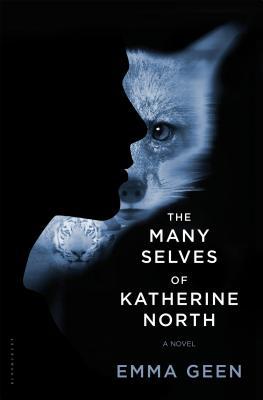
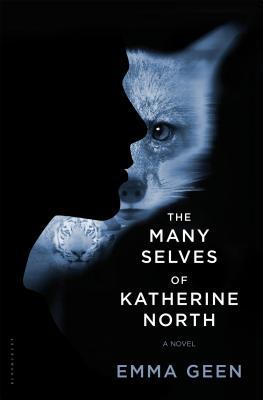 In The Many Selves of Katherine North by Emma Geen, humanity has harnessed the power of consciousness and mechanized the ability to place that consciousness in different bodies at will.
 The Help Desk Book Blog