How to be a Blogger and Vlogger in 10 Easy Lessons: Learn how to create your own blog, vlog, or podcast and get it out in the blogosphere! by Shane Birley

How to be a Blogger and Vlogger in 10 Easy Lessons: Learn how to create your own blog, vlog, or podcast and get it out in the blogosphere! by Shane Birley
howtobeablogger

This is a good resource for kids who are looking to start their own online presence on a variety of platforms.

From podcasts to video blogs, Birley gives basic to expert tips and safety suggestions.

As a parent, I was particularly interested in his Super Skill Section 8 (begins on page 50) in which he talks about online etiquette and how to appropriately handle unruly website visitors.

(Getting on my soapbox) I think that there aren’t enough books that teach kids how to behave online.

With episodes of cyber bullying and trolling on the increase, as a professional educator, I am always on the lookout for books that give effective coping mechanisms for dealing with the issues that arise.

How to Be a Blogger and Vlogger in 10 Easy Lessons is a great place to start and we need more books just like it. (Getting off soapbox)

My only complaint is that this doesn’t include “Parent Tips” or any sections about how the adults in the kids’ lives can support the effort.

Birley doesn’t leave parents entirely out of the loop: “Speak to a trusted adult about any comments on your blog that make you feel uncomfortable or upset.” pg 53. But, I wish that there had been more.

The recommendation on the cover of this book is for ages 12+ but my 9-year-old devoured this text. So, I’d give this to any child who is interested in digital media, no matter their age.

Thanks for reading!

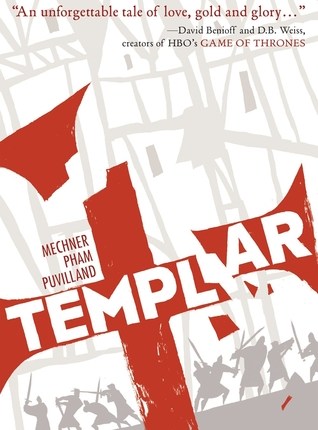
Templar by Jordan Mechner

Templar by Jordan Mechner

templarTemplar: a graphic novel about the dissolution of that famous order and the struggle for the legendary treasure that they left behind. A couple of weeks ago, I read the first book in this series and I enjoyed it more than this complete volume. It was the ending that diminished my enjoyment of it the most, which I won’t get into because I don’t want to ruin it for anyone, but that was really my issue. Mechner ties up the major plot points, but I didn’t like how he did it- at all.
Like the other book, this contains adventure, daring rescues, and amusing “heist movie” type moments. We’ve also got a strong female lead in Madame De Chalancon (love interest) who is actually very hard core for a 12th century woman. She’s sneaking out at night and running around with the guys, stealing horses, manipulating the powerful men around her, kissing people- I mean, that kind of stuff could have gotten her burned as a heretic or witch back then. So, that was good and the other characterizations are solid. The illustrations aren’t gorgeous (compared to Monstress #1 or Saga, Volume 1) but those are considered adult graphic novels while this one is marketed for the teen set.

Which reminds me, there’s a whole scene that takes place in a Turkish steam bath that some parents may find objectionable. I’d let my kid read it, but she’s a girl and has the parts that are revealed through the steam and also, I’m a librarian, and I don’t censor stuff. But yeah, there’s some (very tasteful) nude females, torture scenes, hand to hand combat, men being burned at the stake, arrows through limbs… I honestly think that this may have been better as a mature book than a watered down PG13, but it is what it is.

Still, it is a fun story and semi-educational in that some of the people featured in this book were actual historical figures. Mechner includes his sources in the back and also some recommended reading. I think I’m going to look into Foucault’s Pendulum, which I’ve never read, but Mechner gives high praise.

Some more graphic novels that teens may enjoy are The Guild (ties in to the show of the same name) or the surprisingly fun, Nimona.

Thanks for reading!

Some Kind of Fairy Tale by Graham Joyce

Some Kind of Fairy Tale by Graham Joyce

somekindoffairytaleSome Kind of Fairy Tale is a fantasy set in modern times. Peter is a farrier (shoes horses and fixes small, metallic things). He has a lovely wife and four beautiful children. He also has a sister whom he hasn’t seen for nearly twenty years, presumed dead. Imagine his surprise, when she shows up at their parent’s home on Christmas Day. Where has she been? Where indeed…
The magic in this book isn’t in your face, it’s hidden in the shadows and rocks of the woods and glens- very much like I imagine magic really is: “The Outwoods was one of the last remaining pockets of ancient forest… It was an eerie place, swinging between sunlight and damp, flaring light and shadow; a venue of twisted trees, its volcanic slopes of ash and granite ruptured by mysterious outcropping crags of the very oldest rocks in Britain.” pg 14, ebook.

I loved the twists and turns of the story and it had me questioning myself the entire time. Is Tara bonkers, injured in some way, or did something outside of her power actually spirit her away? “There is a veil to this world, thin as smoke, and it draws back occasionally and when it does we can see incredible things.” pg 142, ebook.

I also loved how Joyce used quotations from poetry, books, and an actual trial where a man was convicted of killing his wife because he thought she was a changeling (can you imagine?!) to introduce a few of the chapters. It was chilling- the deadly combination of superstition and violence and the trial in question happened, not in the dark ages, but 1895. Here’s Joseph Campbell’s thoughts that preface Chapter Twenty-Six: “Nevertheless- and here is a great key to the understanding of myth and symbol- the two kingdoms are actually one. The realm of the gods is a forgotten dimension of the world we know.” pg 169, ebook.

I did not like the surprising vulgarity of this tale, the few violent moments it contains, or when something terrible happens to a neighborhood cat but, if such things don’t bother you, you really must give Some Kind of Fairy Talea try. If you don’t already, it makes you believe in the possibility of other worlds and every day magic.

Some books with similar themes: Meeting the Other Crowd (non-fiction, but reads like fiction), Fairies: Real Encounters With Little People (non-fiction, again, reads like fiction) or Passport to Magonia: On UFOs, Folklore, and Parallel Worlds (classic work on real people and actual encounters with other worlds).

Thanks for reading!

Funeral Games by Colin Heintze

Funeral Games by Colin Heintze

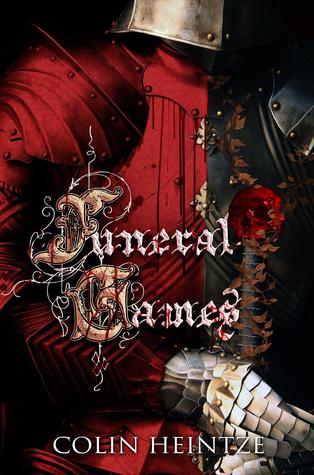
funeralgamesFuneral Games is a unique, fantastical romp through a medieval world. Syphax is a prince, but an unimportant one, being the younger son of one of his father’s many wives. He doesn’t excel in much of anything, other than reading and daydreams of greatness (reminds me of myself in some ways… I jest… but really). Syphax is a member of the nobility who are called the Undying because, when they shuffle off this mortal coil, they rise again as tangible ghosts called ancestors. These ancestors help govern the living and form another spooky faction in the sprawling complex of the capital city that is Ingerval Palace. The walls of the palace are filled with dead and living nobility who are divided into many different houses with a tangled history of treaties and backstabbing, all with the goal of more power for the members of their clan. The future looks, if not bright, then at least rosy, for our hero, Syphax, until, at one very memorable funeral celebration, something completely unexpected happens. And then, all hell breaks loose inside and outside the walls of Ingerval.
I loved the juxtaposition of the living and the dead in Funeral Games. It added a whole other level of political machinations to the usual struggles of a monarchy and its nobility. Here is the scene at one of the funerals: “The crowd roared with laughter- at least the Living among them. The Dead sat at their assigned places. They didn’t eat or drink, and weren’t the least bit amused by the antics of their descendants. There must have been two hundred ghosts and at least as many Living in attendance. Normally, the Dead kept their own company, but the day was a special one.” loc 56, ebook. I also loved how, in the course of the story, Heintze dealt with the ghost’s eternal nature, limitations, and struggle for recognition beyond the grave. It really is unlike anything else I’ve ever read.

There is a love interest in this but it doesn’t dominate the storyline or descend into the ridiculous. In fact, the girl/heroine, though she doesn’t play a huge part, is kind of hard core, which is a refreshing change of pace for the genre. In this passage, she’s talking to Syphax about one of the ancestors: “I feel like he watches me, Syphax.” “You’re in a palace full of ghosts. It’s natural to feel that way.” “Sometimes I have these dreams. And when I wake up, he’s always nearby…” … “It will be fine,” I said. “He’s harmless. All ghosts are.” loc 136, ebook. (suspenseful music building…)

My favorite part of Ingerval is, of course, the Library! “Ingerval Palace had many wonders. None were as great, nor so underappreciated, as the Library. Books were one of the few pleasures afforded to ghosts, and the Dead’s demand for the written word made Ingerval the world’s leader in the production, purchase, and dissemination of books.” loc 367, ebook. I would fit in well with the Undying, I think.

There is some rough language in this, some tense moments, and a small, if not too graphic, torture scene, so I’d suggest a reading audience of 14/15+ depending on the maturity level of the reader. I’d recommend Funeral Games for not-too-serious fantasy fans as it lacks the complexity of, say, the Malazan books, but for some folks (myself included), that may be considered a plus. Some similar reading: The Interminables by Paige Orwin (a ghost plays a large part in this story too), Ink Mage by Victor Gischler (fantasy world, lots of adventure), or The Quick by Lauren Owen (different time period, but also a fantasy).

Thank you to NetGalley and Curiosity Quills Press for a free digital copy of this book.  And, thank you for reading!

Snow White, Blood Red by Ellen Datlow

Snow White, Blood Red by Ellen Datlow

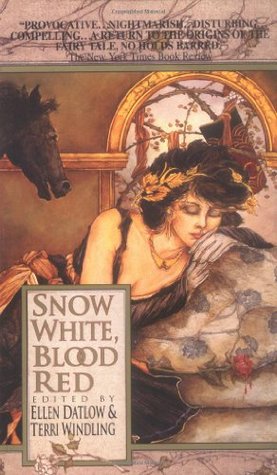
snowwhitebloodredFull credits for Snow White, Blood Red by Ellen Datlow (Editor), Terri Windling (Editor), Elizabeth A. Lynn (Contributor), Harvey Jacobs (Contributor), Steve Rasnic Tem (Contributor), Melanie Tem (Contributor), Caroline Stevermer (Contributor), Ryan Edmonds (Contributor) , Neil Gaiman (Contributor), Leonard Rysdyk (Contributor), Esther M. Friesner (Contributor)

This is a very adult collection of fairy tale re-tellings. From Little Red Riding Hood to Snow White, these are not stories that I’d share with my child or any impressionable young mind.

Fairy tales haven’t always been exclusively for children as Terri Windling explains in the introduction: “..most fairy tales were never initially intended for nursery duty. They have been put there, as J.R.R. Tolkien so evocatively expressed it, like old furniture fallen out of fashion that grown-ups no longer want. And like furniture vanished to the children’s playroom, the tales that have been banished from the mainstream of modern adult literature have suffered misuse as well as neglect.” pg 2

But fairy tales are important because they touch on dreams, archetypes, and the psyche. However, these re-workings were far more bleak than I expected. “The fairy tale journey may look like an outward trek across plains and mountains, through castles and forests, but the actual movement is inward, into the lands of the soul.” pg 10. And personally, I think that the soul is a rather light place.

The most disturbing of the bunch, in my mind was, Little Redby Wendy Wheeler, which told a tale of sexual relations between a mother/wolfish boyfriend/daughter. (A warning for any sensitive readers, triggers abound in these stories from rape to physical/sexual/emotional abuse towards adults as well as children.) “Before she climbed in, Helen looked in my face as though something in my smile disturbed her. “I’ve never noticed before what white teeth you have, Josef,” she murmured. “So large and white.” pg 140 The only saving grace for the darkness of these tales are that they’re short and you’re soon on to the next one.

My favorite was Puss by Esther M. Friesner: an excellent but nightmarish re-imaging of Puss-n-Boots. “Help! Help, ho!” My paws flailed the air; I brandished my plumed hat to make the coachmen see so small a creature as a cat before the horses trampled me. “Robbers, thieves, rascals and hounds! They have despoiled my good master, the Marquis of Carrabas!” pg 319

A close second was Troll Bridge by Neil Gaiman, based on The Three Billy Goats Gruff. His depiction of a troll was creepy but magical, that curious blend of two unrelated traits that Gaiman crafts so well. “Trolls can small the rainbows, trolls can smell the stars,” it whispered, sadly. “Trolls can smell the dreams you dreamed before you were ever born. Come close to me and I’ll eat your life.” pg 286

Recommended for ages 18+ and the brave at heart. Some read-alikes, if you dare: The Book of Ballads by Charles Vess, Alice by Christina Henry or The Library at Mount Char by Scott Hawkins.

Thanks for reading!

Solomon’s Thieves, Book 1 by Jordan Mechner

Solomon’s Thieves, Book 1 by Jordan Mechner
solomons-thieves

I almost flipped out over this series today because I went to request the second book and found that it was never published. Not to be deterred, I used my mad librarian skillz and discovered that, after the release of Solomon’s Thieves, the publisher bound all of the issues together rather than releasing them one at a time.

The continuation to this story is found in the graphic novel: Templar. Crisis averted.

And what is this comic about?

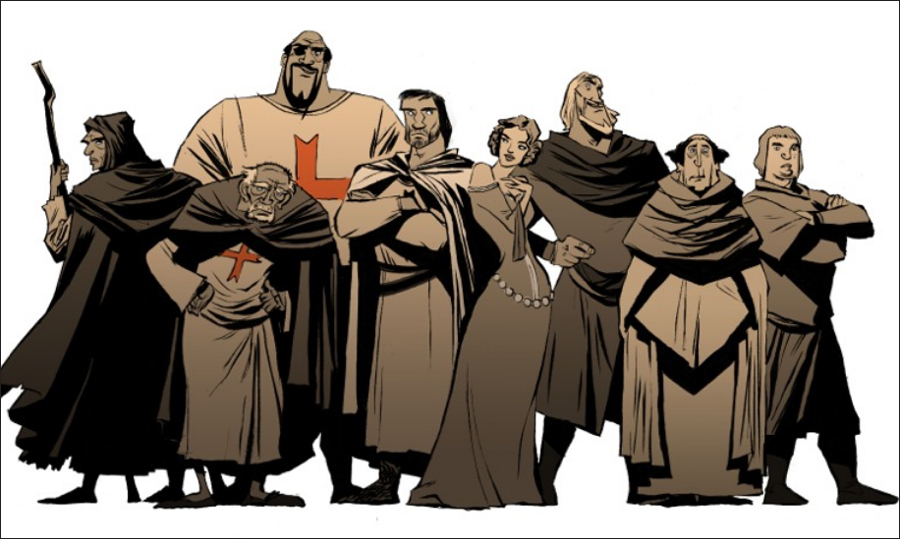
Solomon’s Thieves is a fun romp through 1300’s Paris at the time of the Templar’s disbanding and destruction.

The focus of the story is on a knight named Martin. He was unlucky in love and joined the order to change his life, which he manages to do. But, on the Templar’s return from an unsuccessful campaign in the Holy Land, after a wild night of drinking and some bad choice making in Paris, he ends up not being present when his brethren are arrested by the French king, Philip the Fair.

The adventure really starts when the king’s men discover that the fabled treasure of the Templars is not in their church/compound. Martin, after a series of misadventures and a chance meeting with some unsavory characters, decides to find out where that treasure is and steal it back.

Bit of trivia: the Paris Templars were arrested on Friday, October 13th, 1307. So, 709 years ago tomorrow (I wrote this review on October 12th, 2016). Now, you know.

templarcastFrom the introduction: “From humble beginnings the Knights Templar rose to become the most powerful military monastic order of the medieval world. Pledged to protect pilgrims during the Crusades, the Templars become heroes to Christians everywhere. Their fighting prowess was legendary. … But the Crusades were an expensive, blood-soaked failure. In 1291, after two centuries of warfare, the Muslims drove the Christian armies from the Holy Land once and for all. For the Templars, it was the beginning of the end…” Goosebumps!
I’d consider this a PG-13 level comic because of some rough language, non-graphic violence (dude sticks his sword through the chest of a guy in one of the panels, but there isn’t blood everywhere), and some, again non-graphic, torture scenes.

The afterward by Jordan Mechner is fantastic. Not only does he give the actual history that he based the comic on, but also the sources that he used to research it. Huge librarian thumbs up from me. 🙂

“Like Western gunslingers or Japanese samurai, their legend grew, and it attracted new recruits, donations, and privileges. By their peak in the thirteenth century, the Templars had grown into a religious, military, and banking organization whose assets, power, and reach rivaled any of the kings of Europe. They were the Jedi of their time. Their incredible downfall rocked the world. Its echoes reverberate to this day.” pg 135

If you enjoyed this comic, you may like: The Religion by Tim Willocks(regular book- not a graphic novel, very bloody, for adults only) or The Knights Templar: Discovering The Myth And Reality Of A Legendary Brotherhood by Susie Hodge (regular book also- non-fiction but in-depth examination of the templars).

Thanks for reading!

The Book of Ballads by Charles Vess, Introduction by Terri Windling

The Book of Ballads by Charles Vess, Introduction by Terri Windling
bookofballads

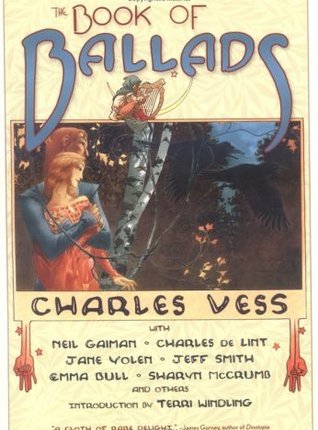
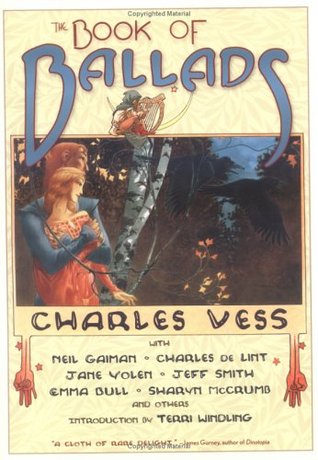
In this graphic novel, Charles Vess illustrates many traditional folk ballads that have been rewritten by some fairly popular fantasy artists like Neil Gaiman or Emma Bull.

I didn’t realize how many traditional ballads have negative interactions with strangers as their primary topic.

According to these stories, any stranger is either a fairy or the devil. If it is a male, he’ll either kill you or impregnate you and then come later to take your kid back to whatever magical land he came from.

If it is a female, she’ll either imprison you, change you into a snake, rape you, or take you away to fairyland.

An alternate title for this book could be: Strangers are Bad- Don’t Talk to Strangers or Let Them In Your House or Have Sex with Them Unless You Want to Die.

But all joking aside, there are very few ballads that end either happily or well. It is unsettling reading them altogether, like delving into a book of short horror stories.

From the introduction by Terri Windling: “Ballads, which are stories in narrative verse, are related to folktales, romances, and sagas, with which they sometimes share themes, plots, and characters (such as Robin Hood). No one knows how old the oldest are. It’s believed that they are ancient indeed…” pg 10

Which disturbs me even more when I consider that these stories were written for a reason. Can you imagine raising a kid in the dawn of time? ‘Don’t go talk to that stranger over there ’cause he might eat you. We don’t know about that exact dude, but seriously… it has happened. Remember how you used to have a sister?’

vess2

Take the ballad of Tam-Lin for instance: “O I forbid you, maidens a’, That wear gowd on your hair, To come or gae by Carterhaugh, For young Tam-Lin is there. There’s nane that gaes by Carterhaugh But they leave him a wad, Either their rings, or green mantles, Or else their maidenhead.” pg 92

In other words, don’t go over there or he’ll take your stuff or rape you.

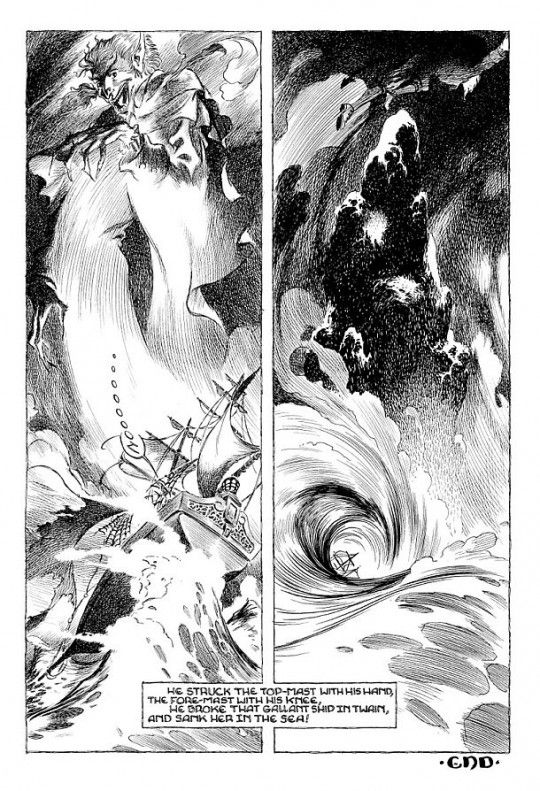
Despite the depressing nature of the stories, the artwork is very pretty and it’s all in black and white which makes the stories even starker. My favorite of the bunch is The Great Selchie of Sule Skerry which was re-written by Jane Yolen.

In it, a young maiden falls in love with a man from the sea. Guess how it ends?

Some read alike graphic novels: A Flight of Angels by Rebecca Guay, The Last Dragon by Jane Yolen, or The Sleeper and the Spindle by Neil Gaiman.

Thanks for reading!

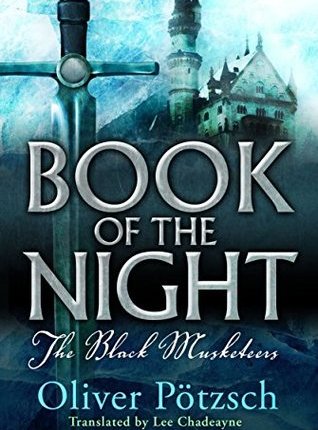
Book of the Night: the Black Musketeers by Oliver Pötzsch, translated by Lee Chadeayne

Book of the Night: the Black Musketeers by Oliver Pötzsch, translated by Lee Chadeayne

“Book of the Night” tells the story of Lukas Lohenfels, whose family is driven apart by an evil monk, intent upon finding a relic of power.

Along the path to revenge and redemption, Lukas makes some friends, some enemies, and discovers that magic may be more real than he ever imagined.

This is the 1600’s Germany, a land of princes and shifting alliances. A war has been going on for a very long time.

Photo by Kai Pilger on Pexels.com

Who are the Black Musketeers of the title?: “The Black Musketeers were the best fighters in the Reich,” he began, “trained in the use of all sorts of weapons and fear by everyone. They served as bodyguards to the Imperial General Wallenstein … We fought and shot like the devil, with swords, pikes, daggers, muskets, and pistols, and drove the Danes and their allies back across the Elbe River.” loc 129, ebook.

Lukas is forced to grow up quickly, not only because of what happens to his family, but also because of the unending war: “Lukas thought of the dreadful stories he’d heard about the war. Last year in Magedeburg, twenty thousand citizens had been slaughtered by mercenaries, who then completely destroyed the city.

Similar things had happened in other parts of the Reich. Whenever the troops passed by, no matter which side they were on, they left behind death, destruction, hunger, and disease. When he was young, Lukas had always imagined war as something heroic. … but for some time now, he had understood that war was not an adventure, but left horror and misery in its wake.” loc 1112, ebook.

Photo by Egor Kamelev on Pexels.com

Author Oliver Pötzsch is a master storyteller. His story flows smoothly and well.

I particularly enjoyed this homage to the classic, The Three Musketeers by Alexandre Dumas:

“If you have something to tell me or the others,” Gionvanni said softly, in order not to waken the other sleeping boys, “please don’t hesitate. We’re always here for you, do you understand?” He smiled. “One for all and all for one. I heard those words somewhere before, and they apply to us as well.” loc 1148, ebook.

I liked how Lukas and his friends were never entirely certain about the existence of magic until it entered their lives in a very real way: “Nonsense,” Paulus muttered. “Magic is humbug! I only believe things I can see and fight with my sword.” “It’s said there are certain vapors and gases that make people sick and can even cause the plague,” Giovanni replied matter-of-factly. “Can you see them, Paulus?

No. But still they’re there, invisible, all around us. Perhaps there’s lots more out there that we simpleminded little men can’t even imagine.” loc 1428, ebook.

Photo by Simon Berger on Pexels.com

When I saw the name, Oliver Pötzsch, and snapped up this book from NetGalley, not realizing that Book of the Night is intended for a young adult audience.

As I wrote earlier, it is very well-written and I had a lot of fun reading it. That being said, the Book of the Night isn’t very sophisticated nor are there any true surprises within its pages.

Book trailer for ‘Book of the Night’ in German.

However, it is a perfect pick for anyone in the 12 to 16 age group, or anyone who enjoys an adventure with some magical undertones.

If you’re looking for some more magical/coming-of-age young adult read-alikes try: Seraphina by Rachel Hartman, Archivist Wasp by Nicole Kornher-Stace, and Jackaby by William Ritter.

Thank you to NetGalley and Amazon Crossing Publishing for a free digital copy of this book!  And, thank you for reading.

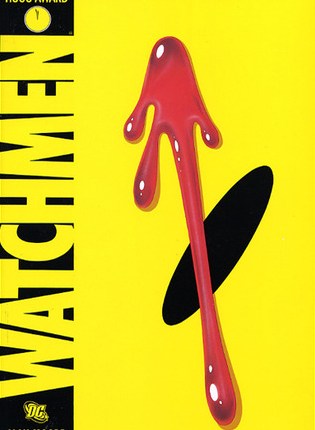
Watchmen by Alan Moore

Watchmen by Alan Moore
watchmen

I can’t stop thinking about this graphic novel. It’s not something I’d usually like- ultra-violent with a very dark vision of humanity- but there is something incredibly compelling about it.

It starts with a murder. Watchmen is the story of a group of super heroes who don’t fight crime anymore because vigilantism was outlawed. Among the many costumed regular heroes (The Comedian, Rorschach, Nite Owl), there is an actual superhero, Dr. Manhattan, who suffered a freak radiation accident and was changed, permanently. He perceives time as happening all at once and can manipulate matter in multiple dimensions. Each of the heroes has a story, some are very sad, and all of them are upset as one of their own has just been killed. Can they figure out who the murderer is before he/she strikes again?

My favorite character out of the bunch is Dr. Manhattan. “We gaze continually at the world and it grows dull in our perceptions. Yet seen from another’s vantage point, as if new, it may still take the breath away.” pg 27, Chapter XI. He’s nearly godlike in his capabilities but that makes it practically impossible for anyone to understand him.

My husband’s favorite is Rorschach, which I could understand, but he was far too violent for me to truly appreciate the character. I feel like there’s an underlying importance to that character though, something that I couldn’t quite grasp…I tried thinking about Rorschach as a rorschach blot for the Watchmen and it nearly broke my brain.

And the comic within the comic? Fascinating.

The Watchmen is more than a superhero story: it’s an examination of power both physical and in the heart. It’s a criticism of government, the media, and art used to manipulate others. It looks at gender roles, rape, and sexual preferences and predilections. It asks: why would a person dress up and create an alter ego in the first place? And, beyond all that, it is a mystery and a love story. There’s a lot to enjoy in here if you can get past the blood, gore, and soul crushing darkness. Recommended for an adult audience only.

A similar comic, in my mind, is The Walking Dead, Compendium 1 by Robert Kirkman. But, really, Watchmen is in a class all of its own.

Thank you for reading!