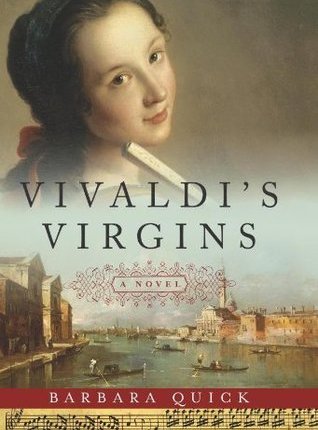
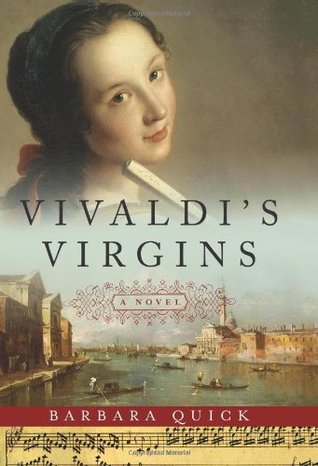
Vivaldi’s Virgins by Barbara Quick

Vivaldi’s Virgins by Barbara Quick
vivaldi

Vivaldi’s Virgins is a sparkling historical fiction about Anna Maria dal Violin, one of the orphans trained to perform music for the well-fare of the souls of Venice in the 1700’s.

One of her instructors is Antonio Vivaldi, who is called “The Red Priest” because of his fiery hair: “I heard and then watched Maestro Vivaldi climb the stairs. He has been my teacher- and one of the very few men who has ever seen my face or spoken to me- for nearly half of my lifetime. I was only a girl of eight when, newly ordained as a priest, Antonio Vivaldi, native son of Venezia, was hired by the governors of the Pieta to be our master of the violin.” pg 2

Only girls are allowed to perform music in the Pieta. They are kept separate from the general population and all men, except for the priests who are their instructors, to maintain their purity. “Our lives are arranged so that every piece of every day and night is fit together into an intricate mosaic of music and study and prayer. But it is only a counterfeit of real life. We have no more reality in the world than the trompe l’oeil floor tiles of the church have depth or height.” pg 85

There is drama among the children through their interactions and competition with each other and some of their instructors, who are either nuns or priests. “Whoever says that girls are kind has never lived among them.” pg 13.

Anna longs to know who her family was, but that is a secret kept by the nuns who watch over the children. She spends much of her time trying to figure out how to learn more about who her family may be.

Anna also strains against the restrictions placed on her because of her gender in the 1700’s. The government only allows the female musicians from the Pieta to perform in public if they remain in the cloister. If they choose to marry, they have to sign a contract to promise not to perform or pay an exorbitant amount of money to the orphanage to pay for their childhood musical education. “It is one of the great injustices of this fair city. And it has made me dream sometimes of other cities- of London and Paris and Vienna, where, I’ve heard, female instrumentalists have actually been welcomed, from time to time, on the performance stage.” pgs 145-146.
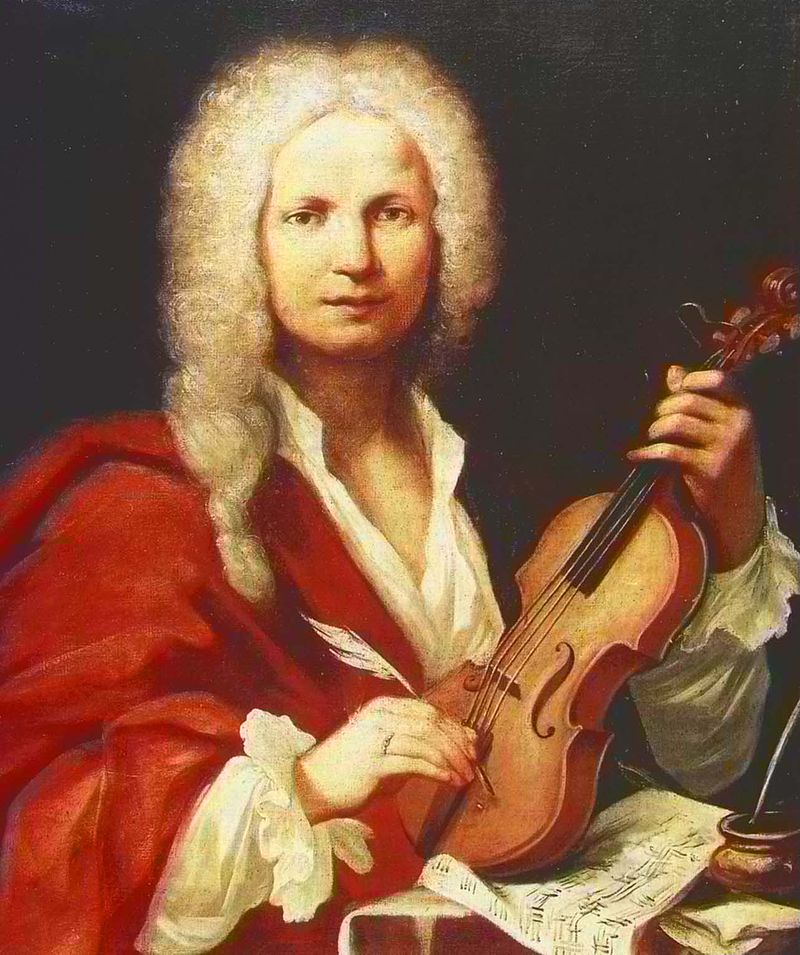
A probable portrait of Vivaldi

During these struggles, Anna forms true friendships with other foundlings in the Pieta. “When I think of who my companions will be in Hell, I feel rather glad that I will be going there. It will be filled with those I most well and truly loved.” pg 150

I learned a lot about 18th century Venice in this book and Vivaldi. All that I knew about Vivaldi, before reading this book, was that he liked to use a bunch of stringed instruments in his compositions.

It makes so much more sense when I discovered who it was he had been composing for.

Recommended for those who enjoy historical fiction, books about composers or stories about troubled childhoods.

Thanks for reading!

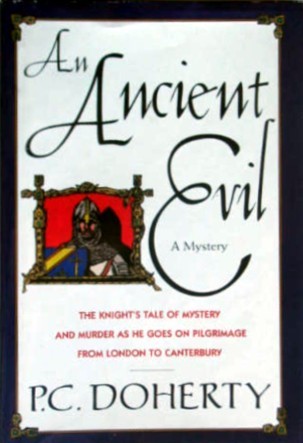
An Ancient Evil (Stories told on Pilgrimage from London to Canterbury, #1) by Paul Doherty

An Ancient Evil (Stories told on Pilgrimage from London to Canterbury, #1) by Paul Doherty
anancientmystery

An Ancient Evil is a charming historical fiction based loosely on the premise of The Canterbury Tales.

In the introduction, a knight tells a story to a group of pilgrims on their way to Canterbury. “My tale begins hundreds of years ago, just after the great Conqueror came here. So, gentles all, your attention as I describe these horrors sprung from the very pit of Hell.” pg 6.

In the story within the story, a menacing prologue introduces the reader to Sir Hugo, who buries alive the leader of a group of evil magic doers and burns the rest of his order. The evil leader who is buried alive doesn’t seem that upset about the whole thing. Which is weird.

Fast forward a couple hundred years into the future.

Sir Godfrey and a clerk, Alexander, are tasked by the king of England to discover the truth behind a series of mysterious and grisly murders in Oxford.

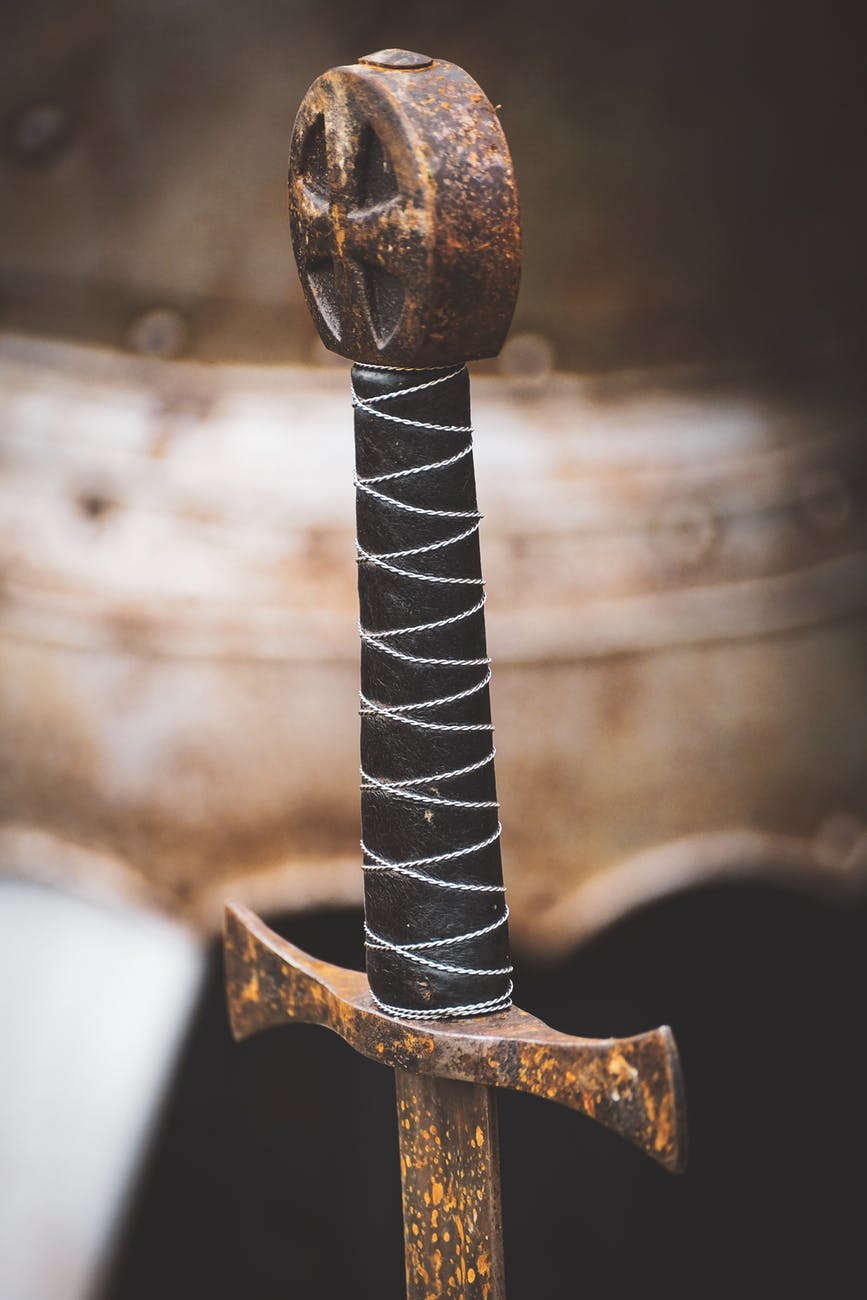
They are assisted in their task by Dame Edith, a blind anchorite who is known for her exorcism talents. ‘Sir Godfrey, whoever the killers are, we are about to enter the Valley of Death, but,’ Alexander couldn’t resist gentle banter, ‘we have your sword, my brains and the prayers of Dame Edith.’ ‘I think we might need more than that.’ pg 64.

I enjoyed this medieval, just a bit too bloody to be called “cozy”, mystery.

Photo by Susanne Jutzeler on Pexels.com

The characters are layered. The author drops enough hints to lead the reader towards the bad guy without giving the game away.

It reads a bit like a Nicholas Cage movie. We’ve got a battle between good and evil with some paranormal stuff and swords thrown in.

“Dame Edith tapped the side of her head. ‘Sir Godfrey, you are a soldier. You, of all people, should realize that a man is what he thinks he is. What causes one man to be a coward and another to be a hero? After all, they may be the same flesh and blood. They may even be brothers from the same womb. It’s what they think.” pg 170.

I also enjoyed the details about medieval life that are sprinkled throughout.

Recommended for readers who enjoyed The Thief Taker by C.S. Quinn or Mistress of the Art of Death by Ariana Franklin.

Thanks for reading!

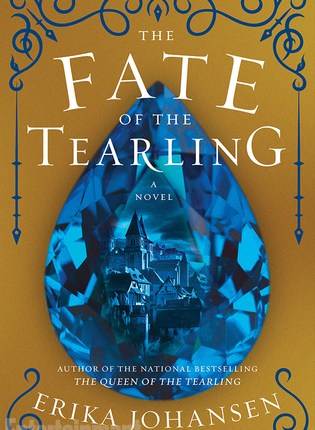
The Fate of the Tearling (The Queen of the Tearling, #3) by Erika Johansen

The Fate of the Tearling (The Queen of the Tearling, #3) by Erika Johansen

The Fate of the Tearling ties up the series nicely. All questions of the founding of Tearling, the shadow and Mort are answered.

And we also learn all of the secrets of the Fetch. Finally! “For three long centuries… William Tear’s dream sunk further and further into the mire. No one in the Tearling could even see Tear’s better world any longer, let alone muster the courage to dig for it.”pg 6, ebook.

The path isn’t easy. Kelsea questions herself every step of the way. “Maybe we aren’t capable of being satisfied, Kelsea thought, and the idea seemed to open a chasm inside her. Maybe utopia is beyond us.” pg 90, ebook.

But she is determined to see things through to the end: “We can’t simply stay here, hiding, while the kingdom burns. What sort of queen would I be?” pg 273.

Though Erika Johansen writes a thorough ending, I found myself dissatisfied with it. Read it and let me know what you think. I’m still thinking about it, even though I finished this book last week.

Photo by Pixabay on Pexels.com

From a lackluster start, I think The Queen of the Tearling series turned out to be fairly enjoyable. I would classify it as adult because of some of the themes, imagery and language.

It uses fantasy to examine the human condition, society and what happens to communes after a charismatic leader dies.

I think Kelsea is one of the strongest female characters I’ve read. Bravery-wise, she fits right in with Katniss Everdeen. She doesn’t quit and isn’t afraid to admit when she’s wrong.

Throughout the series, we see her grow from uncertain child to warrior queen. Bookish and introverted, Kelsea may appeal to those who wish they could be something more than they currently are.

Recommended for readers who are willing to invest some time in a series to enjoy it and for fans of fantasy/dystopian worlds. The Queen of the Tearling grew on me. It has heart.

Thanks for reading!

See my review of the first book here: The Queen of the Tearling (The Queen of the Tearling, #1) by Erika Johansen

Second book here: The Invasion of the Tearling (The Queen of the Tearling, #2) by Erika Johansen

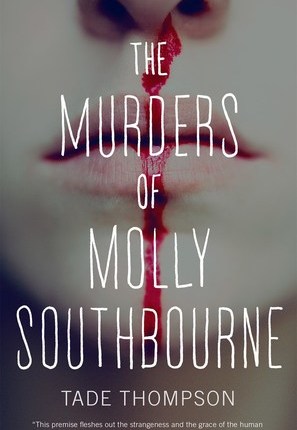
The Murders of Molly Southbourne by Tade Thompson

The Murders of Molly Southbourne by Tade Thompson

The Murders of Molly Southbourne is a short story about a girl who is born with a horrifying condition. Whenever she bleeds, the blood changes into a homicidal version of herself that won’t stop until it, or Molly, is dead.

“The rules are simple. If you see a girl who looks like you, run and fight. Don’t bleed. If you bleed, blot, burn, and bleach. If you find a hole, find your parents. Molly recites the lines to herself many times.” pg 24.

I’m not sure I understood what the author was going for with this short story.

Yes, what happens to Molly is horrific. I guess I didn’t make the connection between what was happening to her and the broader meaning the story was reaching towards.

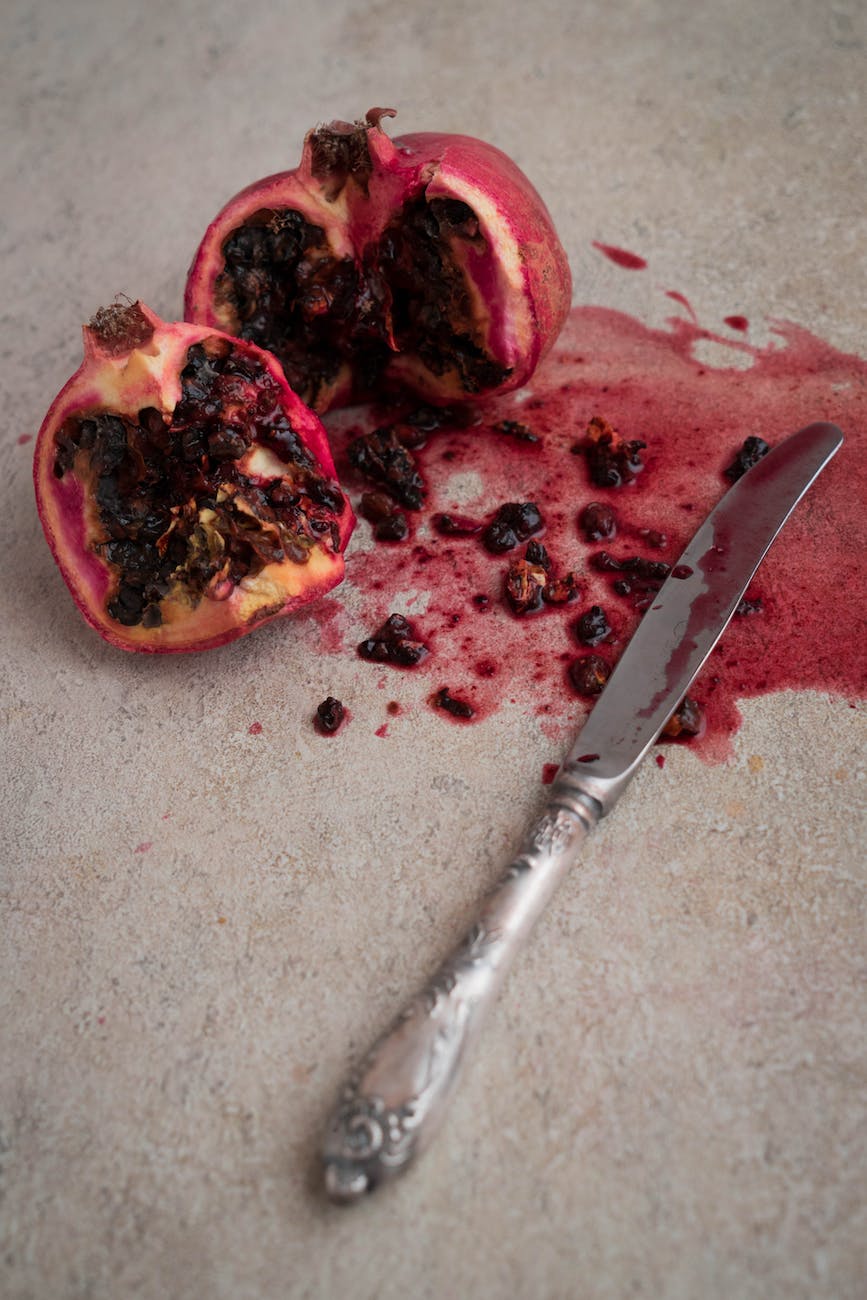
Photo by Badulescu Badulescu on Pexels.com

Because it was certainly reaching: “She cannot stand children. They remind her of the mollys, with their innocence and their half-formed personalities, and she expects them to burst into violence any minute. They never do, but they might.” pgs 63-64

Or, beyond the death-through-your-children angle, I could use this story to consider the futility of life itself. “How is it that humans bleed so much? Or maybe Molly herself bleeds more than the average human. The rule are useless, an attenuation at best. Lifeblood escapes all the time, minor hemorrhages, a little a day. Maybe that is how we age. Maybe that is how we die.” pg 91

It is creepy and could fit the bill if you’re looking for one more short and spooky pre-Halloween read. I just didn’t connect with it.

Thanks for reading!

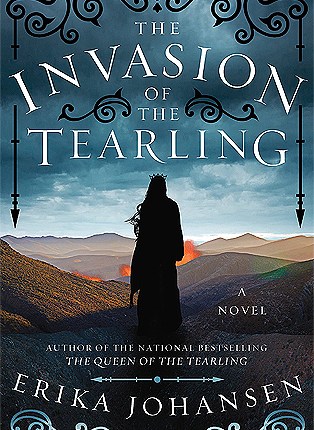
The Invasion of the Tearling (The Queen of the Tearling, #2) by Erika Johansen

The Invasion of the Tearling (The Queen of the Tearling, #2) by Erika Johansen

The Invasion of the Tearling picked up where the last book left off. The Mort army is invading the Tear because of the actions of Kelsea, their new queen.

I won’t say what exactly those actions were, in case you didn’t read the last book. Let’s just say: she’s breaking with tradition in more ways than one.

Kelsea has started to embrace her power in this book. It suits her.

The girl who had been raised by Carlin Glynn would never have trusted in visions, but Kelsea’s world had broadened well beyond the width of Carlin’s library. The Mort would come, and the Tear army wouldn’t be able to stop them. All they could hope to do was slow them down.” pg 33, ebook.

I remember being rather unimpressed by the first book in this series. It felt cliched to me and predictable, except for the shadow creature and the introduction of the magic of the gems.

Photo by Magda Ehlers on Pexels.com

This book has more of both of those things. I approved.

Trigger warning in The Invasion of the Tearling for anyone who has had issues with cutting.

“Just the skin,” Kelsea whispered, staring at her arm, focusing all of her will on a tiny inch of flesh. She had borne worse; surely she could handle this. “Just a scratch.” A shallow line of red appeared on her forearm. Kelsea bore down, watching the line deepen, her breath hissing through her teeth as the skin parted with a sting, allowing a thin line of blood to well up and hold.” pg 117, ebook.

There’s also domestic violence, rape, non-graphic torture and some hints of sexual abuse. I suppose a young adult could read this, depending on their maturity level. 16+ may be appropriate. I would hesitate to go any younger.

Queen Kelsea has a lot on her plate: “My people are starving and uneducated. We have no true medicine. On the eastern border is an army that will crush us into dust. These are real problems, and so for a time I’ve let the others lie.” pg 208, ebook.

Photo by Carolina Basi on Pexels.com

Will she be able to save everybody?

“And Kelsea wondered suddenly whether humanity ever actually changed. Did people grow and learn at all as the centuries passed? Or was humanity merely like the tide, enlightenment advancing and then retreating as circumstances shifted?” pg 381, ebook.

I wonder that sometimes too.

Recommended for readers who enjoy their fantasies on the gritty side. I don’t feel like it ever veers into the truly “dark” but there are some disturbing elements to The Invasion of the Tearling.

Thanks for reading!

The Kingdom of Little Wounds by Susann Cokal

The Kingdom of Little Wounds by Susann Cokal

The Kingdom of Little Wounds is about a seamstress, a nursemaid and a royal family haunted by illness. It is a, sometimes very, adult tale about secrets, sex and power.

Confession: I picked this one out at the library for the cover.

I saw it and thought, “This must be a young adult fantasy of some kind about a princess who works magic with needles.” Sometimes it’s nice to indulge in a pleasant escape from the world.

So, this book is nothing like that.

In the afterword, Susann Cokal describes her work as “a syphilitic fairy tale.” There’s nothing wrong with that. It just really wasn’t what I expected and wanted it to be.

This tale has rape and madness to it. There’s also some torture, severing of body parts and other pretty gross stuff that goes on.

It is definitely geared towards an adult audience. Librarians, please put it in the proper collection. It is not young adult.

The main characters, Ava and Midi, are likeable but powerless. “I truly would like to think I’m in the middle of a fairy tale, facing the period of hardship that precedes a triumph. But I am not a likely heroine.” pg 9, ebook.

The king, Christian, is ridiculous and controlled by his courtiers. “Have you found any… any culprits?” Sir Georg hesitates, and the favorites tense. Who will be blamed? A Lutheran? … Or perhaps some cousin with a tenuous but plausible claim to succession – someone who should be removed for the health of the court anyway?” pg 77, ebook. Notice how they are unconcerned with justice.

Alliances and power shift quickly in this story like the tide. The characters never know who they can trust. “We are all, of course, in service of the Crown and King. Who is known for being liberal with his gratitude, no matter what the rank of the creditor.” I recall something my mother used to say: Be wary of a promise without a clear price.” pg 131, ebook.

Photo by Mike on Pexels.com

Also, in the afterword, Cokal shared that a piece of this story, the appearance of a star, actually happened in Europe in the late 1500’s, early 1600’s. “The new star has put all of us off balance. We’ve always expected things to change down below, in the canals, the streets, and so on, but the heavens have been constant in our memory. This star shines even in the daylight, as if to drive away the sun. It is so bright that it seems heavier than the rest; we have the impression that if we were to stand on tiptoes, we might touch it.” pg 192, ebook.

Recommended for readers who aren’t bothered by dark themes and are in the mood for a “syphilitic fairy tale.”

Thanks for reading!

Grendel by John Gardner

Grendel by John Gardner

Grendel is the ill-fated monster from the ancient story, Beowulf. This is his tale.

There are very few details shared about Grendel in Beowulf. I thought that this story would be an opportunity for the reader to get to know him.

Unfortunately, we spend most of the time in Grendel’s mind, circling endlessly around the ideas of time, brutality, nature and the meaninglessness of existence.

I wanted to know more about Grendel’s mother, but there was very little about her.

John Gardner wrote her as some kind of void-filled slug monster: “Behind my back, at the world’s end, my pale slightly glowing fat mother sleeps on, old, sick at heart, in our dingy underground room. Life-bloated, baffled, long-suffering hag. Guilty, she imagines, of some unremembered, perhaps ancestral crime. (She must have some human in her.) Not that she thinks. Not that she dissects and ponders the dusty mechanical bits of her miserable life’s curse.” pg 10, ebook.

Not like Grendel does, endlessly.

Photo by Laker on Pexels.com

“I understood that the world was nothing: a mechanical chaos of casual, brute enmity on which we stupidly impose our hopes and fears. I understood that, finally and absolutely, I alone exist.” pg 17, ebook.

I think that was the biggest reason I didn’t enjoy this read. I believe every moment in life is, or can be, filled with purpose, meaning and happiness. Grendel falls on the exact opposite end of the scale.

In that way, Grendel is one of the biggest downers you could ever read. He believes that life means nothing. He acts and kills from this empty center.

Out of this morass, the one part I kind of enjoyed was Grendel’s conversation with a dragon in its hoard.

The dragon lives for millennia and sees the world from a view so wide that it is almost outside of time. Again, there’s a nihilist bent to his view, but the dragon brought a weird bit of humor to an otherwise bleak story.

Photo by Suraphat Nuea-on on Pexels.com

“Don’t look so bored,” he (the dragon) said. He scowled, black as midnight. “Think how I must feel,” he said.” pg 43, ebook.

Yeah, think how I must feel. All I wanted was the story of Beowulf from a unique perspective and what I received was a vague feeling of depression about the meaninglessness of it all.

Thanks for reading.

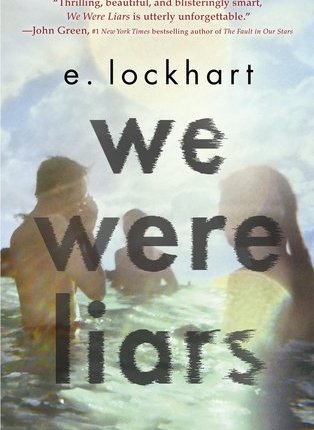
We Were Liars by E. Lockhart

We Were Liars by E. Lockhart

The Sinclair family is blonde, beautiful and wealthy. They gather together in the summer on a private island owned by the patriarch of the family.

Cadence Sinclair Eastman is ill. A terrible accident a few summers ago left her with debilitating migraines and a faulty memory.

Can she put together the pieces of what happened before she has to leave for the summer?

We were Liars is a fantastic coming-of-age book with an unreliable narrator, forbidden love and an excellent twist that I’ll bet you won’t see coming. (I know I didn’t.)

“We are Sinclairs. No one is needy. No one is wrong. We live, at least in the summertime, on a private island off the coast of Massachusetts. Perhaps that is all you need to know.” pg 26, ebook.

This is not a family who wears their hearts on their sleeve: “We believe in outdoor exercise. We believe that time heals. We believe, although we will not say so explicitly, in prescription drugs and the cocktail hour. We do not discuss our problems in restaurants. We do not believe in displays of distress. Our upper lips are stiff, and it is possible people are curious about us because we do not show them our hearts.” pg 55, ebook.

Photo by Matt Hardy on Pexels.com

Cadence, her cousins and Gat, the nephew of one of the boyfriends of a Sinclair daughter, call themselves, ‘The Liars’. Why they do so is one of the biggest mysteries in the story and I won’t ruin it for you.

I loved this book. I loved the tone, the mystery and the slow reveal.

I also loved how the reader gets to know Cadence so completely. This is not a story that leaves you wondering about character motivations.

Highly recommended for fans of young adult books, coming-of-age tales and stories with unreliable narrators. We were Liars may just be one of my favorite reads of 2017.

Thanks for reading!

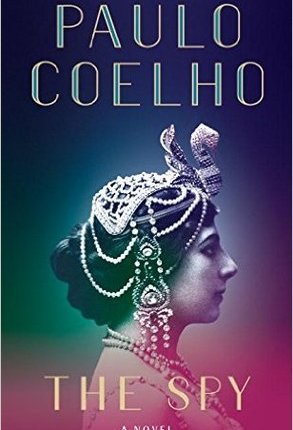
The Spy by Paulo Coelho

The Spy by Paulo Coelho

The Spy is the story of Mata Hari, told first in her voice and then from the point of view of one of her male admirers.

Paulo Coelho isn’t at his best in this novel.

Photo by Faisal Rahman on Pexels.com

He prefers and excels at metaphorical stories. For example, in this tale, Coelho has Mata Hari comparing herself to the nightingale that impaled itself on a thorn to grow a bright red rose for a young man in love.

I get what he was reaching for- but I think this tale would have been told better through details rather than metaphors.

Also, it’s so short. The audiobook was only a couple hours long.

It wasn’t nearly long enough to do Mata Hari’s life justice.

I first learned about the fascinating life of Mata Hari in Inspired!: True Stories Behind Famous Art, Literature, Music, and Film by Maria Bukhoninia. There were enough unbelievable things that happened in Mata Hari’s life to make a compelling historical fiction.

Photo by Pixabay on Pexels.com

Sadly, this didn’t quite fit the bill for me.

If you’re going to read a Coelho novel, may I recommend The Alchemist. (Which is also a novel people love or hate. I fell on the side of love.)

Thanks for reading!