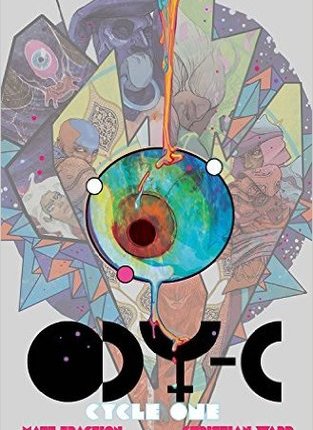
ODY-C: Cycle One by Matt Fraction

ODY-C: Cycle One by Matt Fraction

ODY-C is an incredibly strange, but beautiful graphic novel that takes the classic story line of Homer’s The Odyssey and flips it on its head.

“Here where so many great women died. Three ships leave Troiian space. Three adventures now start. Three great heroes begin their last odyssey.”

Photo by Edvin Richardson on Pexels.com

The book begins with the warriors returning home from an epic war in space. Instead of Helen of Troy, the war was fought over one of the only males in the galaxy, a latex-covered man named “He.”

Like in the old tale, the goddesses, children of Titans, overthrew their father, Kronos. In a twist in this world, they decided that all children grow up to throw down their parents and kill several generations of their own children. In order to ultimately control humanity, Zeus, a curvaceous, powerful woman, in an extraordinary display of power, destroys every male in existence. Eventually leading to the events I just described…

“Sing in us, Muse of Odyssia, witchjack and wanderer. Homeward bound. Warless at last.

Honestly, this book is hard to explain. I think “acid trip” might do it justice. The colors are vivid and the characters can be nightmarish, vulgar or gorgeous. The universe within this book is a science fiction-themed romp with monsters, goddesses, and all sorts of unbelievable settings — a world of bones wherein the child of a goddess forever seeks its prey, a type of space station fueled by a star in which a rare male child of a goddess endlessly mates with women and then kills them when they inevitably give birth to another female… and more.

“Down in the ruinous piles of viscera once her command and her crew, Odyssia recalibrates. Watching the Cyclops of Kylos make feast of the ODY-C’s girls, they know for the first time since Troiia did fall just what fear really feels like inside.”

Photo by Cosmopolitano Model on Pexels.com

It helps to be familiar with classic mythology because the authors don’t take the time to explain how the two are related. Or, I suppose, you could just jump into it blind. I felt like I enjoyed it more knowing both sets of stories.

I was fortunate that the library’s copy of this book included creator interviews in the back to give more context to this incredible work they’ve created.

“Between bearded-lady gods, gender-flipped heroines, gender-uncertain sebex and the odd character who keeps the same gender as their source, the ODY-C is less a gender-bent Odyssey than it is an Odyssey-flavored gender pretzel. Rather, ODY-C is an early next step into what comes after the gender flip: the unfurling of the gender spectrum both to comment on and to dismiss outright what we understand as gender roles and norms in classic literature.”

There is certainly a lot to unpack in here. And it is such a good story.

“The act of telling a story — especially of telling one well — turns your audience’s brain into a photocopy of your own, overriding any other stimuli that the listener is experiencing independently. When a story is so good you feel like you were actually there in the middle of it, it’s because, at least as far as your brain is concerned, you actually were.”
Photo by Engin Akyurt on Pexels.com

In addition to the Greek and Roman mythology, there’s shades of Scheherazade in the unfolding of the fate of He. Readers are also treated to a new twist on the foundation of Rome myth. At least, I think that’s what it is. With the level of creativity in here, it’s honestly hard to tell.

Recommended for readers who are looking for a graphic novel that is completely different from anything you’ve ever seen before. This is that book.

Thanks for reading!

The Testament of Loki (Loki, #2) by Joanne M. Harris

The Testament of Loki (Loki, #2) by Joanne M. Harris

“Once more the Wolf at Hel’s gate greets Asgard’s heroes, one by one. Battle rages, Worlds collide. Stars fall. Once more, Death has won.” pg 5

Ragnarok has come and gone. It didn’t end well for any of the gods, goddesses or, everyone’s favorite Chaos demon, Loki. He begins this story in the same place we left him in the last one — a dungeon in the world of Chaos, wishing and dreaming for light.

Photo by Athena on Pexels.com

What happens next is surprising and told in only the way that Joanne Harris can do it.

“Stories can do so many things. Build empires, topple kings. They can even raise the dead. I should know; they raised me.” pg 10

This wholly unique tale is more along the lines of what I had expected from The Gospel of Loki, but didn’t get. In the previous book, Harris rewrites Norse mythology in much the same way as it has always been told. I get it, she was giving us context. But, it wasn’t very much fun to read… just rehashing old stories.

In this entry, we see Loki in a whole new light with modern characters and his typical problems. It makes for a more cohesive and, in my opinion, entertaining story.

“You know, ‘crazy’ is such a negative word. I prefer ‘disordered.’ Order’s so dull. Chaos is where the party is.” pg 25

Photo by Anni Roenkae on Pexels.com

What has an immortal trickster god learned over his long lifetime? In The Gospel of Loki, he learned the only person he could trust in the world is himself. He learned what it was to be hated for what you were, rather than any actions that one may take. (Though, perhaps, he didn’t always behave in a way to endear himself to others. Not that Loki would ever admit that, of course.)

He learned that prophecies are tricky things and can be bent to be of use to those who deliver them.

“The Prophecy promised us new runes, new gods, a new beginning. And I mean to find those new runes with whatever resources this World can provide.” pg 68

Is it too late for Loki to learn new tricks?

It’s been awhile since I read Harris’ other fantasy series Runemarks, but from what little I can remember of it, I think this book leads perfectly into that one. Which is a curious thing, because Runemarks was published years before this.

Oh, that Joanne Harris. She’s so sneaky. I wonder if she planned that or was embracing a bit of chaos in her writing career. If there’s anything I’ve learned from this book and the last one, it’s that a little chaos can be a good thing.

Thanks for reading!

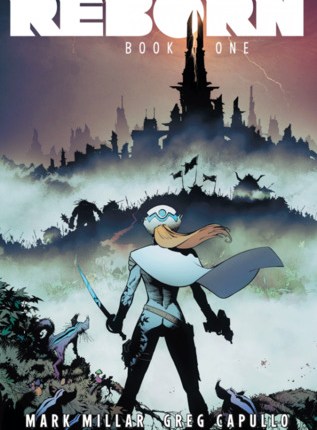
Reborn: Book One by Mark Millar

Reborn: Book One by Mark Millar

Beautiful artwork highlights a so-so story about a woman who dies, only to be reborn into a fantasy-themed world where a perpetual war of good versus evil rages on.

I think the basic idea of this graphic novel is fascinating. What happens to us after we die? We have faith, religion and all sorts of near-death experiences to fall back on, but who can say with any certainty.

From an interview in the back of the book with Greg Capullo, one of the creators: “What I loved about the story is that it deals with all of our fears about what happens when we die, but amidst the fear and the sorrow, we have this spectacular adventure that takes place in a fantastic and exciting world — a world I got to invent.”

Photo by Susanne Jutzeler on Pexels.com

Some of my quibbles with this story include that the good versus evil theme makes all of the characters seem so simplistic. You can predict almost exactly what they’re going to do before they do it — no gray areas. Also, everything is based around Bonnie, one character, and she becomes the savior archetype for the entire tale.

But, on the other hand, if you take this book, as a whole, for a metaphor of what happens after death, it works. Like so many near-death experiences, it all boils down to one view point, that of the newly departed. If you consider it like that, of course the story would be based around one person. She is seeing the next world entirely from her point of view, everything is interpreted through that lens.

It’s a curious phenomena, those who have had NDE’s, generally describe imagery and a storyline that makes sense to them culturally and fits within their framework of faith. Bonnie didn’t want to die, but when she does, she sees a world so similar to where she just came from, except it contains people who have died before she did.

Bonnie’s relationships with the people she knew before her death determine so many of the other character’s roles in the story. She has a curious relationship with the “faerie queen” which I found interesting.

Photo by Ferdinand Studio on Pexels.com

I can’t decide if I’m reading more into this story than is actually there, or if it was actually touching on some of the larger themes I mentioned. As I said, I got bogged down in the predictable characters.

At least the artwork is pretty…

I’m interested to see where Netflix goes with this, as I read in Variety that they’re developing it into a film starring Sandra Bullock.

Thanks for reading!

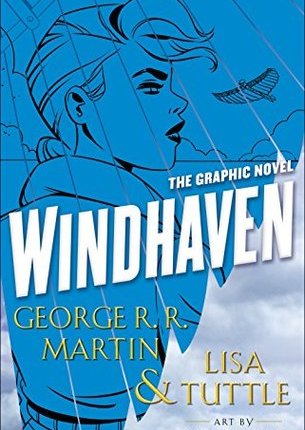
Windhaven: the Graphic Novel by George R.R. Martin, Lisa Tuttle

Windhaven: the Graphic Novel by George R.R. Martin, Lisa Tuttle

Windhaven is a world of small islands, connected by messengers who fly with intricate metal wings. The culture of the “flyers” is a closed one, with wings handed from messenger to his or her first born child.

Maris is not the child of a flyer, but that’s not going to keep her from joining their world.

“You don’t bother me. Maybe when you grow up, you can help the flyers like my friends here. Would you like that?” “No.” ” No? What then.” “I want to fly.”

Photo by eberhard grossgasteiger on Pexels.com

And when she does, things will never be the same.

This graphic novel was based off of Windhaven, the first book in a fantasy series by George R.R. Martin and Lisa Tuttle. Readers get a “Game of Thrones”-ish feeling from this book in the political machinations between the flyers and those they call the “land bound.” But it lacks the intricacy and extraordinary cast of characters that is “Game of Thrones”.

Having never read anything by Tuttle, I’m not sure how she and Martin blended their visions.

“Don’t waste your time on foolish dreams! I won’t have my daughter be a woodwings!”

Photo by Wendy Wei on Pexels.com

The artwork by Elsa Charretier is pretty and I enjoyed how she aged Maris throughout the book.

The scenes of the flyers themselves, especially a few of the chase scenes, must have been difficult to draw. Charretier had to make the characters look like they were in motion for it work. I think she did well, but the wings look kind of chunky in some of the pages, rather than the slick, technological wonders I pictured in my mind.

As for the story itself, I was surprised by the actions of some of the characters, but for the most part, it all seemed inevitable. Maybe that’s what the authors were going for — Maris’ fate was more destiny than choice.

Thanks for reading!

Shades of Magic Vol. 1: The Steel Prince by V.E. Schwab

Shades of Magic Vol. 1: The Steel Prince by V.E. Schwab

V.E. Schwab has penned a graphic novel about Maxim Maresh, one of the ancillary characters from The Shades of Magic series.

I was very excited to read this. The tidbits Schwab dropped about Maxim in the trilogy were enticing. We learned he had a storied past. He fought notable outlaw figures. Somehow he developed an extraordinary control of his powers, which others had not been able to mimic.

Under his reign, a certain magician opened the doors between the worlds to act as emissaries and messengers. But also, exposed the worlds to the greatest danger that they had ever faced.

Photo by Aidan Roof on Pexels.com

“Before he was the King of Arnes, Maxim Maresh was a young, head strong prince with a penchant for metal magic and a lot to learn about the world beyond Red London. Banished by his own father to Verose, a city on the dangerous Blood Coast, Maxim was plunged into a world of danger and adventure.” Foreward, by V.E. Schwab.

So, who was this man? This graphic novel series sheds some light on an enigmatic figure.

“Why would you see those doors pried open again?” “Because sooner or later, all spells fail. And one day the doors to those worlds will open whether we wish it or not.”

What did I think of it? It was the first in a series. It’s hard to give all of the contextual information of a new story without it turning into an info dump or neglecting to develop the characters.

Schwab does a good job of avoiding these pitfalls, but I wanted more depth and development.

We do get to see something of “bone magic,” one of the more terrifying of the magics from Schwab’s stories. Bone magic, unlike the elemental basis of the other magics, allows the user to literally control the actions of those around them.

Photo by Pixabay on Pexels.com

Bone magicians can make you throw yourself onto their enemies or your friends. Hold still while you’re tortured. Stick a knife in your own eye.

Bone magic, the removal of free will, is the idea that has continued to haunt me from the Shades of Magic series and Schwab uses it to good effect in this story.

That being said, Maxim, at first, acts like a brat and doesn’t understand the complexities of real life, running headlong into the “royalty removed from the world” trope. This focus of his character doesn’t lend itself to likability. Perhaps that will change as the series goes along. Also, we get to see so very little of his extraordinarily abilities and more of his mediocrity.

However, the artwork is stunning. I hope to read and enjoy the next volume. But I can’t say I was knocked off my feet by this installment.

Recommended, of course, for fans of the Shades of Magic series.

Thanks for reading!

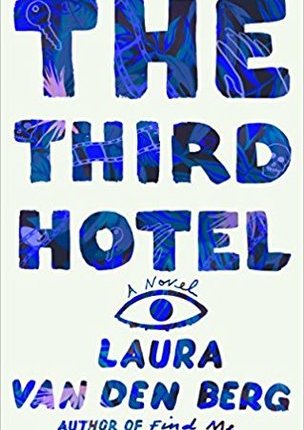
The Third Hotel by Laura van den Berg

The Third Hotel by Laura van den Berg

A strange and confusing ride through a world seen through the eyes of a grieving widow. A short time prior to attending a film festival in Cuba, Clare’s husband Richard was killed. Now, she sees him on the streets of Cuba.

“Clare had never before seen her husband operate a motorbike, but he navigated it like he had been riding one all his life, like he had been riding one in Havana all his life, like he had not been struck by a car and killed in the United States of America some five weeks ago.” pg 13

Photo by Valeriia Miller on Pexels.com

What is going on? The reader isn’t sure what’s real and what’s only in the mind of Clare. Laura van den Berg raises mammoth questions and leaves the interpretation to the reader.

My book club picked a heck of a read for March. Reactions to this book ranged from the disgusted to the mystified to the fascinated. I’d put myself somewhere in between.

I like having complex symbolism to pick apart and magical realism to consider in a story. I like having an open-ended mystery. I don’t need to have all the answers.

But I do like to have more hints at the possible interpretations than van den Berg gives us.

“She might have said, I am not who you think I am. She might have said, I am experiencing a dislocation of reality.” pg 3

Photo by cottonbro on Pexels.com

Or she might have said, I have no idea what’s going on in this story. A character in the novel itself explains this confusion (in the guise of talking about horror films), suggesting it’s purposefully created by the author, and says it is designed to create a sensation of “eels under the skin.” This book definitely had that type of impact on me.

“Besides, he added, raising a finger, the foundation of horror is a dislocation of reality, a dislocation designed to reveal the reality that has been there all along, and such dislocations happen all the time.” pg 9

As I said, it’s weird, but there’s something genius about it too. Van den Berg’s words are beautiful, but they don’t always make sense. I turned the last page and was infuriated at how confused I was.

“She wondered what the eye would see and what she would see in what the eye saw. She imagined the suspension transforming into a warm flood of inevitability as the gate swung open and she stepped into whatever new dislocation of reality lay ahead.” pg 32

Photo by Tobias Bju00f8rkli on Pexels.com

In conclusion, it’s a hard book to read, but perfect for groups who are looking to spur a literary discussion. There’s so much to unpack.

Is she in an alternate reality or having a psychotic break? Or is she just grieving the whole time? What does her life now have to do with her childhood? What is the secret Clare shares with her father? Is there hidden meaning in her trip to the southern part of the island?

That’s just what pops into my head when considering the title of this book. Recommended for readers who don’t mind being totally confused and left with eels under their skin.

Thanks for reading!

The Gospel of Loki (Loki #1) by Joanne M. Harris

The Gospel of Loki (Loki #1) by Joanne M. Harris

Joanne M. Harris treats readers to episodes from Norse mythology from Loki’s point of view.

“No doubt about it, I told myself. These bastards really don’t like me.” pg 27

Born from literal Chaos and tricked into joining Odin’s forces of Order, Loki is perpetually a child of both worlds. From his first moments out of the world of Chaos, Loki is disliked by the other gods. That leads to some initial unpleasantness and he vows, no matter how long it takes, to get his revenge.

Photo by Gioele Fazzeri on Pexels.com

“Till then, I bided my time, and smiled as sweetly as my scarred lips would allow, until the day I would take my revenge and bring the gods down, one by one.” pg 67

And it is a long game. Through schemes, tricks and straight up cons, Loki weaves disorder throughout the worlds.

There’s the memorable time he convinces Thor to dress up as a bride in order to sneak into the home of their enemies: “I’ll be your handmaid, Thor,” I said. “Don’t worry, I won’t steal your thunder. You’ll make a gorgeous bride.” Thor growled. pg 118

As he becomes famous for his trickery, it becomes more difficult for Loki to pull off his tricks. He’s pushed into marriage by Odin, but it doesn’t fit who he is. It isn’t in his nature to settle.

“I began to see that celebrity wasn’t all hot girls and free beer. It’s also the curse of expectation — and the bitterness of falling short.”pg 141

Photo by Little Visuals on Pexels.com

We all know where the story is headed, but it’s a train wreck you can’t quite look away from.

My quibbles with this book included a disjointed feel to the overall story. Loki and company run from one disaster to the next. I realize that the source material is probably the reason for this, but it just doesn’t coalesce into something more than its parts.

Odin’s gods, the gods of Order, come off as rather one note. It’s interesting how Odin was able to see potential in Loki, enough so that he calls him from Chaos to begin with, but the other immortals share none of his vision.

Other than a few notable exceptions, they never extend an olive branch or give Loki the smallest chance to prove himself. In my mind, it’s easy to see why he wants them to fall. Who wouldn’t wish that on the people who are mistreating you?

Photo by Nick Bondarev on Pexels.com

I’ve read a few of Joanne Harris’ other books, and I remember they contained delightful twists in them, so that the plot wasn’t so straight forward. She’s somehow stuck in telling conventional mythology in this book.

If only she could have used this book to tell aspects of the story we haven’t heard before, or even imagined, using the voice of one of the most interesting of the gods to do so. That would have been something I may have enjoyed even more.

Recommended for readers who adore Loki. There’s plenty of him in here, and that’s it.

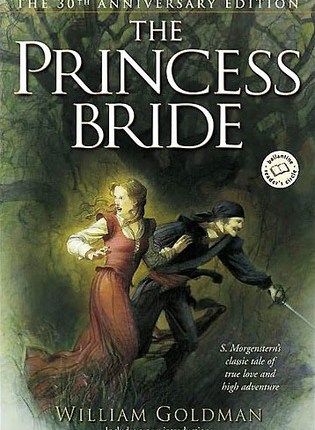
The Princess Bride by William Goldman

The Princess Bride by William Goldman

** spoiler alert ** Please be aware: major spoilers ahead if you have not read the book or watched the film. Consider yourself warned.

A new classic tale about a woman named Buttercup, the man she loves named Westley, a giant who loves to rhyme named Fezzik and Inigo, a Spanish swordsman out for revenge.

Of course, like many, I’ve seen the film The Princess Bride about a bajillion times, but I’d never read the book. It was time to rectify that error. Because the book is always better than the movie, right?

“I love you,” Buttercup said. “I know this must come as something of a surprise, since all I’ve ever done is scorn you and degrade you and taunt you, but I have loved you for several hours now, and every second, more.” pg 59, ebook.

Photo by Charles Pragnell on Pexels.com

But not this time, friends. I know, I was shocked too.

That’s not to say the book isn’t charming, because it is. There’s all of the characters you love and they deliver the classic lines from the film, plus you get the backstory and additional humorous injections from William Goldman. Goldman created a story within a story — he acts as if he’s simply editing a book by S. Morgenstern and has created an entire history around this idea.

He’s so convincing, in fact, that I immediately googled Goldman to make sure I hadn’t missed something.

My favorite part of the book was exploring Prince Humperdinck’s “Zoo of Death”, which we only get to see in passing in the movie.

“The fifth level was empty. The Prince constructed it in the hopes of someday finding something worthy, something as dangerous and fierce and powerful as he was. Unlikely. Still, he was an eternal optimist, so he kept the great cage of the fifth level always in readiness.” pg 68, ebook.

Photo by Daniel Torobekov on Pexels.com

Honestly, some of the scenes in the book go on a bit too long. The part where Westley challenges Prince Humperdinck “to the pain” instead of “to the death” comes off as creepy in the book, whereas, I felt, in the film it was kind of awesome. I’m not entirely certain what the difference is, except his speech is more to the point in the film.

“It means that I leave you to live in anguish, in humiliation, in freakish misery until you can stand it no more; so there you have it, pig, there you know, you miserable vomitous mass, and I say this now, and live or die, it’s up to you: Drop your sword!” pg 225

Those are all just quibbles compared to the ending, which was the most shocking point of all.

Ok, as we all know, in the movie, it ends with a kiss and they all live happily ever after.

In the book, not so! Here are the last lines in the “official story” not counting a few more comments by Goldman:

However, this was before Inigo’s wound reopened, and Westley relapsed again, and Fezzik took the wrong turn, and Buttercup’s horse threw a shoe. And the night behind them was filled with the crescendoing sound of pursuit… pg 228, ebook.

Photo by Min An on Pexels.com

That’s it. I nearly fell out of my chair when I read it. Here’s what our author said about it a few paragraphs later:

“I’m not trying to make this a downer, understand. I mean, I really do think that love is the best thing in the world, except for cough drops. But I also have to say, for the umpty-umpth time, that life isn’t fair. It’s just fairer than death, that’s all.”

It’s such an unsatisfying ending. I can see why they changed the film because I don’t think audiences would have stood for it, which probably says more about film-going audiences than readers, but still. Don’t readers deserve a happy ending too?

Thanks for reading!

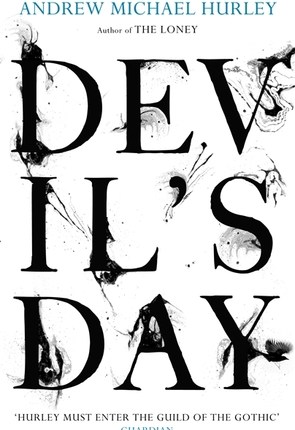
Devil’s Day by Andrew Michael Hurley

Devil’s Day by Andrew Michael Hurley

A slow-moving horror story that asks the reader to consider what may be the truth behind ancient customs and myths, and what secrets a small, isolated community may be hiding from the rest of the world.

“One late October day, just over a century ago, the farmers of the Endlands went to gather their sheep from the moors as they did every autumn. Only this year, while the shepherds were pulling a pair of wayward lambs from a peat bog, the Devil killed one of the ewes and tore off her fleece to hide himself among the flock.” pg 1

Photo by Snapwire on Pexels.com

The small gathering of farms, Underclough, is as much a character in this story as the actual characters.

“When the first buildings appeared, I could tell that Kat was disappointed. I think she’d expected to find Underclough nestled in the valley, not dark and cramped like something buried at the bottom of a bag.” pg 24

There’s a sense of inevitability about the whole thing. You’re not just born in this place. You live, work and die here, on the edge of the wilderness and the known world.

“Living on the farms was one endless round of maintenance. Nothing was ever finished. Nothing was ever settled. Nothing. Everyone here died in the midst of repairing something. Chores and damage were inherited.” pg 38

Photo by Karolina Grabowska on Pexels.com

John Pentecost knows from his childhood that there are forces in nature that cannot be explained. There are whispers in the woods and shadows beneath the trees that move with their own power. There’s a reason why the farmers have a “Devil’s Day” each year, to put the spirit to sleep while they gather their flocks in peace.

“As the Devil watched me, the same question ran through my mind as incessantly as the river. Did I like stories? Did I like stories? I answered yes.” pg 146

Andrew Michael Hurley uses the environment and setting to slowly create a feeling of dread, but then I felt like he never delivered on the story that he so painstakingly sets up. The pace is glacially slow.

Photo by Lucas Pezeta on Pexels.com

That being said, there are one or two scenes from Devil’s Day that haunted me when I read them. I just happened to be reading this the night a record-breaking windstorm blew through town. I heard eerie shrieks and groans coming from outside my windows throughout the evening.

I couldn’t help but wonder what I would say if the Devil asked me if I like stories…

Thanks for reading!