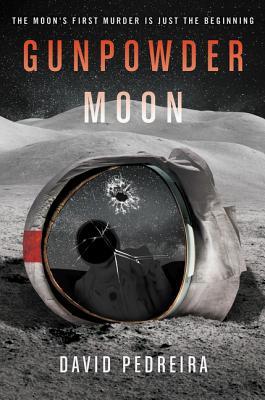
In a dystopian world where the once powerful countries are now scrambling for fuel, the helium3-rich fields of the moon are a godsend. But when an American miner turns up dead, it may become the new front in a war, not just for control of the Earth, but also the galaxy.
“Cold enveloped him. He opened his eyes in Moon shadow and had to blink to make sure they weren’t closed.” pg 5
This is a story that could have been a thriller, but it gets bogged down in the technical aspects of life on the moon. I imagine the science is sound, but, unlike “The Martian”, I felt like it slowed the action down to a crawl rather than speeding it along.
The characters were problematic. There are half a dozen of them and I couldn’t seem to connect with any.
“Dechert wondered for the hundredth time if the people back home had any clue what it was like to live on the Moon.” pg 15
The mystery wasn’t all that mysterious and is tied up in one paragraph towards the end. I was disappointed. I like my mysteries with more twists and turns, an unexpected bump or two.
“I’m going to catch a quick two hours,” he said. “Wake me up if something bad happens.” pg 29.
A nap was starting to sound pretty good to me too.
I read David Pedreira’s bio and it seems he’s a journalist, or was. I could tell from his writing. The sections read sort of like mini-news stories. Lede, information, kicker, repeat. Not that there’s anything wrong with that format, but I wish the story had been shaken up somewhat.
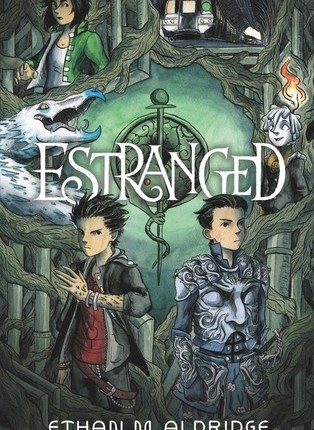
A cute graphic novel for middle graders that features a changeling, his human counterpart, their human sister and a golem made out of wax.
“There hasn’t been a human in High Court in a century. That makes you special, doesn’t it?” “Oh, they never let me forget that. It’s always ‘the human childe’.”
But trouble brews when a disgruntled elf turns the king and queen of the High Court into rodents. Then, she goes after the “Childe”. In response, he seeks out his changeling twin in the world above or the real world. And that is where our adventure begins.
“The only home I’ve ever had has been taken! This was meant to be my home, my life, and it was taken before I was old enough to remember it!” “I’ve got nothing, nowhere to go! I have as much right to be here as you!”
Along the way, they have to face goblins, magic statues, a witch and a treasure-hungry dragon. The plot is a bit simplistic but it is perfect for children who like fantasy and urban fantasy.
In fact, I picked this book up at the local game shop for my daughter and she read it in one sitting, which is a miracle because she’s a reluctant reader. I’m always looking for stories or formats that appeal to someone who enjoys video games more than books.
She absolutely loved it and said I HAD to read it. I asked why and she said, “Because it’s just awesome.” She loved the magic and world Ethan Aldridge has created. She also loved the artwork. Her favorite character, and mine, was Whick, the brave wax golem who accompanies the Human Childe from the court below to the world above and back.
The story also touches on the sometimes difficult relationship between a brother and sister. There’s a good message about taking care of your family that I resonated with.
In conclusion, I loved that my Human Childe loved it. Highly recommended.
Author Brooke Bolander takes two unrelated historical events and ties them together in an effort to make a statement about the inherent darkness in humanity. Historically speaking, an elephant named Topsy was actually put to death by electrocution. The radium dial painters, whom you can read about in The Radium Girls: The Dark Story of America’s Shining Women, actually existed.
In this science fiction/alternative history story, elephants are a sentient race, forced to work where the radium girls once worked. And to bear the same lethal doses of radiation. It leads to a sad conclusion.
“The ‘greater good’, as you put it, was also used to justify the use of my people in your radium factories during the war, was it not? To save costs. To save your own from poisoning.” pg 32
This new history is reflected in a future narrative that takes place between the historical portions of the story. (You’ve got three stories being told from three different narrators. I didn’t find it confusing once I figured out that the author switched stories after each break on the page. But prior to that, I was grasping at straws.)
In this new future, the government is looking for a way to warn humankind away from nuclear waste sites. They decide to ask the elephants if they can alter their DNA, to make them glow in a version of a living “keep away” sign.
And so here Kat sits, tie straightened, hair teased heaven-high, waiting to meet with an elephant representative. Explaining the cultural reasons why they want to make the elephant’s people glow in the dark is going to be an exercise in minefield ballet…” pg 12
I felt like this book lessened each historical event rather than making them stronger by tying them together. They were both awful, yes, and sentient elephants deserve their own story. The women who suffered and died because no one shared the dangers of radiation with them, deserve their own story. Something far more than the simplistic alternative future Bolander gives them in which, yet again, elephants were about to be abused by human beings and confined to a nuclear wasteland.
“They will see how we shine, and they will know the truth.” pg 59
In some ways, it all reminded me of what was done to the Native American tribes. Which was also awful. And also deserves its own write-up.
Another quibble I had with this story, Bolander takes aim at the males of both species, painting them as both stupid and addicted to violence.
“The bull rolled one red eye to look up at her. He laughed with malice and with scorn, but most of all with madness. As is the way with bulls. … Furmother looked at him with sadness — because then as now We pitied the bulls, our Sons and Fathers and occasional Mates.” pgs 30-31
Can you imagine if those pronouns were reversed? “The Furmother rolled one red eye to look up at him. She laughed with malice and with scorn, but most of all with madness. As is the way with Furmothers…” I don’t believe in hurling hate or blame from either end of the spectrum. We’re all in this together.
On a more positive note, the curious collective intelligence of the elephants that the author hinted at was fascinating, as well as their different methods of communication. But this short story format doesn’t allow for an in-depth examination of this aspect of the story.
“They had blown raw red holes through the Many Mothers, hacked away their beautiful tusks, and the sky had not fallen and she had not mourned the meat. She was She — the survivor, the prisoner, the one they called Topsy — and She carried the Stories safe inside her skull, just behind her left eye, so that they lived on in some way.” pg 14
Elephants are something special. I’m reminded of the Romans and how they loved to kill people and all manner of animals in the Coliseum, except elephants. They banned killing elephants because they couldn’t stand to look the creatures in the eye as they died. There was something too sad to be borne that was communicated in the moments before an elephant’s death, something that crossed species lines.
That’s why I wanted this story to work. And, sadly, I just didn’t connect with it.
A gorgeously-drawn graphic novel that suffers from a bonkers plot and scrambled timeline.
I’ll try to give a brief summary here, but understand that this is gleaned from every part of the book — beginning, middle, end. Farel Dalrymple doesn’t present the story in a linear fashion, which is incredibly frustrating.
A boy and his brother enter a cave and are attacked by a demon-like creature called a shadowman. During the course of the attack, the demon messes with the first boy’s eyes and something radically shifts in his brain/destiny. After his brother saves him, the boy’s eyes are drawn to a medallion in the demon’s cave through which he sees/astral travels into a different dimension where he can view aspects of the future.
This future is an apocalyptic world filled with these shadowmen and children who fight against them. All grownups in the world have become shadowmen. When a child reaches a certain age, they are “harvested” by the demons and become part of the problem. Something powerful and magical is fueling these shadowmen, but discovering and disabling that artifact is the large story arc so I won’t spoil it for you here.
Meanwhile, the boy-with-the-demon-altered-eyes is (I kid you not) kidnapped by aliens while his brother goes on to fight the shadowmen in the real world. Then there’s some character development about the children/warriors in the apocalyptic world, the involvement of a child from our time, a blind child who uses technology in a way that borders on magic, another child who actually uses magic… And, at one point, I think the author tries to add the difficulty he had writing the comic into the comic itself.
This isn’t a fairy tale story for teens though it seems to reach for a coming-of-age feel. The children use drugs to protect themselves from the mind-altering powers of the shadowmen and are constantly fighting bugs that pop out of the shadowmens’ heads after they kill them. It is a paranoid schizophrenic’s nightmare.
The Wrenches is violent and disturbing, rather like Peter Pan on acid with demons instead of pirates. And not in a good way.
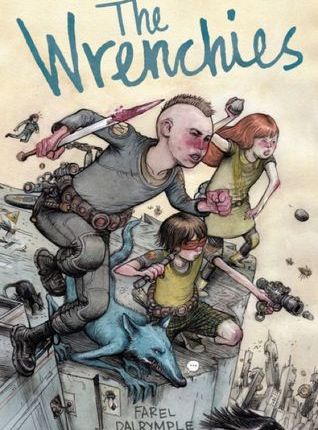
I suppose if you just looked at the artwork and didn’t read it, you might enjoy this graphic novel. Honestly, the panels are stunning. Shame about the story tho.
A science fiction twist on the mystery genre — each morning a man, who can’t even remember his own name, wakes up in a different body at a party in the country. Each night, the daughter of the hosts dies. It is his job to solve the mystery to break the cycle. But where to begin?
“My dear man, what on earth happened to you?” he asks, concern crumpling his brow. “Last I saw —” … “We must fetch the police,” I said, clutching his forearm. pg 7
As the man lives the same day again and again, he discovers that he is not the only one trying to solve this mystery. And none of the people in the house are who they appear to be.
“A party?” she says, shaking her head. “Oh, my dear man, you really have no idea what’s happening here, do you?” pg 48
Any readers out there watch the television show, Quantum Leap, in the 80’s and 90’s? (It may be on Netflix now too, I don’t know.) I devoured that show every time it was on.
The television show is about a doctor named Sam Beckett who enters a time travel/quantum physics experiment and it goes terribly wrong. He finds himself stuck in the body of other people throughout history. He has to solve a mystery or right a wrong in each life and then he “leaps” into somebody else.
From the introduction to Quantum Leap: “And so Dr. Beckett finds himself leaping from life to life, striving to put right what once went wrong and hoping each time that his next leap will be the leap home.”
This story is quite similar to a mystery version of that show.
“Somebody’s going to be murdered at the ball tonight. It won’t appear to be a murder, and so the murderer won’t be caught. Rectify that injustice and I’ll show you the way out.” pg 68
I enjoyed it immensely. My only complaint is that the introduction is completely baffling until the author begins to drop clues about what’s going on. Other than that, prepare yourself for a twisting, complex ride through the same day, over and over again.
“Somebody wants me dead.” It feels strange to say it out loud, as though I’m calling fate down upon myself, but if I’m to survive until this evening, I’ll need to face down this fear.” pg 34
It doesn’t sound like very much fun, but similar to the film Groundhog Day, the reader soon discovers that much more goes on in one day than can be entirely lived through one viewpoint or life.
This book helped me ponder how complex life actually is. Imagine everything you’re missing by living each day in just one body.
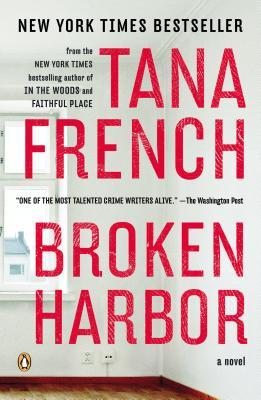
When a family is attacked and three of its members die, the Dublin Murder Squad activates Detective Michael “Scorcher” Kennedy to solve the case.
“Here’s what I’m trying to tell you: this case should have gone like clockwork. It should have ended up in the textbooks as a shining example of how to get everything right.” pg 13, ebook
But things are never that simple in Tana French’s thrilling, mystery series.
I said, “This is a bad one.” O’Kelly laid one heavy palm on the call sheet, like he was holding it down. He said, “Husband, wife and two kids, stabbed in their own home. The wife’s headed for the hospital; it’s touch and go. The rest are dead.” pg 15, ebook.
Readers were introduced to Scorcher in the last book, as the tight-laced and slightly inept officer assigned to investigate the cold case that took place in Faithful Place. I didn’t like him much in that book and this one didn’t change my opinion.
“Probably he was thinking what a boring bollix I was. … Only teenagers think boring is bad. Adults, grown men and women who’ve been around the block a few times, know that boring is a gift straight from God.” pg 22, ebook.
Unlike the last books which mainly dealt with psychological tension caused by fear, Broken Harbor delves into the murky waters of mental illness.
“I don’t know what word you want me to use, but if this fella’s mental, then nobody has to go asking for trouble. He’s bringing it with him.” pg 81, ebook.
In addition to juggling his case, Scorcher is trying to protect his sister, who is bipolar and refuses to seek help. The family hides her illness from their neighbors because of shame and something that happened in their past.
This plot point seemed outdated to me. Culture has shifted in the past decade so that mental illness is no longer something that is swept under the rug. Maybe this is different in Ireland than the States, but I kept getting hung up on that and it spoiled my enjoyment of what would have otherwise been another thrilling story.
Recommended for readers who enjoy psychological thrillers. Be aware of potential triggers for anyone who struggles with auditory hallucinations, suicidal tendencies and mood swings.
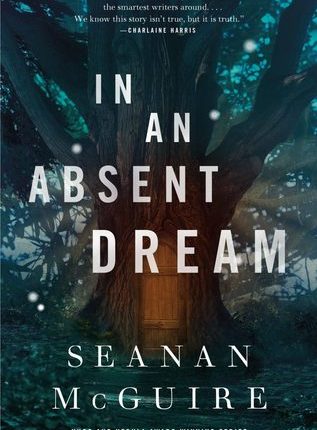
In this enjoyable entry in the Wayward Children series by Seanan McGuire, we learn the other-worldly wanderings of the person who calls herself Lundy and why she is the way she is.
Like the other children from this series, the world, in this case the Goblin Market, chose the child for specific reasons.
“Katherine’s remarkability took the form of a quiet self-assuredness, a conviction that as long as she followed the rules, she could find her way through any maze, pass cleanly through any storm.” pg 18
The most enjoyable aspect of this story is Lundy’s unrepentant bibliophilia. I think anyone who loves to read can empathize with much of her character.
“Mysteries in books were the best kind. The real world was absolutely full of boring mysteries, questions that never got answered and lost things that never got found. That wasn’t allowed, in books. In books, mysteries were always interesting and exciting, packed with daring and danger, and in the end, the good guys found the clues and the bad guys got their comeuppance.”pgs 27-28
But it is Lundy’s penchant for always trying to find a loophole in reality, which serves her well in reading and the Goblin Market, that eventually creates a problem.
“If she thought of this as a fairy tale that she had somehow stumbled into, she could handle it. She knew the rules of fairy tales. Most importantly of all, she knew that fairy tales ended with “happily ever after” and everything being just fine.” pg 48
Like McGuire’s other entries in this series, nothing is simple in this tale and there are decisions far more complex than a child can easily make. That’s part of the brilliance of it. These worlds that the children stumble into are dangerous and sometimes innocent people get hurt.
“What’s the Goblin Market?” “It is a place where dreamers go when they don’t fit in with the dreams their homes think worth dreaming.” pgs 56-57
Highly recommended for readers who like their fairy tales told with just enough reality to make it feel real. The Wayward Children series is a treat.
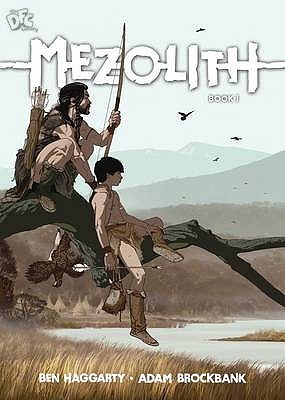
A beautifully illustrated coming-of-age tale about a boy who lives with his stone age tribe. Reality and mythology are mixed in his life to create something else, something that feels true though it couldn’t possibly be.
“Poika, at the heart of the world there is a cave and in that cave there are countless urgas, all sleeping… all dreaming… and when one dreams that a brother has been destroyed he wakes. Crawls into the world. Finds some humans and cries pitifully near them… until someone comes to care for him…”
How do you imagine that Stone Age peoples explained phenomena that scientists today have only begun to unravel? Where does love come from? What brings a fever or trouble? They explained these things by telling stories.
There’s the story of a man who fell in love with a woman who was actually a swan, so he travels to the end of the world to convince her father, the Swan King, to let her live with him.
There’s a demon who conceals itself as a baby and then in the night, if you take it into your tribe, it wakes and consumes everything in its path.
There’s a woman who should have died, but survived, and now has an uncanny relationship with crows and can see through their eyes… and more.
It’s magical and strange, and Adam Brockbank has illustrated Ben Haggarty’s stories beautifully. It is easy to see why this was a Times pick for Best Graphic Novel.
Despite this excellence, only one library in my enormous, interconnected library system owned this book. I was surprised. It has appeal for both young adults and the young-at-heart. The violence in it isn’t overly graphic. The themes are appropriate and intriguing for reluctant readers.
If any librarians read this review, please consider buying a copy of Mezolith for your shelves. I think your patrons would enjoy it. I certainly did.
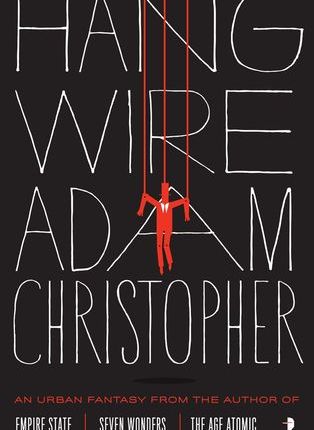
Hang Wire is an urban fantasy novel with a half dozen characters, some immortal, some every-day people, who come together to face a threat of a magnitude that humanity has never known.
In between flash backs to the villain setting up his ghastly scheme, readers get to follow the trail of a killer in San Francisco who garrotes his victims with thick cable and then hangs them by their necks in a grisly display.
“When the second surge threw him up to the surface, and the third pulled him down, he knew something was wrong. When he surfaced again he could hear it, a moaning, like a deep wind howling through a canyon a million miles away.” pg 10
It’s actually a rather complex plot between the flashbacks and the modern day with nearly constant back and forth skips in time, almost like waves in an ocean.
“You are the master of every situation.” pg 45
Which leads to my main complaint about this book. Similar to other urban fantasies I’ve had the privilege of reading in the past, it felt like the plot either needed to be simplified or fully fleshed out. By zipping over so much in so few pages, I felt like we only got part of the story.
“Of course it had happened before. Several times. San Francisco, like an unfortunate number of other cities across the United States, knew what it was like to have a serial killer in their midst.” pg 47






















 The Help Desk Book Blog