The Dream Lover: A Novel of George Sand by Elizabeth Berg

The Dream Lover: A Novel of George Sand  by Elizabeth Berg
thedreamlover

The Dream Lover encompasses some of the best qualities that historical fiction has to offer. It transports you to the 1800’s France. It introduces you to an extraordinary person: Aurore Dupin, pen name, George Sand. Then, the reader gets to sit back and enjoy the wild ride that was her life. Talk about escapism.

For a woman in the 1800’s, George Sand had it going on. She left her husband, had a series of lovers- both male and female- became a famous author, involved herself in the political upheavals of her time… it is truly an incredible life.

Not everyone in her life accepted her for who she was: “I feel I have made a mistake, George, and that I do not love you after all. … The only thing you are passionate about is locking yourself up at night and writing your precious fiction, ignoring all that is before you here, which, if you would pay attention to it, would make your stories infinitely richer!” … It was as if I had been shot in the chest.” pg 242. But she wrote and loved anyway. Well done, Aurore, well done.

She rejected the role that society set out for her. “Tell me, George. Do you wish you’d been born a man?” … “In my youth, I wished that. … But now I find I don’t wish to be either man or woman. I wish to be myself. Why should men serve as judge and jury, deciding for us what can and cannot be done, what is our due? Why should they decide in advance of our deciding for ourselves what is best for us; why should they decide what IS us?” “But then you do wish to be a man!” “Perhaps I wish to be a woman with a man’s privileges.” pg 151. Amen.

I loved the drama in this novel as well as the romance. One would think that the sheer quantity of lovers that she had would have nullified any quality in the feelings, but Berg does a good job proving that this was otherwise. The passion that she exhibits in one, Sand seems to have shown in them all.

My only complaint about The Dream Lover is that it felt rushed because of the almost unbelievable amount of important events that peppered Sand’s life. I would have savored a 1000+ page book like Margaret George’s treatment of Cleopatra in The Memoirs of Cleopatra, but The Dream Lover appeals to the more casual reader.

Still, it would have been awesome. A bookworm can dream, can’t she?

If you enjoy Margaret George, you may like this book too for its sumptuous descriptions and tempestuous relationships. Also, you may want to pick up In the Company of the Courtesan or Marrying Mozart. Both are excellent historical fiction novels with similar themes to The Dream Lover.

I received a free advance reader’s copy of this book through Goodreads First Reads. FTC guidelines: check!

Thanks for reading!

Sarah (The Canaan Trilogy #1) by Marek Halter

Sarah (The Canaan Trilogy #1) by Marek Halter
sarah

A historical fiction about the early days of Abraham from Sarah’s (Sarai’s) point-of-view.

I think that this novel wasted an opportunity for a great story. Like a majority of women in the Bible, Sarai’s life was largely untold. So, Marek Halter had a blank slate to work with.

And what he wrote for Sarai was a life of waiting. Waiting for Abram to talk to his god. Waiting for Abram to come back from war. Waiting to become pregnant. Waiting and wandering, looking for a home.

If I had written this story, Sarai would have been so busy doing something spectacular that she would have hardly even noticed Abram’s absence or presence. Maybe she invented a new form of weaving. Maybe she started her own business selling those herbed loaves that she was so proud of. Or, to introduce a fantasy twist, maybe she was secretly a vampire hunter, like Abraham Lincoln: Vampire Hunter.

My point is: for a story about a woman, it was mostly about the men in her life. Which makes it not very different than the source material. And, in my mind, a disappointment.

Thanks for reading!

Mistress of the Art of Death by Ariana Franklin

mistressoftheart

A medieval mystery in which Simon of Naples, a eunuch and a unique woman with the ability to decipher the wounds inflicted on bodies, race to discover the identity of a violent killer of children before he strikes again.

From its opening lines, The Mistress of the Art of Death had me in its thrall. “Here they come. From down the road we can hear harnesses jingling and see dust rising into the warm spring sky. Pilgrims returning after Easter in Canterbury. Tokens of the mitered, martyred Saint Thomas are pinned to cloaks and hats- the Canterbury monks must be raking it in. They’re a pleasant interruption in the traffic of carts whose drivers and oxen are surly with fatigue from plowing and sowing. These people are well fed, noisy, exultant with the grace their journey has gained them. But one of them, as exuberant as the rest, is a murderer of children.” pg 1.

I have been to Canterbury and viewed the spot where Thomas Becket was cut down by the knights of Henry II. It is an amazing place. Even more so when you consider that it has been standing for so long. I loved going back there, if only in a story.

The Mistress of the Art of Death herself, Adelia, is a brilliant and headstrong heroine. She embodies what I imagine women to have been in the time before we were allowed the same privileges as men. “She sighed with impatience. “I see you are regretting that the woman, like the doctor, is unadorned. It always happens.” She glared at him. … “Turn over that stone”- she pointed to a flint nearby-“and you will find a charlatan who will dazzle you with the favorable conjunction of Mercury and Venus, flatter your future, and sell you colored water for a gold piece. I can’t be bothered with it. From me you get the actuality.” He was taken aback. Here was the confidence, even arrogance, of a skilled artisan.” pg 52.

The reality that Adelia has been taught to see is not pretty. She learns all about the horrors that mankind inflicts on one another through her schooling. It has hardened her, but she seeks, beyond all else, to give voice and justice to the murdered. “Man hovers between Paradise and the Pit… Sometimes rising to one, sometimes swooping to the other. To ignore his capacity for evil is as obtuse as blinding oneself to the heights to which he can soar.” pg 77.

And yet, Adelia is still sassy. I loved her attitude. “He found her modest- a description, Adelia had long decided, that was applied to women who gave men no trouble.” pg 88. Though this novel could have dragged the reader through the stultifying reality of medieval attitudes and prejudices, instead Ariana Franklin takes us on a sparkling adventure filled with just enough detail to give the flavor of the time.

Recommended for those who like mysteries, historical fiction, strong heroines and perhaps some romance on the side. The Mistress of the Art of Death, though it touches on dark themes, was a welcome respite for me from a world that so often shows its shadows. I hope that it is an escape for you too.

Thanks for reading!

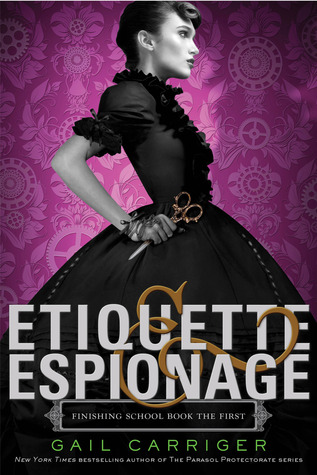
Etiquette & Espionage (Finishing School #1) by Gail Carriger

Etiquette & Espionage (Finishing School #1) by Gail Carriger
etiquette

A cute, young adult book with a steampunk theme that takes place at a “finishing” school which isn’t about etiquette at all.

I made the mistake of reading this without realizing that it was based in a world from another series of books. I’m guessing that I would have enjoyed it more if I had read the other set first.

Etiquette and Espionage had plenty of fun moments in it. One of my favorites is when Sophronia inexplicably claims that werewolves enjoy the theater. From one of the other books? I’m assuming so. But it sounds legit.

I also loved when one of the students bemoans the fact that she doesn’t believe she’ll ever be able to kill anyone and the teacher comforts her with the fact that she may never have to. What a relief.

But funny moments do not a story make. The plot centers around Sophronia’s introduction to a world filled with spies that she didn’t know existed, the concealment of a highly desirable piece of equipment that has something to do with wireless technology, and, of course, fashion.

It is funny, frivolous and frothy. I found that I wanted more substance. Recommended for a light summer read around the pool and, perhaps, you may want to read The Parasol Protectorate series first, starting with Soulless.

Thanks for reading!

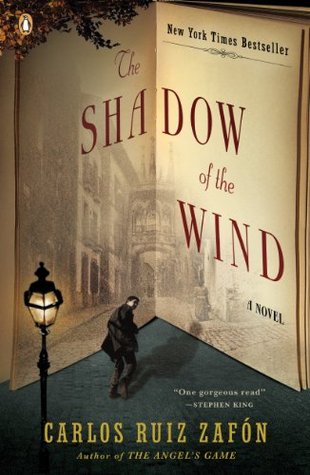
The Shadow of the Wind (The Cemetery of Forgotten Books, #1) by Carlos Ruiz Zafón

The Shadow of the Wind (The Cemetery of Forgotten Books, #1)  by Carlos Ruiz Zafón
shadowofthewind

I’m incredibly embarrassed that I didn’t enjoy The Shadow of the Wind. So many of my Goodreads friends gave this five stars, I feel like I’m missing something. Perhaps my taste in books is all in my head. 🙂

I thought this was going to be a fantastical story about protecting books and defeating an evil that was trying to destroy them- sort of a magic librarian/coming-of-age/historical fiction adventure. It was not that.

It is more about the character descriptions and the scene descriptions and… well… descriptions. Not much happens. If I had to meet one more character and absorb one more backstory, I was going to freak out.

The Shadow of the Wind has been called “gothic” and “lyrical” and “beautiful.” I can think of a few different descriptions, but the most pertinent one would be: “not-for-Heidi.”

I just couldn’t get into this book. My apologies to its fans. If we all enjoyed the same things, what a boring world this would be.

Thanks for reading!

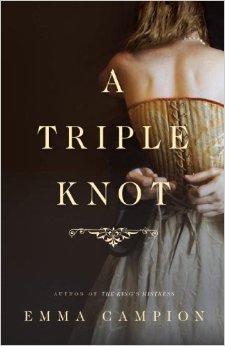
A Triple Knot by Emma Campion

A Triple Knot by Emma Campion
a triple knot

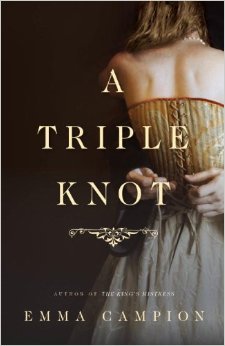
I love historical fiction about the English monarchy and court. This time period, the 1300’s, is one that I wasn’t very familiar with, which was fine with me. I’m always up for learning something new while being entertained. Warning: there are some spoilers ahead if you aren’t familiar with English history.

This story centers around Joan of Kent. Joan’s father was executed by her grandmother’s lover when she was very young. She also didn’t trust her own family to provide for her or believe that they had her best interests at heart. After reading about the actions of some of her clan, I can’t really blame her for that.

Joan seemed ridiculously naive when she married, clandestinely, at the age of twelve for love. Then, when her family insisted on a more advantageous match, she was heart broken.

I was surprised at first about her behavior and reaction but then I imagined that the lack of training, guidance or protection that she received during her childhood was probably the reason that she believed she could marry whomever she wished. Royalty didn’t enjoy the freedom of marrying for love. Poor Joan.

The historical figures described in this tale, such as Edward III and his son, The Black Prince, were larger than life with tempers to match. I loved the descriptions of the clothing, the feasts, the dancing, building maintenance and other minutiae of daily life.

I didn’t love other aspects of this story. I felt like this book was too long and the second half was incredibly rushed. I think the author should have created a trilogy.

She could have ended book one at the decision of the Pope about Joan’s marriage status. (I won’t ruin that one for you.) Then, a second book could have followed about the birth of her first four children and family life. A third book could have chronicled her next marriage and what followed.

In this book, five years passed in approximately a page and a half, sometimes less. There could have been so much more to the story and I would have loved to have read it.

Fans of Philippa Gregory’s brand of historical fiction will probably eat this up with a spoon. Prepare yourself for some rushed passages though.

I received a free copy of this book through Goodreads First Reads. Thanks for reading!

Feast of Sorrow: A Novel of Ancient Rome by Crystal King

Feast of Sorrow: A Novel of Ancient Rome  by Crystal King
feastofsorrow

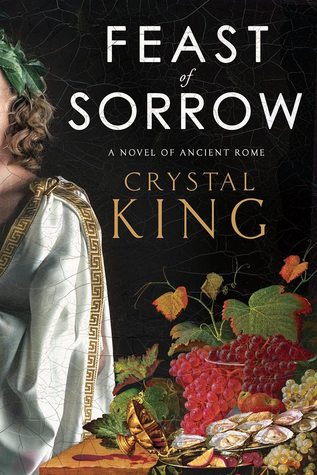
A Feast of Sorrow captures the beauty, opulence and madness of Rome during the reign of the Caesars. The story is told from the point of view of a slave in the household of Apicius. But, not just any slave. Thrasius is a cook, a coquus, the head of Apicius’ kitchen. He makes some of the finest delicacies known and invents new ones.

Apicius is wealthy beyond reason. He has the ability to purchase Thrasius the finest ingredients and the rarest spices. Apicius’ dream is to become Caesar’s gastronomic adviser. But that position isn’t acquired by wealth alone. Political currency and power is the only way forward.

And the stage is set. Feast of Sorrow has heroes, villains and, of course, food. What a strange and weird feast it is. Honeyed dormice, flamingo tongues, and more- only the best for Apicius and his clients.

Thrasius begins writing a book to preserve his master’s recipes for all time. “I added your trick about using eggs to help make cloudy wind clear, instructions on how to preserve oysters, and even Fannia’s recipe for how to make wormwood liquor. I thought about how many cooks don’t have the right information or knowledge.” loc 1592. Interestingly enough, after the tale, Crystal King talks about how Apicius’ recipes are some of the oldest surviving examples of ancient cuisine.

“Stuff the dormice with pork forcemeat and also with all the flesh from all the parts of the dormouse, pounded with pepper, pine nuts, silphium, and liquamen. Sew them up and arrange them on a tile and put them into the oven or cook them, stuffed, in a covered pot.” -On Cookery, Apicius. Loc 4466, ebook. Mmmmmm.

King fills these pages not just with food, but also, to modern eyes, the strange and sometimes cruel practices of the Roman people. Did you know that Roman diners used to wipe their hands clean in the hair of their slaves? Did you know that Romans had special priests who read the flight of birds to determine if an event was going to be successful or not? Did you know that patricians, the nobility of Rome, were judged not only for their appearance and natural abilities but also how well they could throw a dinner party?

I enjoyed this book not only for the way that King told the story of the nameless people who made Apicius’ name known for all time but also for the twists and turns it contains. Feast of Sorrow will shock you, entertain you and, maybe, make you want to try a dormouse.

Thank you to NetGalley and Touchstone Publishing for a free digital advance reader copy of this book. Note: the brief quotations that I pulled from my copy may change in the final published version. Thanks for reading!

Wolf Hall (Thomas Cromwell Trilogy #1) by Hilary Mantel

Wolf Hall (Thomas Cromwell Trilogy #1) by Hilary Mantel
wolfhall

Wolf Hall is a historical fiction reader’s feast. Henry the VIII’s story, though it has been told, is re-examined through the eyes of Thomas Cromwell, one of his counselors. Who knew that a professional paper-pusher and merchant could be so fascinating?

Cromwell’s history made it unlikely that he would ever climb to such heights among the powerful. Born the son of an alcoholic blacksmith, Cromwell’s cleverness is his only advantage.

Then, through a relative, Cromwell is taken into Cardinal Wolsey’s household. Wolsey recognizes the diamond in the rough and Cromwell becomes his right-hand man. It is a life-or-death dance that Cromwell and Wolsey play with King Henry, as the king demands a new wife. (the Cardinal speaks) “Tell me why you are scowling in that way.” (Cromwell) “The people up there say they are going to kill me.” “Really?” the cardinal says. He face says, I am astonished and disappointed. “And will they kill you? Or what do you think?” pg 31, ebook.

Meanwhile, those around the king never let Cromwell forget his humble beginnings for a moment. The duke of Norfolk scowls. He paces; he rattles a little; at last he bursts out, “Damn it all, Cromwell, why are you such a … person? It isn’t as if you could afford to be.” Thomas waits, smiling. He knows what the duke means. He is a person, he is a presence. He knows how to edge blackly into a room so that you don’t see him; but perhaps those days are over.” pg 154, ebook.

The fact that Cromwell survives Wolsey’s disgrace is a miracle. As he builds his connections and power, the reader can only gape in amazement. “Chapuys greet him without a smile. “Well, you have succeeded where the cardinal failed, Henry has what he wants at last. I say to my master, who is capable of looking at these things impartially, it is a pity from Henry’s point of view that he did not take up Cromwell years ago. His affairs would have gone on much better.” pg 415.

The BBC made a fantastic book-to-screen version of this story. Many of my favorite moments from the book were taken exactly from these pages. I highly recommend it too.

My only complaint about this novel is that the style is ambiguous. Instead of labeling who is speaking, Mantel often just says “he”.

The reader must stay on her toes to keep up with the machinations of the characters, because Mantel doesn’t bother to explain it or their reasoning. I expect, that in some ways, it is very much like how these historic figures lived their lives. Never quite knowing who to trust or how the wind was blowing.

Yes, now we know what happened, who went to the block and who didn’t, but this story nearly succeeds in making the reader forget the ending. Wolf Hall throws you right into confusion of Henry the VIII’s reign. And, it was a Wolf Hall indeed.

Thanks for reading!

The Drowning King (Fall of Egypt #2) by Emily Holleman

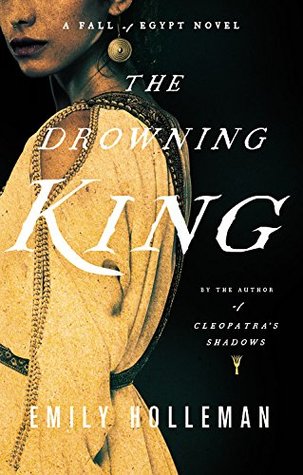
thedrowningkingA well-researched historical fiction written from the point of view of Arsinoe and Ptolemy, Cleopatra’s ill-starred siblings. I didn’t even know that Cleopatra had a sister. And, I only knew Cleopatra had a brother because of his infamous gaffe when he presented Caesar with Pompey’s head.

The Ptolemys were a storied dynasty. Descended from one of Alexander the Great’s generals, they had the charming tradition of marrying their siblings. This politically motivated inbreeding kept all of the power in the family. There’s a lot of weird brother/sister vibes in this book, but it’s historically accurate. If that kind of thing freaks you out, you’d be better off avoiding this read.

The Drowning King takes advantage of these unknown characters to spin the history in a different way. I can’t say that I was a fan of all of the changes.

Holleman depicts Cleopatra as a manipulative hysteric who sat idly by while her libraries burned because she trusted that Caesar’s men would protect them. Blinded by love, perhaps? I couldn’t swallow that interpretation.

But, the Roman attitude towards women is portrayed accurately: “The soldiers distrusted her sister for what she was: an Eastern woman with an eye for rule. Hadn’t they already deposed one of those? In Rome, Cleopatra had told her once, slack-jawed with shock, women are chattel, no more and often less. Or as Arsinoe had heard more than one centurion sneer after Berenice’s death, In Rome, women know their place.” loc 96, ebook. How extraordinary then that Cleopatra managed to rise to the heights that she ultimately obtained. I suppose that also helps explain her extraordinary fall.

I liked how Holleman incorporates the size and diversity of Egypt in her tale: “Alexandria was full of Upper Landers, but they bore no more relation to these creatures than a tomcat did to a lion. The men who busied themselves along the palace courtyards wore tunics and mantles and bantered in flawless Greek. … But here men of the same blood looked different, foreign to her eyes, ghosts of some forgotten land. She doubted whether they could even speak her tongue, and she wondered how so many members of her family had ruled without bothering to learn theirs.” loc 871. That’s because the descendants of Alexander’s general spoke Greek and the common people spoke Egyptian. It reminds me of how the nobility in England spoke French while everybody else spoke English.

I also enjoyed the conversation between Ptolemy’s counselors and the young ruler about whether or not they should kill Pompey: “Pompey was once wed to Caesar’s beloved daughter, Julia. And if you kill him, you’ll be slaying Caesar’s former son-in-law.” loc 2472. Beyond the fact that Pompey was Caesar’s son-in-law, he was still a Roman. Ptolemy was not. Romans divided the world into two groups- those that were Roman and those that were not. The counselors didn’t understand that, advised the boy poorly and sowed the seeds for his destruction from that very first meeting with Caesar.

I felt badly for Ptolemy. He was surrounded by either incompetent or power hungry people. There were none who loved him for just who he was rather than what he could bring them. “Nothing he’d done- nothing he’d ever done- had made a dent. With one nauseating exception: the murder of Pompey. And for all he knew, that would be his sole legacy: the ignoble assassination of his father’s alley. Dark thoughts consumed him too frequently now; he had to stay strong and drive them from his mind.” loc 4532, ebook. “The drowning king,” indeed.

I enjoyed this book, I did, but it was no Margaret George’s The Memoirs of Cleopatra. I found myself comparing the two in my mind and this one came up wanting. Unfair, perhaps, but there it is.

Thank you to NetGalley and Little, Brown and Company publishing for a free digital copy of this book.

And thank you for reading!