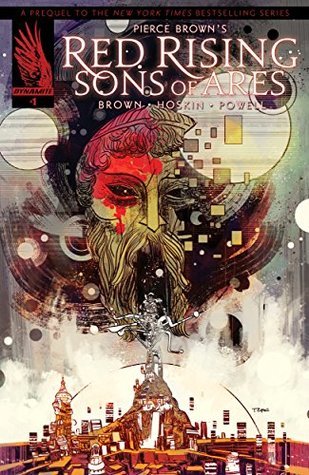
Sons of Ares (Sons of Ares, #1) by Pierce Brown

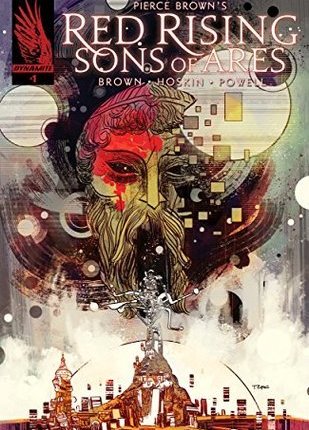
Sons of Ares (Sons of Ares, #1) by Pierce Brown
sonsofares

A comic that claims is going to give us the backstory of the Sons of Ares. But, in this entry, it just rehashes what goes on in the Gold school with an intro and conclusion teaser.

For anyone who hasn’t had the chance to read Red Rising, you’d need that backstory. For someone like me, who has, I wanted more new details. I didn’t get them.

I suspect that these comics, another coming out in June, are whetting the appetites of readers for the 2018 debut of Iron Gold. (Can’t wait, by the way.)

The art is beautiful but not breath-taking or highly stylized like Monstress, Vol. 1: Awakening.

The story takes place in a world I’ve come to love. But, it was only 32 pages and that was not enough.

On the other hand, I actually bought this comic. I wasn’t patient enough to recommend it for purchase at the library and then wait to see if they picked it up. I had to have it NOW. That says something for how much I love it. Having worked as a librarian, I take my book purchasing very seriously.

If you’re not a die-hard fan like me, you may want to wait until the libraries get their hands on it. As I said, this entry doesn’t give the reader much beyond a small window into Brown’s world. If you’re satisfied with crumbs, buy it now.

Thanks for reading!

Girl in Dior by Annie Goetzinger

Girl in Dior by Annie Goetzinger
girlindior

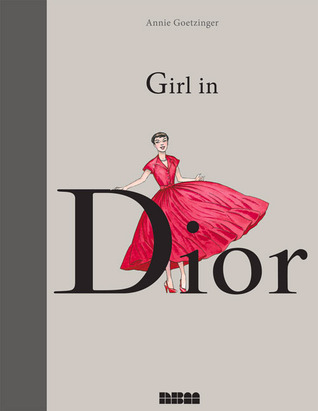
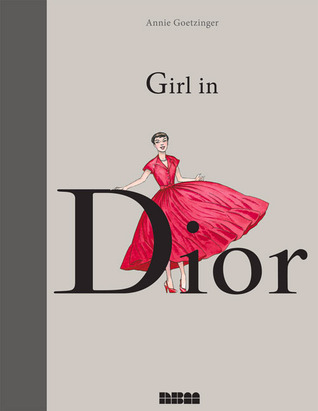
In “Girl in Dior” by Annie Goetzinger, A girl falls into the world of high fashion and then out of it and then back in again. A so-so storyline that should have been elevated by, come on, Dior!

Sadly, that was not the case.

I would have enjoyed this graphic novel more if it had just been panels of the dresses rather than pretending to be a story.

Literally, a girl in Dior on each page would have been epic.

Only recommended for serious fashionistas or those who study graphic novel art. Every one else, strut your stuff on down the library aisle and pick another book.

Thanks for reading!

The Autumnlands V. 1: Tooth & Claw by Kurt Busiek

The Autumnlands V. 1: Tooth & Claw by Kurt Busiek
autumnlands

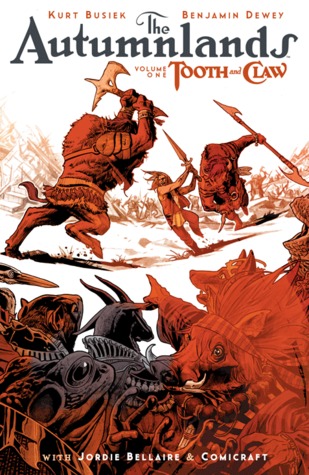
Excellent introduction to a world where anthropomorphized animals live on cities that float in the sky with the help of a magic that is fading from existence.

To combat this magic shortage, a talented magic user gathers a coalition of wizards to bring a great warrior from the past to the present in order to reawaken the powers.

The warrior is surprising, his summoning has unintended consequences, and the reader, after just a few pages, finds herself quickly caught up in a strange new world.

Highly recommended for adult readers who enjoy fantasy graphic novels.

There is a bunch of graphic violence and full frontal male nudity in here so, head’s up librarians. Make sure to shelve The Autumnlands in the appropriate section.

Some similar graphic novels, though I didn’t enjoy them nearly as much as this book: Monstress, Volume 1: Awakening or Wild’s End, Vol. 1: First Light.

Thanks for reading!

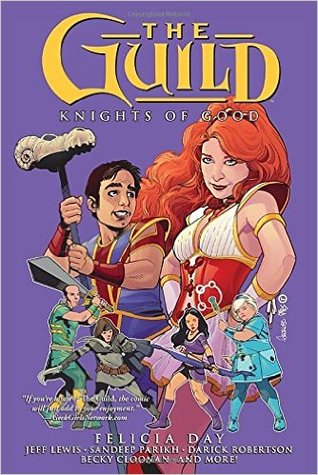
The Guild: Knights of Good (Guild v. 2) by Felicia Day

The Guild: Knights of Good (Guild v. 2) by Felicia Day
knightsofgood

A continuation of the first Guild comic. Please watch the show before you enjoy these comics!

If you don’t know what The Guild is about, let me give you a quick recap: Cyd likes to play videogames, specifically MMORPG’s. She spends much of her time avoiding reality and playing a character named Codex.

Codex is a member of an online guild, which is a group of other real life people who are also playing the computer game.

Together, they forge friendships and explore real life issues, online and off. It’s a heart-felt series and perfect for any fans of MMORPG’s or loved ones of computer players who want to understand their partners more.

On to the context of the comic itself: the first chapter/issue with Vork’s backstory and the story behind Bladezz’s infamous sausage photo were engaging but the rest was so-so.

I felt like all of the other characters were basically re-hashing what happens on the show rather than giving the reader any huge surprises. On the plus side, there are some more panels showing the characters in-game, which is more than we were ever given on screen.

If you’re going to read any of the Guild comic books, I recommend reading The Guild (the first one) and skipping this. Unless you’re a major fan of the show and you have to read every little piece of literature that is out there on it, by all means, borrow this from the nearest library.

Thanks for reading!

Solomon’s Thieves, Book 1 by Jordan Mechner

Solomon’s Thieves, Book 1 by Jordan Mechner
solomons-thieves

I almost flipped out over this series today because I went to request the second book and found that it was never published. Not to be deterred, I used my mad librarian skillz and discovered that, after the release of Solomon’s Thieves, the publisher bound all of the issues together rather than releasing them one at a time.

The continuation to this story is found in the graphic novel: Templar. Crisis averted.

And what is this comic about?

Solomon’s Thieves is a fun romp through 1300’s Paris at the time of the Templar’s disbanding and destruction.

The focus of the story is on a knight named Martin. He was unlucky in love and joined the order to change his life, which he manages to do. But, on the Templar’s return from an unsuccessful campaign in the Holy Land, after a wild night of drinking and some bad choice making in Paris, he ends up not being present when his brethren are arrested by the French king, Philip the Fair.

The adventure really starts when the king’s men discover that the fabled treasure of the Templars is not in their church/compound. Martin, after a series of misadventures and a chance meeting with some unsavory characters, decides to find out where that treasure is and steal it back.

Bit of trivia: the Paris Templars were arrested on Friday, October 13th, 1307. So, 709 years ago tomorrow (I wrote this review on October 12th, 2016). Now, you know.

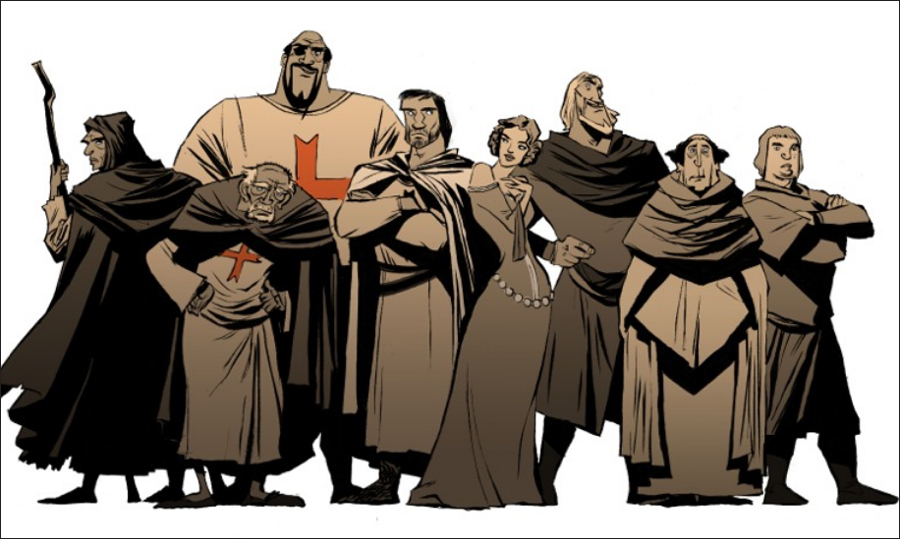
templarcastFrom the introduction: “From humble beginnings the Knights Templar rose to become the most powerful military monastic order of the medieval world. Pledged to protect pilgrims during the Crusades, the Templars become heroes to Christians everywhere. Their fighting prowess was legendary. … But the Crusades were an expensive, blood-soaked failure. In 1291, after two centuries of warfare, the Muslims drove the Christian armies from the Holy Land once and for all. For the Templars, it was the beginning of the end…” Goosebumps!
I’d consider this a PG-13 level comic because of some rough language, non-graphic violence (dude sticks his sword through the chest of a guy in one of the panels, but there isn’t blood everywhere), and some, again non-graphic, torture scenes.

The afterward by Jordan Mechner is fantastic. Not only does he give the actual history that he based the comic on, but also the sources that he used to research it. Huge librarian thumbs up from me. 🙂

“Like Western gunslingers or Japanese samurai, their legend grew, and it attracted new recruits, donations, and privileges. By their peak in the thirteenth century, the Templars had grown into a religious, military, and banking organization whose assets, power, and reach rivaled any of the kings of Europe. They were the Jedi of their time. Their incredible downfall rocked the world. Its echoes reverberate to this day.” pg 135

If you enjoyed this comic, you may like: The Religion by Tim Willocks(regular book- not a graphic novel, very bloody, for adults only) or The Knights Templar: Discovering The Myth And Reality Of A Legendary Brotherhood by Susie Hodge (regular book also- non-fiction but in-depth examination of the templars).

Thanks for reading!

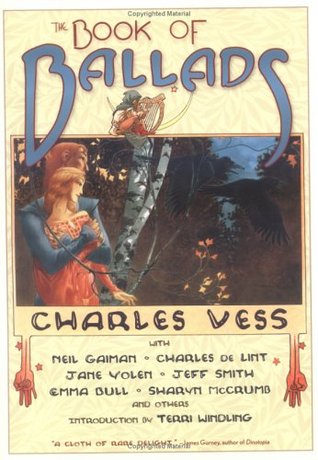
The Book of Ballads by Charles Vess, Introduction by Terri Windling

The Book of Ballads by Charles Vess, Introduction by Terri Windling
bookofballads

In this graphic novel, Charles Vess illustrates many traditional folk ballads that have been rewritten by some fairly popular fantasy artists like Neil Gaiman or Emma Bull.

I didn’t realize how many traditional ballads have negative interactions with strangers as their primary topic.

According to these stories, any stranger is either a fairy or the devil. If it is a male, he’ll either kill you or impregnate you and then come later to take your kid back to whatever magical land he came from.

If it is a female, she’ll either imprison you, change you into a snake, rape you, or take you away to fairyland.

An alternate title for this book could be: Strangers are Bad- Don’t Talk to Strangers or Let Them In Your House or Have Sex with Them Unless You Want to Die.

But all joking aside, there are very few ballads that end either happily or well. It is unsettling reading them altogether, like delving into a book of short horror stories.

From the introduction by Terri Windling: “Ballads, which are stories in narrative verse, are related to folktales, romances, and sagas, with which they sometimes share themes, plots, and characters (such as Robin Hood). No one knows how old the oldest are. It’s believed that they are ancient indeed…” pg 10

Which disturbs me even more when I consider that these stories were written for a reason. Can you imagine raising a kid in the dawn of time? ‘Don’t go talk to that stranger over there ’cause he might eat you. We don’t know about that exact dude, but seriously… it has happened. Remember how you used to have a sister?’

vess2

Take the ballad of Tam-Lin for instance: “O I forbid you, maidens a’, That wear gowd on your hair, To come or gae by Carterhaugh, For young Tam-Lin is there. There’s nane that gaes by Carterhaugh But they leave him a wad, Either their rings, or green mantles, Or else their maidenhead.” pg 92

In other words, don’t go over there or he’ll take your stuff or rape you.

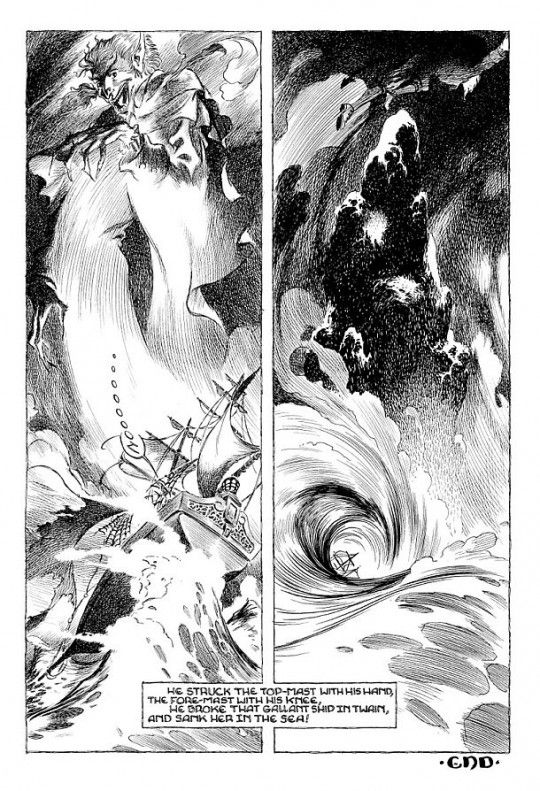
Despite the depressing nature of the stories, the artwork is very pretty and it’s all in black and white which makes the stories even starker. My favorite of the bunch is The Great Selchie of Sule Skerry which was re-written by Jane Yolen.

In it, a young maiden falls in love with a man from the sea. Guess how it ends?

Some read alike graphic novels: A Flight of Angels by Rebecca Guay, The Last Dragon by Jane Yolen, or The Sleeper and the Spindle by Neil Gaiman.

Thanks for reading!

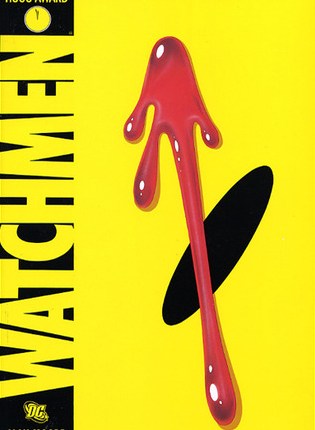
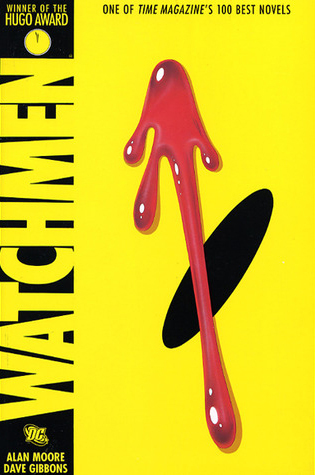
Watchmen by Alan Moore

Watchmen by Alan Moore
watchmen

I can’t stop thinking about this graphic novel. It’s not something I’d usually like- ultra-violent with a very dark vision of humanity- but there is something incredibly compelling about it.

It starts with a murder. Watchmen is the story of a group of super heroes who don’t fight crime anymore because vigilantism was outlawed. Among the many costumed regular heroes (The Comedian, Rorschach, Nite Owl), there is an actual superhero, Dr. Manhattan, who suffered a freak radiation accident and was changed, permanently. He perceives time as happening all at once and can manipulate matter in multiple dimensions. Each of the heroes has a story, some are very sad, and all of them are upset as one of their own has just been killed. Can they figure out who the murderer is before he/she strikes again?

My favorite character out of the bunch is Dr. Manhattan. “We gaze continually at the world and it grows dull in our perceptions. Yet seen from another’s vantage point, as if new, it may still take the breath away.” pg 27, Chapter XI. He’s nearly godlike in his capabilities but that makes it practically impossible for anyone to understand him.

My husband’s favorite is Rorschach, which I could understand, but he was far too violent for me to truly appreciate the character. I feel like there’s an underlying importance to that character though, something that I couldn’t quite grasp…I tried thinking about Rorschach as a rorschach blot for the Watchmen and it nearly broke my brain.

And the comic within the comic? Fascinating.

The Watchmen is more than a superhero story: it’s an examination of power both physical and in the heart. It’s a criticism of government, the media, and art used to manipulate others. It looks at gender roles, rape, and sexual preferences and predilections. It asks: why would a person dress up and create an alter ego in the first place? And, beyond all that, it is a mystery and a love story. There’s a lot to enjoy in here if you can get past the blood, gore, and soul crushing darkness. Recommended for an adult audience only.

A similar comic, in my mind, is The Walking Dead, Compendium 1 by Robert Kirkman. But, really, Watchmen is in a class all of its own.

Thank you for reading!

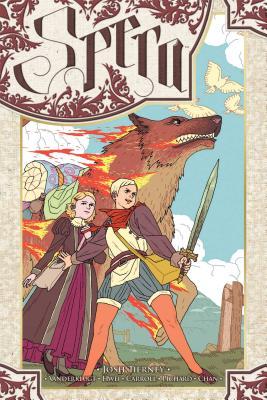
Spera, Volume 1 by Josh Tierney, Illustrated by Kyla Vanderklugt, Hwei Lin Lim, Emily Carroll, Olivier Pichard, Afu Chan, Rebecca Taylor

Spera, Volume 1 by Josh Tierney, Illustrated by Kyla Vanderklugt, Hwei Lin Lim, Emily Carroll, Olivier Pichard, Afu Chan, Rebecca Taylor

Spera is the story of two princesses, one who likes to sword fight and explore and another who likes to read and stay inside. One day, the tomboy princess, whose name is Pira, turns up in Lono’s (the reader) kingdom and says that her father the king is dead. They have to get away now to save Lono’s life. Where will two young princesses go to hide? A magical land called Spera. And so, the adventure begins.

I think that Spera tried to tell an engaging fairy tale with built in gender role options to educate impressionable young girls about who and what they can choose to be, but it didn’t quite work. Graphic novels need more than an interesting characterization idea- to engage reluctant readers, they need to tell a great story. Spera never gets there. The underlying message is sound- let children be who they are. Don’t point girls towards a book or boys towards a sword just because that’s their gender. But frankly, that’s it. The rest of the story, minus a run in with a creepy child, is kind of a non-starter.

Multiple authors contributed to this book so that’s a plus in my mind. Every chapter the reader gets a different artistic interpretation of Pira, Lono, and the fire spirit, Yonder. I gave Spera an extra star on Goodreads just for the artwork. As an adult, I found the variety enjoyable but I could see it being confusing for younger readers. They may not understand why the characters look so different every couple of pages.

If I was asked for a graphic novel recommendation for young girls that has fantasy elements, I’d skip Spera and point readers towards Princeless #1 by Jeremy Whitley.

Thanks for reading!

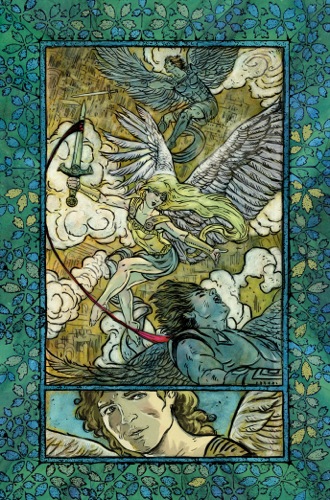
A Flight of Angels, Illustrated by Rebecca Guay

A Flight of Angels, Illustrated by Rebecca Guay

A Flight of Angels includes stories by Holly Black, Louise Hawes, Todd Mitchell, Alisa Kwitney, Bill Willingham.

Lovely art elevates a so-so collection of short stories about angels. Rebecca Guay, in my opinion, is one of the most talented illustrators I’ve ever seen. The artwork is classic but ephemeral with tasteful nudes and multi-layered backgrounds. In a word: gorgeous.

flightofangels

I picked this one up because of The Last Dragon by Jane Yolen. In that book, as in this, I loved the art but thought that the story was predictable. I feel like the authors that Guay has partnered with, at least so far, don’t measure up to the masterworks she produces.

flightofangels2

Borrow this one from your nearest library so that you can see how beautiful it is.

Read alikes: some of the Fables, Vol. 1: Legends in Exile series has art on this level but they’re kind of hit or miss. Saga, Volume 1 is beautiful but the story has some very vulgar moments popped in there. If you can handle that, and I know that some people are huge fans of Saga, then that series might be a good fit. Or, of course, you may want to pick up The Last Dragon as that is done by the same illustrator.

Thanks for reading!