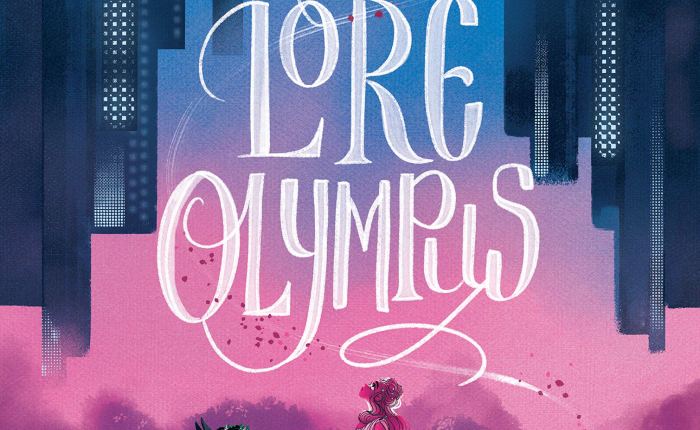
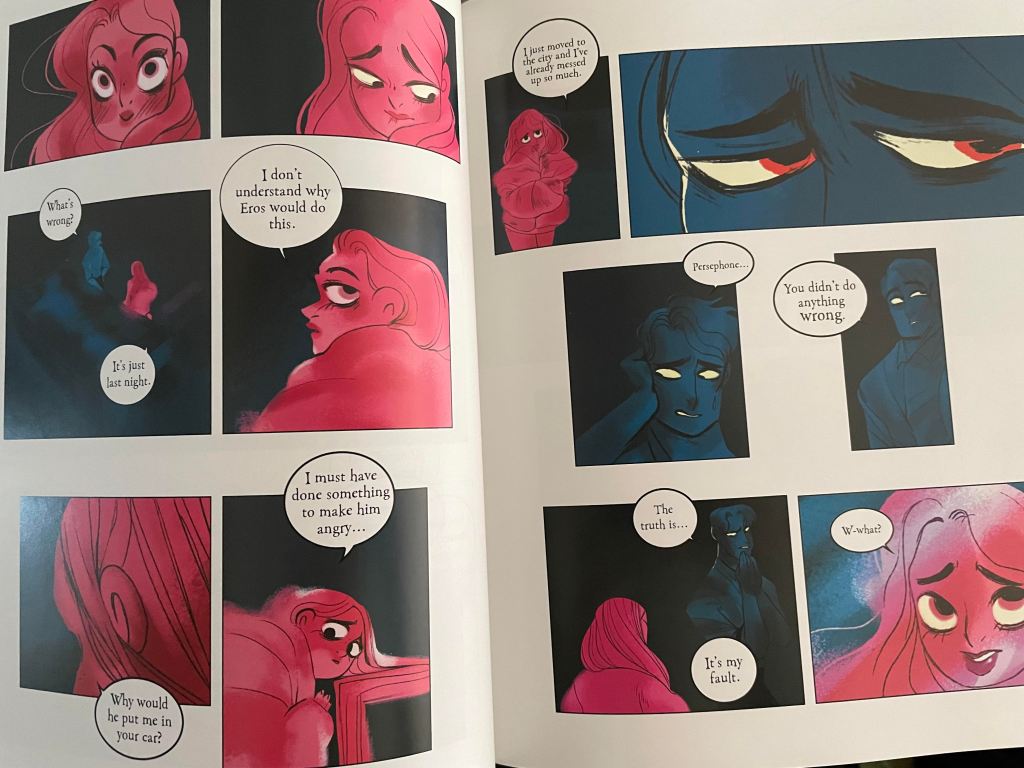
Rachel Smythe has created a cotton-candy colored, contemporary re-telling of Hades and Persephone. It is a very pretty creation but, like the start of most graphic novel series, lacks a little in the storytelling.
I also had trouble telling some of the characters apart. In some panels their features were so blurred that it was impossible to tell who was who.
That being said, I’m not sure that I am the intended audience for this work. The bright colors and quick pacing make me think this may be more appropriate for young adults.
It is shelved with the adult selections at my library, but nothing in the story is inappropriate for teens 14+.
I enjoyed the artwork more than the story itself. It is very pretty and stylized with flourishes and smooth edges.
Recommended for readers who enjoy their mythology being told with a fresh new voice and perspective.
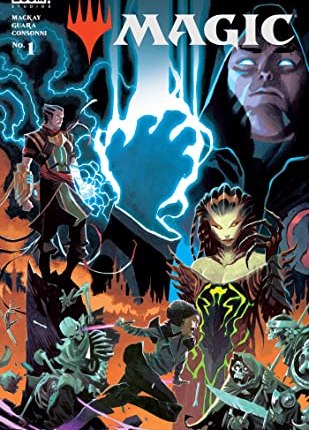
Magic Vol. 1 is a beautiful beginning to a fantasy series based on the card game, “Magic the Gathering.”
The story is quite busy for a first volume, bringing together a number of characters and introducing a fairly complex system of magic.
At least, it seemed like a lot to me as I’ve never played Magic the Gathering and have no idea how it goes. To those who are familiar with the game, this might be less of an issue.
The artwork is gorgeous. I love when talented artists team up with great writers to produce graphic novels. I believe that is the case with this book.
I’m interested to see where this goes. Recommended for fantasy readers ages 14 plus because of some violence.
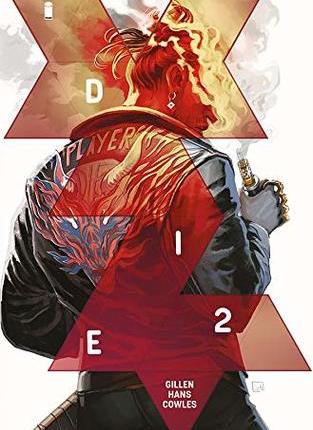
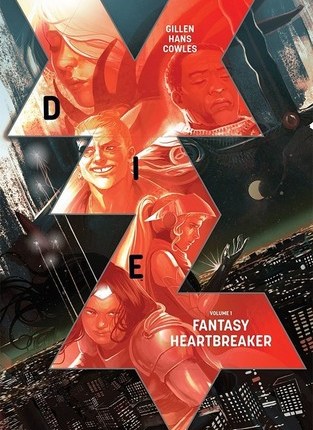
Now that the main characters from Die, Vol. 1: Fantasy Heartbreaker are back in the fantasy gaming world of Die, they are struggling to make their way back to the real world.
Part of that struggle involves delving into the past and decisions made by their teenage selves. There are lost loves, old enemies and even a few descendants to contend with- not to mention old hurts that they’ve carried for years between members of their own party.
Which is a particular problem for our intrepid heroes. They all have to agree that they want to leave “Die” in order to do just that. And they don’t all want to leave anymore.
Like most sequels, at least in my experience, the follow up to the first issue wasn’t as strong. Now that readers are in the character development section of the story, action moves a little slower and it reads less like a fantasy adventure and more like a drama.
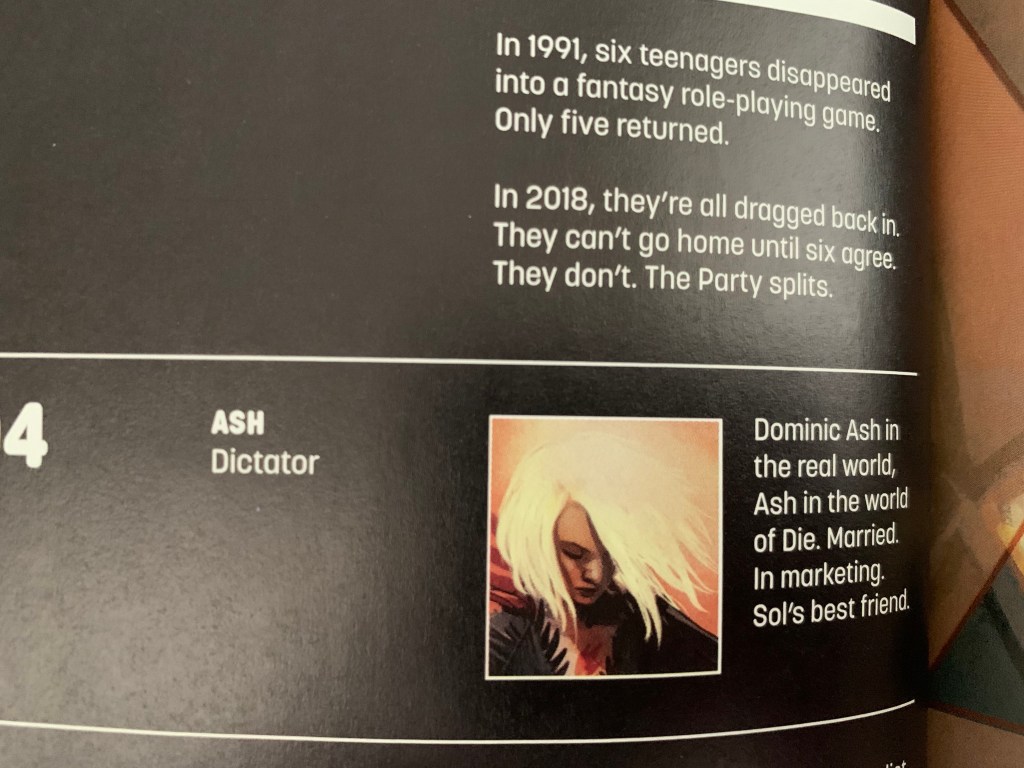
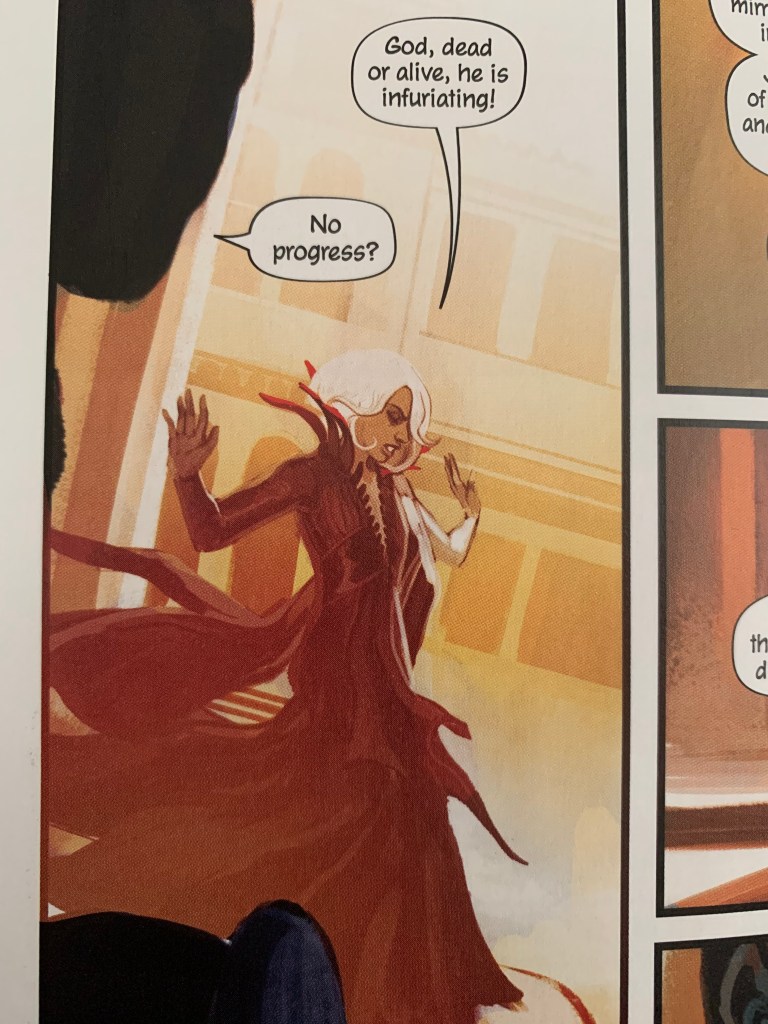
I think the character with the most potential for growth is Ash, the Dictator, who is a man in the real world, but a woman in the world of Die, and controls people’s emotions with her voice. But all of the movers and shakers in this drama have some growing to do.
Ash from “Die #2”
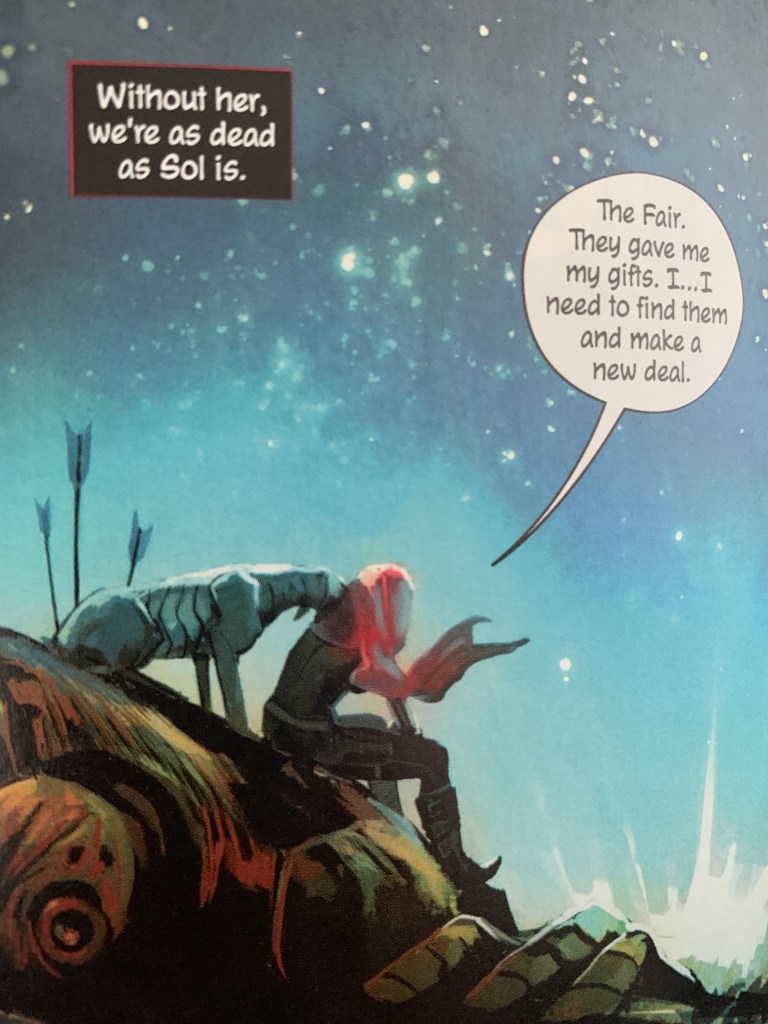
There’s Ash’s sister Angela who plays a cyberpunk named Neo. In order to power her electronics, she uses ‘fair gold’, something which readers get to learn a little more backstory about in this issue.
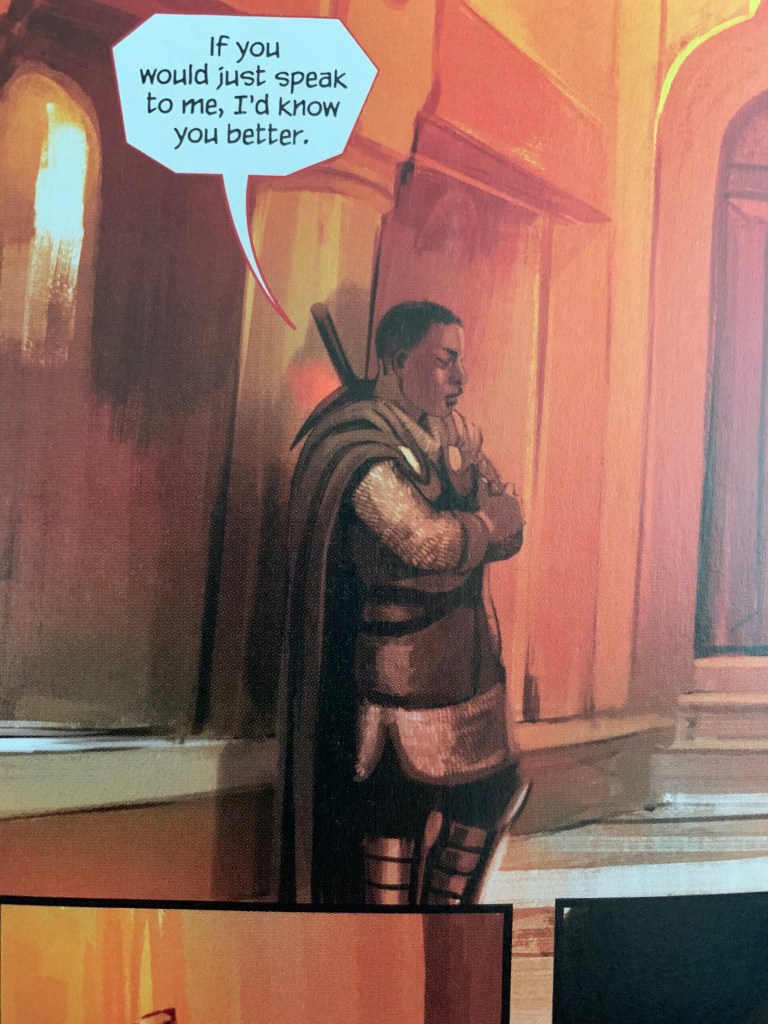
My favorite character is Matt, the Grief Knight, whose power is fueled by his depression and despair. Of everyone in this story, I’m rooting for him to get home the most because of the unshakable love and devotion he has for his family.
He’s also, I think, the most relatable of the group. Who among us hasn’t felt the sting of the pain and sadness that life occasionally dishes up and wishes for a way to harness that power for the greater good?
Matt, The Grief Knight
In this issue, readers get to learn about the origins of Matt’s magical sword, the outer representation of that inner voice that whispers to him about his failings and secret anxieties.
We also brush on the mysteries of Sol’s resurrection, Chuck’s astounding conflict avoidance and the awesome extent, as well as limitations, of Isabelle’s godbinding powers.
Neo the Cyberpunk from “Die #2”
I’m interested to see where the story goes next. Highly recommended for readers who enjoy fantasy and horror-tinged graphic novels.
“I have a homeland to return to and protect. I inherited Alsace from my father. Abandoning it is out of the question.”
Warring factions lead to the capture of Tigrevurmud Vorn, the young count of Alsace by Eleonora Viltaria, a war maiden, one of many, chosen by a powerful dragon king and given a magical weapon to help her succeed in battle.
Eleonora has offered to return Tigre to his home, but first his people must pay a huge ransom, which they can’t afford.
Meanwhile, another powerful leader is preparing to take advantage of Tigre’s absence to ravage Alsace.
What will happen next? Pick up volume 2 to find out.
Which I’m not sure I want to do. Having not read a manga series before, I didn’t realize that some cater to particular audiences and preferences. This one, I have since discovered, is classified as “seinen” and recommended for adults (men, says the wiki) between the ages of 18 and 45.
I inadvertently discovered the classification when I turned to a page containing a balloon-chested young woman nearly nude except for a tiny hand towel.
In another, there’s a cantankerous maid in Eleonora’s palace whom is given a teddy bear to sweeten her mood. After admiring the cute cartoon of the teddy bear, I realized that readers could see up the young woman’s skirt.
I prefer to read manga for the story and not semi-naked cartoon figures. But, if that’s your thing, this fantasy series might be of interest. It is an art form, after all.
As for the story, I was particularly intrigued by the war maiden and dragon part, which volume one didn’t really have time to get into between the introductions to the various characters and the naked scenes. Which, in my opinion, is a shame.
In Die, six teens enter a fantasy role-playing game, disappearing from the mundane world for two years. When they reappear, they are missing one of their members and carrying scars, both physical and emotional, from their ordeal.
Fast forward twenty five years, and a blood stained die shows up on someone’s birthday, mirroring the date when they last entered the game. The group has to face the fantasy world that has given them nightmares for decades in order to put the past to rest. But some things are easier said than done.
Readers of this series seem heavily divided on its quality. I thought it was brilliant.
This isn’t because of the fantasy elements which, as many have noted, rely heavily on tropes and the established world building of touchstone series like The Lord of the Rings and The Chronicles of Narnia.
What I loved was the character development and its relatability for aging gamers.
The author shares a series of essays in the back of the graphic novel about the development of the story and characters as well as their associations with classic rpgs. He nails the reasons why I loved the book so much:
“… the simple idea of six forty-something adults contrasting their teenage fantasies with the realities of where their lives ended up. It’s a pure midlife crisis scream of a book. And the bit that got me? The idea that maybe part of me did disappear into a fantasy world at the age of sixteen and never came out.”
In the hero’s journey, we venture forth into trials and return changed but bearing gifts from the experiences we went through. That format- there and back again- seems so clear cut and simple in many of the “through the looking glass” fantasy stories.
In Fantasy Heartbreaker, the journey isn’t finished when the characters return to where they started and they aren’t bearing gifts, but a curse. It is only through the natural passage of time and the development of the adolescent into the adult, that the heroes in this story can finish their journey or, unbeknownst to them, begin an entirely new one.
This delayed emotional development speaks to any manner of gamers, both video or tabletop, who may find themselves, for a variety of reasons, gaming with a dysfunctional group of people over and over again each week. Perhaps this is because there are only a few people in their lives who love to game as much as they do.
For whatever reason, from the outside, such intense and conflict-prone relationships can seem confusing at best or borderline abusive at worst. But from inside the group itself, the bonds created through the traversing of realms of the imagination and overcoming obstacles as a team are real and important.
The members of the group form a family of sorts- one that they chose rather than one they were born with. It can be beautiful but bewildering. Something that one has to experience to truly understand.
Sort of like visiting a different world, and never really coming home again.
In addition to the peek into gamer culture, the artwork in Fantasy Heartbreaker is gorgeous, one of the most beautiful I’ve ever seen in a comic.
Highly recommended for readers, and gamers, who like fantasy graphic novels.
Some works of fiction, after enchanting countless readers, become classics, a touchstone of culture for generations. I would submit “Peanuts”, created by Charles Schulz, as one of these classics.
The existential struggles of the boy named Charlie Brown, the adventures (real and imagined) of his beagle, Snoopy, and the rest of the Peanuts gang, seem timeless.
Charlie Brown wants to fly his kite, but it is always getting “eaten” by the “kite-eating tree.” He pitches for a baseball team that never wins. He tries to kick a football, but it is always removed at the last moment.
I first read Peanuts in dusty paperback books kept in the spare bedroom at my grandparents’ house. Through lazy Sunday afternoons or the occasional sleepover, I learned the names of all the Peanut characters and their defining traits.
My favorite was Schroeder, the virtuoso on his tiny piano. I even had a watch with piano keys on the plastic band and Schroeder on the watch face, pounding out his music as the second hands ticked by. I loved that watch so much – I wore through the plastic wristband, replaced it, and wore through it a second time.
When I read Peanuts Treasury, it transported me back to a time when my biggest concern was finishing my homework before the end of the weekend and to a sense of comfort that family members who loved me were just in the next room. It was a nice escape from the current reality, where my biggest concerns seem so impossibly out-of-my-hands and loved ones are all in their separate spaces.
Recommended for readers who are looking to spend a few hours away from this world and in the life of a boy who never succeeds and never ever gives up.
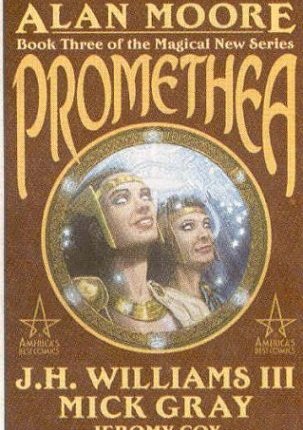
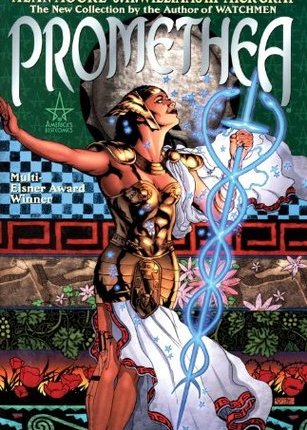
The saga of Promethea continues in Volume Three of the five book series.
Promethea, the version embodied by Sophie Bangs, has embarked on an adventure through the myriad worlds of the Tree of Life. She seeks another of the avatars of Promethea who recently died. Together, they hope to find the deceased woman’s husband and learn about the occult on the way.
Photo by Stacey Gabrielle Koenitz Rozells on Pexels.com
Meanwhile, back in the real world, Sophie has left someone unexpected in charge of keeping the baddies at bay while she’s away. Is Stace up to the task?
The artwork of the series continues to impress with its beauty and ingenuity. I especially enjoyed the mobius strip path of the world of Hod.
Alan Moore’s writing is at its best when he’s waxing on about the complexity of the universe and delivering punchy one-liners ending those conversations.
However, he takes the characters through so many different places so quickly that the adventures themselves end up feeling rather stilted. I think I may have enjoyed this entry more if he had spent a little more time exploring the worlds rather than simply explaining them.
I get that Promethea has places to be. But she could have savored the journey along the way.
Recommended for graphic novel readers who enjoy a mix of fantasy and occult in their stories. Thanks for reading!
Here are links to the other two reviews I’ve written for this series:
Promethea, Volume 2 was an incredibly disappointing follow-up to a promising comic series.
The reader continues to follow the efforts of Sophie, a student who has learned to channel the spirit of a being of enlightenment named Promethea, while battling demons and other nebulous, bad guys.
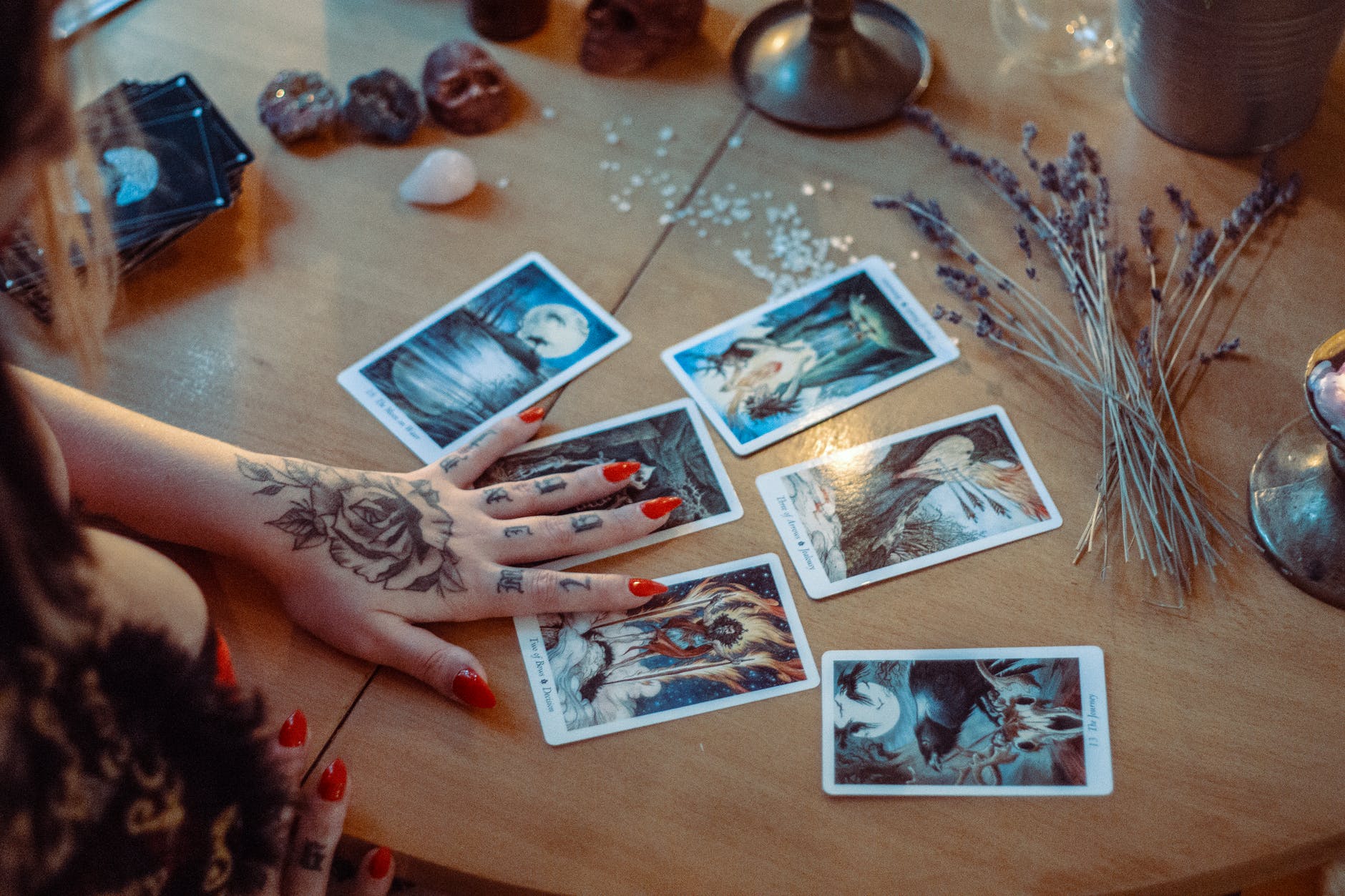
My quibbles with the tarot card piece is it is far too simplistic but also too long. Each card can be interpreted a number of different ways, and not just applied to principles of civilization. It is also a metaphor for the soul’s journey, which Alan Moore touches on, but, I feel, never truly explains.
Also, by presenting the whole thing through rhyme, I couldn’t help but draw comparisons to Dr. Seuss. I get what Moore was going for, but it didn’t work for me.
Meanwhile, I couldn’t help but wonder if the lead character in this story was a guy if we would have been subjected to the tantric stuff at all.
I believe the earthly can be spiritual and the spiritual can be earthly. I think “kundalini rising” is just the lightning flash of inspiration in reverse. But a male hero being pressured into trading his body for secret knowledge? I don’t see it happening.
I liked the first entry of Promethea. I thought it was ground-breaking in the way it depicted a strong female character on a spiritual journey.
This second book simply isn’t of the same quality. Perhaps the series will redeem itself in the next entry. One can only hope.
Promethea is a brilliant fantasy graphic novel by the legendary Alan Moore. It follows a woman who is researching a story for her thesis, only to discover that the story actually lives in the imagination and can explode into the real world in surprising and mystical ways.
It is a clever, gender-bent retelling of Prometheus. But, it presents the exploration and knowledge of the mystical worlds of the qabalah as Prometheus’ gift to the world, instead of the usual literal interpretation of the gift of fire to light the night.
It seems to be Promethea’s destiny to bring fire and knowledge back to the imagination of humanity in order to change the world forever for the better.
“I am Promethea, the rumored one, the mythic bough that reason strains to bend. I am that voice left, once the book is done… I am the dream that waking does not end.”
To free her conditioned mind from the limitations of this reality, the woman, now bearing the incarnation of Promethea, needs to learn from her previous incarnations. If she doesn’t quickly grasp the secrets of the four sacred weapons, the cup, sword, pentacle and wand, Promethea’s ancient enemies will rip her to pieces.
“Humans are amphibious, Sophie. That means they live in two worlds at once: matter and mind. Yet many people only notice the solid world they have been conditioned to think of as more real while all about them diamond glaciers creak and star-volcanoes thunder.”
This graphic novel is pretty far out there. I really liked the mythic and occult themes, and strong female characters.
There’s some near nudity, but nothing too ridiculous. One of the incarnations of Promethea was brought into being by an author who used words and his imagination to shape his mistress into something more. Because of this sexual-themed awakening, she only wears a sheet, but it covers all the wobbly bits. Barely.
Highly recommended for adult readers who like fantasy graphic novels. There are few authors who write such themes better than Alan Moore.









 The Help Desk Book Blog