“The years, of which I have spoken to you, when I pursued the inner images, were the most important time of my life. Everything else is to be derived from this.” preface
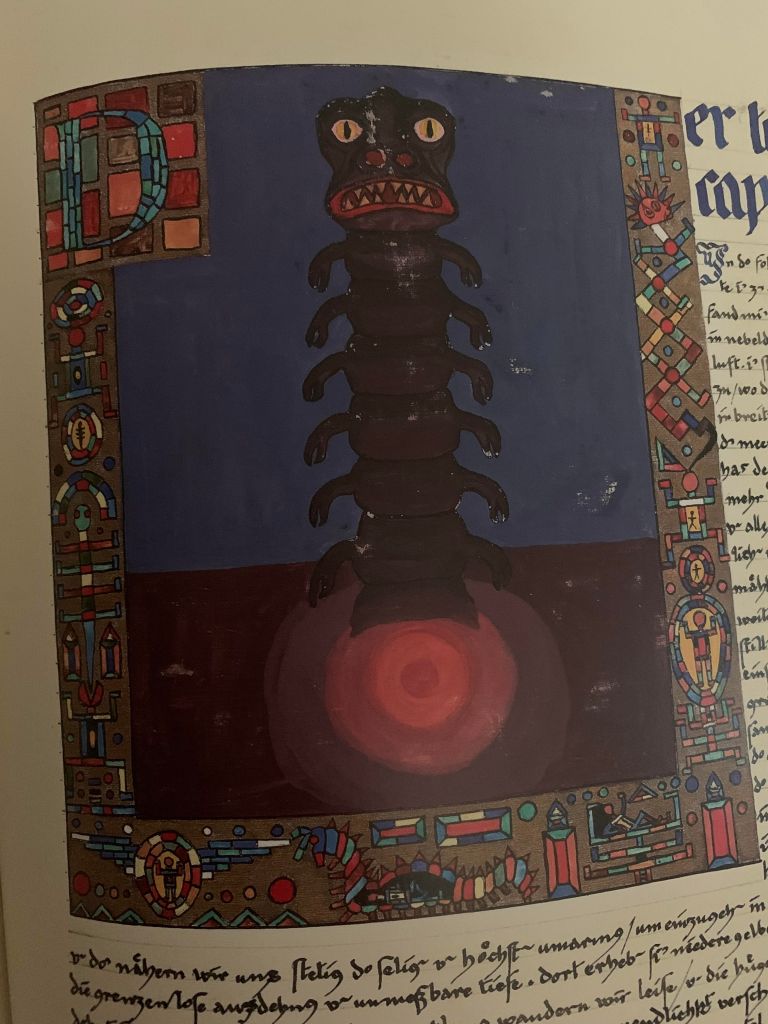
The Red Book is a stunning publication. It is a physically large book which mimics Jung’s own handwritten copy which measured 11.57 inches by 15.35 inches.

The contents are just as impressive. The first part is a brief history of Jung and his publications. The second contains pages of calligraphy in both German and Latin of his “active imagination” visualizations as well as sketches and paintings created by Jung to accompany the text.
The last section of the book is the English translation of the second part.
“Jung described his technique for inducing such spontaneous fantasies: ‘The training consists first of all in systematic exercises to eliminating critical attention, thus producing a vacuum in consciousness.'” pg 209

The visions themselves are interactions between Jung and voices or figures that he named his soul, gods and other archetypical figures.
“To this my soul spoke a word that roused my anger: ‘My light is not of this world.’ I cried, “I know of no other world.” The soul answered, “Should it not exist because you know nothing of it?” pg 240
As he stated in the preface, Jung felt as if his ‘confrontations with his subconscious’ affected his work for the rest of his life. It is a fascinating, little-examined side of a man who has had a huge effect on psychology and is credited, by some, as being one of the leading figures of the New Age movement.
The road to publication for this book is a story in itself. At first, Jung’s family carefully kept The Red Book in a safe deposit box to protect it as they recognized its value as a one-of-a-kind creation. They also believed that Jung wouldn’t have wanted its contents made public as he hadn’t left any specific instructions in his will about it.
However, researchers and scholars have since examined the text and found parts where Jung addresses, “my dear friends,” leading to the opinion that he did intend to share it with a wider audience. They also point to its importance to Jung’s following works as another reason why it should be published.
Whatever their reasoning, I’m so very glad his family and foundation made the decision to publish. This book is a treasure.
Curiously, The Red Book ends in an incomplete sentence.
Here it is:“I knew of nothing better than to write them down in a ‘precious,’ that is to say, costly book and to paint the images that emerged through reliving it all- as well as I could. I knew how frightfully inadequate this undertaking was, but despite much work and many distractions I remained true to it, even if another/possibility never…” epilogue

I wonder what he was going to write next.
Though I didn’t use Jung’s method of active imagination, I too have undertaken lengthy ‘confrontations’ of my subconscious and have come back with pages of material that read, in some ways, quite similar to this book.
Perhaps, one day, I will also find the courage to publish it.
Highly recommended for any readers interested in Carl Jung’s methods, archetypes or dream interpretation.
Thanks for reading!
- The Ballad of a Small Player: a Metaphysical Movie Review
- Otherwhere: A Field Guide to Nonphysical Reality for the Out-Of-Body Traveler by Kurt Leland
- Psychic Dreamwalking: Explorations at the Edge of Self by Michelle Belanger
- Archetypes on the Tree of Life: The Tarot as Pathwork by Madonna Compton
- The Goddess and the Shaman: The Art & Science of Magical Healing by J.A. Kent

 The Help Desk Book Blog