Books of Beasts is a scholarly examination of medieval texts called “bestiaries”. These curious works consisted of lists of animals with accompanying pictures and traditional stories. Sometimes they were printed alongside other works, like the Bible, sometimes not.
Elizabeth Morrison and twenty six other medieval scholars assert that these were the second most popular texts in the medieval world. They weren’t concerned with accuracy or science, part of the purpose of the books were to use creation as a window to contemplate the mysteries of God.
This particular book, Books of Beasts, was made to accompany a ground-breaking exhibition at The J. Paul Getty Museum. You can learn more about the exhibition here: http://www.getty.edu/art/exhibitions/…
I also used the information in this book to write a script for The History Guy YouTube Channel.
“Book of Beasts: The Bestiary in the Medieval World” presents the largest number of medieval bestiaries ever gathered together, representing one third of the known surviving illuminated bestiaries, including some that have never before left their countries of origin.”
The stunning portion of this book are the bestiaries themselves. The colors and the animals in their various tableau are simply beautiful. When you consider how old the artwork is, it’s staggering that something that fragile has survived so long.
“Animals both real and fantastic parade by the dozens, and sometimes hundreds, across the pages of these remarkable works. Their stories were among the most familiar and beloved of the time, and many survive today, though their origins in medieval and earlier times have, sadly, been largely forgotten.”
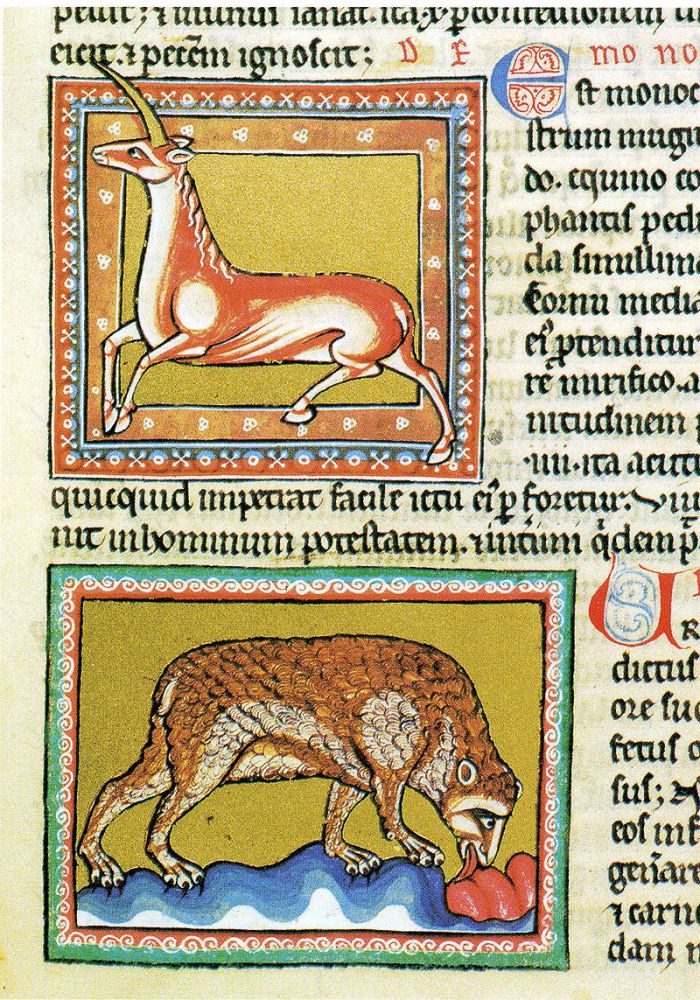
My favorite part of this book were the stories attached to the animals. Everyone in the medieval world knew them and so, when that animal appeared somewhere else say, for example, on a tapestry or dish, it was a hidden code of sorts, imparting meaning that the modern reader has never learned.
Consider the lion: “The natural philosophers say that the lion has three principal natures. His first nature is that he likes to walk on the mountain heights. And if it should happen that he is sought by hunters, the odor of the hunters reaches to him and with his tail he covers the trail of foot prints he left behind…. And thus our Savior… covered over the foot prints of his love in Heaven, until sent by the Father, he might descend into the womb of the Virgin Mary, and save the human race that was lost.”

The lion was always presented first in the bestiaries and was given the name “the King of Beasts” not only for its position on the food chain but also for its association with Jesus Christ. These associations have bled over to today, and I had no idea that’s where they came from.
Fascinating, isn’t it?
But as interesting as the stories and images were, this book suffers from some serious academia-itis. The various scholars, the only experts on the topic in the world I’m sure, have different writing styles and some are far more palatable than others.
By the time I got to my fifth or sixth explanation why this text was related to that text and may or may not have come first, my brain was glazing over a little bit. Other sections read more like dissertations than material that someone would pick up for fun.

That criticism aside, the topic itself is absolutely worthy of investigation, if for nothing else than these stories that were, as one of the authors said, as popular as a “viral meme” that some of their meanings are still in use today. Isn’t it cool how history haunts us in ways that we may be unaware of?
Thank you to NetGalley and the publisher for a free digital advance reader copy of this book. The projected publication date is in June 2019. The short quotations I cited in my review may change in the final version.
Thanks for reading! #BookOfBeasts #NetGalley
- The Ballad of a Small Player: a Metaphysical Movie Review
- Otherwhere: A Field Guide to Nonphysical Reality for the Out-Of-Body Traveler by Kurt Leland
- Psychic Dreamwalking: Explorations at the Edge of Self by Michelle Belanger
- Archetypes on the Tree of Life: The Tarot as Pathwork by Madonna Compton
- The Goddess and the Shaman: The Art & Science of Magical Healing by J.A. Kent

 The Help Desk Book Blog
2 thoughts on “Book of Beasts: The Bestiary in the Medieval World by Elizabeth Morrison”